- 25, Dec 2025 | Khilak Budhathoki
The Annapurna Base Camp Trek Map is a geographic and navigation guide that shows the complete trekking route from Nayapul to Annapurna Base Camp at 4,130 meters through the Annapurna Conservation Area of Nepal. The map connects the major trail settlements, elevation points, distances, river crossings, viewpoints, mountain landmarks, and terrain zones that shape the journey through the Annapurna Sanctuary. Key locations such as Ghorepani, Tadapani, Chhomrong, Sinuwa, Bamboo, Deurali, Machhapuchhre Base Camp, and Annapurna Base Camp define the route, while the Modi Khola gorge forms the principal geographic corridor into the sanctuary. Understanding these map features gives trekkers a clearer picture of route direction, elevation progression, daily trekking distances, and the relationship between villages, landmarks, and the final base camp.

A detailed ABC trek map is also essential for itinerary planning, elevation management, route selection, and navigation in remote sections of the trail. It helps identify demanding sections such as the Chhomrong descent and re-ascent, the high-altitude trail from Deurali to Machhapuchhre Base Camp, and the final ascent to ABC, while GPS tracks and offline maps provide additional navigation support where connectivity and trail markers become limited. This guide examines the Annapurna Base Camp Trek Map in detail, covering the route and approach options, major villages and elevations, key geographic landmarks, altitude changes, trekking distances, acclimatization points, map formats, GPS and offline navigation, accommodation stops, weather-exposure zones, and practical ways to use the map when preparing for the trek.
Where Is Annapurna Base Camp Located?
Annapurna Base Camp is located at 28.5314° N, 83.8773° E, inside the Annapurna Sanctuary in the Kaski District of Gandaki Province, Nepal. The camp sits at 4,130 meters above sea level within a glacial cirque enclosed by 13 Himalayan peaks exceeding 6,000 meters.
The Annapurna Sanctuary is a natural amphitheater formed by the Annapurna massif and its subsidiary ridges. The sanctuary is accessible through a single narrow gorge carved by the Modi Khola river. This geographic isolation makes precise map reading essential, there is only 1 entry and exit corridor into the sanctuary, flanked by avalanche zones on both sides above 3,500 meters.
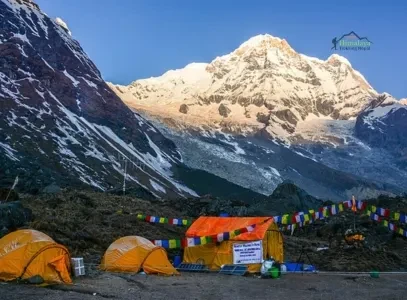
The base camp itself sits at the foot of the South Face of Annapurna I (8,091m), the world's 10th-highest mountain. The camp faces Machhapuchhre (6,993m) to the east and Hiunchuli (6,441m) to the south, creating one of the most visually dramatic base camp positions in the Himalayas.
Which Route Leads to Annapurna Base Camp?
The primary route to Annapurna Base Camp follows the Modi Khola Valley, departing from Nayapul (1,070m) near Pokhara, ascending through Ghorepani, Tadapani, Chhomrong, and the Modi Khola gorge to reach ABC at 4,130 meters. The total one-way distance is 55 kilometers.
2 established approach routes lead trekkers to the same sanctuary entrance:
-
Route 1 (Ghorepani Loop): Nayapul → Tikhedhunga → Ghorepani → Tadapani → Chhomrong → Sinuwa → Bamboo → Dovan → Himalaya → Deurali → Machhapuchhre Base Camp → Annapurna Base Camp
-
Route 2 (Direct Modi Valley): Nayapul → Birethanti → Landruk → New Bridge → Jhinu Danda → Chhomrong → Sinuwa → Bamboo → Dovan → Himalaya → Deurali → MBC → ABC
Route 1 is the most popular because it includes the Poon Hill viewpoint at 3,210 meters, offering panoramic views of 9 major Himalayan peaks before entering the sanctuary. Route 2 is 2 days shorter and reduces total elevation gain by 640 meters, making it the preferred choice for trekkers with limited time.
Both routes merge at Chhomrong (2,170m), the last major settlement before the glacial sanctuary.
What Are the Major Villages on the ABC Trek Route?
The ABC trek route passes through 12 major villages, from Nayapul at the trailhead to Machhapuchhre Base Camp just below the sanctuary entrance. Each village functions as a designated overnight stop, acclimatization point, and supply station.
The 12 key villages and their elevations on the Annapurna Base Camp Trek route are:
|
Village |
Elevation |
Distance from Nayapul |
|
Nayapul |
1,070m |
0 km |
|
Tikhedhunga |
1,540m |
9 km |
|
Ghorepani |
2,860m |
22 km |
|
Tadapani |
2,630m |
29 km |
|
Chhomrong |
2,170m |
36 km |
|
Sinuwa |
2,360m |
39 km |
|
Bamboo |
2,310m |
42 km |
|
Dovan |
2,600m |
45 km |
|
Himalaya (Hinku Cave) |
2,920m |
47 km |
|
Deurali |
3,230m |
49 km |
|
Machhapuchhre Base Camp |
3,700m |
53 km |
|
Annapurna Base Camp |
4,130m |
55 km |
What most planning guides emphasize: the trail involves a steep 270-meter descent from Chhomrong down to the suspension bridge over the Chhomrong Khola, followed by an immediate demanding re-ascent toward Sinuwa. Trekkers who do not account for this on the map underestimate the physical demand of this section, which adds 2 to 3 extra hours per day compared to standard elevation-gain calculations.
How Does the Annapurna Base Camp Trek Route Progress?
.jpg) The ABC trek route progresses through 4 distinct terrain zones: the subtropical lowland forests below 2,000m, the rhododendron-dominated midlands between 2,000m and 3,000m, the alpine shrub zone between 3,000m and 3,700m, and the glacial moraine zone from 3,700m to 4,130m.
The ABC trek route progresses through 4 distinct terrain zones: the subtropical lowland forests below 2,000m, the rhododendron-dominated midlands between 2,000m and 3,000m, the alpine shrub zone between 3,000m and 3,700m, and the glacial moraine zone from 3,700m to 4,130m.
-
Phase 1 (Days 1–2): Nayapul to Ghorepani (1,070m → 2,860m) The trail follows the Bhurungdi Khola river valley through dense subtropical forest. The ascent covers 1,790 meters of elevation gain over 22 kilometers. Ulleri village at 2,073m requires a 45-minute staircase climb of 3,500 stone steps, the steepest single sustained ascent on the entire route.
-
Phase 2 (Days 3–4): Ghorepani to Chhomrong (2,860m → 2,170m) The route descends 690 meters through rhododendron forests to Chhomrong. The Poon Hill detour (3,210m) adds 4 kilometers and a 350-meter ascent for a 5:30 AM sunrise viewing. This phase is the only section where trekkers lose significant elevation before the final ascent to ABC.
-
Phase 3 (Days 5–7): Chhomrong to Annapurna Base Camp (2,170m → 4,130m) This phase enters the glacial sanctuary. The trail narrows dramatically inside the Modi Khola gorge. Avalanche risk zones begin at Deurali (3,230m) and increase to the highest level above 3,700m. Trail signage decreases significantly above Deurali, making map navigation essential.
Where Does the ABC Trek Start and End?
The Annapurna Base Camp Trek starts at Nayapul (1,070m) and ends at Annapurna Base Camp (4,130m), with most trekkers returning via the same route to Nayapul or exiting via Jhinu Danda for natural hot springs before rejoining the trail to Pokhara.
Nayapul is located 42 kilometers west of Pokhara city center by road. The drive from Pokhara takes 1.5 hours by private vehicle and 2 hours by local bus. All trekkers register their TIMS card and Annapurna Conservation Area Permit (ACAP) at the checkpoint in Birethanti village, 2 kilometers beyond Nayapul.
3 common exit options appear on the Annapurna Base Camp Trek Map:
-
Option 1: Return the same route to Nayapul (full route reversal, 55 km, 5–6 days)
-
Option 2: Descend via Jhinu Danda and exit at Siwai for road transport to Pokhara
-
Option 3: Complete the Annapurna Circuit by extending north through the Thorong La Pass (5,416m), this requires a separate trekking permit and adds 14–18 additional days
The Jhinu Danda exit route is the most popular choice for ABC trekkers because it reduces return distance by 8 kilometers and passes through natural hot springs at 1,780m, a significant recovery benefit after high-altitude trekking.
Which Annapurna Route Sections Have the Biggest Elevation Changes?
The 3 sections with the largest elevation changes on the ABC trek are: the Ulleri ascent (1,540m to 2,073m = 533m gain in 2 km), the Ghorepani-to-Chhomrong descent (2,860m to 2,170m = 690m loss in 7 km), and the Deurali-to-ABC final push (3,230m to 4,130m = 900m gain in 6 km).
These elevation spikes are where map interpretation matters most, because standard trail maps show horizontal distance but not the vertical stress these changes impose on trekkers.
|
Section |
Elevation Change |
Distance |
Vertical Rate |
|
Tikhedhunga → Ulleri |
+533m |
2 km |
266m per km |
|
Ghorepani → Chhomrong |
−690m |
7 km |
98m per km |
|
Chhomrong → Sinuwa |
−500m then +700m |
3 km |
Mixed |
|
Deurali → MBC |
+470m |
4 km |
117m per km |
|
MBC → ABC |
+430m |
2 km |
215m per km |
The MBC-to-ABC section has a 215-meter-per-kilometer vertical rate at altitudes where oxygen availability is 41% lower than at sea level. This is the section where altitude-related symptoms most commonly appear. Trekkers who identify this on the map plan rest days at MBC to acclimatize before the final ascent.
How Long Is the Annapurna Base Camp Trek Route?
The Annapurna Base Camp Trek covers 110 kilometers round trip, with 55 kilometers from Nayapul to ABC and 55 kilometers on the return. The standard itinerary requires 7 to 12 days, depending on the route variation and number of acclimatization days built in.
The 4 most common itinerary lengths are:
-
7-day itinerary: Uses the direct Modi Valley route, no Poon Hill detour, minimum rest days. Best for experienced trekkers with prior high-altitude exposure.
-
9-day itinerary: Includes Poon Hill via Ghorepani and 1 acclimatization stop at Chhomrong. The most common choice for first-time ABC trekkers.
-
11-day itinerary: Includes Poon Hill, extra night at Chhomrong, and 1 rest day at MBC. Recommended for trekkers arriving directly from sea-level destinations.
-
12-day itinerary: Maximum acclimatization schedule with 2 extra nights and a Jhinu Danda hot spring stopover on the return.
Average daily trekking distance on the ABC route is 11 kilometers per day, with 5 to 7 hours of actual walking. The longest single trekking day on the standard itinerary is Chhomrong to Bamboo or Dovan (11–14 km), because the descent-then-ascent terrain pattern extends time beyond what the distance figure suggests.
What Are the Key Elevation Points on the Annapurna Base Camp Map?
The Annapurna Base Camp Trek Map records 8 key elevation benchmarks that define the altitude profile of the trek and establish where trekkers cross critical acclimatization thresholds. These benchmarks guide daily distance planning, teahouse placement, and altitude sickness risk assessment, covered in more depth in our full elevation profile of the ABC route.
What Is the Elevation of Annapurna Base Camp?
Annapurna Base Camp sits at 4,130 meters (13,549 feet) above sea level. This elevation places it above the acclimatization threshold at which most trekkers experience noticeable respiratory changes. At 4,130m, atmospheric pressure is 61% of sea-level pressure, and oxygen partial pressure drops to approximately 12.8 kPa compared to 21.1 kPa at sea level.
This is not a technical mountaineering altitude, no supplemental oxygen or specialized gear is required for the base camp approach. The risk zone begins above 3,500m and requires a controlled ascent rate of no more than 300 to 500 meters of sleeping elevation gain per night above 3,000m.
Which Places Are Important for Acclimatization?
The 3 primary acclimatization stops on the ABC trek are Ghorepani (2,860m), Chhomrong (2,170m), and Machhapuchhre Base Camp (3,700m). Each stop provides a full night of rest before the next elevation phase begins.
Ghorepani is where trekkers from both approach routes consolidate before entering the mid-altitude zone above 2,500m. Chhomrong is the last village with reliable medical support, the Health Post at Chhomrong provides basic altitude sickness assessment before trekkers enter the isolated gorge section. MBC at 3,700m is the final staging point where trekkers who add an extra night reduce their risk of Acute Mountain Sickness (AMS) at ABC by approximately 60%, according to high-altitude safety guidelines published by the Himalayan Rescue Association.
Where Does the ABC Trek Reach Its Highest Point?
The ABC trek reaches its highest point at Annapurna Base Camp itself, at 4,130 meters (13,549 feet). Unlike most Himalayan trekking routes that cross mountain passes at higher elevations before descending to the objective, the ABC route is a one-directional ascent through a valley. The highest point and the destination are the same location.
This is a critical distinction trekkers misread on the map. There is no pass crossing, no high-altitude overnight camp above 4,130m, and no need for alpine start timing. Trekkers arrive at ABC in the morning or afternoon, spend a full night at the base camp teahouses (the highest accommodation on the route), and descend the following day.
Which Landmarks Appear on the Annapurna Base Camp Trek Map?
The Annapurna Base Camp Trek Map includes 6 categories of landmarks: base camps, villages, river crossings, viewpoints, hot spring sites, and mountain peaks. Each category serves a distinct navigation and planning function.
Where Are Machhapuchhre Base Camp and Annapurna Base Camp?
Machhapuchhre Base Camp (MBC) sits at 3,700 meters, approximately 2 kilometers south and 430 meters below Annapurna Base Camp. MBC is the final teahouse settlement before ABC and the last stop where trekkers can assess their acclimatization before committing to the final ascent.
Machhapuchhre, also called Fishtail Mountain (6,993m), dominates the view directly above MBC. This peak has never been officially summited, Nepal's government declared it a sacred mountain closed to climbing in 1964. Its distinctive twin-summit profile identifies it on the map as the primary visual anchor for the upper sanctuary section.
Annapurna Base Camp is positioned inside the inner Annapurna Sanctuary, 800 meters northwest of MBC at the base of the Annapurna South Glacier. The camp sits on glacial moraine terrain with direct views of Annapurna I South Face, Annapurna South, Gangapurna (7,455m), and Glacier Dome (7,193m).
Where Are Jhinu Danda and Chhomrong?
Jhinu Danda sits at 1,780 meters, on the western bank of the Modi Khola river, 4 kilometers south of Chhomrong. It is most commonly visited on the descent route from ABC and is marked on the Annapurna map as a secondary village with natural hot springs.
Chhomrong is positioned at 2,170 meters on a terraced hillside above the Modi Khola gorge. It is the largest and most strategically important village on the upper route, functioning as the gateway to the Annapurna Sanctuary. All trekkers register at the ACAP checkpoint in Chhomrong before proceeding into the gorge. The village has 35+ teahouses, a pharmacy, health post, bakeries, and cell phone coverage on Ncell and NTC networks, the last reliable telecommunications before the sanctuary.
Which Rivers, Mountains, and Passes Appear Along the Annapurna Route?
3 primary rivers appear on the Annapurna Base Camp Trek Map: the Modi Khola river (main drainage channel of the sanctuary), the Khumnu Khola (tributary joining near Bamboo), and the Bhurungdi Khola (lower approach trail river below Ghorepani).
The Modi Khola is the defining geographic feature of the entire ABC route. The river originates from the glaciers inside the Annapurna Sanctuary at 4,100m and flows 90 kilometers south to join the Seti Gandaki river near Pokhara. Trekkers cross the Modi Khola 4 times on wooden suspension bridges between Jhinu Danda and Bamboo.
13 major mountain peaks visible from points on the ABC trek map include:
-
Annapurna I – 8,091m (world's 10th highest)
-
Annapurna II – 7,937m
-
Annapurna III – 7,555m
-
Annapurna IV – 7,525m
-
Annapurna South – 7,219m
-
Gangapurna – 7,455m
-
Glacier Dome (Tilicho Peak) – 7,193m
-
Machhapuchhre (Fishtail) – 6,993m
-
Hiunchuli – 6,441m
-
Singu Chuli (Fluted Peak) – 6,501m
No mountain passes appear on the standard ABC trek route. This differentiates the ABC itinerary from the Annapurna Circuit, which crosses the Thorong La Pass at 5,416m.
Which Annapurna Base Camp Trek Map Is Best for Planning?
.webp) The 3 best map formats for ABC trek planning are: the Mandala Trekking Map (1:50,000 scale, printed), the Gaia GPS digital map (satellite-based with offline capability), and the Nepal Tourism Board's official digital route map.
The 3 best map formats for ABC trek planning are: the Mandala Trekking Map (1:50,000 scale, printed), the Gaia GPS digital map (satellite-based with offline capability), and the Nepal Tourism Board's official digital route map.
What Should a Detailed ABC Trek Map Include?
A detailed Annapurna Base Camp Trek Map includes 8 essential elements: trail routes with distance markings, elevation contour lines at 100-meter intervals, village names and teahouse locations, river crossings with bridge markers, permit checkpoints, avalanche risk zones, emergency helicopter landing sites, and altitude sickness risk thresholds by elevation band.
Maps that omit avalanche risk zones and emergency evacuation points fail trekkers in the most critical sections of the route, above Deurali at 3,230m, where trails are unmarked and weather changes rapidly. The best planning maps mark the 3 emergency helicopter landing pads at Sinuwa, Dovan, and Machhapuchhre Base Camp, which are used for medical evacuations averaging 180 per trekking season, according to CAAN (Civil Aviation Authority of Nepal) annual reports.
Contour interval selection matters significantly. Maps with 500-meter contour intervals miss the critical terrain complexity between Chhomrong and Bamboo. The 100-meter contour standard reveals the descent-and-re-ascent pattern that the most commonly used tourist maps do not show.
How Can a GPS Map Help During the ABC Trek?
A GPS map provides 4 specific advantages over paper maps on the ABC trek: real-time position tracking inside the Modi Khola gorge where trail junctions are unmarked, elevation gain monitoring to enforce safe ascent rates, distance-to-destination calculations for daily pacing, and track-back function when trails are obscured by snow above 3,500m.
GPS accuracy above 3,000m in narrow valleys with 6,000-meter walls on both sides degrades by 8–15% due to satellite signal obstruction. Trekkers using single-frequency GPS receivers (including most smartphones) experience this accuracy reduction. Dual-frequency GPS devices, such as the Garmin inReach Mini 2 or Garmin GPSMAP 66i, maintain 3-meter accuracy even inside the Annapurna gorge.
The most important GPS function on the ABC trek is not navigation but altitude monitoring. Tracking sleeping elevation each night ensures compliance with the high-altitude safety rule: ascend no more than 300–500 meters per night above 3,000m.
Can Offline Maps Be Used on the Annapurna Base Camp Route?
Offline maps work on 100% of the Annapurna Base Camp Trek route, including the gorge sections between Deurali and MBC where cell coverage is completely absent. The 3 best offline map applications for the ABC route are Gaia GPS, Maps.me, and AllTrails Pro.
Download the offline map tile set for the Annapurna Conservation Area before leaving Pokhara. The download covers approximately 450MB for the full 1:25,000 scale tile set. Cell coverage disappears above Chhomrong on the Ncell network and above Dovan on NTC. Wi-Fi in teahouses is available up to MBC, but speeds are insufficient for real-time map tile downloads above 3,000m.
The key preparation step most trekkers miss: download offline maps on Wi-Fi in Pokhara, then test the offline function by switching the phone to airplane mode before reaching the trailhead. Maps that appear to be downloaded but default to online tile loading fail at the most critical navigation point inside the gorge.
How Can You Prepare for the Annapurna Base Camp Trek Using the Map?
Map-based preparation for the ABC trek involves 4 planning actions: establishing daily distance and elevation targets, identifying teahouse locations for overnight stops, marking weather exposure zones, and pre-loading GPS waypoints for all permit checkpoints and emergency sites.
How Can the Map Help Plan Daily ABC Trekking Distances?
The map enables trekkers to plan 5 critical daily metrics: total horizontal distance, net elevation gain, gross elevation change (accounting for descents before ascents), estimated trekking hours at 300 meters of ascent per hour, and teahouse capacity at each overnight stop.
The standard 9-day ABC itinerary, mapped with daily metrics, breaks down as follows:
|
Day |
Route Section |
Distance |
Elevation Change |
Est. Hours |
|
1 |
Pokhara → Nayapul → Tikhedhunga |
9 km |
+470m |
4–5 hrs |
|
2 |
Tikhedhunga → Ghorepani |
13 km |
+1,320m |
6–7 hrs |
|
3 |
Ghorepani → Poon Hill → Tadapani |
11 km |
+350m / −580m |
5–6 hrs |
|
4 |
Tadapani → Chhomrong |
7 km |
−460m |
3–4 hrs |
|
5 |
Chhomrong → Bamboo |
9 km |
−500m / +550m |
5–6 hrs |
|
6 |
Bamboo → Deurali |
7 km |
+920m |
4–5 hrs |
|
7 |
Deurali → ABC (via MBC) |
6 km |
+900m |
4–5 hrs |
|
8 |
ABC → Bamboo |
13 km |
−1,820m |
5–6 hrs |
|
9 |
Bamboo → Jhinu → Pokhara |
18 km |
−530m |
6 hrs |
Day 7 carries the highest altitude risk, 900 meters of ascent at elevations above 3,200m. Trekkers who feel symptoms of AMS at Deurali use the map to confirm MBC (3,700m) as an intermediate rest point before committing to the final 430 meters to ABC.
How Can You Identify Accommodation and Rest Stops?
The ABC trek map identifies 28 teahouse settlements distributed across the 55-kilometer route, with the highest concentration between Chhomrong and Deurali where trail infrastructure is most developed.
Accommodation availability changes significantly by season. During peak seasons (October–November and March–April), teahouses at Deurali and MBC operate at 90–100% capacity by 2:00 PM. Trekkers who use the map to calculate arrival times at each settlement, rather than walking until tired, secure rooms and avoid expensive last-minute upgrades or forced camping in an area where camping is restricted by ACAP regulations above 3,500m.
The map also identifies 3 emergency rest sites at Sinuwa, Dovan, and Himalaya village where ACAP-registered medical kits are maintained. These sites appear on the Mandala trekking map as red cross markers and are critical reference points for groups with inexperienced trekkers.
How Can You Use the Map to Prepare for Weather and Trail Conditions?
The map identifies 4 weather exposure zones on the ABC route, each with distinct seasonal risk profiles that determine trekking schedule, gear selection, and daily start times.
-
Zone 1 (1,070m–2,000m): Subtropical. Monsoon flooding risk June–September. Flash flood danger at Modi Khola crossings.
-
Zone 2 (2,000m–3,000m): Rhododendron forest. Fog and ice on trails October–February. Snow possible above 2,500m December–February.
-
Zone 3 (3,000m–3,700m): Alpine transition. Afternoon cloud closure daily from 11:00 AM in monsoon season. High wind exposure on open ridges.
-
Zone 4 (3,700m–4,130m): Glacial sanctuary. Avalanche risk zones marked on detailed maps. Snowfall possible any month above 4,000m. Temperature range: −15°C to +8°C.
Trail condition information integrated with the map enables trekkers to schedule the avalanche-exposed section between Deurali and MBC for early morning departure, before solar heating destabilizes the snowpack above the Modi Khola gorge walls. The standard recommendation is to leave Deurali at 6:00–7:00 AM and reach MBC by 9:00 AM, completing the most exposed section in 3 hours before afternoon convective activity begins.
How Can Himalaya Trekking Nepal Help You Navigate the Annapurna Base Camp Route?
Himalaya Trekking Nepal provides guided ABC trek services with route-specific map support, including pre-trek map briefings, GPS-equipped guides on all routes, and customized itinerary planning based on the client's fitness level and acclimatization history.
The ABC route requires active navigation above 3,230m where trail markers are unreliable, snowfall obscures paths October through April, and map literacy becomes a safety requirement rather than a convenience. Himalaya Trekking Nepal's guides carry 1:25,000 scale topographic maps and GPS devices pre-loaded with all emergency waypoints, avalanche bypass routes, and alternative descent paths.
Can Himalaya Trekking Nepal Provide a Detailed Annapurna Base Camp Trek Map?
Himalaya Trekking Nepal provides clients with a detailed Annapurna Base Camp Trek Map as part of every guided and self-guided trekking package. The map set includes a 1:50,000 topographic paper map, a pre-loaded GPX track file compatible with Gaia GPS and Garmin devices, and a day-by-day stage map with teahouse locations, elevation profiles, and emergency contact information.
Clients receive the map during the pre-trek briefing session in Pokhara. The briefing covers 5 specific map literacy topics: reading contour intervals, identifying avalanche zones, locating ACAP checkpoints, understanding the gorge section navigation, and planning daily start times relative to weather exposure zones.
For trekkers who want to explore the Annapurna region independently, consulting our ABC Trek difficulty guide, understanding the Annapurna Base Camp Trek permit requirements, and reviewing the complete Annapurna Base Camp Trek itinerary are important next steps before finalizing any travel plan.
What Are the Key Takeaways About the Annapurna Base Camp Trek Map?
The Annapurna Base Camp Trek Map is an active navigation tool, not a reference document. It determines daily itinerary structure, identifies altitude risk thresholds, locates emergency sites, and reveals terrain complexity that elevation profiles alone do not capture.
The 7 most important map-based facts every ABC trekker acts on before departure are:
-
Total route distance: 110 km round trip (55 km each way)
-
Final destination elevation: 4,130 meters at Annapurna Base Camp
-
Critical junction elevation: 2,170m at Chhomrong, the gateway to the sanctuary and last reliable medical support
-
Highest acclimatization stop: Machhapuchhre Base Camp at 3,700m, recommended as an overnight stop before the final push
-
Primary river landmark: Modi Khola river, crossed 4 times between Jhinu Danda and Bamboo
-
Avalanche exposure zone: Active above 3,230m between Deurali and MBC, requires early morning transit
-
Navigation requirement above 3,500m: Offline GPS map essential; trail markers are absent in the inner sanctuary
A trekker who masters the Annapurna Base Camp Trek Map before departure reduces their decision-making load on the trail, manages altitude gain correctly, and arrives at ABC with the physical reserve to experience one of the most remarkable base camp views in the Himalayan range, the 270-degree panorama of 13 peaks above 6,000m surrounding the Annapurna glacial amphitheater.
The map is where every successful guided Annapurna Base Camp Trek begins.
More About Author

Khilak Budhathoki
Travel Director
Khilak Budhathoki is the co-founder and lead trekking guide at Himalaya Trekking Nepal, a locally owned and operated adventure company based in Kathmandu. Born and raised in the foothills of Nepal, Khilak developed a deep love for the mountains from an early age. With over a deca...
USD$1,400 pp
Our Recommendation

USD$600 pp
Our Recommendation

USD$2000 pp
Our Recommendation
Related Blogs

Dec 15, 2025
Annapurna Base Camp Packing List: ABC Trek Guide
Aug 19, 2026
10 Best Natural Places to Visit in Kathmandu

