Trip Facts

Trip Start/Ends
Kathmandu

Trip Difficulty
Moderate

Trip Style
Adventurous

Meals
Breakfast, Lunch and Dinner

Accomodation
3-star hotel in Kathmandu, teahouses along the trek

Max. Elevation
4,130 m at ABC

Group Size
1-16 Pax

Activity
Hiking, Sightseeing

Best Season
Spring & Autumn
Overview
If you're dreaming of standing face-to-face with the Himalayas, the Annapurna Base Camp trek is something you shouldn't miss. From the moment you land in Nepal, everything feels like an adventure. You start off in Kathmandu, where the streets are full of life, color, and culture. Then, after a short flight or scenic drive to Pokhara, the real journey begins.
You’ll stroll through peaceful villages where the Gurung people live, known for their warm smiles and welcoming nature. Their villages are cozy and colorful, surrounded by terraced fields that climb the hills like giant steps. Every day offers something new. You might hear the rush of a river, spot a waterfall sparkling in the sun, or see wild birds and unique plants along the way. The higher you go, the clearer and colder the air becomes.
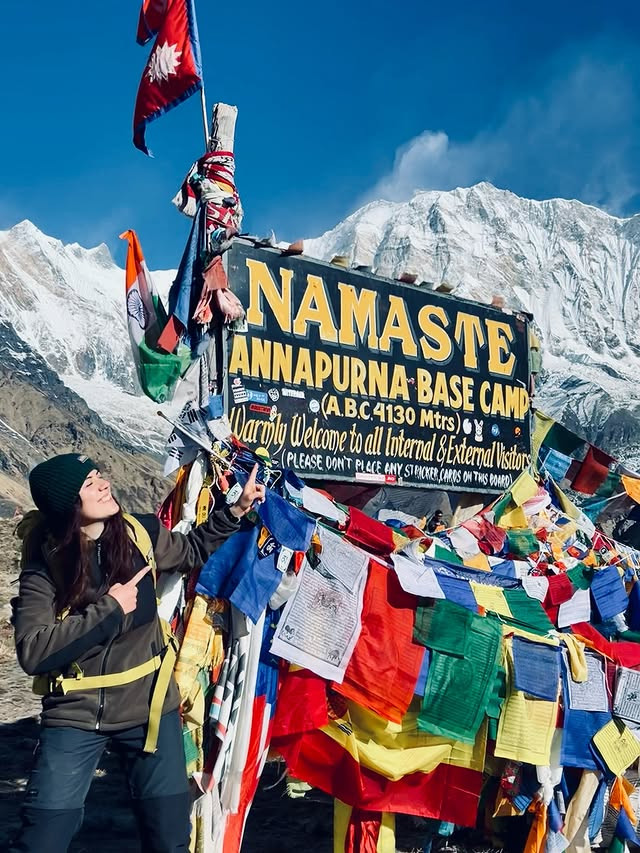
Reaching Annapurna Base Camp is something you won’t forget. At 4,130 meters, you’re surrounded by some of the tallest peaks like Annapurna I, Machapuchare (Fishtail), Hiunchuli, and more. Watching the sunrise here feels magical. The mountains glow in shades of gold and pink, and it makes you feel small but also part of something really special.
After days of trekking, your body will thank you for the relaxing stop at the hot springs in Jhinu Danda. Soaking in warm, natural water surrounded by nature is like a mini-spa for tired muscles - a perfect way to unwind and think about the incredible journey you’ve had.
This trek isn’t only about walking step after step; it’s also about being close to nature, learning about the local culture, meeting new people, and enjoying calm moments in the mountains. Whether you’ve hiked before or it’s your first time in the Himalayas, Annapurna Base Camp gives you a mix of challenge, amazing views, and memories that stay with you for a long time.
If you’re looking for a trip that fills you with awe and leaves you with unforgettable memories, this trek is waiting for you. Contact Himalaya Trekking Nepal Now
ABC Trek Highlights
-
See amazing views of Annapurna I, Fishtail (Machapuchare), Hiunchuli
-
Culturally rich Gurung villages and warm hospitality
-
Natural hot springs at Jhinu Danda for post-trek relaxation
-
Subtropical forests, terraced fields, alpine meadows, and glacier views
-
Well-managed trekking routes with comfortable teahouses
-
Sunrise over the Annapurna range from Annapurna Base Camp
 Important Trip Note
-
The trek is moderate to challenging and requires good physical fitness.
-
Maximum altitude is 4,130 m / 13,549 ft, so proper acclimatization is essential.
-
Weather can change rapidly; carry layered clothing and rain gear.
-
Teahouses provide basic, clean rooms with shared bathrooms; hot showers and Wi-Fi may cost extra.
-
Bring trekking shoes, warm clothing, a water bottle, and personal medical supplies.
-
Respect local customs and communities while minimizing environmental impact.
Itinerary
-
Day 1 Arrival in Kathmandu (1400 m)
When you arrive at Tribhuvan International Airport, our staff will greet you and take you to your hotel. In the evening, you'll meet your guide, enjoy a short briefing about the trek, and experience a traditional Nepali welcome dinner with local cultural touches. Overnight in Kathmandu.

Accommodation
3-star hotel in Kathmandu

Meals
Welcome dinner

Duration
Half Day

Max Altitude
1400m
-
Day 2 Drive from Kathmandu to Pokhara (820 m)
Today starts with a 6-7 hour drive to Pokhara, a calm lakeside city at the foot of the Annapurna mountains. Along the way, you’ll see amazing views of terraced fields, rivers, and distant peaks. When you arrive, you’ll check into your hotel and have time to explore the lively lakeside area. You’ll stay overnight in Pokhara.
Accommodation
3-star hotel in Pokhara
Meals
Breakfast, Lunch and Dinner
Duration
Full day
Max Altitude
821m
-
Day 3 Drive to Nayapul and trek to Ghandruk (1940 m)
After breakfast, you’ll drive about 1.5 hours to Nayapul, where the trek starts. From there, you’ll hike through pretty forests, terraced fields, and small villages before reaching the traditional Gurung village of Ghandruk. Along the way, you’ll get amazing views of Annapurna South and Machapuchare. You’ll stay overnight in Ghandruk.
Accommodation
Teahouse in Ghandruk
Meals
Breakfast, Lunch, and Dinner
Duration
Full day
Max Altitude
1940m
-
Day 4 Trek from Ghandruk to Chhomrong (2170 m)
Start with a gentle climb to Komrong Danda, followed by a descent to Komrong Khola. The trail then climbs steeply up to Chhomrong, a beautiful village perched on the hillside with breathtaking views of the Annapurna range. Chhomrong also marks the official entry to the Annapurna Sanctuary. Overnight in Chhomrong.
Accommodation
Teahouse in Chhomrong
Meals
Breakfast, Lunch, Dinner
Duration
Full day
Max Altitude
2170m
-
Day 5 Trek from Chhomrong to Himalaya (2920 m)
The hike today climbs through thick rhododendron and bamboo forests after descending to a suspension bridge. As the trail follows the Modi Khola, you'll travel through the villages of Sinuwa, Bamboo, and Dovan while gradually rising in altitude. The Himalaya, a serene retreat encircled by towering cliffs, is where the day comes to a close.
Accommodation
Teahouse in the Himalaya
Meals
Breakfast, Lunch, Dinner
Duration
Full day
Max Altitude
2921m
-
Day 6 Trek to Annapurna Base Camp via Machapuchare Base Camp (4130 m)
This is the most-awaited day of the trek. Begin your ascent through Deurali and continue to Machapuchare Base Camp, where the towering peak of Machapuchare greets you. The trail then leads into the Annapurna Sanctuary, where you're rewarded with awe-inspiring views upon reaching Annapurna Base Camp, surrounded by towering Himalayan giants. Overnight at ABC.
Accommodation
Teahouse at ABC
Meals
Breakfast, Lunch, Dinner
Duration
Full day
Max Altitude
4131m
-
Day 7 Trek down to Bamboo (2310 m)
Wake up early to see a beautiful sunrise over Annapurna I and the nearby peaks. After breakfast, start your trek back through the sanctuary, passing MBC, Deurali, and Dovan, until you reach Bamboo, a quiet village in the forest. You’ll stay overnight in Bamboo.
Accommodation
Teahouse in Bamboo
Meals
Breakfast, Lunch, Dinner
Duration
Full day
Max Altitude
2310m
-
Day 8 Trek to Jhinu Danda (1780 m)
The trail goes downhill through Sinuwa and Chhomrong, then drops steeply down to Jhinu Danda. After a long day, treat yourself to a rejuvenating soak in the natural hot springs located just a short walk from the village along the Modi Khola. Overnight in Jhinu.
Accommodation
Teahouse in Jhinu Danda
Meals
Breakfast, Lunch, Dinner
Duration
Full day
Max Altitude
1780m
-
Day 9 Trek to Nayapul and drive to Pokhara (820 m)
On your last day of trekking, you’ll walk through the river valley, passing green forests and terraced fields. After reaching Nayapul, a private vehicle will drive you back to Pokhara. In the evening, you can rest by the lake and celebrate your trek. You’ll spend the night at a hotel in Pokhara.
Accommodation
3-star hotel in Pokhara
Meals
Breakfast, Lunch, Dinner
Duration
Full day
Max Altitude
820m
-
Day 10 Drive or fly back to Kathmandu (1400 m)
After breakfast, you head back to Kathmandu, either by a flight with great views or by a tourist bus, depending on what you choose. Once in the capital, you’ll have time for last-minute shopping or sightseeing before gathering for a farewell dinner to conclude your unforgettable Himalayan adventure.
Accommodation
3-star hotel in Kathmandu
Meals
Breakfast, Farewell dinner
Duration
Full day
Max Altitude
1401m
Cost Breakdown
The average cost of the Annapurna Base Camp trek is between USD 800 and USD 1,200 per person. The price depends on things like group size, trekking season, and what’s included. Most of the time, this covers your stay in Kathmandu, Pokhara, and on the trail; daily meals during the trek; required permits; guides; porters; and ground transport. Private treks can be a bit more expensive than group ones but give you more comfort and flexibility.
At Himalaya Trekking Nepal, our prices are clear with no hidden costs. The packages include good food and accommodation, experienced guides, porter support, reliable transport, and the needed permits, giving you full value in one deal.
Dates & Price
- January
- February
- March
- April
- May
- June
- July
- August
- September
- October
- November
- December
Meals & Accommodation
Meals
On the Annapurna Base Camp trek, you’ll get a mix of freshly made meals that keep you full and energized. Common dishes include traditional Nepali dal bhat, warm soups, noodles, pasta, eggs, and Tibetan breads.
Vegetarian food is easy to find, and most meals are served in small, comfortable teahouses along the trail. Each meal will keep you energized after a long day of trekking and let you savor local flavors.
Accommodation
During the trek, you’ll stay in teahouses with twin-sharing rooms, basic bedding, and shared bathrooms. The facilities are simple but clean, comfortable, and friendly. Each night, you can relax, eat, and share stories with other trekkers, making your stay both restful and memorable.
Best Time for Annapurna Base Camp Trek
The best time to trek to Annapurna Base Camp is in spring and autumn (March to May and September to November). During these months, the skies are clear, the days are pleasantly warm, rhododendrons are in bloom, and you get amazing views of the snow-covered mountains - perfect for trekking.
Spring (March - May)
Spring is one of the peak trekking seasons, offering mild temperatures, clear skies, and colorful rhododendron blooms along the trail. It’s an ideal time for comfortable trekking and spectacular mountain views.
-
Clear skies, moderate temperatures (10-20°C at lower altitudes, -2-10°C at higher camps)
-
Rhododendron forests in bloom
-
Trails are mostly snow-free, suitable for trekking and photography
Autumn (September - November)
In autumn, the weather is steady, and the mountains are clear after the monsoon rains. The trails are dry, making it a great time for amazing views and outdoor photos.
-
Cool, stable weather with crystal-clear skies (10 - 20°C lower, -1 - 12°C higher)
-
Post-monsoon freshness gives excellent mountain visibility
-
Dry and firm trails, perfect for panoramic views at ABC
Winter (December - February)
Winter is colder and quieter, offering peaceful trekking with fewer crowds. Snow at higher altitudes adds a magical touch to the landscapes, but higher camps can be freezing.
-
Cold temperatures (5-15°C lower, -5-5°C higher) with occasional snow
-
Fewer trekkers, quiet trails, very clear skies
-
Higher camps may be freezing; limited services at teahouses
Monsoon / Summer (June-August)
The monsoon season brings heavy rain and green landscapes. Trails can be slippery and mountain views limited, making it suitable only for experienced trekkers prepared for wet conditions.
-
Heavy rainfall and slippery trails, frequent clouds block views
-
Temperatures: 15-25°C lower, 5-12°C higher
-
Green scenery, quieter trails, only for experienced trekkers
ABC Trek Packing List
Packing properly is key to a successful and comfortable Annapurna Base Camp trek. The packing lists for Annapurna Base Camp Trek below is to make sure you have all the right gear and clothing to stay safe and comfortable, warm, and prepared throughout the journey.
General
-
Duffel bag and daypack
-
Sleeping bag (four-season)
Upper Body
-
Thermal base layers
-
Fleece jacket or down jacket
-
A jacket that is waterproof
-
Trekking shirts with breathability
-
Liner gloves and insulating mid-layer warm gloves
Lower Body
-
Trekking trousers
-
Waterproof pants
-
Trekking socks and thermal socks
-
Trekking boots
-
Moisture-wicking underwear
First Aid Kits and Medications
-
Personal medication
-
Blister kits, antiseptics, and pain relievers
Other Essentials
-
Headlamp with spare batteries
-
Sunglasses, sunscreen, and lip balm
-
Reusable water bottle and purification tablets
Optional
-
Camera, journal, power bank
-
Lightweight crampons (if trekking in early spring or late autumn)
Important Information on ABC Trek
Packing your baggage is only one aspect of getting ready for your Annapurna Base Camp hike; another is being ready for a rewarding and safe experience. To help you get the most out of your trip to Nepal, this section contains important information on acclimatization, travel insurance, and cultural sensitivity.
Acclimatization
Proper acclimatization is essential when trekking to high-altitude destinations like Annapurna Base Camp. As the trail ascends above 4,000 meters, your body needs time to adjust to lower oxygen levels. Our itinerary is designed with gradual elevation gain to help lower the risk of altitude sickness. To help your body adjust, make sure to stay hydrated, avoid alcohol, and keep a steady walking pace. If you feel symptoms like a headache, nausea, or dizziness, let your guide know right away.
Insurance
It’s strongly recommended to have travel insurance that covers high-altitude trekking and helicopter rescue up to 5,000 meters. Make sure your policy covers emergency helicopter evacuation, medical costs, trip cancellations, and lost/stolen items. Because medical facilities are limited in Nepal’s remote mountains, the right insurance gives you safety and support if something unexpected happens.
Cultural Notes
Respecting local customs and traditions is important while trekking through the culturally rich Annapurna region. Villages along the trail are predominantly home to Gurung and Magar communities, known for their warm hospitality and rich cultural traditions, and vibrant heritage.
Dress modestly, especially in villages and at religious places, and avoid showing affection in public. Be polite by asking before taking photos of people, and support the locals by buying handmade crafts or eating at local lodges.
Related Information for Annapurna Base Camp Trek
1. Annapurna Base Camp Elevation
The highest point of the Annapurna Base Camp trek is 4,130 meters (13,550 feet), where towering Himalayan peaks surround you. It’s a spot that offers some of Nepal’s most breathtaking panoramic views - an unforgettable high-altitude adventure.
2. How Difficult is the Annapurna Base Camp Trek?
The Annapurna Base Camp trek difficulty is moderate, suitable for trekkers with a basic level of fitness. Each day involves walking 4 to 7 hours through varied terrain, including stone steps, forests, and ridgelines. With proper preparation, it’s achievable for most adventure enthusiasts.
3. Preparing for the ABC Trek in Nepal
The key to a good hike is preparation. The endurance required to hike four to seven hours a day is developed by regular cardio and muscle training. To acclimate to trekking conditions, concentrate on leg exercises, endurance training, and practice hikes with a full backpack.
4. Permits for ABC Trekking
Two permits for ABC are required for this trek: You'll need the Annapurna Conservation Area Permit (ACAP) and a TIMS card (Trekkers’ Information Management System) for the trek. Himalaya Trekking Nepal handles all logistics and paperwork to ensure a hassle-free trekking experience.
5. Jhinu Hot Springs
After days of trekking, Jhinu Danda’s natural hot springs provide the perfect reward. Located near the Modi Khola, the springs are soothing and scenic, an ideal place to relax sore muscles and reflect on your journey before returning to Pokhara.
Choose Himalaya Trekking Nepal for Your ABC Trek
Picking the right trekking company makes a big difference for a safe, fun, and unforgettable experience in the Himalayas. At Himalaya Trekking Nepal, we do more than just plan treks; we make sure every step of your journey is meaningful.
From respecting nature to supporting local communities, we focus on creating real experiences that stay with you long after the trek ends.
Are you ready to travel Annapurna Region? Nepal. We customize your trek as per your needs.
Annapurna Base Camp Trek requires the right information about routes, permits, seasons, food, and accommodation. Below are detailed guides to help you prepare better and make the most of your trek.
- Annapurna Base Camp Trek – Complete Guide
- Annapurna Base Camp Trek Map & Route Guide
- Annapurna Base Camp Trek Difficulty
- Annapurna Base Camp Trek Permits & Cost
- Annapurna Base Camp Trek Budget/Cost Breakdown
- Food & Accommodation on Annapurna Base Camp Trek
- Annapurna Base Camp Trek Packing List
- Annapurna Base Camp Trek in Spring
- Annapurna Base Camp Trek in Autumn
- Annapurna Himalaya Region Overview
Gallery


FAQ's
-
How long is the Annapurna Base Camp trek?
The standard Annapurna Base Camp trek takes about 10 days, depending on your itinerary and walking pace. This includes arrival in Pokhara, the trek to base camp, and the return. Some itineraries may add extra days for acclimatization or side trips.
-
Is Annapurna Base Camp trek suitable for solo travelers from Europe?
Yes, many solo visitors, especially those from Europe, choose to hike to Annapurna Base Camp. It has well-marked trails, is well-traveled, safe, and has welcoming residents. To increase safety and social interaction, many independent hikers also sign up for group tours.
-
What is the weather like during different seasons on the Annapurna Base Camp trek?
Spring (March-May) and autumn (September-November) offer clear skies and stable weather, making them ideal for trekking. Summer (June-August) brings monsoon rains and slippery trails, while winter (December-February) can be snowy and cold. Each season offers different scenery, from rhododendron blooms to snowy peaks.
-
What are the temperature variations at different altitudes?
Daytime highs in lower regions, such as Pokhara, often range from 15 to 25°C. It gets colder as you ascend, and during the winter months at Annapurna Base Camp, nighttime lows can fall below freezing. You can remain comfortable during these fluctuations by dressing in layers.
-
Do European citizens need a visa to enter Nepal?
Yes, European citizens require a tourist visa to enter Nepal. It’s easy to obtain either online or upon arrival at Tribhuvan International Airport in Kathmandu. Multiple-entry visas for 15, 30, or 90 days are available.
-
Can I get a visa on arrival at Kathmandu Airport?
Yes, you can get a visa on arrival at Kathmandu Airport. Simply fill out the application at the visa kiosk, pay the fee, and present your documents. It’s a quick and convenient process for most travelers.
-
What documents are required for entry?
You’ll need a valid passport (valid for at least six months), a filled-out visa application, and a passport-sized photo. Proof of travel plans and a return or onward ticket may also be requested. An online visa pre-application can speed up the process.
-
What is included in the Annapurna Base Camp trek cost?
The cost usually covers permits, guide and porter fees, accommodation, meals during the trek, and ground transportation. Some packages also include Kathmandu-Pokhara flights. Check with your trekking company for exact inclusions.
-
Are there any extra expenses during the trek?
Yes, expect extra costs for hot showers, Wi-Fi, charging devices, and snacks. Personal expenses like drinks, souvenirs, and tips are not included. Always carry some cash, as ATMs are not available in the mountains.
-
How much should I tip the guide and porters?
Tipping is customary in Nepal. A general guideline is $5-10 USD per day for guides and $3-5 USD per day for porters, depending on your group size and satisfaction. Tips are usually given at the end of the trek in Nepalese rupees.
-
Is the Annapurna Base Camp Trek Suitable for Beginners?
Yes, it’s considered one of the more accessible high-altitude treks in Nepal. As long as you’re moderately fit and prepared, beginners can complete it with ease. A guided trek ensures better support and safety for first-timers.
-
What should I do if my flight is delayed or canceled?
Flight delays due to weather are common, especially during the monsoon and winter. In case of cancellation, you may need to travel by road or adjust your itinerary. It’s wise to keep your itinerary flexible and have travel insurance in place.


.jpeg)

-
 Safety Trips
 - Expert Guides
- Resonable Price
- Experienced