- 23, Jul 2026 | Khilak Budhathoki
The Manaslu Circuit Trek is one of Nepal's most spectacular high-altitude trekking routes, circling Mount Manaslu (8,163 m) through the remote Manaslu Conservation Area before crossing the challenging Larke Pass (5,106 m). The trek combines diverse landscapes, traditional Tibetan-influenced villages, alpine forests, glacial valleys, and panoramic Himalayan views, making it one of the country's finest alternatives to the Everest and Annapurna circuits. Because the route passes through a restricted region with significant elevation changes, seasonal weather has a direct impact on trail conditions, mountain visibility, acclimatization, permit logistics, teahouse operations, and overall trekking safety.
 Choosing the right time to trek the Manaslu Circuit is essential for a safe and rewarding journey. Every season offers a different experience, from spring rhododendron blooms and autumn's crystal-clear mountain panoramas to the snow-covered challenges of winter and the lush but landslide-prone monsoon months. This guide explores the best months to trek the Manaslu Circuit by comparing weather patterns, temperatures, trail conditions, Larke Pass accessibility, accommodation availability, packing requirements, and seasonal advantages, helping beginners, experienced trekkers, photographers, and adventure travelers choose the ideal departure window for their goals.
Why Does the Best Time Matter for the Manaslu Circuit Trek?
The best time matters because the Manaslu Circuit Trek crosses restricted high-altitude terrain where weather directly controls trail safety, pass accessibility, and teahouse availability. A wrong-season decision closes the Larke Pass, triggers landslides on lower trails, or exposes trekkers to temperatures below -25°C (−13°F) without reliable shelter.
The Manaslu Circuit Trek, also called the Manaslu Conservation Area Trek, is a restricted-area route requiring four mandatory permits and fees: the Manaslu Restricted Area Permit (MRAP), the Manaslu Conservation Area Permit (MCAP), the Annapurna Conservation Area Permit (ACAP), and the local Chumnubri Rural Municipality Fee. Because this is a regulated zone, permit windows, guide requirements, and lodge openings all align with seasonal conditions. Season selection is not preference, it is a structural planning decision.
How Do Weather and Trail Conditions Affect the Trek?
Weather directly controls 4 key trail variables: Larke Pass accessibility, river crossing safety, trail surface stability, and lodge operational status. Each variable shifts significantly across Nepal's 4 trekking seasons.
The Budhi Gandaki river trail, the route's backbone through the lower gorge between Soti Khola (700m) and Jagat (1,410m), washes out during monsoon months (June–August). Landslide frequency in this section increases dramatically during peak monsoon, with trail erosion weeks to stabilize after the monsoon ends. This is why early September entry still carries residual risk in low-elevation sections.
Larke Pass behavior by season:
-
Spring (March–May): Snow-packed upper section in March, ice-free and firm by April and May
-
Autumn (September–November): Dry, compacted surface with excellent grip from September 25 onward
-
Winter (December–February): Deep snowpack, frequent avalanche risk, often impassable by December 15
-
Monsoon (June–August): Frequent snowfall at altitude, saturated approach slopes, dangerous rock surfaces
How Does the Season Influence Safety and Trekking Experience?
Season influences trekking safety through 3 primary factors: altitude weather stability, trail infrastructure availability, and emergency evacuation feasibility. The Manaslu Circuit passes through remote villages, Namrung (2,630m), Samagaun (3,520m), and Samdo (3,875m), where emergency helicopter evacuations from Kathmandu require under an hour of actual flight time, though the logistical process of coordinating insurance, weather clearance, and dispatch can take 2 to 5 hours to execute.
Teahouse lodges along the circuit operate seasonally. Approximately 85% of lodges between Namrung and Bimthang (3,720m) close between December and February. Autumn delivers the highest lodge occupancy with fresh food supply, while spring delivers moderate services. A winter trek with closed lodges means trekking without acclimatization shelter, a risk no reputable trekking operator recommends.
The experience dimension also changes sharply by season. Autumn delivers crystal-clear mountain panoramas from Samagaun camp. Spring delivers rhododendron forests in peak bloom with occasional afternoon cloud buildup above 3,000m. Monsoon delivers waterfalls and lush lower gorge landscapes but severely restricts views of Mount Manaslu, Ganesh Himal (7,422m), and Himalchuli (7,893m).
When Is the Best Overall Time to Trek the Manaslu Circuit?
 The best overall time to trek the Manaslu Circuit is October and November in autumn, and April in spring. These 3 months deliver the highest combination of weather stability, trail safety, mountain visibility, and lodge availability across the entire 177-kilometer route.
Why Is Spring Considered One of the Best Seasons?
Spring is one of the best seasons because March through May delivers warming temperatures, blooming rhododendron forests, active wildlife, and a reliably drier Larke Pass compared to post-winter conditions. April specifically offers the optimal balance between clear morning skies and comfortable daytime temperatures from Soti Khola to Larke Pass.
Spring trekking occurs during Nepal's pre-monsoon window. Daytime temperatures at Samagaun (3,520m) average 8°C to 14°C (46°F to 57°F) in April. Night temperatures at Dharamsala (4,460m), the last camp before Larke Pass, drop to -5°C to -8°C (23°F to 17°F). These are manageable conditions with proper layering.
March offers the quietest spring window, with trail populations 40% lower than April peak. The trade-off: higher snowpack at Larke Pass in early March makes the ascent more demanding and requires microspike traction devices or crampons.
Why Is Autumn the Most Popular Trekking Season?
Autumn is the most popular season because September through November delivers post-monsoon atmospheric clarity, stable high-pressure weather, dry firm trails, and fully operational teahouse lodges serving fresh seasonal produce. October is the single most popular trekking month on the entire Manaslu Circuit.
Post-monsoon air quality in Nepal reaches its annual peak in October. The monsoon washes out dust and particulate matter, producing atmospheric visibility that exceeds 80 kilometers on clear days. Mountain views of Manaslu's north face, Larke Peak (6,249m), and the Annapurna Massif, visible from the pass, appear in their sharpest definition during this window.
October temperatures at lower elevations (below 2,000m) average 18°C to 24°C (64°F to 75°F). At Larke Pass in October, crossing-hour temperatures average -5°C to -12°C (23°F to 10°F) during the recommended 3 AM to 9 AM departure window. By November, pass temperatures drop further to -10°C to -18°C (14°F to 0°F), and trail traffic decreases by 60% compared to October peak.
What Is the Manaslu Circuit Trek Like in Spring?
The Manaslu Circuit Trek in spring delivers a transforming landscape, from subtropical rhododendron forests in the lower Budhi Gandaki gorge to snow-dusted alpine terrain above Samagaun, across a 14-to-18-day route with warming but unpredictable afternoon weather patterns above 3,000m.
What Are the Weather and Temperature Conditions?
Spring temperature ranges on the Manaslu Circuit follow a clear elevation gradient: 15°C to 25°C (59°F to 77°F) at the trailhead near Soti Khola, dropping to -5°C to -15°C (23°F to 5°F) at Larke Pass during overnight hours.
The table below shows average spring temperatures across 4 key elevation points on the circuit:
|
Location |
Elevation |
Daytime Temp (Spring) |
Night Temp (Spring) |
|
Soti Khola |
700m |
22–28°C (72–82°F) |
15–18°C (59–64°F) |
|
Deng |
1,804m |
16–22°C (61–72°F) |
8–12°C (46–54°F) |
|
Samagaun |
3,520m |
8–14°C (46–57°F) |
-2 to 3°C (28–37°F) |
|
Larke Pass |
5,106m |
-2 to 5°C (28–41°F) |
-8 to -15°C (18–5°F) |
Spring precipitation increases through the season. March receives approximately 38mm of monthly precipitation at lower elevations. May receives up to 110mm as the pre-monsoon pattern builds. Afternoon cloud cover develops by 1 PM to 3 PM at elevations above 3,000m in May, making early morning starts before 7 AM essential for summit photography and Larke crossing safety.
Which Flowers, Wildlife, and Mountain Views Can You Expect?
Spring delivers 12 rhododendron species in bloom across the Manaslu Conservation Area, active wildlife including red pandas (Ailurus fulgens), Himalayan tahr, and snow leopards, plus clear morning views of Manaslu's north face across all 3 spring months.
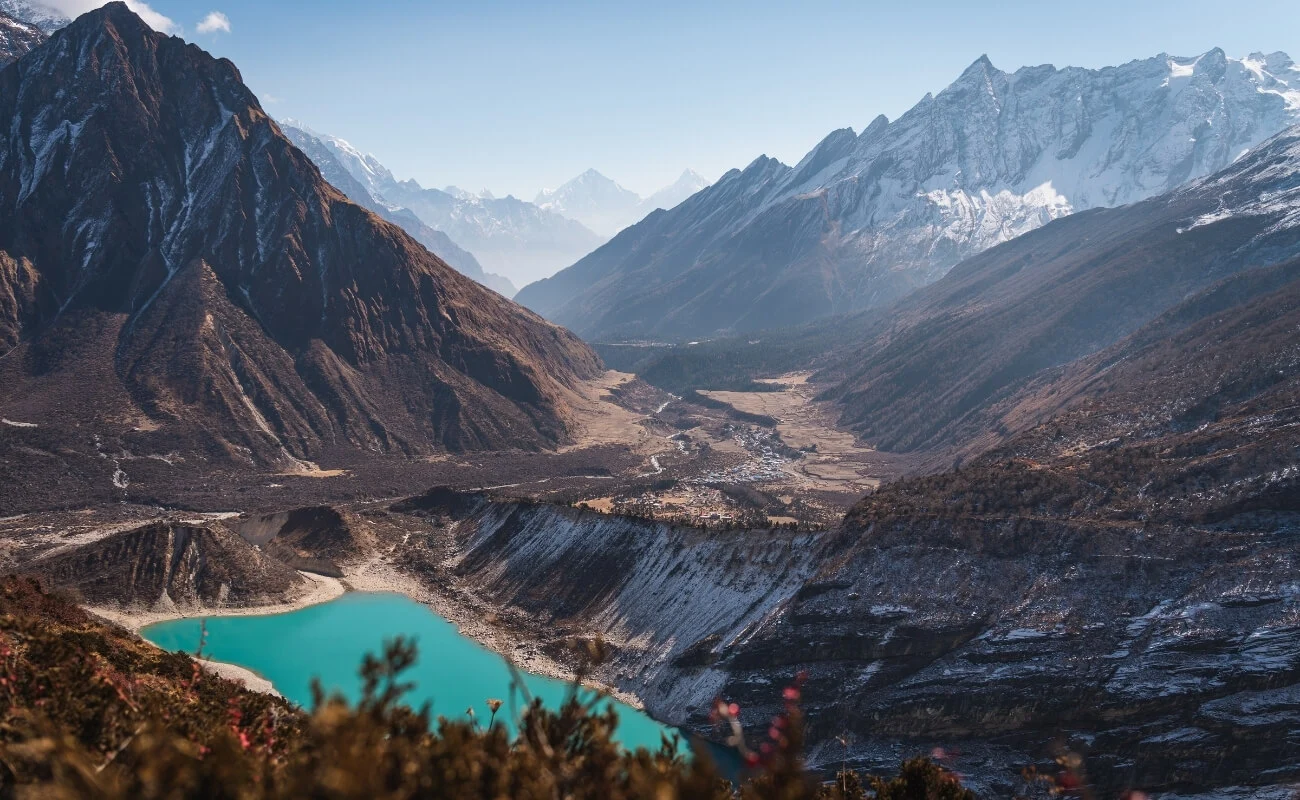
Rhododendron forests between Machha Khola (869m) and Namrung (2,630m) peak in bloom from mid-March through mid-April. The Manaslu Conservation Area protects 11 forest types and more than 2,000 plant species, and is home to 39 mammal species and 201 bird species, according to NTNC's Manaslu Conservation Area Project.
Wildlife sightings are most active in spring due to breeding season behavior. Red pandas occupy rhododendron forest zones between 2,200m and 3,800m. Himalayan tahr graze open slopes near Samagaun. Snow leopard sightings, rare in any season, increase near Samdo (3,875m) where researchers have documented spring territorial movement patterns.
Mountain views in spring favor morning hours. The north face of Manaslu (8,163m) is directly visible from Samagaun village. Himalchuli (7,893m) and Peak 29 / Ngadi Chuli (7,871m) are visible from the Larke Pass descent toward Bimthang (3,720m) on clear mornings.
What Are the Pros and Cons of Trekking in Spring?
Spring trekking on the Manaslu Circuit delivers 5 clear advantages and 4 significant trade-offs that trekkers must evaluate before booking.
Advantages of spring trekking:
-
Rhododendron forests in peak bloom from mid-March to mid-April
-
40% lower trail population in March compared to autumn peak
-
Active wildlife breeding season increases red panda and tahr sighting probability
-
Warming temperatures reduce cold-weather gear burden compared to November or winter
-
Larke Pass is reliably snow-free by 7 AM from April 1 onward
Trade-offs of spring trekking:
-
Pre-monsoon storm cells build rapidly after midday at high altitude from late April
-
Late May trails become muddy and slippery in lower gorge sections
-
Afternoon cloud cover blocks mountain views from 2 PM onward in April–May
-
Larke Pass retains deep snow patches in early March, requiring microspike traction devices
What Is the Manaslu Circuit Trek Like in Autumn?
The Manaslu Circuit Trek in autumn is the highest-quality trekking experience on the route, dry trails, clear mountain panoramas, fully operational lodges, and stable weather create optimal conditions across all 14-to-18 trekking days from Soti Khola to Bimthang.
What Are the Weather and Temperature Conditions?
Autumn delivers the most stable 60-day weather window of the Nepal trekking year, with daytime temperatures ranging from 20°C (68°F) at lower elevations to -10°C (14°F) at Larke Pass, and precipitation averaging below 30mm per month across September and October.
The table below compares autumn temperatures at the circuit's 4 key elevation zones:
|
Location |
Elevation |
Daytime Temp (Autumn) |
Night Temp (Autumn) |
|
Soti Khola |
700m |
18–25°C (64–77°F) |
12–16°C (54–61°F) |
|
Deng |
1,804m |
14–20°C (57–68°F) |
5–10°C (41–50°F) |
|
Samagaun |
3,520m |
5–12°C (41–54°F) |
-5 to 0°C (23–32°F) |
|
Larke Pass |
5,106m |
-5 to 0°C (23–32°F) |
-12 to -18°C (10–0°F) |
November brings the season's most dramatic temperature drop. Daytime highs at Samagaun fall to 1°C to 6°C (34°F to 43°F) by late November. Night temperatures at Dharamsala (4,460m) in November range from -10°C to -18°C (14°F to 0°F), requiring a -20°C rated sleeping bag and 4-season tent capability for those camping.
Why Are Visibility and Trail Conditions Excellent?
Visibility is excellent in autumn because the monsoon rain system flushes particulate matter from the atmosphere between September and October, creating conditions where mountain peaks 80 kilometers distant are identifiable with the naked eye. Larke Pass trail surfaces are completely dry, compacted, and frost-free during October daylight crossing hours.
Post-monsoon atmospheric clarity delivers measurable photography benefits. The contrast ratio between snow-covered peaks and deep blue sky reaches its annual maximum in October. Peaks like Manaslu (8,163m), Larke Peak (6,249m), and Cheo Himal (6,820m) appear with sharp relief lines from Samagaun camp.
Trail surface conditions in autumn are superior to all other seasons. The Budhi Gandaki gorge paths dry completely within 3 to 4 weeks of monsoon end. Larke Pass rock surfaces are free of ice during the 5 AM to 9 AM recommended crossing window. River crossings along the route are at their lowest annual water volume in October and November.
What Are the Pros and Cons of Trekking in Autumn?
Autumn trekking on the Manaslu Circuit delivers 5 primary advantages and 3 notable trade-offs compared to spring conditions.
Advantages of autumn trekking:
-
Clearest sky and maximum visibility across all 4 trekking seasons
-
Dry, firm trail surfaces on all elevation zones from lower gorge to Larke Pass
-
All teahouse lodges fully operational with fresh food stock from Gorkha supply routes
-
Larke Pass reliably ice-free during morning crossing hours in October
-
Stable high-pressure weather produces consistent and predictable daily patterns
Trade-offs of autumn trekking:
-
October trail traffic peaks, groups of 15 to 30 trekkers share narrow gorge paths on popular dates
-
November temperatures drop sharply, requiring heavier cold-weather gear investment
-
Lodge accommodation bookings for October require 60 to 90 days advance reservation
Is the Manaslu Circuit Trek Worth Doing in Winter?
 The Manaslu Circuit Trek in winter (December to February) is a high-risk expedition reserved for experienced cold-weather trekkers with full technical mountaineering gear. Larke Pass crossing in January carries objective avalanche and frostbite risk that disqualifies the route for general recreational trekking purposes.
What Challenges Should You Expect?
Winter trekking on the Manaslu Circuit presents 4 serious challenges: Larke Pass closure under accumulated snowpack, lodge closures above Namrung (2,630m), extreme night temperatures of -20°C to -35°C (-4°F to -31°F) at altitude, and severely limited emergency evacuation options during storm cycles.
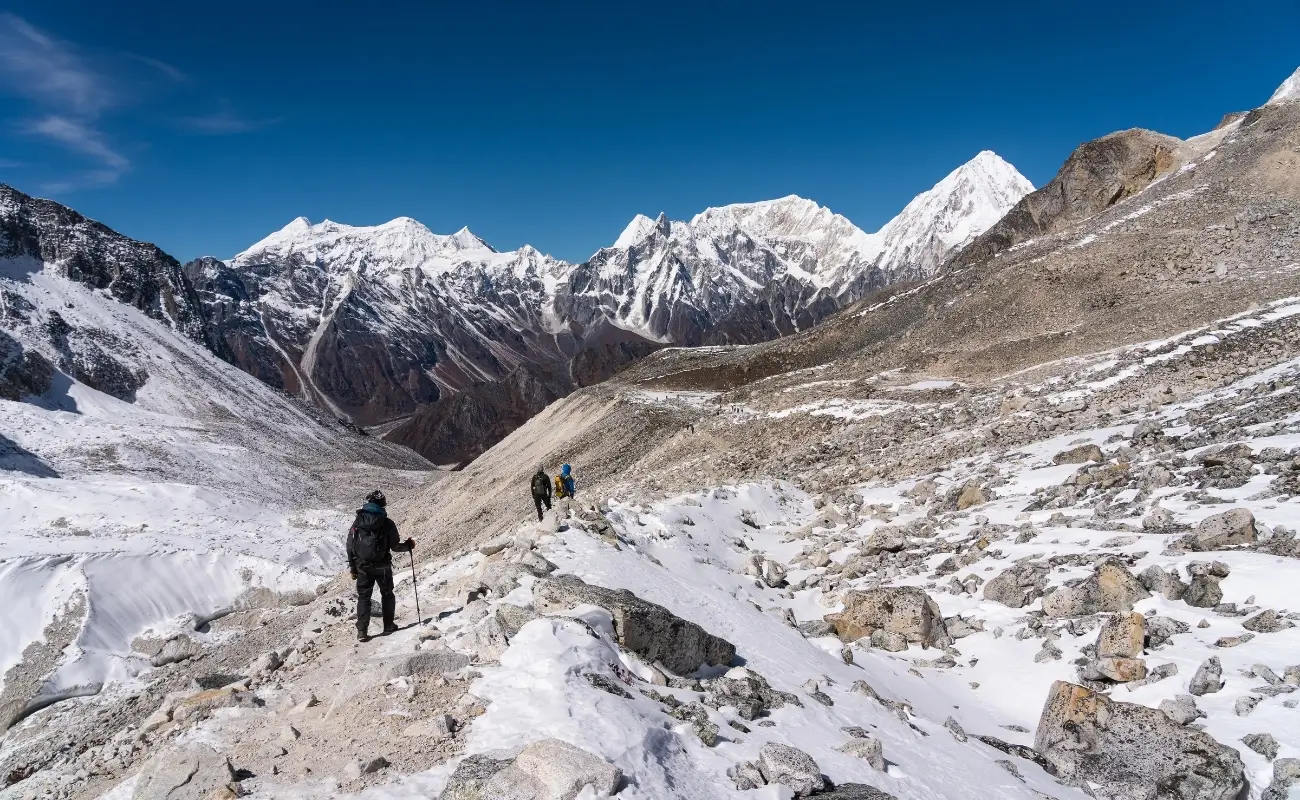
Larke Pass becomes impassable under 1 to 2 meters of accumulated snow between December and February in high-snow years. Trail markers disappear under snowpack, requiring an experienced mountain guide with winter route-finding capability. At least 70% of teahouse lodges above Namrung close by December 1 and reopen in late February or March, depending on snowmelt conditions.
Frostbite risk at Larke Pass reaches its annual maximum in January. Recorded low temperatures at the pass drop to -28°C to -35°C (-18°F to -31°F) during January cold spells, combined with 30-to-50 km/h winds that push effective wind chill below -45°C (-49°F). Exposed skin at these temperatures experiences frostbite within 10 minutes without proper protection.
Who Should Consider a Winter Trek?
Winter trekking suits 3 specific trekker profiles: experienced mountaineers with technical ice and snow travel skills, professional photographers targeting Himalayan winter light aesthetics, and serious trekkers seeking complete trail solitude in lower-elevation gorge sections below Namrung.
Below Namrung (2,630m), winter trail conditions are manageable for fit, well-equipped trekkers. The Budhi Gandaki gorge in December and January offers extraordinary solitude, an estimated 95% reduction in trail traffic compared to October. Rhododendron forests in the lower section carry snow dusting that creates unique photographic compositions unavailable in any other season.
Any winter Manaslu Circuit departure requires licensed high-altitude guides, full camping gear with 4-season tents, and pre-arranged emergency evacuation protocols. Reputable trekking operators require documented cold-weather trekking experience from clients before confirming winter bookings.
Can You Trek the Manaslu Circuit During the Monsoon?
Trekking the Manaslu Circuit during monsoon (June to August) is possible but carries substantial risk from landslides, swollen river crossings, leech-infested forest trails, and near-total mountain view obstruction on approximately 60% of trekking days. Most reputable trekking agencies do not schedule monsoon departures for first-time visitors to the circuit.
What Are the Main Risks During the Rainy Season?
Monsoon trekking on the Manaslu Circuit presents 5 identified hazards: trail-blocking landslides in the Budhi Gandaki gorge, high-water river crossings, leech infestation on lower forest paths, continuous cloud cover eliminating Manaslu views, and reduced teahouse food quality from limited supply line access.
The Budhi Gandaki gorge between Arughat (488m) and Jagat (1,410m) experiences the highest landslide frequency of any trekking route section in Gandaki Province during June through August. Nepal's Department of Roads has documented dozens of trail-blocking landslides in this corridor during past monsoon seasons.
Larke Pass at 5,106m receives snowfall during monsoon months as the jet stream interacts with moisture-laden air masses from the Bay of Bengal. This snowfall combined with wet and icy rock surfaces creates dangerous crossing conditions even for experienced trekkers. Average monsoon visibility at Samagaun drops to under 500 meters on approximately 60% of monsoon days.
Are There Any Advantages to Trekking in Summer?
Summer trekking on the Manaslu Circuit delivers 3 specific advantages: the lowest permit fees and accommodation costs of the year, zero trail congestion on all route sections, and dramatically lush lower-gorge vegetation from continuous rainfall.
Waterfalls throughout the Budhi Gandaki gorge reach peak volume and visual spectacle in July and August. The lower trail section between Soti Khola and Jagat transforms into a cascading water landscape that no other season replicates. Trekkers from humid-climate regions who tolerate rain sometimes prefer monsoon trekking for this green landscape and complete trail privacy.
A licensed guide with detailed local knowledge of active landslide zones is essential for any monsoon departure. Independent trekking without a guide on the Manaslu Circuit is prohibited year-round under the restricted-area permit regulations, and navigating monsoon conditions carries life-threatening risk.
How Does the Weather Change by Elevation?
Weather on the Manaslu Circuit changes across 3 distinct elevation bands, lower subtropical zone (700m to 2,000m), mid-mountain zone (2,000m to 4,000m), and high alpine zone (4,000m to 5,106m), with temperature dropping 6.5°C for every 1,000 meters of elevation gain.
What Weather Can You Expect in the Lower Region?
The lower region of the Manaslu Circuit (700m to 2,000m) experiences subtropical to temperate climate conditions, with daytime temperatures ranging from 18°C to 28°C (64°F to 82°F) in spring and autumn, high humidity in the gorge, and significant rainfall during monsoon months.
The Budhi Gandaki gorge is one of Nepal's deepest river gorges, creating a microclimate that traps heat and moisture at lower elevations. Trekkers between Soti Khola and Machha Khola (869m) encounter near-tropical forest conditions in spring and autumn. Leeches are active in this zone from May through October during wet periods.
Lower-region weather shifts rapidly with elevation gain within a single trekking day. The thermal gradient between Arughat (488m) and Namrung (2,630m) spans 15°C to 20°C. A morning departure in a light shirt from Arughat transitions to a down jacket requirement at the Namrung overnight stop, a reality that surprises trekkers who underpack for the lower sections.
What Conditions Should You Expect at Larke Pass?
Larke Pass (5,106m) experiences year-round sub-zero night temperatures, with crossing-hour conditions ranging from -5°C (23°F) in October to -25°C (-13°F) in January, combined with wind speeds averaging 20 to 40 km/h during morning crossing hours across all trekking seasons.
The standard Larke Pass crossing protocol, departure from Dharamsala camp (4,460m) between 3 AM and 5 AM, is dictated by weather physics, not tradition. Morning hours deliver calm wind conditions and a frozen firm snow surface for traction. By 11 AM, solar warming destabilizes snow conditions on south-facing slopes, and afternoon cloud buildup reduces visibility to under 50 meters on vulnerable days.
Crossing duration from Dharamsala to Bimthang (3,720m) averages 6 to 8 hours for acclimatized trekkers. This timeframe places crossing completion between 9 AM and 1 PM, safely before afternoon weather deterioration in spring and autumn conditions.
Altitude sickness risk peaks at Larke Pass. A 1-day acclimatization rest at Samdo (3,875m) before the Dharamsala approach is standard protocol. The elevation gain from Samdo to Larke Pass summit covers 1,231 meters in a single day, one of the highest single-day ascent stages on any Nepal trekking circuit.
Which Month Is Best for the Manaslu Circuit Trek?
October is the single best month for the Manaslu Circuit Trek, delivering 31 days of post-monsoon clarity, stable temperatures, ice-free Larke Pass conditions, and fully operational lodge infrastructure from Soti Khola to Bimthang. April is the second-best month with comparable trail safety and 40% fewer trekkers.
How Does March to May Compare?
March, April, and May each offer distinct advantages and limitations that determine which spring month best matches a trekker's experience level and trekking priorities.
March is the quietest spring month with 40% lower trail population than April peak. Larke Pass retains significant snowpack through mid-March, requiring crampons or microspike traction devices. Daytime visibility is excellent, and temperatures at altitude are the coldest of the spring window. March suits experienced trekkers who prioritize solitude over comfort.
April is the optimal spring month. Larke Pass snow consolidates to firm, manageable sections by April 1. Rhododendron bloom peaks in mid-April across the 2,200m to 3,500m elevation band. Daytime temperatures at Samagaun reach a comfortable 10°C to 14°C (50°F to 57°F). Morning sky clarity rivals October during the April high-pressure window.
May closes the spring window. Trail conditions deteriorate progressively as pre-monsoon storm cells build over the Bay of Bengal. The first 2 weeks of May remain viable for experienced trekkers with schedule flexibility for weather delays. Departures after May 20 carry significant probability of monsoon weather intrusion below planned trekking altitudes.
How Does September to November Compare?
September, October, and November each deliver distinct versions of the autumn trekking experience, from September's transitional monsoon tail to November's cold, uncrowded solitude at Larke Pass.
September is a transitional month. The monsoon ends officially in mid-September, but the Budhi Gandaki gorge trails retain mud and residual water damage from July–August. Lower-elevation landslide risk persists through September 15. The final 2 weeks of September offer rapidly improving conditions, with near-October clarity developing by September 25 in most years.
October is the peak month. All lodges are fully operational, trail surfaces are dry and firm, and Larke Pass conditions are optimal. October 1 to October 25 delivers the most consistent Himalayan trekking conditions of the calendar year. The trade-off is maximum trail traffic, the Manaslu Circuit receives 30 to 40 permit holders per day during peak October dates, creating teahouse congestion at Samagaun and Samdo.
November is the underrated autumn choice. Trail population drops 60% from October peak by the second week of November. Temperatures are colder, requiring a heavier sleeping bag and additional insulation layers. Mountain views are equally clear, teahouse services remain fully operational, and permit wait times are zero. Late November departures (after November 20) approach winter conditions at Larke Pass and require -20°C gear specification.
What Should You Pack for Different Trekking Seasons?
Packing for the Manaslu Circuit Trek requires a season-specific layering system covering a temperature range of 35°C (63°F) between trailhead and Larke Pass summit, across 14 to 18 trekking days without resupply options above Samagaun.
Which Clothing and Gear Are Essential?
All 4 seasons require the same 6 core clothing items: moisture-wicking base layers, insulating mid-layers, a down jacket rated for the season, a waterproof outer shell, trekking pants, and sun protection. Season variation determines the temperature specification of each item rather than the item category itself.
Spring (March–May) gear specifications:
-
Down jacket rated to -15°C (5°F)
-
Waterproof rain jacket (mandatory from late April onward)
-
Microspike traction devices for Larke Pass in March
-
UV400 sunglasses (spring snow reflection intensity is acute above 4,000m)
-
Gaiters for muddy lower-trail sections in May
Autumn (October–November) gear specifications:
-
Down jacket rated to -20°C (-4°F) for November departure, -15°C (5°F) for October
-
4-season sleeping bag rated to -15°C (5°F) minimum
-
Insulated trekking boots rated to -15°C for November conditions
-
Fleece liner gloves plus outer waterproof mittens for Larke crossing
-
Chemical hand warmers for Larke Pass pre-dawn departure
Winter (December–February) gear specifications:
-
Full mountaineering insulation system rated to -30°C (-22°F)
-
Crampons and ice axe for Larke Pass technical crossing
-
4-season tent (teahouse closure above Namrung requires self-sufficient camping)
-
Emergency bivy sack as mandatory safety backup
Monsoon (June–August) gear specifications:
-
Quick-dry clothing system throughout all elevation zones
-
Waterproof ankle gaiters for leech protection in lower forests
-
Trekking poles with rubber tips for wet rock surface grip
-
Packable rain poncho with full-length coverage for trail protection
How Should You Prepare for Changing Mountain Weather?
Preparation for Manaslu Circuit weather change requires 3 strategies: a layering system calibrated to the 35°C elevation temperature gradient, a daily weather monitoring protocol using local mountain forecasts, and a committed early morning departure discipline at all high passes.
Manaslu Circuit weather changes fastest in the 2-hour window between 11 AM and 1 PM at elevations above 3,500m. A trekker above Namrung who departs late from camp (after 9 AM) frequently encounters afternoon cloud buildups that reduce visibility and complicate route-finding on snow-covered sections near Larke Pass.
The Nepal Meteorological Forecasting Division issues altitude-specific 72-hour forecasts that licensed expedition guides use daily. Checking forecasts at Samagaun before the Larke Pass approach day determines whether to proceed on schedule or rest for 24 hours. Guides from established operators carry satellite-based weather devices to access forecasts in zones where mobile network coverage is unavailable.
How Can You Choose the Right Season for Your Trekking Style?
The right season for the Manaslu Circuit Trek depends on 3 primary factors: cold-weather tolerance, high-altitude pass experience, and whether photography quality, wildlife encounters, or trail solitude ranks as the primary trekking priority. Trekkers exploring the wider Manaslu region can also combine this circuit with nearby cultural stops for a fuller Himalayan experience.
Which Season Is Best for Beginners?
October is the best single month for beginner trekkers on the Manaslu Circuit. Dry trails, clear weather patterns, fully operational lodges, and stable Larke Pass conditions reduce the variables a first-time high-altitude trekker manages simultaneously.
Beginners on the Manaslu Circuit benefit from October's predictable daily weather rhythm: clear mornings until 11 AM, potential light cloud buildup in early afternoon, clearing by sunset. This pattern allows scheduled acclimatization days without anxiety about unexpected weather windows. Lodge availability in October also ensures warm sleeping quarters and cooked meals at each acclimatization stage.
April is the best spring option for beginners with schedule flexibility. The combination of warm lower-trail temperatures, moderate trail traffic (which aids route-finding confidence), and blooming rhododendron forests makes April a rewarding first Himalayan circuit experience. For a wider seasonal comparison across Nepal's other trekking regions, see our guide to the best time to trek in Nepal.
Which Season Is Best for Experienced Trekkers and Photographers?
November, late March, and winter months (for technical specialists) offer experienced trekkers and photographers 3 distinct advantages: reduced crowd interference in compositions, unique seasonal light conditions, and landscape states that peak-season visitors never encounter.
November delivers golden-hour light lasting 40% longer than October due to the lower solar angle above the horizon. Samagaun village in early November under clear sky produces mountain photography conditions that professional Himalayan photographers specifically schedule. The combination of low-angle light, fresh snowfall on peaks, and empty trails creates compositions unavailable in any other month.
Late March offers rhododendron forests with occasional snow dusting, a mixed spring-winter composition unavailable in April or May. For experienced cold-weather trekkers, the empty trails and snow-loaded forest sections between Machha Khola and Namrung in early March produce images that October trekking cannot replicate. For a detailed breakdown of prime locations along the route, see our guide to Manaslu photography spots.
How Can Our Trekking Agency Help You Plan the Best Time for the Manaslu Circuit Trek?
Our trekking agency provides personalized season selection guidance based on 3 matching criteria: your fitness level, photography or wildlife priorities, and preferred crowd density, then coordinates the full Manaslu permit logistics, licensed guide assignment, and teahouse booking chain within your optimal departure window.
Planning the Manaslu Circuit Trek requires acquiring the Manaslu Restricted Area Permit (MRAP) from Nepal's Department of Immigration, which costs $100 USD per person for the first 7 days ($15 USD/additional day) during peak autumn season, but drops to $75 USD ($10 USD/additional day) from December to August. Additionally, you must acquire the Manaslu Conservation Area Permit (MCAP, $30 USD) and the Annapurna Conservation Area Permit (ACAP, $30 USD), which are both issued by the National Trust for Nature Conservation (NTNC). The MRAP requires a licensed government trekking guide, but under the Department of Immigration's 2026 restricted-area permit policy, solo trekkers are fully permitted and the old two-person minimum has been abolished. Our trekking agency handles all documentation, guide assignment, and permit processing from Kathmandu before your arrival. For the complete fee breakdown by season, see our Manaslu permit cost guide.
Can Our Trekking Agency Recommend the Ideal Season Based on Your Goals?
Our trekking agency recommends trekking seasons across 4 goal categories: first-time Himalayan trekkers (October), wildlife and botanical photographers (April), serious mountain photographers (November), and solitude-focused experienced trekkers (March or late November). The team provides a pre-departure consultation that matches your specific fitness level, gear inventory, and schedule to the specific week, not just the season, that delivers optimal results.
Departure date selection within a season matters as much as season selection itself. An October 5 departure delivers a different Larke Pass experience than an October 25 departure due to 3 weeks of cold accumulation and changing overnight temperatures. Our trekking agency uses multi-year client debrief data from Manaslu Circuit departures to identify the specific 5-to-7-day windows within each season that consistently produce the highest trek satisfaction outcomes.
For groups with mixed experience levels, common in family and corporate adventure groups, Our trekking agency recommends October 7 to October 20 as the highest-confidence departure window combining safety, comfort, and peak view quality across all trekker profiles.
What Are the Key Takeaways About the Best Time for the Manaslu Circuit Trek?
The best time for the Manaslu Circuit Trek is October in autumn and April in spring, these 2 months deliver the highest probability of safe Larke Pass crossing, optimal mountain visibility, trail stability, and lodge availability across the entire 177-kilometer route.
The 6 core seasonal facts every Manaslu Circuit planner needs:
-
October delivers post-monsoon clarity, dry trails, and all lodges operational, the single highest-quality trekking month
-
April delivers rhododendron bloom, moderate traffic, and stable Larke Pass conditions, the best spring month
-
November offers October-quality views with 60% fewer trekkers, the best value timing in autumn
-
March provides trail solitude and blooming lower forests with Larke Pass snow risk, for experienced trekkers only
-
Monsoon (June–August) carries landslide and flooding risk in the Budhi Gandaki gorge, not recommended for most trekkers
-
Winter (December–February) closes most lodges above 2,630m and requires technical mountaineering capability for Larke Pass crossing
The Manaslu Circuit Trek covers terrain from 700m subtropical gorge to 5,106m glacial pass. The optimal departure window is determined by your experience level, gear capacity, and the specific landscape or photography conditions you prioritize.
Plan your Manaslu Circuit Trek package with our trekking agency to secure the permits, guide, and teahouse reservations that match your exact travel window. October lodge availability fills 60 to 90 days before departure, and permit processing requires advance documentation. Contact our trekking agency to confirm your ideal season and departure week today.
More About Author

Khilak Budhathoki
Travel Director
Khilak Budhathoki is the co-founder and lead trekking guide at Himalaya Trekking Nepal, a locally owned and operated adventure company based in Kathmandu. Born and raised in the foothills of Nepal, Khilak developed a deep love for the mountains from an early age. With over a deca...
USD$1500 pp
Our Recommendation