- 19, Nov 2025 | Khilak Budhathoki
Helicopter rescue insurance for trekking in Nepal provides financial protection for emergency evacuation from high-altitude and remote mountain routes, where medical facilities and road access are limited. Nepal does not impose a universal insurance requirement on standard treks such as Everest Base Camp and the Annapurna Circuit, while Restricted Area treks such as Manaslu, Upper Mustang, and Dolpo require rescue insurance for permit approval. The distinction between a legal requirement and practical protection is important because helicopter evacuation can cost thousands of dollars, with expenses increasing further when hospital treatment, search and rescue, or medical repatriation is required.
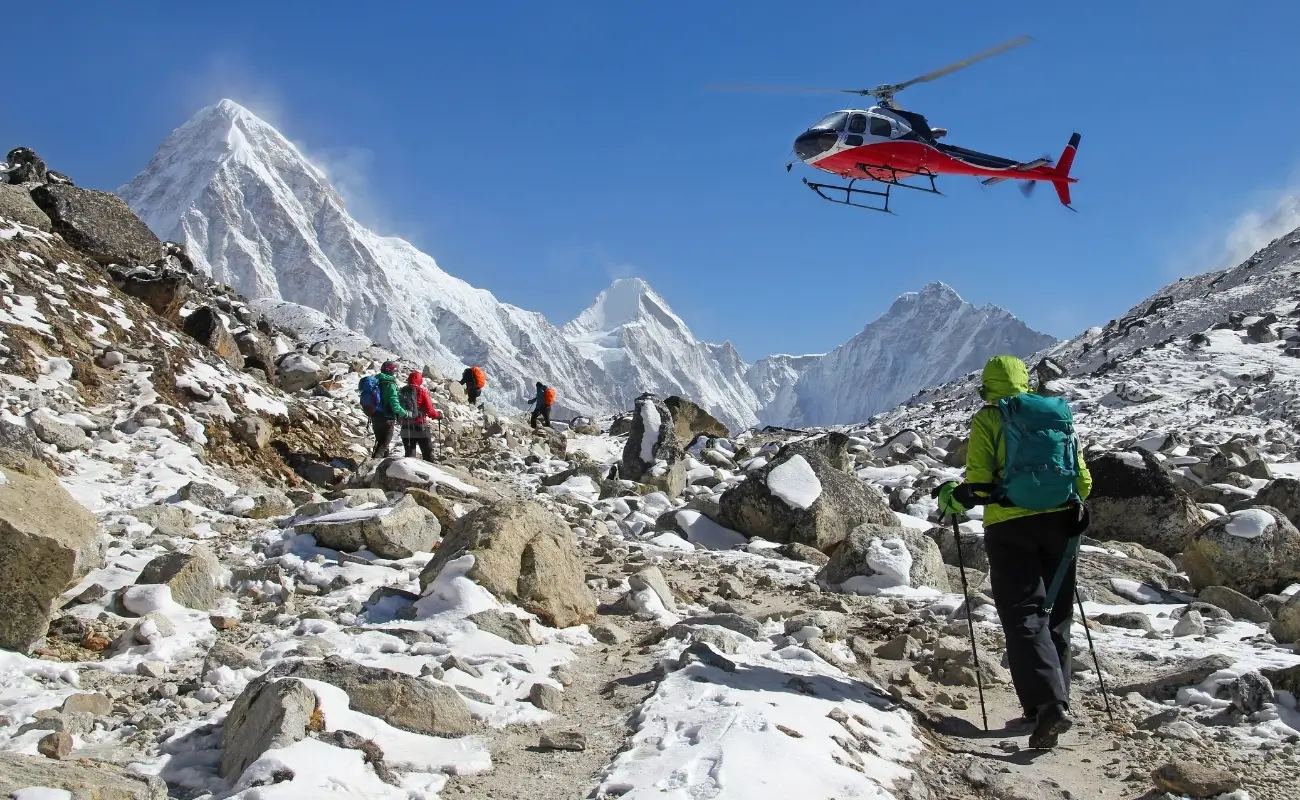 Choosing suitable trekking insurance for Nepal therefore involves more than purchasing a general travel policy. Trekkers need to verify helicopter evacuation, search and rescue, emergency medical treatment, repatriation, altitude limits of at least 6,000 meters for major high-altitude routes, covered trekking activities, and policy exclusions. Route elevation, remoteness, weather, rescue access, and permit requirements all affect the level of protection needed. Understanding how Nepal's rescue system works, what insurance covers, how much evacuation can cost, and which requirements apply to Everest, Annapurna, Manaslu, Upper Mustang, Dolpo, and other routes helps trekkers prepare financially and operationally before entering the mountains.
Is Helicopter Rescue Insurance Legally Required for Nepal Treks?
Helicopter rescue insurance is not a blanket legal requirement for all of Nepal. For standard routes like Everest Base Camp or the Annapurna Circuit, no government authority mandates coverage as a condition of entry or trek permit issuance. However, the government does legally mandate insurance for Restricted Area Permits. That said, even on standard routes where it isn't legally required, the absence of a legal mandate does not mean trekking without insurance is safe or advisable, especially above 4,000 meters. That said, the absence of a legal mandate does not mean trekking without insurance is safe or advisable, especially above 4,000 meters.
The distinction between "legally required" and "practically essential" matters here. Nepal's trekking framework requires permits and TIMS cards. It does not require proof of insurance at any checkpoint. What happens when a trekker needs evacuation without coverage, however, is a financial emergency on top of a medical one.
Does Nepal Require Trekking Insurance for Foreign Travelers?
Nepal does not require travel insurance or helicopter rescue coverage for foreign trekkers at a national policy level. Foreign trekkers obtain a TIMS (Trekkers' Information Management System) card for NPR 2,000 and relevant restricted area permits, but neither document carries an insurance obligation.
The Nepal Tourism Board recommends travel insurance as standard guidance for all foreign visitors, but that recommendation carries no enforcement mechanism. While airport immigration may not verify insurance upon arrival, the Department of Immigration strictly requires trekking agencies to submit a copy of your helicopter rescue and travel insurance policy to issue Restricted Area Permits (RAP) for routes like Manaslu, Upper Mustang, and Dolpo.
What this means practically: while you might technically secure an Everest Base Camp entry permit without presenting insurance, you cannot obtain legal permission for restricted areas like the Manaslu Circuit or Upper Mustang. The Department of Immigration mandates proof of rescue coverage for these specific permits. The mountain does not care.
Is Helicopter Evacuation Insurance Required by Trekking Agencies?
Many established trekking agencies in Nepal, including Himalaya Trekking Nepal, require proof of valid helicopter evacuation insurance as a booking condition. This is a company policy, not a government regulation, but the distinction rarely matters once a client is on the trail.
Agencies impose this requirement for 3 clear reasons:
-
Financial protection for the trekker: Agencies do not front rescue costs without guarantee of repayment
-
Operational reliability: A guide contacting a rescue helicopter needs an insurance authorization number to initiate deployment
-
Liability management: Agencies operating under professional licensing have reputational stakes in evacuation outcomes
Because Nepal legally banned independent trekking in 2023, all foreign trekkers must book through a government-registered trekking agency. These licensed agencies universally require proof of insurance before confirming your booking to ensure operational safety. Trekkers who attempt to bypass these laws by hiking illegally without a registered agency face the highest-risk evacuations, as they have no structured protocol or ground support for getting help quickly.
Which Nepal Treks Carry the Highest Rescue Risks?
The 5 Nepal trekking routes with the highest documented rescue frequency are the Everest Base Camp Trek, Annapurna Circuit, Manaslu Circuit Trek, Upper Mustang Trek, and Dolpo Trek. Each shares 3 common risk factors: remote terrain, high elevation gain, and limited road access for ground evacuation.
EBC leads in absolute rescue volume because of its annual trekker numbers, over 50,000 trekkers attempt the route each year. Manaslu and Dolpo carry higher per-capita risk because evacuation response times from remote sections can exceed 4 hours under clear conditions, and significantly longer in poor weather.
What Does Helicopter Rescue Insurance Cover in Nepal?
Helicopter rescue insurance for Nepal treks covers the cost of emergency air evacuation from trail to hospital, and in most comprehensive policies, includes medical treatment, search and rescue coordination, and international repatriation. Coverage scope varies significantly between policies and providers.
Understanding what a policy actually covers, not just what its marketing says, determines whether it functions in a real emergency.
Does Trekking Insurance Cover Emergency Helicopter Evacuation?
Trekking insurance covers emergency helicopter evacuation when the policy explicitly lists "emergency medical evacuation" or "helicopter rescue" as a named benefit. General travel insurance policies, the type designed for flight cancellations and lost luggage, frequently do not cover helicopter evacuation in high-altitude mountain terrain.
The core distinction is between:
-
General travel insurance: Covers trip cancellation, lost baggage, and basic medical up to a defined limit, often without helicopter-specific coverage
-
Adventure travel insurance: Designed for trekking, climbing, and wilderness activities; explicitly covers helicopter rescue as a benefit category
-
Trekking-specific insurance: The most targeted product, covering mountain-specific emergencies at defined altitudes with rescue coordination included
Nepal trekking requires the second or third category. Policies from providers such as World Nomads Explorer plan, IMG Signature Travel Insurance, and Battleface explicitly cover helicopter rescue. Standard domestic travel insurance from most banks does not.
What Trekking Emergencies Can Trigger Helicopter Rescue?
The 6 most common trekking emergencies that trigger helicopter rescue in Nepal are acute mountain sickness (AMS), high-altitude cerebral edema (HACE), high-altitude pulmonary edema (HAPE), traumatic injury from a fall, cardiac events, and severe infection or illness requiring immediate hospitalization.
AMS, HACE, and HAPE together account for approximately 60% of helicopter evacuations from high-altitude trekking routes in Nepal, according to rescue frequency data from Himalayan Rescue Association field clinics in Pheriche and Manang.
Each of these conditions deteriorates rapidly at altitude, which is why understanding altitude sickness symptoms and prevention matters before any high-altitude trek. HACE, in which fluid accumulates in the brain, can progress from first symptoms to unconsciousness within 12 to 24 hours. HAPE, in which fluid accumulates in the lungs, causes death without descent or evacuation. No amount of acclimatization completely eliminates these risks, they affect fit, experienced trekkers as often as first-timers.
Traumatic injuries, broken ankles, dislocated joints, deep lacerations, are the second major category. Terrain on routes like the Manaslu Circuit and Kanchenjunga Trek is uneven, wet in monsoon, and icy in winter. Ground evacuation via stretcher is possible on some sections, but below 4,000 meters only and only when local rescue teams are available.
Does Insurance Cover Medical Treatment Along With Helicopter Rescue?
Comprehensive trekking insurance covers both helicopter evacuation and subsequent medical treatment, including hospitalization in Kathmandu, surgical procedures, and prescribed medications. These two coverage types are distinct line items in most policies.
Here is how the coverage typically structures:
-
Helicopter rescue: Covers the flight cost from rescue point to the nearest appropriate medical facility
-
Emergency medical treatment: Covers hospital fees, surgery, specialist consultation, ICU, and medication
-
Medical repatriation: Covers transport from Nepal back to the trekker's home country once medically stable
The critical point most trekkers miss: helicopter rescue coverage without medical treatment coverage solves only part of the problem. A trekker evacuated to Kathmandu still faces hospital bills of $1,500 to $5,000 or more for serious conditions. The two coverages work together.
Are Search and Rescue Costs Covered by Standard Travel Insurance?
Standard travel insurance does not cover search and rescue costs in Nepal. Search and rescue (SAR) operations, conducted when a trekker is missing, unreachable, or lost, are distinct from medical helicopter evacuation and require separate coverage in most policy documents.
Nepal does not operate a government-funded mountain rescue service equivalent to those found in European alpine nations. SAR operations are organized by the Nepal Army, Armed Police Force, and licensed rescue operators, but the operational costs are not state-subsidized for foreign trekkers.
A SAR operation on a remote route like Dolpo can involve multiple helicopters, ground teams, and coordination over several days. Combined costs can exceed $15,000. Adventure travel insurance policies from providers like Global Rescue and Ripcord Rescue Travel Insurance explicitly include SAR as a coverage category. Most standard insurers do not.
How Much Does Helicopter Rescue Cost During a Nepal Trek?
Helicopter rescue costs in Nepal range from $3,000 to $12,000 USD depending on flight distance, altitude, weather conditions, and the rescue operator. Evacuations from routes above 5,000 meters cost more than those from lower elevations because of aircraft fuel demands and operational risk at high altitude.
These are not estimates with wide margins, they reflect consistent pricing from Nepal's 3 primary rescue helicopter operators: Fishtail Air, Simrik Air, and Nepal Army Aviation.
What Factors Affect Helicopter Rescue Costs in Nepal?
The 5 primary factors that determine helicopter rescue costs in Nepal are:
-
Flight distance: Routes farther from Kathmandu or from intermediate airstrips require longer flight times; each flight hour costs $800 to $1,500 USD depending on aircraft type
-
Altitude of rescue point: Helicopters require more fuel and carry fewer passengers above 4,500 meters; some routes above 5,500 meters require specialized aircraft and crews
-
Weather window: Weather delays requiring multiple flight attempts or overnight crew positioning add significant cost
-
Rescue timing: After-hours or night-adjacent rescues requiring dawn deployment carry premium rates
-
Medical personnel onboard: Some evacuations require a doctor or paramedic to fly with the aircraft; their fee adds $200 to $600 to the total
What most people overlook is the positioning cost. A helicopter based in Kathmandu must fly to the rescue point and return. The trekker pays for the entire round trip, not just the portion carrying them back. A round trip to the upper Khumbu from Kathmandu covers approximately 550 km total, and that distance is priced accordingly.
How Much Can an Emergency Helicopter Evacuation Cost?
Emergency helicopter evacuation from specific Nepal trekking zones carries these documented average costs:
|
Rescue Zone |
Approximate One-Way Cost (USD) |
|
Lukla / Lower Khumbu |
$3,000 – $4,500 |
|
Namche Bazaar / Upper Khumbu |
$4,500 – $7,000 |
|
Everest Base Camp (5,364m) |
$6,000 – $12,000 |
|
Annapurna Base Camp (4,130m) |
$3,500 – $5,500 |
|
Manaslu Circuit (high section) |
$4,000 – $6,500 |
|
Dolpo / Upper Mustang |
$8,000 – $15,000 |
These figures reflect 2024–2025 market rates and exclude hospital fees in Kathmandu, which typically add $1,000 to $5,000 for overnight treatment. For a full cost breakdown by pickup location, see our guide to Everest Base Camp evacuation cost.
Why Can Rescue Bills Become Expensive for Trekkers?
Rescue bills become expensive because trekkers pay for 4 simultaneous cost categories that compound: the helicopter positioning cost, the actual evacuation flight, the emergency hospital assessment, and any necessary specialist treatment before repatriation. Each of these bills arrives separately.
A realistic expense sequence looks like this: helicopter rescue from above EBC ($7,000) + ER assessment at CIWEC Hospital Kathmandu ($400) + hospitalization for HAPE treatment ($3,500) + supplemental oxygen and medication ($300) + international medical repatriation to the UK ($12,000 for a commercial stretcher flight). Total: over $23,000 for a single incident.
Without insurance, that bill is paid before the trekker leaves Nepal. Hospitals require payment guarantees before discharge. The embassy provides no financial assistance. The rescue company requires payment on delivery.
How Can Trekkers Choose Insurance for Helicopter Evacuation?
Trekkers choose appropriate helicopter evacuation insurance by checking 4 specific policy criteria: altitude coverage limit, helicopter rescue as a named benefit, 24-hour emergency assistance line, and no exclusion for the specific trekking activity. Price comparison alone fails to identify adequate coverage.
The cheapest adventure insurance policy is not necessarily the most appropriate one for a 5,000+ meter trek.
What Altitude Limits Should Trekking Insurance Include?
Trekking insurance for Nepal routes must cover altitudes up to at least 6,000 meters. This threshold covers the following high points on Nepal's most popular routes:
-
Everest Base Camp: 5,364 meters
-
Kala Patthar viewpoint: 5,645 meters
-
Annapurna Base Camp: 4,130 meters
-
Thorong La Pass (Annapurna Circuit): 5,416 meters
-
Larkya La Pass (Manaslu Circuit): 5,106 meters
-
Dolpo High Route sections: above 5,200 meters
Policies with a 4,500-meter altitude cap are insufficient for EBC and will deny claims for any rescue above that elevation. This exclusion is buried in policy documents under "altitude limitations" or "high-altitude activity conditions", sections that most trekkers skip.
Policies targeting Nepal trekking from World Nomads, IMG Global, and Battleface include 6,000-meter altitude coverage as a standard option. Some require selecting an "extreme altitude" add-on for routes above 5,500 meters.
Does Insurance Cover High-Altitude Trekking in Nepal?
Standard adventure travel insurance covers high-altitude trekking in Nepal when the policy classifies the activity as a covered sport. The policy's covered activities list determines this.
Some insurers classify high-altitude trekking (above 4,000m) as a separate category from standard trekking, requiring an additional premium. Others include it automatically under an "adventure sports" umbrella. The trekker's responsibility is to confirm the classification before purchasing, not after an incident.
Trekking agencies in Nepal operate at altitudes that fall in 3 coverage tiers used by most international insurers:
-
Tier 1 (up to 3,000m): Covered by most standard adventure policies
-
Tier 2 (3,000m–5,000m): Requires adventure travel classification, covered by most specialist insurers
-
Tier 3 (above 5,000m): Requires explicit high-altitude coverage, available from specialist insurers only
Should Insurance Cover Medical Evacuation and Repatriation?
Insurance for Nepal trekking covers medical evacuation and repatriation as separate but complementary benefits. Medical evacuation covers transport to the nearest adequate medical facility, typically a Kathmandu hospital. Repatriation covers transport from Nepal back to the trekker's home country.
Both benefits are necessary for serious incidents. A trekker evacuated for HAPE treatment in Kathmandu may spend 3 to 7 days in hospital before being stable enough for international transport. The repatriation leg, particularly if a medical escort or stretcher configuration is required, costs $8,000 to $20,000 from Nepal to Europe, North America, or Australia.
Repatriation of remains, in the event of death, is an additional coverage category worth confirming. This benefit covers the cost of transporting remains home rather than local cremation or burial, a distinction with significant personal and religious implications for many families.
What Insurance Exclusions Should Nepal Trekkers Check?
The 6 insurance exclusions that most frequently deny claims for Nepal trekkers are:
-
Pre-existing medical conditions: Cardiovascular conditions, asthma, and diabetes are common denial triggers without prior medical disclosure
-
Altitude above policy limit: Claims above the stated maximum altitude are automatically denied
-
Alcohol or substance use: Any evacuation where substance use is documented can result in denial
-
Trekking without licensed guide: Some policies deny claims when the trekker was not accompanied by a licensed local guide in restricted areas
-
Failure to obtain required permits: Missing restricted area permits can void coverage in some policy frameworks
-
Self-rescue or delay in seeking help: Some policies deny coverage when a trekker delayed medical contact beyond a reasonable period
The pre-existing condition exclusion causes the most disputes. A trekker with a managed heart condition who experiences cardiac symptoms at altitude may find coverage denied if the condition was not disclosed at policy purchase and documented in the medical history section.
What Happens If a Trekker Needs Helicopter Rescue in Nepal?
When a trekker needs helicopter rescue in Nepal, the sequence moves through 4 stages: emergency assessment by the guide, contact with the trekking agency or emergency line, insurance company authorization, and helicopter deployment. The entire process takes 45 minutes to 4 hours depending on weather and communication access.
Understanding this sequence matters because delays at any stage extend time-to-rescue, particularly dangerous for HACE and HAPE patients.
Who Arranges Helicopter Evacuation During a Trek?
The trekker's guide arranges helicopter evacuation in almost every real-world scenario. The guide contacts the trekking agency's emergency line or a designated rescue coordination number, provides the GPS location or known landmark, describes the medical situation, and initiates insurance pre-authorization if required.
Trekkers who attempt to self-arrange rescue by calling helicopter companies directly encounter 2 immediate problems: rescue companies require insurance authorization or payment guarantees before dispatch, and the companies' contact details change seasonally.
This is why trekking with a licensed, experienced guide is the most reliable safety mechanism on any Nepal route, not because guides prevent all emergencies, but because they have working relationships with rescue coordinators and understand the authorization process.
How Does the Insurance Company Approve Emergency Evacuation?
Insurance companies approve emergency evacuation through a 24-hour emergency assistance line, a separate number from the standard claims department. The guide or trekker calls this number, provides the policy number, describes the medical situation, and receives a verbal authorization number that the rescue operator accepts before flying.
The 3 pieces of information rescue operators need before deployment:
-
Insurance company name and emergency contact number
-
Policy authorization number for the specific flight
-
Confirmed pickup location with GPS coordinates or known landmark
Trekkers carrying physical copies of their insurance card, with the emergency line number and policy number visible, dramatically reduce delay. Digital copies stored without offline access fail when communication infrastructure is limited, which it frequently is above 4,000 meters.
What Should Trekkers Do Before a Helicopter Rescue?
Trekkers complete 5 actions before helicopter rescue to ensure safe and efficient evacuation:
-
Signal the landing zone: Clear a flat area of at least 20 meters diameter and mark it visually with a brightly colored item
-
Stabilize the patient: Keep the patient warm, horizontal if injured, and away from the rotor wash danger zone
-
Confirm location: Send GPS coordinates via satellite communicator or describe the nearest known landmark to the rescue coordinator
-
Gather documents: Ensure the patient's passport, insurance card, and permit documents travel with them in the helicopter
-
Brief the guide: Leave the guide with emergency contact numbers for the patient's family and the trekking agency
Patients experiencing HACE or HAPE deteriorate faster when moved to incorrect positions. A guide with wilderness first aid training keeps the patient positioned appropriately until the aircraft arrives.
Which Nepal Treks Should Include Helicopter Rescue Coverage?
Every Nepal trek that reaches above 3,500 meters warrants helicopter rescue insurance. Routes above this elevation enter the physiological altitude zone where AMS becomes a realistic risk, descent routes are not always accessible, and ground evacuation time exceeds the safe window for several high-altitude conditions.
This threshold covers most of Nepal's popular trekking destinations beyond short Kathmandu Valley hikes.
Is Helicopter Rescue Insurance Important for Everest Base Camp?
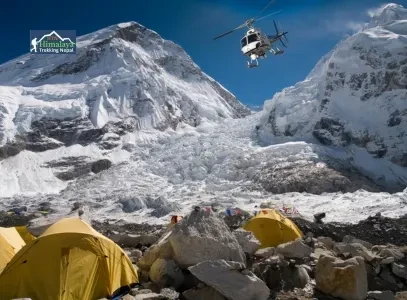
Helicopter rescue insurance is essential for the Everest Base Camp Trek. EBC sits at 5,364 meters, and the approach routes cross elevations between 3,400 meters at Namche Bazaar and 5,545 meters at Kala Patthar.
Pheriche (4,240m) and Everest Base Camp (5,364m) both feature Himalayan Rescue Association (HRA) aid posts staffed seasonally by volunteer physicians. These clinics diagnose AMS, HACE, and HAPE, but they do not perform surgery, do not carry blood products, and cannot manage polytrauma. Evacuation to Lukla's airstrip requires a helicopter above Namche Bazaar.
Three facts about EBC rescue frequency: the Pheriche HRA clinic treats over 300 patients per trekking season for altitude illness, approximately 80 to 120 helicopter rescues depart from the Khumbu region during peak spring season, and rescue costs above 5,000 meters on this route average $7,500 USD.
Is Helicopter Coverage Recommended for Annapurna Treks?
Helicopter rescue coverage is strongly recommended for Annapurna Circuit trekkers and essential for those completing the full circuit over Thorong La Pass (5,416 meters). Annapurna Base Camp trekkers, whose high point reaches 4,130 meters, also benefit from coverage.
The Annapurna region presents a specific risk profile: the route is well-trodden, but the northern section above Manang (3,519 meters) enters a physiological zone where AMS incidence rises sharply. Thorong La's elevation rivals portions of the EBC approach, and weather windows for helicopter access over the Annapurna massif are narrower than in the Khumbu.
Annapurna Base Camp trekkers sometimes believe the route's relatively lower maximum elevation reduces their risk. It does not eliminate it. The gradient gain on the ABC approach is aggressive, trekkers gain over 1,500 meters of elevation in the final 2 days. Rapid ascent at any altitude above 3,000 meters carries AMS risk, for a full breakdown of route hazards, see our Annapurna Base Camp safety guide.
Do High-Altitude and Remote Treks Need Extra Coverage?
High-altitude and remote treks require both higher altitude coverage limits and increased coverage amounts. Remote routes like Dolpo, Kangchenjunga, and Upper Mustang combine extreme altitude with evacuation delays that multiply rescue complexity and cost.
Routes classified as restricted area treks in Nepal require government-issued restricted area permits, licensed guide accompaniment, and minimum group sizes. These requirements exist precisely because rescue infrastructure in restricted zones is minimal. The nearest helicopter-accessible landing area on some Dolpo sections is more than 30 minutes of flight from the emergency point, adding $800 to $1,500 to evacuation cost above standard rates.
Trekkers on these routes need coverage with:
-
Altitude limits of 6,000 meters or higher
-
SAR inclusion as a named benefit
-
Total rescue benefit of at least $100,000 USD
-
24-hour emergency assistance with documented Nepali operational contacts
How Can You Plan a Safer Nepal Trek With Himalaya Trekking Nepal?
Planning a safer trek in Nepal begins with route selection, permit preparation, and insurance verification, three elements that Himalaya Trekking Nepal addresses for every client before departure.
High-altitude trekking is genuinely achievable for most healthy adults with proper preparation. The variables that determine outcome are planning quality, guide experience, and safety infrastructure, not luck.
Can Himalaya Trekking Nepal Help You Prepare for Trekking Insurance?
Himalaya Trekking Nepal provides structured pre-trek insurance guidance to all confirmed clients. The agency's team reviews the client's intended route, identifies the maximum altitude reached, and specifies the minimum coverage requirements for that itinerary.
This includes:
-
Altitude verification: Confirming the route's highest point and recommending coverage accordingly
-
Insurance checklist: Providing a written list of required policy features (altitude limit, named benefits, emergency line), see our Nepal travel insurance guide for coverage and vaccination basics
-
Emergency protocol briefing: Sharing emergency contact numbers, guide contacts, and rescue authorization procedures before departure
-
Guide coordination: Ensuring the assigned guide holds emergency first aid certification and carries rescue contact protocols
This preparation work takes approximately 20 minutes per client but eliminates the most common insurance failure modes before they become emergencies. Every trekker who books with Himalaya Trekking Nepal departs with verified, appropriate coverage, not a policy that sounds adequate but lacks altitude coverage for their specific route.
What Are the Key Takeaways About Helicopter Rescue Insurance in Nepal?
Helicopter rescue insurance is not legally required for Nepal treks but is practically necessary for any route above 3,500 meters. A single rescue incident without coverage costs $4,000 to $23,000+ USD, which exceeds the annual income of most trekkers and cannot be waived by any embassy or trekking authority.
The 7 key takeaways every Nepal trekker carries before departure:
-
Legal requirement vs. practical necessity: While Nepal law only explicitly mandates rescue insurance for Restricted Area Permits, real-world rescue costs make it non-negotiable for responsible trekkers on all routes.
-
Altitude limit matters: Policies with limits below 5,000 meters deny claims on EBC, Annapurna Circuit, Manaslu Circuit, and most other major routes
-
Named benefits matter more than price: A policy must explicitly name helicopter rescue, emergency medical evacuation, and ideally search and rescue as benefits
-
SAR coverage is separate: Search and rescue is distinct from helicopter evacuation; confirm both are included
-
Rescue costs compound: Helicopter flight + hospital + repatriation routinely exceed $20,000 for serious incidents
-
Guide access is the fastest rescue path: A licensed guide with agency contacts initiates rescue faster than any self-arranged protocol
-
Pre-existing condition disclosure is mandatory: Undisclosed conditions void coverage at the moment it is most needed
Nepal's mountains reward preparation. The trekkers who encounter the most avoidable problems, delayed rescues, coverage denials, unpaid hospital bills, are those who treated insurance as a checkbox rather than a trip planning element.
Reach out to Himalaya Trekking Nepal to confirm that your insurance meets the specific requirements of your chosen route, including our guided Everest Base Camp trek, before your trek begins.
More About Author

Khilak Budhathoki
Travel Director
Khilak Budhathoki is the co-founder and lead trekking guide at Himalaya Trekking Nepal, a locally owned and operated adventure company based in Kathmandu. Born and raised in the foothills of Nepal, Khilak developed a deep love for the mountains from an early age. With over a deca...
USD$3,800 pp
Our Recommendation
Related Blogs