- 19, Apr 2026 | Khilak Budhathoki
Altitude sickness symptoms on the Everest Base Camp trek are the body's measurable signals of hypobaric hypoxia, the reduction in available oxygen as air pressure drops above 2,500 m / 8,202 ft. On the EBC route, symptom onset begins as early as Lukla (2,860 m) and peaks in severity at Gorak Shep (5,140 m) and Kala Patthar (5,545 m / 18,192 ft) inside Sagarmatha National Park.
Altitude sickness presents across 3 clinical forms: Acute Mountain Sickness (AMS), the mildest and most common; High Altitude Pulmonary Edema (HAPE), affecting the lungs; and High Altitude Cerebral Edema (HACE), affecting the brain. Symptoms first appear 6 to 10 hours after reaching a new elevation. Approximately 75% of trekkers develop mild AMS on the Namche Bazaar ascent day, the route's largest single-day elevation gain from Phakding (2,610 m) to Namche Bazaar (3,440 m / 11,286 ft).
Symptom recognition is the primary safety tool on this route. Physical fitness is not a protective factor. Genetic make-up, not conditioning, determines individual susceptibility. At 3,600 m, each breath delivers 40% fewer oxygen molecules than at sea level.
At 5,300 m, oxygen availability drops to approximately 50% of sea-level concentration. HAPE is fatal within 12 hours without descent. HACE is fatal within 24 hours. Recognizing the progression from mild AMS to HACE and HAPE early is the difference between a successful summit day and a helicopter evacuation from Lukla or Surke.
What Do Altitude Sickness Symptoms Actually Indicate in the Body?
Altitude sickness symptoms are the body's oxygen deprivation signals, triggered when the rate of ascent exceeds the rate of physiological adaptation to hypobaric hypoxia. They are early warning indicators, not coincidental discomfort.
Above 2,500 m, air pressure drops enough to reduce oxygen delivery per breath. The body responds by raising breathing rate, increasing red blood cell production, and secreting enzymes that improve oxygen transfer to tissues. This adaptation process is called acclimatization. Symptoms emerge when ascent outpaces adaptation, meaning the body is signalling oxygen debt before physiological compensation catches up. Headache, nausea, and disturbed sleep are the first measurable outputs of this hypoxia response at altitude. Ignoring these signals does not slow the physiological process; it removes the decision window before HACE and HAPE develop.
What Are the Early Symptoms of Altitude Sickness on the EBC Trek?
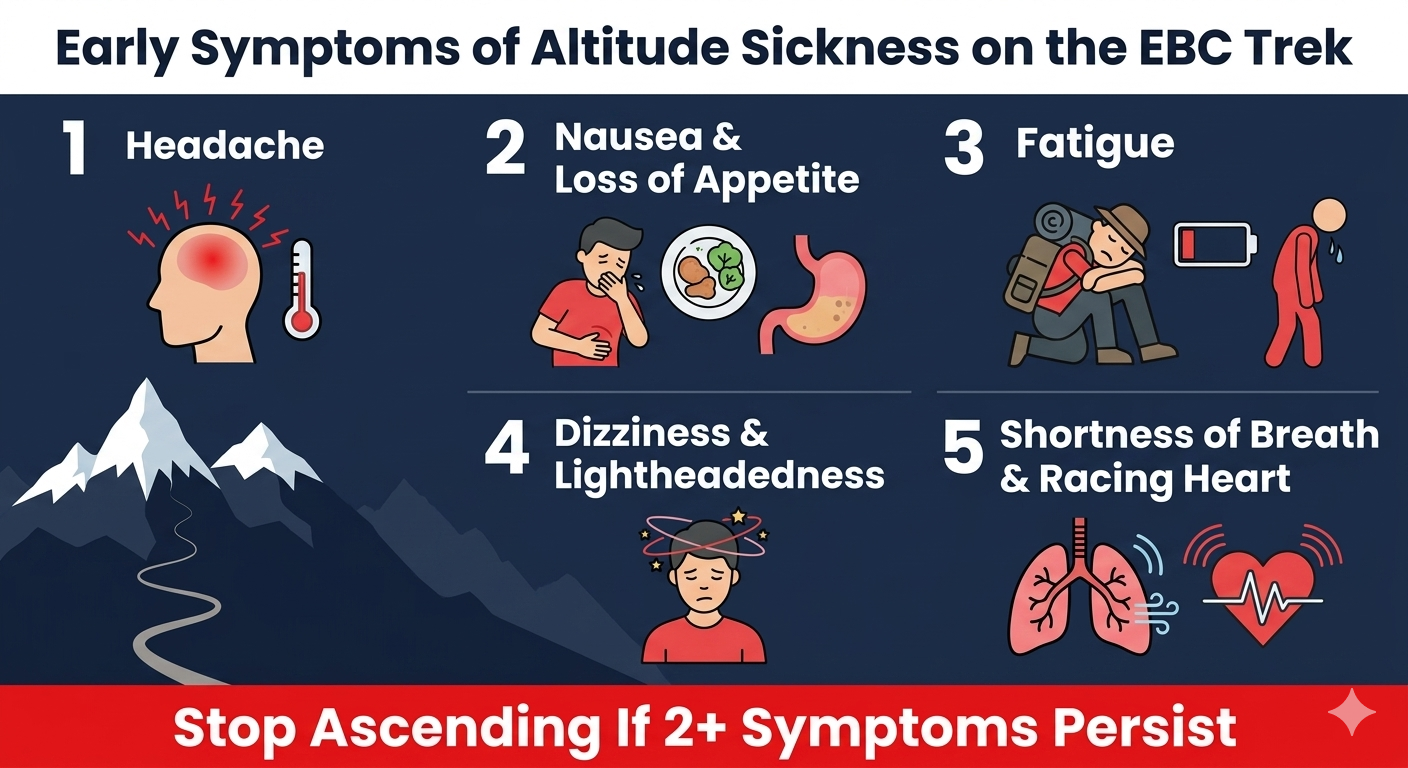
The 5 early AMS symptoms are headache, nausea, fatigue, dizziness, and loss of appetite, appearing within 6 to 10 hours of reaching a new elevation above 2,500 m.
Headache
Headache is the earliest and most reliable AMS indicator. An altitude headache differs from a dehydration or exertion headache in 3 ways: it is persistent rather than transient, it worsens at night as SpO₂ (oxygen saturation) drops during sleep, and it does not fully resolve with fluid intake alone. A headache that continues after 500 ml of water and 2 hours of rest at the same altitude is an AMS signal.
Nausea and Loss of Appetite
Nausea and appetite suppression are direct physiological responses to oxygen deprivation. Lack of oxygen reduces cognitive function and suppresses the appetite regulatory systems. Trekkers describe mild AMS as feeling like a hangover: persistent nausea without a clear cause, reluctance to eat despite caloric need, and general malaise, the medical term for a noticeable and sustained unwell feeling.
Fatigue
Altitude fatigue differs from trekking fatigue. Trekking fatigue resolves with 2 to 4 hours of rest. Altitude fatigue persists even after full overnight rest and is present even when resting, not only after exertion. Fatigue at rest is a symptom of AMS, not a sign of poor fitness.
Dizziness and Lightheadedness
Dizziness signals hypoxia-driven reduction in cerebral blood oxygen. It presents as lightheadedness on standing, instability during slow walking, and visual blurring on rapid head movement. Dizziness combined with headache and nausea across 2 or more consecutive hours indicates AMS progression requiring no further ascent.
Shortness of Breath and Racing Heart
Rapid breathing and elevated resting heart rate are early compensatory responses to hypoxia. At Namche Bazaar (3,440 m), a resting heart rate above 100 bpm with shortness of breath signals that acclimatization is incomplete.
When Do Altitude Sickness Symptoms Start After Ascent?
Altitude sickness symptoms appear 6 to 10 hours after reaching a new elevation, with the most common presentation occurring that night or the following morning.
The Namche First-Night Effect
The single most frequent AMS presentation on the EBC trek occurs on the night of arrival in Namche Bazaar (3,440 m). Trekkers ascend from Phakding (2,610 m) in one day, a gain of 830 m. The body begins its hypoxia response immediately but symptom onset is delayed. Trekkers who feel well at arrival in Namche wake at 1 to 3 a.m. with headache, nausea, and racing heart. This is the Namche first-night effect: the 6 to 10 hour lag between exposure and symptomatic onset.
Second-Night Escalation
Trekkers who ascend without a full acclimatization rest day at Namche Bazaar show symptom escalation on the second night at higher altitude. AMS symptoms that are mild on night one at Namche become moderate or severe on night one at Tengboche (3,860 m) or Dingboche (4,410 m). HAPE and HACE take 2 to 5 days to develop from the point of first AMS exposure, meaning they typically emerge between Dingboche and Lobuche (4,940 m) in undertreated trekkers.
What Symptoms Appear at Different Locations on the EBC Route?
Altitude sickness symptoms vary in type and severity across the 7 key locations on the EBC route, tracking directly with elevation gain and acclimatization status.
|
Location |
Elevation |
Expected Symptom Profile |
|
Lukla |
2,860 m / 9,383 ft |
Mild shortness of breath, transient dizziness on rapid movement |
|
Phakding |
2,610 m / 8,563 ft |
Below AMS threshold for most trekkers; dehydration common |
|
Namche Bazaar |
3,440 m / 11,286 ft |
Headache, nausea, insomnia in 75% of trekkers on arrival night |
|
Tengboche |
3,860 m / 12,664 ft |
Persistent headache, appetite loss, erratic sleep, vivid dreams |
|
Dingboche |
4,410 m / 14,469 ft |
Moderate AMS common; SpO₂ drops to 80 to 87% range |
|
Lobuche |
4,940 m / 16,207 ft |
Severe fatigue, laboured breathing on mild exertion |
|
Gorak Shep |
5,140 m / 16,860 ft |
Maximum AMS exposure zone; HAPE and HACE risk highest |
Gorak Shep is the most clinically significant overnight stop on the route. Trekkers sleep here with no descent option. SpO2 readings at Gorak Shep typically range from 70 to 80%. The suffocation feeling when lying horizontal is a HAPE warning signal at this elevation. Confusion or inability to walk a straight line at Gorak Shep is a HACE warning signal requiring immediate descent.
How Do You Differentiate Altitude Sickness from Fatigue and Dehydration?
The 3 diagnostic differences between AMS, fatigue, and dehydration are symptom persistence, symptom combination, and response to rest and hydration.
AMS vs Trekking Fatigue
Trekking fatigue resolves with 4 to 6 hours of horizontal rest. AMS fatigue does not resolve with rest and is present even when stationary. Trekking fatigue causes no headache at rest. An AMS headache persists in the resting state and worsens overnight.
AMS vs Dehydration
Dehydration and AMS share 3 overlapping symptoms: headache, fatigue, and dizziness. The diagnostic test is 500 ml of water over 30 minutes. A dehydration headache reduces within 60 minutes of rehydration. An AMS headache persists or worsens despite adequate hydration. Loss of appetite and nausea are AMS signals; dehydration alone does not suppress appetite or cause nausea at trekking elevations.
Cold Weather Confusion
Cold temperatures on the EBC route produce symptoms that overlap with AMS: shivering, fatigue, and reduced cognitive sharpness. Cold alone does not produce persistent headache, nausea, or SpO2 below 85% at Namche. Any combination of headache plus nausea, or headache plus fatigue that does not resolve with warmth and rest, is AMS until confirmed otherwise.
Assume any sickness above 2,500 m is altitude sickness until hydration, warmth, Diamox prophylaxis, and rest at the same elevation eliminate alternative causes.
What Altitude Sickness Symptoms Occur at Night?
Night-time altitude sickness symptoms include insomnia, periodic breathing, waking headache, vivid dreams, and erratic sleep patterns, driven by SpO2 decline during sleep above 3,000 m.
Periodic Breathing
Periodic breathing (Cheyne-Stokes respiration) is a specific night-time symptom at altitude. The breathing pattern cycles from rapid and shallow to a near-complete pause, lasting 5 to 15 seconds, before resuming. This pattern wakes trekkers with a gasping sensation. Periodic breathing is not a sign of HAPE. It is the body's sleep-state compensation for CO2 imbalance under hypoxia.
Waking Headache and SpO2 Drop
SpO2 drops 3 to 8 percentage points during sleep compared to waking readings at the same elevation. At Namche Bazaar (3,440 m), waking SpO2 of 88% can fall to 80 to 82% during sleep. This nocturnal SpO2 drop is why HACE most commonly occurs at night and why most HACE deaths happen during sleep rather than during the climbing day.
Insomnia and Vivid Dreams
Insomnia at altitude is not psychological. Hypoxia disrupts the neurological sleep architecture. Vivid or unusually intense dreams, frequent waking, and inability to achieve sustained sleep are physiological altitude responses. Erratic sleep across 2 or more consecutive nights above 3,440 m indicates incomplete acclimatization.
What Does Oxygen Saturation (SpO2) Indicate About Altitude Sickness Symptoms?
 Indicate About Altitude Sickness Symptoms.png)
SpO2 (oxygen saturation) measures the percentage of haemoglobin in the blood carrying oxygen, providing a physiological reading that often precedes or contradicts visible AMS symptoms.
Normal SpO2 at sea level is 95 to 99%. Expected SpO2 ranges at key EBC elevations are:
-
Namche Bazaar (3,440 m): 85 to 92%
-
Dingboche (4,410 m): 78 to 87%
-
Lobuche (4,940 m): 72 to 82%
-
Gorak Shep (5,140 m): 70 to 80%
Symptom-Measurement Mismatch
The most dangerous SpO2 pattern on the EBC trek is the asymptomatic low reading: a trekker with no reported symptoms but SpO2 below 75% at Dingboche or below 70% at Gorak Shep. This mismatch occurs because some individuals have blunted hypoxic ventilatory response, meaning the brain does not trigger a distress signal despite measurable oxygen deficit. Guides at Himalaya Trekking Nepal conduct oximeter checks at each camp above 3,500 m because symptom self-reporting alone misses this pattern.
Pulse Oximeter Limitations
A pulse oximeter reading is one data point, not a complete diagnostic. Cold fingertips produce inaccurate readings. Nail polish interferes with the sensor. Readings taken immediately after exertion reflect exercise SpO2, not resting baseline. Always take pulse oximeter readings after 5 minutes of seated rest, with warm hands, on a bare fingertip.
What Are the Severe Altitude Sickness Symptoms of HACE and HAPE?
HACE (High Altitude Cerebral Oedema) and HAPE (High Altitude Pulmonary Oedema) produce distinct and non-overlapping symptom profiles that signal life-threatening organ involvement.
HACE Symptom Profile
HACE develops when hypoxia causes fluid to breach capillary walls in the cranium, creating pressure-driven brain swelling. The 6 specific HACE symptoms are:
-
Confusion and irrational behaviour
-
Ataxia (loss of coordination or clumsiness, inability to walk a straight line)
-
Slurred speech
-
Severe and unrelenting headache unresponsive to any rest
-
Lapsing in and out of consciousness
-
Coma in advanced cases without immediate descent
HACE is fatal within 24 hours. It occurs most often at night. Brain swelling from HACE is detectable on MRI scans and produces longer-lasting neurological changes in survivors who delayed descent.
HAPE Symptom Profile
HAPE develops when hypoxia causes fluid to breach pulmonary capillaries, filling the lung cavity and reducing oxygen exchange. The 6 specific HAPE symptoms are:
-
Extreme shortness of breath at rest, not only during exertion
-
Suffocation feeling specifically when lying down to sleep
-
Coughing up white or mucus-coloured frothy spit
-
Chest tightness or chest pain
-
Cyanosis: blue or grey discolouration of lips, skin, tongue, or nails
-
Racing heart combined with severe breathlessness
On brown or black skin, cyanosis is visible on the palms or soles of the feet, not the lips. HAPE is fatal within 12 hours without descent. X-ray confirms lung fluid in HAPE. HAPE kills faster than HACE.
When Do Symptoms Indicate an Emergency Condition?
An altitude sickness emergency exists when any 1 of 3 signs appears: loss of coordination (ataxia), breathlessness at rest, or confusion and cognitive decline.
The escalation sequence from AMS to HACE or HAPE follows a recognisable pattern:
-
Persistent headache unresolved after 12 hours at the same elevation
-
Vomiting, severe dizziness, and inability to walk a straight line
-
Confusion, irrational behaviour, or slurred speech
-
Unconsciousness or coma (HACE) / inability to breathe when horizontal (HAPE)
HACE and HAPE are life-threatening medical emergencies. Do not wait for all symptoms to appear before descending. The transition from severe AMS to HACE or HAPE is rapid, developing within hours of ignored warning symptoms. Most HACE deaths occur during sleep because trekkers choose rest over immediate descent.
EKG (electrocardiogram) examination rules out heart attack when chest pain and breathlessness coexist at altitude, as some AMS symptoms resemble cardiac events. MRI detects brain swelling specific to HACE.
Which Symptoms Should Never Be Ignored on the EBC Trek?
The 4 symptom patterns that require stopping ascent immediately are: persistent headache unresolved after 12 hours, any 2 symptoms occurring together, worsening symptoms at the same altitude, and any single HACE or HAPE signal.
Symptom Combination Pattern
Any 2 of the 5 early AMS symptoms appearing together, specifically headache plus nausea, or headache plus fatigue that persists through rest, indicate AMS severity requiring no further ascent that day. Symptom combination is a stronger predictor of progression than any single symptom in isolation.
Worsening at the Same Altitude
Symptoms that worsen while the trekker stays at the same elevation signal that the body is failing to acclimatize. Staying at the same altitude resolves mild AMS symptoms within 1 to 2 days in the majority of trekkers. Symptoms that worsen across 24 hours at a fixed elevation indicate progressive hypoxia requiring descent.
Vision Changes
Vision changes at altitude, including blurred vision or visual disturbances, result from blood vessel ruptures in the retinas caused by elevated intracranial pressure. Vision changes are a rare but high-severity signal indicating more serious altitude sickness beyond early AMS.
Why Do Trekkers Ignore Altitude Sickness Symptoms?
Trekkers ignore AMS symptoms due to 3 documented behavioural pressures: group pace pressure, summit mindset bias, and deliberate underreporting to guides.
Group Pressure
Group trekking creates social obligation to maintain pace. Trekkers with symptoms suppress reporting to avoid slowing others or appearing physically weak. People travelling in groups are statistically more likely to continue ascending with active symptoms than solo trekkers or trekkers on private itineraries.
Summit Mindset
Summit mindset describes the cognitive bias where months of planning for the guided EBC trek and social commitment override real-time symptom assessment. Trekkers rationalise headache as dehydration and nausea as bad food. This rationalisation continues until symptoms reach HACE or HAPE severity, at which point descent is no longer optional.
Underreporting to Guides
Stress and fatigue reduce cognitive function at altitude, impairing decision-making precisely when accurate self-assessment is most critical. Trekkers who underreport to guides remove the safety check that trained guides provide. Let your guide and your tent or room companion know the moment any symptom appears. A companion who knows your symptom status contacts the guide if you become incapacitated.
Your health takes priority over completing the trek. Guides at Himalaya Trekking Nepal is trained to identify AMS symptoms and advise on descent. Listen when a guide advises stopping.
Altitude Sickness Symptoms on the EBC Trek: Recognition Summary
Altitude sickness symptoms on the Everest Base Camp trek are the measurable physiological signals of hypobaric hypoxia, beginning with AMS above 2,500 m and progressing to HACE and HAPE when ignored. The 5 early AMS symptoms are headache, nausea, fatigue, dizziness, and appetite loss, appearing 6 to 10 hours after elevation gain. Nighttime symptoms include insomnia, periodic breathing, vivid dreams, and waking headache driven by SpO₂ decline during sleep.
At Gorak Shep (5,140 m) on the Khumbu Himalayan trekking route, HAPE and HACE risk reach maximum. HAPE kills within 12 hours. HACE kills within 24 hours. Genetic make-up, not fitness, determines individual susceptibility. SpO2 monitoring via pulse oximeter at each camp above 3,500 m detects the asymptomatic low-reading pattern that symptom self-reporting alone misses.
Symptom recognition is the only real-time safety system available at altitude. Descent is the only treatment for HACE and HAPE.
More About Author

Khilak Budhathoki
Travel Director
Khilak Budhathoki is the co-founder and lead trekking guide at Himalaya Trekking Nepal, a locally owned and operated adventure company based in Kathmandu. Born and raised in the foothills of Nepal, Khilak developed a deep love for the mountains from an early age. With over a deca...

USD$1,600 pp
Our Recommendation
Related Blogs
.jpg)


