- 20, Apr 2026 | Khilak Budhathoki
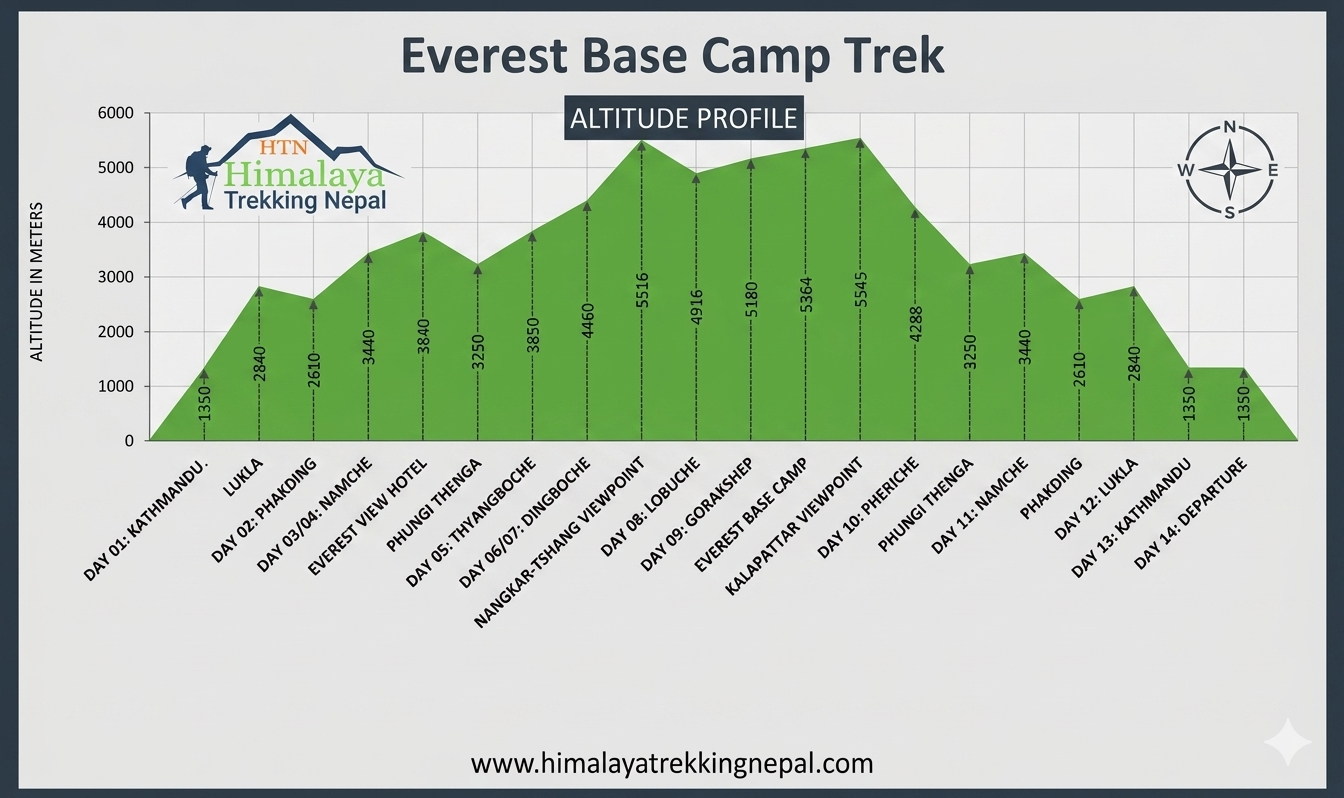
The Everest Base Camp trek is rated moderate to strenuous. It reaches 5,545 m at Kala Patthar and 5,364 m at Everest Base Camp. No technical climbing or ropes are required. Difficulty score for a beginner trekker is 7.5 out of 10.
Altitude is the primary difficulty driver. Oxygen at Kala Patthar is 49% of sea level volume, 50% at Everest Base Camp, 55% at Lobuche (4,940 m), and 67% at Namche Bazaar (3,440 m). 5 factors create EBC trek difficulty: altitude and low oxygen, 130 km round-trip distance, 12 to 14 days duration, glacial moraine terrain from Gorak Shep to Everest Base Camp, and cumulative fatigue above 4,000 m.
Difficulty splits across 3 altitude zones: below 3,000 m rates 3 to 4 out of 10, between 3,000 m and 4,500 m rates 5 to 7 out of 10, and above 4,500 m rates 7 to 9 out of 10 where walking pace drops 30 to 40%. Day 8 is the hardest at 9 out of 10, covering 14 km round trip from Lobuche (4,940 m) to Everest Base Camp (5,364 m) across glacial moraine in 7 to 8 hours. Day 2, the Namche Wall, is second hardest at 830 m gain over 12 km.
Beginners complete EBC on a 14-day guided itinerary at 85 to 90% success rate with 3 months training. Compressed 12-day itineraries drop that to 60 to 65%. AMS incidence on structured 14-day itineraries stays below 8%. Spring and Autumn rate 3 out of 10 for weather difficulty. Winter rates 8 out of 10. Monsoon rates 7 out of 10.
What Is the Overall Difficulty Level of the Everest Base Camp Trek?
The Everest Base Camp trek is rated moderate to strenuous on a standard trekking difficulty scale. It is not a technical climb. No ropes, harnesses, or mountaineering skills are required. The difficulty comes from 5 combined factors: altitude, duration, terrain, cumulative fatigue, and weather exposure.
The trek covers 130 km round trip over 12 to 14 days. Daily walking ranges from 5 to 8 hours. Maximum altitude reaches 5,545 m at Kala Patthar. Oxygen at this altitude is 49% of sea level volume.
Difficulty score by trekker profile on a 1 to 10 scale:
-
Beginner trekker with 3 months training: 7.5 out of 10
-
Intermediate trekker with prior highland experience: 5.5 out of 10
-
Experienced trekker with altitude above 4,000 m: 4 out of 10
The trek does not require technical climbing skills. Endurance capacity, altitude tolerance, and acclimatization adherence determine outcome.
Why Is the Everest Base Camp Trek Considered Difficult?
The Everest Base Camp trek is difficult because altitude, multi-day physical output, and terrain complexity combine into a cumulative strain system that increases daily above 4,000 m. No single factor creates the difficulty. All 5 work together.
How Does Altitude and Low Oxygen Impact Trek Difficulty?
Altitude is the primary difficulty driver on the Everest Base Camp trek. Oxygen availability drops from 209 ml per liter at sea level to 104 ml per liter at Everest Base Camp (5,364 m) and 102 ml per liter at Kala Patthar (5,545 m).
Low oxygen forces the cardiovascular system to work 30 to 50% harder at 5,000 m compared to sea level. Heart rate elevates. Breathing rate increases. Physical output per step costs more energy. The body compensates through increased red blood cell production, but this adaptation takes 3 to 5 days per major altitude zone.
Altitude thresholds and their physiological impact:
-
2,860 m (Lukla): Oxygen at 74% of sea level. Mild adjustment begins.
-
3,440 m (Namche Bazaar): Oxygen at 67%. AMS onset zone starts here.
-
4,410 m (Dingboche): Oxygen at 60%. Fatigue multiplies sharply.
-
4,940 m (Lobuche): Oxygen at 55%. Performance drops 35 to 45%.
-
5,364 m (Everest Base Camp): Oxygen at 50%. Extreme effort zone.
How Does Trek Duration Create Cumulative Fatigue?
Trekking 5 to 8 hours daily for 12 to 14 consecutive days builds fatigue that compounds across the route. Daily recovery at teahouses above 4,000 m is incomplete. Sleep quality drops above 3,500 m due to lower oxygen during rest.
According to the Wilderness Medical Society guidelines on expedition trekking, sleep disturbance above 3,500 m reduces muscular recovery efficiency by 20 to 30% compared to sea level sleep. This means each day above Namche Bazaar starts with a recovery deficit.
Cumulative fatigue peaks between Day 7 and Day 9, from Dingboche (4,410 m) to Gorak Shep (5,164 m). Trekkers who underestimate cumulative fatigue abandon the trek most often between Lobuche and Gorak Shep.
How Does Terrain Increase Physical Strain?
The Everest Base Camp trail crosses 5 distinct terrain types, each adding a different physical demand. Forest paths below 3,000 m are moderate. Stone steps from Namche Bazaar onward increase knee load. Suspension bridges above Phakding require balance and confidence under load.
The 5 terrain types on the route:
-
Forest trail (Lukla to Phakding): Moderate gradient, packed earth
-
Steep stone ascent (Phakding to Namche): 830 m gain over 12 km
-
Alpine ridge trail (Namche to Tengboche): Exposed, drop and regain profile
-
High-altitude rocky path (Dingboche to Lobuche): Loose stone, wind exposure
-
Glacial moraine (Gorak Shep to EBC): Unstable glacier rock, no clear trail
The Khumbu Glacier moraine on Day 8 is the most technically demanding terrain. Steps are unpredictable. Altitude adds disorientation. Time per kilometer on moraine is 40 to 60% longer than on packed trail.
How Do Weather and Temperature Conditions Affect Difficulty?
Temperature at Kala Patthar at dawn reaches minus 15°C in October and November. Wind chill at Lobuche (4,940 m) drops the effective temperature to minus 25°C in winter months.
Weather changes rapidly above 4,500 m in the Khumbu region. A clear morning at Dingboche can become a snow storm by afternoon. Trail conditions shift from dry rock to ice-covered stone within hours.
Temperature and difficulty by zone:
-
Lukla to Namche: 5°C to 15°C daytime. Manageable.
-
Namche to Dingboche: 0°C to 10°C daytime. When it's cold at night, the wind increases.
-
Dingboche to Kala Patthar: Minus 5°C to 5°C daytime. Minus 15°C to minus 25°C at night and dawn.
How Does Accommodation Limit Recovery?
Teahouses above 4,000 m provide basic accommodation with limited heating, shared toilets, and no hot showers. Recovery quality at Lobuche and Gorak Shep is significantly lower than at Namche Bazaar.
Sleep disturbance is standard above 3,500 m. Periodic breathing (Cheyne-Stokes respiration) wakes trekkers 3 to 6 times per night at altitudes above 4,000 m. This is a normal physiological response to low oxygen, not a medical emergency, but it accumulates fatigue across consecutive nights.
How Difficult Is the Everest Base Camp Trek by Altitude Profile?
Trek difficulty increases in 3 distinct altitude zones, each with different physiological and physical demands.
Below 3,000 m: Early Adaptation Phase
Below 3,000 m, difficulty is moderate and comparable to a multi-day mountain hike. Oxygen is above 70% of sea level volume. AMS risk is low. Trail terrain is forest paths and stone steps.
Lukla (2,860 m) to Phakding (2,610 m) involves a 250 m descent. Phakding to Namche Bazaar (3,440 m) crosses this threshold with the 830 m ascent on Day 2. This single climb is where most beginners feel the first real physical strain of the trek.
3,000 m to 4,500 m: Altitude Stress Zone
Between 3,000 m and 4,500 m, oxygen drops below 65% of sea level volume and AMS onset risk rises sharply. Physical output requires 20 to 35% more cardiovascular effort than equivalent output at sea level.
Namche Bazaar (3,440 m), Tengboche (3,860 m), and Dingboche (4,410 m) all sit in this zone. Acclimatization days at Namche Bazaar and Dingboche are built into the 14-day itinerary to allow red blood cell adaptation before ascending further. Skipping these rest days increases AMS risk from under 8% to over 30%.
Above 4,500 m: Extreme Difficulty Zone
Above 4,500 m, the Khumbu region enters the primary hypoxia zone. Oxygen falls below 55% of sea level volume. Walking pace drops 30 to 40% below pace at 3,000 m. Every 100 m of ascent requires measurably more cardiovascular output than the same gain at lower altitude.
Lobuche (4,940 m), Gorak Shep (5,164 m), Everest Base Camp (5,364 m), and Kala Patthar (5,545 m) all sit in this zone. Most helicopter evacuations from the EBC route originate from this altitude band.
How Difficult Is the Everest Base Camp Trek Day by Day?
Day-by-day difficulty scores follow the altitude ladder from Lukla (2,860 m) to Kala Patthar (5,545 m), with the hardest single day at Day 8.
The table below maps each active trekking day by distance, altitude, and effort score on a 1 to 10 scale.
|
Day |
Route |
Altitude |
Distance |
Effort Score |
|
Day 1 |
Lukla to Phakding |
2,860 m to 2,610 m |
8 km |
3 out of 10 |
|
Day 2 |
Phakding to Namche |
2,610 m to 3,440 m |
12 km |
7 out of 10 |
|
Day 3 |
Namche acclimatization |
3,440 m |
4 to 8 km optional |
3 out of 10 |
|
Day 4 |
Namche to Tengboche |
3,440 m to 3,860 m |
10 km |
5 out of 10 |
|
Day 5 |
Tengboche to Dingboche |
3,860 m to 4,410 m |
11 km |
6 out of 10 |
|
Day 6 |
Dingboche acclimatization |
4,410 m |
5 to 7 km optional |
4 out of 10 |
|
Day 7 |
Dingboche to Lobuche |
4,410 m to 4,940 m |
9 km |
7 out of 10 |
|
Day 8 |
Lobuche to Gorak Shep to EBC |
4,940 m to 5,364 m |
14 km round trip |
9 out of 10 |
|
Day 9 |
Kala Patthar and descent |
5,164 m to 5,545 m |
5 km up and back |
8 out of 10 |
Lukla to Namche: First Major Strain
Day 2, Phakding to Namche Bazaar, delivers the first high-difficulty section at 830 m elevation gain over 12 km. The Namche Wall, the final 600 m climb into Namche Bazaar, is the steepest kilometer-per-meter ratio on the route below 4,000 m. Trekkers who complete Day 2 without stopping more than 3 times are on pace for the full route.
Namche Acclimatization Phase
The Namche Bazaar rest day (Day 3) is rated 3 out of 10 for effort but is the most important day for trek success. The recommended hike to Everest View Hotel (3,880 m) or Syangboche (3,780 m) exposes the body to higher altitude during daylight, then returns to sleep at 3,440 m. This "climb high, sleep low" protocol accelerates red blood cell production by 15 to 20% over passive rest.
Tengboche to Dingboche Transition
The Day 5 section from Tengboche (3,860 m) to Dingboche (4,410 m) crosses the 4,000 m threshold where oxygen drops below 62% of sea level. Net gain is 550 m but cumulative gain including descent and re-ascent across the Imja Khola valley is 900 m. Most trekkers notice breathing becomes labored on this section even at slow pace.
Dingboche to Lobuche: High Altitude Push
Day 7, Dingboche to Lobuche, scores 7 out of 10 and enters the primary hypoxia zone above 4,500 m. The Thukla Pass memorial at 4,620 m marks the physiological line where performance drops sharply. Breathing rate increases 40 to 60% above sea level norm. Trekkers who have not acclimatized properly at Dingboche show acute mountain sickness onset on this section at a rate 3 times higher than properly acclimatized trekkers.
Lobuche to Gorak Shep to Everest Base Camp: Final Challenge
Day 8 is the hardest day on the trek at 9 out of 10 difficulty. It combines 14 km round trip, glacial moraine terrain from Gorak Shep to EBC, 5,000 m plus altitude, and 7 to 8 walking hours. Oxygen at Everest Base Camp (5,364 m) is 50% of sea level volume. The Khumbu Glacier moraine surface adds 45 to 60 minutes per 4 km compared to packed trail. Most trekkers reach EBC in 3.5 to 4.5 hours from Lobuche.
What Is the Hardest Part of the Everest Base Camp Trek?
The hardest section of the Everest Base Camp trek is the Lobuche to Everest Base Camp leg on Day 8, combining maximum altitude, glacial terrain, and the longest single walking day. The second hardest section is the Namche Wall on Day 2.
3 hardest sections ranked by combined effort score:
-
Lobuche to EBC via Gorak Shep: Altitude 4,940 m to 5,364 m, 9 out of 10, glacial moraine, 7 to 8 hours
-
Phakding to Namche Bazaar: Altitude 2,610 m to 3,440 m, 7 out of 10, 830 m gain, Namche Wall
-
Dingboche to Lobuche via Thukla Pass: Altitude 4,410 m to 4,940 m, 7 out of 10, hypoxia zone entry
The hardest moment for most trekkers is not the EBC arrival. It is the final 2 km of moraine from Gorak Shep to the glacier camp at 5,364 m, where footing is unstable, altitude is at maximum, and cumulative 8-day fatigue is at its highest point.
How Fit Do You Need to Be for the Everest Base Camp Trek?
The Everest Base Camp trek requires cardiovascular endurance to sustain 5 to 8 hours of uphill walking at altitude over 12 to 14 consecutive days. Muscular strength supports descent load. Neither gym fitness nor sport fitness alone predicts altitude performance.
Minimum Fitness Baseline
The minimum baseline to attempt the EBC trek on a 14-day itinerary is the ability to walk 15 km continuously on hilly terrain carrying 8 kg without stopping. Trekkers who cannot meet this baseline before departure face dropout risk above Namche Bazaar.
Baseline fitness markers:
-
Walk 10 km on hilly terrain with 5 kg pack without rest stops
-
Climb 400 m elevation in under 90 minutes
-
Complete 60 minutes of moderate cardio 4 times per week without discomfort
Recommended Training Level
The recommended training level is 3 months of structured preparation combining cardio, strength, and load-bearing hiking. Trekkers who complete the 3-month protocol reduce cumulative fatigue impact by 30 to 40% above 4,000 m compared to untrained beginners.
3-month training structure:
-
Months 1 to 2: Cardio base building. Running 4 times per week, 30 to 60 minutes. Stair climbing 3 times per week.
-
Month 2 to 3: Introduce weighted hiking with 8 to 12 kg pack on hilly terrain. 2 hikes per week, 3 to 6 hours each.
-
Final 2 weeks: Taper. Reduce volume, maintain frequency.
Real Fitness Benchmarks
3 measurable benchmarks confirm trek readiness:
-
Stair test: Climb 30 floors (300 m vertical) carrying 8 kg without stopping
-
Hiking test: Complete a 20 km day hike with 600 m elevation gain carrying 10 kg
-
Recovery test: Complete the hiking test on 2 consecutive days without performance drop above 15%
Altitude fitness is separate from these benchmarks. No sea-level training fully replicates the physiological demand above 4,500 m. Acclimatization days in the itinerary exist specifically to close this gap.
Can a Beginner Do the Everest Base Camp Trek?
Yes. Beginners complete the Everest Base Camp trek on a 14-day guided itinerary with 3 months of prior training and both acclimatization days. The trek is not exclusive to experienced mountaineers. It requires fitness, not technical skill.
Conditions Where Beginners Succeed
Beginners succeed on EBC under 4 conditions: structured 14-day itinerary, guide-led group, 3 months training, and zero itinerary compression. Removing any one of these conditions raises dropout and AMS risk significantly.
According to expedition data from Sagarmatha National Park-registered operators, the completion rate for first-time trekkers on 14-day guided itineraries is 85 to 90%. The completion rate drops to 60 to 65% on 12-day itineraries for the same beginner group.
Common Beginner Mistakes
4 beginner mistakes account for 80% of EBC dropouts: ascending too fast, skipping acclimatization hikes on rest days, under-hydrating above 4,000 m, and carrying packs above 10 kg without porter support.
The most common dropout point for beginners is Lobuche (4,940 m). At this altitude, combined fatigue, hypoxia, and insufficient acclimatization create AMS onset in 25 to 35% of unprepared first-time trekkers.
Success Rate Factors for Beginners
Trek success for beginners depends on 5 measurable variables:
-
Itinerary length: 14 days achieves 85 to 90% completion rate
-
Guide presence: Guide-led completion rate is 15 to 20% higher than independent
-
Training duration: 3 months produces 35% better altitude tolerance than 1 month
-
Hydration: 3 to 4 liters daily above 3,500 m reduces AMS symptom intensity by 30%
-
Pack weight: Under 8 kg day pack with porter support reduces fatigue accumulation by 20 to 25%
How Does Altitude Sickness Affect Trek Difficulty?
Acute mountain sickness increases EBC trek difficulty from moderate to extreme for affected trekkers. AMS onset is the leading cause of premature trek abandonment and helicopter evacuation from the Khumbu Valley.
AMS Impact on Performance
AMS reduces trekking performance through 4 physical effects: headache, nausea, fatigue, and dizziness. These symptoms appear within 6 to 12 hours of altitude gain above 2,500 m in susceptible trekkers.
At Namche Bazaar (3,440 m), 25 to 30% of trekkers experience mild AMS symptoms on the first night. At Dingboche (4,410 m), 35 to 40% experience symptoms. Most cases resolve within 24 hours with rest and hydration.
HAPE and HACE Risk
High Altitude Pulmonary Edema (HAPE) and High Altitude Cerebral Edema (HACE) are rare but life-threatening altitude conditions. HAPE affects the lungs. HACE affects the brain. Both require immediate descent.
According to the Wilderness Medical Society, HAPE occurs in 0.1 to 1% of trekkers ascending above 4,500 m without acclimatization protocols. HACE occurs in under 0.5% of trekkers on structured guided itineraries. Risk increases 3 to 4 times on compressed 10-day or shorter itineraries.
Prevention Impact on Difficulty
Proper acclimatization reduces AMS-driven difficulty by 70%. The standard 14-day EBC itinerary with rest days at Namche Bazaar (3,440 m) and Dingboche (4,410 m) keeps AMS incidence below 8% in guided groups. Adding Diamox (acetazolamide) at 125 mg twice daily further reduces onset risk by 75% in high-risk trekkers.
How Difficult Is the Everest Base Camp Trek in Each Season?
The Everest Base Camp trek varies in difficulty across 4 seasons. Spring (March to May) and Autumn (September to November) are the standard trekking windows with the lowest combined weather difficulty.
Spring: March to May
Spring is the most popular EBC trekking season. Daytime temperatures at Namche Bazaar reach 10°C to 15°C. Trail conditions are stable. Rhododendron forests below 3,500 m are in bloom. Trail congestion from high trekker volume increases wait times at suspension bridges and teahouses by 20 to 30 minutes per day above Namche.
Weather difficulty score: 3 out of 10.
Autumn: September to November
Autumn delivers the clearest skies and most stable weather of the year. Daytime temperatures at Dingboche range from 5°C to 10°C in October. October is the peak month by visibility. November brings colder mornings (minus 5°C to minus 10°C at Lobuche) and increasing summit snow. Trail conditions remain manageable through mid-November.
Weather difficulty score: 3 out of 10 in September and October. 5 out of 10 in November.
Winter: December to February
Winter trekking on EBC is the hardest seasonal option. Temperatures at Gorak Shep drop to minus 20°C at night. Trails above Dingboche carry ice and compacted snow. Many teahouses above Lobuche close between December and February, limiting accommodation and food availability.
Weather difficulty score: 8 out of 10.
Monsoon: June to August
Monsoon season brings continuous rainfall below 3,500 m, trail flooding along the Dudh Koshi River, and landslide risk in the lower Khumbu Valley. Trails become slippery. Leeches are common on forest paths below Namche. Visibility for mountain views drops to near zero above 4,000 m. Lukla flight cancellations increase by 40 to 60% during peak monsoon weeks.
Weather difficulty score: 7 out of 10.
How Many Hours Do You Walk Per Day on the EBC Trek?
Daily walking time on the Everest Base Camp trek ranges from 3 to 8 hours depending on the day, altitude, and terrain. The average active trekking day requires 5 to 7 hours of walking.
The following table shows walking hours and terrain for each active trekking day.
|
Day |
Route |
Walking Hours |
Terrain Type |
|
Day 1 |
Lukla to Phakding |
3 to 4 hours |
Forest trail, moderate |
|
Day 2 |
Phakding to Namche |
5 to 6 hours |
Stone ascent, steep |
|
Day 4 |
Namche to Tengboche |
5 to 6 hours |
Ridge trail, exposed |
|
Day 5 |
Tengboche to Dingboche |
5 to 6 hours |
Valley trail, rocky |
|
Day 7 |
Dingboche to Lobuche |
4 to 5 hours |
High altitude rocky |
|
Day 8 |
Lobuche to EBC and back to Gorak Shep |
7 to 8 hours |
Glacial moraine |
|
Day 9 |
Kala Patthar and descent |
3 to 4 hours up plus 4 hours descent |
Rocky peak ascent |
Total walking hours across the full 14-day itinerary, including 2 acclimatization day optional hikes, is approximately 70 to 90 hours. Walking pace drops from 3 km per hour at Lukla elevation to 1.5 to 2 km per hour at Everest Base Camp altitude.
How Do You Reduce the Difficulty of the Everest Base Camp Trek?
4 strategies reduce Everest Base Camp trek difficulty: proper acclimatization, structured pacing, 3 months of pre-trek training, and porter support for load management. No single strategy is sufficient alone.
Proper Acclimatization Strategy
Follow the "climb high, sleep low" protocol on both acclimatization days. At Namche Bazaar, hike to Everest View Hotel (3,880 m) or Syangboche (3,780 m) during the day. Sleep at 3,440 m. At Dingboche, hike to Nangkartshang Peak (5,100 m) or Nagarkot Hill during the day. Sleep at 4,410 m. This controlled altitude exposure accelerates red blood cell production by 15 to 20% over full passive rest.
Acclimatization reduces the effective difficulty score above 4,500 m by 1.5 to 2 points on a 10-point scale.
Pacing and Itinerary Design
Walk at a pace that allows full conversation without breathlessness above 4,000 m. This is the Sherpa pace rule: slow and steady at high altitude beats fast and stopped. A trekker who maintains conversation pace from Dingboche to Lobuche uses 20 to 25% less cardiovascular output than one who pushes hard.
Choose the 14-day itinerary over the 12-day option. The 2 extra acclimatization days reduce risk by 20 to 25%.
Training Before the Trek
Complete 3 months of structured training covering cardiovascular endurance, strength, and load-bearing hiking. Strength training targets quadriceps, hamstrings, and calves for descent load. Cardio training targets sustained aerobic output for 5 to 8 hours daily.
Training reduces cumulative fatigue impact above 4,000 m by 30 to 40% based on guide-observed performance differences between trained and untrained trekker groups.
Nutrition and Hydration
Drink 3 to 4 liters of water daily above 3,500 m. Dehydration at altitude accelerates AMS onset and fatigue. Dal bhat, the traditional Nepali lentil and rice meal available at every teahouse from Lukla to Gorak Shep, provides high-calorie carbohydrate fuel optimal for sustained altitude trekking output.
Avoid alcohol above 3,000 m. Alcohol dehydrates, suppresses the acclimatization response, and reduces sleep quality at altitude.
Gear and Load Management
Carry a day pack of 6 to 8 kg maximum. Hire a porter for the main pack above 12 kg. A porter carries loads up to 25 kg for USD 25 to USD 35 per day in the Khumbu region. Reducing personal pack weight from 15 kg to 8 kg cuts fatigue accumulation by 20 to 25% over the full route.
Essential gear that directly reduces difficulty: trekking poles (reduce knee load on descent by 25%), microspikes for Kala Patthar in October and November, and a pulse oximeter for daily oxygen saturation monitoring.
Does Trekking with a Guide Reduce Difficulty?
Guide-led trekking reduces EBC trek difficulty by managing pacing, monitoring altitude symptoms, and making real-time itinerary decisions. The completion rate for guided trekkers is 85 to 90%. The completion rate for independent trekkers is 65 to 70%.
A Sherpa guide reads altitude symptoms 12 to 24 hours before a trekker notices them. Guides adjust daily pace, recommend rest, administer pulse oximeter checks, and contact helicopter evacuation when necessary. Guide-led groups with Khilak Budhathoki and Ronit Dahal at Himalaya Trekking Nepal carry full emergency evacuation protocols and maintain 24-hour contact with Kathmandu rescue services.
Porter support reduces load difficulty independently of guide presence. A porter carrying the main pack cuts daily physical output by 15 to 20%, leaving cardiovascular reserve for altitude demands rather than load-bearing effort.
How Does Everest Base Camp Trek Difficulty Compare to Other Treks?
The Everest Base Camp trek is harder than the Annapurna Base Camp trek and comparable in aerobic demand to Kilimanjaro, though structurally different in terrain and altitude profile.
The table below compares EBC against 3 benchmark treks on 5 difficulty variables.
|
Variable |
EBC Trek |
Annapurna Base Camp |
Kilimanjaro |
Gokyo Lakes Trek |
|
Max altitude |
5,545 m |
4,130 m |
5,895 m |
5,357 m |
|
Duration |
12 to 14 days |
7 to 10 days |
6 to 8 days |
12 to 14 days |
|
Distance |
130 km |
110 km |
90 km |
110 km |
|
Terrain difficulty |
7 out of 10 |
5 out of 10 |
6 out of 10 |
7 out of 10 |
|
Overall difficulty |
7.5 out of 10 |
5 out of 10 |
7 out of 10 |
7 out of 10 |
Is the Everest Base Camp Trek Harder Than Annapurna Base Camp?
Yes. The Everest Base Camp trek is harder than Annapurna Base Camp on 4 of 5 difficulty variables. EBC reaches 5,545 m vs ABC's 4,130 m. EBC is 3 to 4 days longer. EBC includes glacial moraine terrain not present on the ABC route. The oxygen level at EBC (50%) is 17% lower than at ABC (67%).
Is the Everest Base Camp Trek Harder Than Kilimanjaro?
Kilimanjaro reaches a higher summit (5,895 m) but takes 6 to 8 days versus 12 to 14 for EBC. Kilimanjaro's faster ascent profile creates higher AMS risk per day. EBC's longer duration creates higher cumulative fatigue. Both rate 7 to 7.5 out of 10 overall. Kilimanjaro is harder in acute altitude terms. EBC is harder in endurance terms.
Is the Everest Base Camp Trek Dangerous or Just Difficult?
The Everest Base Camp trek is difficult, not inherently dangerous, on a 14-day guided itinerary with proper preparation. Risk increases sharply on compressed itineraries, without guide support, and when AMS symptoms are ignored rather than treated.
Danger on EBC comes from 3 sources: altitude sickness escalating to HACE or HAPE, weather-related trail conditions above 4,500 m, and Lukla flight disruption causing itinerary pressure.
According to Nepal Ministry of Tourism data, fatal incidents on the EBC trekking route average 4 to 8 per year across 40,000 to 50,000 annual trekkers. The fatality rate is under 0.02%. All recorded fatalities involve at least one of 3 conditions: undiagnosed cardiac condition, ignored AMS symptoms above 4,500 m, or unsupported solo trekking in extreme weather.
The trek is safe for healthy, prepared trekkers on structured itineraries. It is risky for trekkers who ignore symptoms, compress the schedule, or ascend without acclimatization.
Is the Everest Base Camp Trek Worth the Difficulty?
The Everest Base Camp trek at 5,364 m and Kala Patthar at 5,545 m delivers direct views of Everest (8,848 m), Lhotse (8,516 m), Nuptse (7,861 m), Ama Dablam (6,812 m), and the Khumbu Glacier. These views are not replicable by any other non-technical trek in the world.
The 85 to 90% completion rate in guided EBC trek groups confirms that the difficulty is achievable for prepared trekkers. The 2,953 verified reviews for Himalaya Trekking Nepal, a TAAN and Nepal Tourism Board licensed guide-founded operator, consistently report that Day 8 at Everest Base Camp is the most significant physical achievement of participants' trekking careers.
Frequently Asked Questions About Everest Base Camp Trek Difficulty
Is the Everest Base Camp Trek Harder Than Annapurna Base Camp?
Yes. EBC is harder than Annapurna Base Camp on altitude, duration, and terrain. EBC reaches 5,545 m vs ABC's 4,130 m. Oxygen at EBC is 49% of sea level vs 62% at ABC. EBC takes 12 to 14 days vs 7 to 10 for ABC.
Is the Everest Base Camp Trek Harder Than Climbing Mount Kilimanjaro?
EBC and Kilimanjaro are comparable in overall difficulty at 7 to 7.5 out of 10. Kilimanjaro reaches 5,895 m but takes only 6 to 8 days. EBC takes 12 to 14 days. Kilimanjaro is harder acutely. EBC is harder in cumulative endurance terms.
What Is the Success Rate of the Everest Base Camp Trek?
The overall EBC trek success rate is 85 to 90% for guided 14-day itineraries. Independent trekkers on compressed 10 to 12-day itineraries show a 60 to 65% completion rate. AMS is the leading cause of premature trek abandonment in both groups.
At What Altitude Does the Everest Base Camp Trek Become Difficult?
Difficulty increases noticeably above 3,440 m at Namche Bazaar. The primary difficulty zone starts above 4,500 m at Lobuche. Above this threshold, oxygen drops below 55% of sea level and walking pace reduces 30 to 40% below baseline.
How Many People Fail to Complete the Everest Base Camp Trek?
10 to 15% of guided trekkers and 30 to 40% of independent trekkers fail to complete EBC on compressed itineraries. The most common abandonment points are Lobuche (4,940 m) and Gorak Shep (5,164 m), where cumulative fatigue and altitude combine at maximum intensity.
Is Everest Base Camp Harder for Older Trekkers?
Age alone does not determine EBC difficulty. Trekkers above 60 complete the trek regularly on 14-day guided itineraries. Cardiovascular fitness and acclimatization adherence predict success more accurately than age. Trekkers above 50 with no prior altitude experience benefit from a pre-trek medical check including ECG and blood pressure review.
Do You Need Previous Trekking Experience for Everest Base Camp?
Previous trekking experience above 3,000 m is not required but reduces difficulty significantly. Beginners with 3 months of structured training complete the trek on 14-day itineraries at 85 to 90% success rate. Prior altitude experience above 3,500 m reduces AMS risk by 25 to 35% compared to zero altitude history.
How Physically Exhausting Is the Everest Base Camp Trek?
The EBC trek produces maximum physical exhaustion between Days 7 and 9. Trekkers at Lobuche (4,940 m) report perceived exertion levels equivalent to sustained high-intensity exercise at sea level, even at slow walking pace. This is the direct result of 50 to 55% oxygen availability combined with 7 to 8 days of accumulated fatigue.
Is the Everest Base Camp Trek Mentally Challenging?
Yes. The Everest Base Camp trek is mentally demanding across 3 dimensions: motivation management over 14 days, altitude anxiety above 5,000 m, and isolation above Dingboche (4,410 m). Above Dingboche, mobile connectivity is limited. Weather forces tent-bound rest days. Trekkers who establish a daily pace routine and goal-setting pattern at Namche Bazaar show 20 to 25% lower dropout rates from motivation-related causes than those who do not.
Can You Quit the Everest Base Camp Trek Midway?
Yes. Descent is available at any point on the route. The trail from every camp connects back to Lukla via the same path used on ascent. Helicopter evacuation is available from Lobuche, Gorak Shep, and Namche Bazaar helipads within 30 to 90 minutes of request. No permit or regulation requires trek completion. Guide-led trekkers receive descent recommendations from their Sherpa guide when AMS or safety conditions warrant.
Does Altitude Sickness Make the Everest Base Camp Trek Dangerous?
Mild AMS makes the EBC trek harder, not dangerous. Severe AMS progressing to HACE or HAPE is dangerous and requires immediate descent. HACE and HAPE combined affect under 1.5% of trekkers on standard guided itineraries with proper acclimatization. The risk rises to 5 to 8% on compressed 10-day itineraries without acclimatization days.
Is Everest Base Camp Worth the Difficulty and Effort?
The Everest Base Camp trek delivers a direct view of the world's highest mountain from the base of the Khumbu Glacier at 5,364 m. 85 to 90% of guided trekkers who prepare for 3 months and follow a 14-day itinerary complete the trek. The combination of Khumbu Valley culture, Sagarmatha National Park terrain, and the Khumbu Glacier approach is not replicated by any other non-technical trekking route on Earth.
More About Author

Khilak Budhathoki
Travel Director
Khilak Budhathoki is the co-founder and lead trekking guide at Himalaya Trekking Nepal, a locally owned and operated adventure company based in Kathmandu. Born and raised in the foothills of Nepal, Khilak developed a deep love for the mountains from an early age. With over a deca...

USD$1,600 pp
Our Recommendation
Related Blogs