- 22, Apr 2026 | Khilak Budhathoki
For Everest Base Camp trek, use a 60L to 70L waterproof duffel bag carried by a porter and a 25L to 30L daypack carried by you each trekking day. The duffel bag holds sleeping gear, clothing layers, and overnight supplies. The daypack carries water, snacks, documents, a camera, and first aid essentials from teahouse to teahouse. Porters carry the duffel using Nepal's traditional load system across all sections from Lukla (2,845 m / 9,334 ft) to Gorak Shep (5,170 m / 16,962 ft).
Lukla domestic flights on Tara Air and Summit Air enforce a 15 kg total baggage limit per passenger. A wheeled bag, hardshell case, or framed backpack is not compatible with EBC porter transport or Lukla flight cargo holds. The packed duffel's weight targets 13 kg to 15 kg within TAAN porter limits. Daily daypack weight targets 5 kg to 8 kg.
A duffel bag exceeding 15 kg triggers excess porter fees of USD 5 to USD 15 per additional kg per day. EBC trekkers using only a backpack require an ultralight gear system under 12 kg in a 40L to 50L pack. The dual-bag setup (60L to 70L duffel plus 25L to 30L daypack) is the standard system used by TAAN-accredited trekking agencies for guided EBC packages.
Should You Use a Duffel Bag or Backpack for Everest Base Camp Trek?
EBC trek requires both: a 60L to 70L duffel bag carried by a porter and a 25L to 30L daypack carried by you. The duffel holds sleeping gear, clothing layers, and teahouse equipment. The daypack carries water, snacks, a camera, documents, and emergency supplies during daily hiking. Porters carry the duffel on the trail between teahouses.
You carry the daypack every step from Lukla (2,845 m / 9,334 ft) to Everest Base Camp (5,364 m / 17,598 ft). Lukla domestic flights enforce a 15 kg total baggage limit per passenger. A wheeled suitcase, hardshell case, or framed backpack is unsuitable for porter transport on suspension bridges and narrow mountain trails.
What Is the Difference Between a Duffel Bag and a Trekking Backpack?
A duffel bag is a soft-shell, top-loading bag carried by a porter on the main trail. A trekking backpack is a structured, strapped bag carried by you every trekking day. These 2 bags serve completely different functions in the EBC luggage system.
The following table compares duffel bag and daypack across 10 key attributes covering size, weight, carry method, trail use, flight role, and porter compatibility.
|
Attribute |
Duffel Bag |
Daypack (Backpack) |
|
Recommended size |
60L to 70L |
25L to 30L |
|
Who carries it |
Porter (namlo or back-strap) |
You (every trekking day) |
|
Packed weight target |
13 kg to 15 kg |
5 kg to 8 kg |
|
Trail access |
Teahouse stops only |
Continuous on-trail access |
|
Lukla flight role |
Checked luggage |
Carry-on |
|
Bag structure |
Soft-shell, no frame |
Structured, shoulder straps and hip belt |
|
Porter compatible |
Yes |
No |
|
Teahouse storage |
Flat under bed |
Propped in room corner |
|
Waterproofing |
Waterproof shell required |
Rain cover recommended |
|
Items stored |
Overnight gear and clothing layers |
Daily essentials, documents and camera |
Duffel bag and daypack are not alternatives. They are 2 complementary components of the EBC luggage system.
What Is a Duffel Bag Used for on EBC Trek?
A duffel bag stores all gear not needed during daily trekking. Contents travel from teahouse to teahouse via porter and arrive at each overnight stop ahead of or alongside trekkers.
A duffel bag holds: sleeping bag, rental or personal down jacket, spare trekking clothes, extra boots, trekking poles (when strapped), first aid kit base supplies, and teahouse overnight items. Trekkers access duffel contents only at teahouse stops, not on the trail.
Waterproof duffel bags protect contents from rain, stream crossings, and snow exposure between Namche Bazaar (3,440 m) and Gorak Shep (5,170 m).
What Is a Backpack Used for on EBC Trek?
A daypack carries all items needed during each trekking day between teahouses. Contents stay on your back from morning departure to afternoon arrival.
A daypack holds: water bottle (1 to 2 liters), thermos flask, snacks, rain jacket, camera, phone, portable charger, headlamp, sunscreen SPF 50, UV sunglasses, trekking documents, passport copy, first aid essentials, and Diamox (Acetazolamide).
Total daypack weight targets 5 kg to 8 kg for sustainable trekking above 4,000 m.
Which Bag Is Carried by Porters?
Porters carry the duffel bag on the Everest Base Camp trail. According to the Trekking Agencies Association of Nepal (TAAN), licensed porters carry a maximum of 25 kg total load. Most agencies set a 15 kg duffel limit per client to protect porter health and maintain fair labor standards.
Porters transport the duffel bag on their back or head using a headband load system. Soft-shell duffel bags conform to this carrying method. Rigid framed backpacks, wheeled bags, and hard cases cannot be porter-carried on EBC terrain.
Which Bag Do You Carry Yourself?
You carry the daypack yourself throughout every trekking day on the EBC route. No porter service applies to the daypack. The daypack stays on your back across suspension bridges, steep ascents, and acclimatization hikes to Khumjung, Chhukung, and Kala Patthar (5,644 m / 18,514 ft).
Why Do Most Trekkers Use a Duffel Bag for Everest Base Camp Trek?
Most trekkers on the Khumbu Valley trekking routes use a duffel bag because teahouse trekking logistics, porter load systems, and Lukla flight baggage rules make it the most functional main bag choice. 3 operational reasons drive this preference: porter compatibility, trail terrain, and airline requirements.
Why Is a Duffel Bag Better for Porter Transport?
A duffel bag is the standard porter-carried bag on EBC trek because its soft shell, top-loading design, and flexible shape fit the Himalayan load-carrying system. Porters use a namlo (headband strap) or back-strap method. This system requires a bag that compresses and conforms to body shape.
Rigid bags, wheeled luggage, and framed backpacks cannot be carried safely across the 8 suspension bridges between Phakding and Namche Bazaar. Duffel bags with external compression straps reduce bulk and improve porter comfort.
According to the International Porter Protection Group (IPPG), porters carry loads more safely and efficiently with soft bags weighing under 15 kg.
Why Is a Duffel Bag Easier for Teahouse Trekking?
Duffel bags store flat under teahouse beds and in narrow lodge storage areas where framed backpacks do not fit. Teahouse rooms from Phakding to Gorak Shep average 4 m² to 6 m² in floor space. A 60L to 70L duffel compresses to fit under a single bed. A 60L framed backpack stands upright and occupies floor space in small rooms.
Trekkers open the duffel, extract overnight items, and compress it flat for storage. This process takes 3 to 5 minutes. Accessing a large framed backpack in a narrow teahouse room takes longer and risks knocking over room contents.
Why Do Trekking Companies Prefer Duffel Bags?
Licensed trekking agencies accredited by TAAN and Nepal Tourism Board specify duffel bags in pre-trek packing guidelines because duffel bags are compatible with their entire logistics system. Agency logistics include: porter weight measurement, load distribution, flight check-in, and teahouse storage.
Agencies weigh duffel bags at the pre-trek briefing in Kathmandu. A duffel folds flat on a scale for accurate weighing. A framed backpack sits upright and tips on standard luggage scales.
What Size Duffel Bag Is Best for Everest Base Camp Trek?
A 60L to 70L duffel bag is the recommended size for Everest Base Camp trek. This capacity holds a full 14-day gear load within the 15 kg porter weight limit.
What Duffel Bag Size Do You Need for EBC?
The correct duffel bag size for EBC trek is 60L to 70L. This range accommodates all required clothing layers, a sleeping bag (rated to minus 10°C / 14°F), a down jacket, and personal care items without exceeding the 15 kg porter limit.
The following table shows duffel bag size options, capacity, and suitability for EBC trek.
|
Duffel Size |
Capacity |
Porter Suitability |
Recommended Use |
|
50L |
Small |
Marginal |
Ultralight packer only |
|
60L |
Standard |
Yes |
Optimal for most trekkers |
|
70L |
Large |
Yes |
Cold season with full layer system |
|
90L |
Oversized |
Risk of overweight |
Avoid for standard EBC trek |
A 60L duffel at 15 kg meets TAAN-compliant porter weight limits. A 90L duffel packed to capacity routinely exceeds 20 kg, triggering porter load rejection or excess porter fee charges.
Is a 50L Duffel Bag Enough for Everest Base Camp Trek?
A 50L duffel bag is sufficient only for ultralight packers with technical compression gear. Standard 14-day EBC gear including a sleeping bag rated to minus 10°C, down jacket, 3 base layers, 2 mid layers, waterproof shell, trekking pants, and personal care items typically fills 60L to 65L of volume.
A 50L duffel requires compression sacks for sleeping bags and down jackets. This reduces packing flexibility and increases pack time at each teahouse stop.
Is a 60L Duffel Bag Enough for Everest Base Camp Trek?
A 60L duffel bag is sufficient for EBC trek across all standard seasons. 60L accommodates rental sleeping bag, down jacket, 3 clothing layers, 1 pair trekking boots, personal care kit, and teahouse accessories within 14 kg to 15 kg total weight.
60L is the most commonly recommended size by EBC trekking agencies in Kathmandu, including those accredited by TAAN and Nepal Tourism Board.
What Duffel Bag Size Do Guides Usually Recommend?
EBC guides with 15 or more years of Himalayan trekking experience recommend 60L to 70L duffel bags as the default. A 60L duffel serves spring (March to May) and autumn (September to November) trekkers. A 70L duffel serves winter trekkers (December to February) who require additional insulation layers and a heavier sleeping bag rated to minus 20°C (minus 4°F).
How Much Should a Duffel Bag Weigh for Everest Base Camp Trek?
A packed duffel bag for EBC trek targets 13 kg to 15 kg total weight. This range keeps the load within TAAN-compliant porter limits and avoids porter load rejection, excess fee charges, and trekker-porter disputes.
What Is the Porter Weight Limit on EBC Trek?
According to the International Porter Protection Group and TAAN regulations, the maximum porter load on Himalayan treks is 25 kg total across all bags. Most EBC trekking agencies set a per-client duffel limit of 15 kg to protect porter health and comply with ethical porter standards.
Porters carrying loads above 25 kg face musculoskeletal injury risk on ascents above 3,500 m. Agencies enforcing the 15 kg duffel limit protect both porter welfare and trekker logistics continuity.
What Is the Ideal Duffel Weight for Trekking?
The ideal duffel bag weight for EBC trek is 13 kg to 15 kg packed. A 13 kg duffel gives the porter 12 kg of additional capacity for their own supplies. A 15 kg duffel uses the full TAAN-recommended per-client allocation.
Duffel weight by packing type:
-
Ultralight packing: 10 kg to 12 kg
-
Standard packing: 13 kg to 15 kg
-
Overpacked: 16 kg or above (requires additional porter fee or load redistribution)
How Much Weight Should Go in the Duffel Bag?
The duffel bag carries 13 kg to 15 kg of gear that is not required during daily trekking. Heavy items go in the duffel: sleeping bag (1.2 kg to 2.5 kg), down jacket (0.8 kg to 1.5 kg), camp shoes (0.5 kg), spare trekking boots (1.0 kg to 1.5 kg), clothing layers (3 kg to 5 kg), and personal care kit (0.5 kg to 1.0 kg).
Light but bulky items also travel in the duffel: sleeping bag liner, extra gloves, balaclava, and base layer spares.
What Happens If the Duffel Bag Is Too Heavy?
A duffel bag exceeding 15 kg at a TAAN-compliant agency briefing requires repacking or payment of an excess porter fee. Excess porter fees on EBC trek range from USD 5 to USD 15 per additional kg per trekking day.
A 20 kg duffel with a 15 kg limit creates a 5 kg excess. Over a 14-day trek, the excess porter fee reaches USD 350 to USD 1,050 depending on agency pricing.
Some independent porters on the trail accept loads above 25 kg but face higher injury risk and slower pace, disrupting group trekking schedules.
What Backpack Size Is Best for Everest Base Camp Trek?
A 25L to 30L daypack is the optimal backpack size for Everest Base Camp trek. This capacity holds all daily trekking essentials within a 5 kg to 8 kg target weight.
What Daypack Size Do You Need for EBC Trek?
The correct daypack size for EBC trek is 25L to 30L. This range carries all items needed between teahouse stops without adding excessive weight above 4,000 m.
The following table shows daypack size options and suitability for EBC daily trekking.
|
Daypack Size |
Capacity |
Daily Carry Suitability |
Notes |
|
20L |
Minimal |
Marginal |
Too small for full-day supplies |
|
25L |
Standard |
Yes |
Optimal for most trekkers |
|
30L |
Large Standard |
Yes |
Best for cold season or camera gear |
|
35L to 40L |
Oversized |
Not recommended |
Adds unnecessary weight and fatigue |
Is a 20L Backpack Enough for Everest Base Camp Trek?
A 20L backpack is marginal for EBC trek. 20L fits water (1 liter), light snacks, a rain jacket, documents, and a phone. It does not fit a 1-liter thermos flask, a full camera kit with extra lenses, a tripod, and cold-weather layers simultaneously.
Trekkers using 20L daypacks regularly cannot carry all required daily items above Dingboche (4,410 m) where cold layering and additional water become critical.
Is a 30L Backpack Better for EBC Trek?
A 30L daypack is the better choice for trekkers carrying camera equipment, shooting with a mirrorless or DSLR system, or trekking in winter season. 30L accommodates: 2 liters of water, thermos flask, full camera kit, rain jacket, insulation layer, snacks, documents, first aid kit, and headlamp simultaneously.
30L adds minimal volume bulk compared to 25L but provides 5L of flexible capacity for variable daily carry needs between Lukla and Gorak Shep.
What Should You Carry in Your Backpack Each Day?
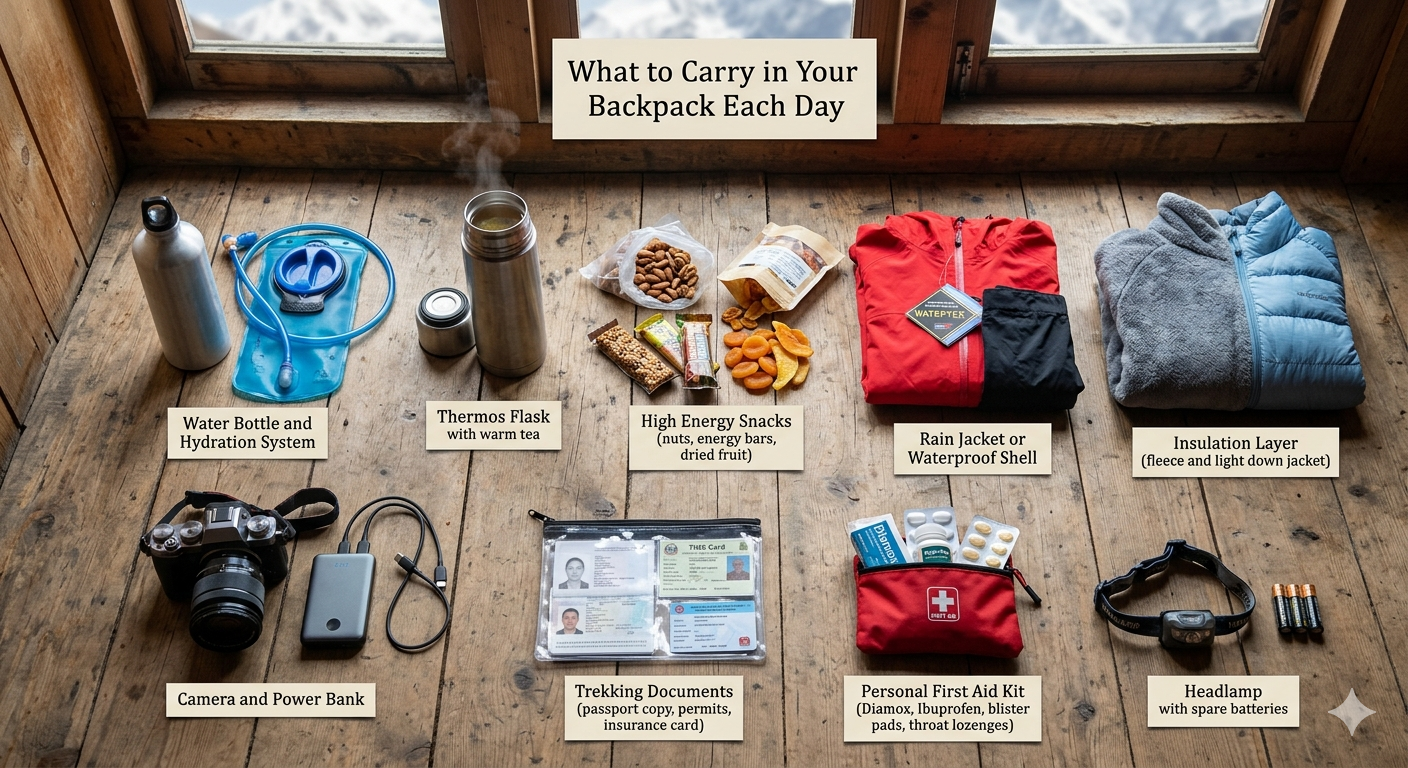
Carry 9 essential item categories in your daypack every trekking day:
-
Water bottle or hydration system (1 to 2 liters)
-
Thermos flask with warm tea or hot water
-
High-energy snacks (nuts, energy bars, dried fruit)
-
Rain jacket or waterproof shell
-
Insulation layer (fleece or light down jacket)
-
Camera and power bank
-
Trekking documents (passport copy, permits, insurance card)
-
Personal first aid kit (Diamox, Ibuprofen, blister pads, throat lozenges)
-
Headlamp with spare batteries
Total weight for this 9-item system sits between 5 kg and 8 kg depending on camera gear weight and water quantity.
What Should Go in the Duffel Bag and What Should Go in the Backpack?
The duffel bag carries overnight and base camp gear. The daypack carries daily trail essentials. This 2-bag load distribution system is the standard EBC logistics model used by TAAN-accredited trekking agencies.
What Should Go in the Porter Duffel Bag?
Pack 8 gear categories in the porter duffel bag:
-
Sleeping bag rated to minus 10°C (14°F) for standard season or minus 20°C (minus 4°F) for winter
-
Down jacket (600 fill power or above)
-
Spare trekking clothes (base layers, mid layers, socks)
-
Camp shoes or lightweight sandals
-
Personal care kit (toothbrush, soap, sunscreen, lip balm)
-
Sleeping bag liner
-
Teahouse accessories (earplugs, eye mask, outlet adapter)
-
Non-essential first aid supplies
The duffel bag carries all gear that does not need trail access between teahouse stops.
What Should Go in Your Daypack?
Pack 9 item categories in your daypack for daily trail carry:
-
Water and thermos flask
-
Trail snacks
-
Rain jacket and insulation layer
-
Camera and power bank
-
Documents and cash
-
Personal first aid essentials
-
Headlamp
-
UV sunglasses and sunscreen SPF 50
-
Trekking poles (when not in use, attach externally)
The daypack carries everything required from morning departure at one teahouse to afternoon arrival at the next.
What Should Never Go in the Porter Duffel Bag?
4 item types must never travel in the porter duffel bag: passport and visa originals, travel insurance certificate, cash and credit cards, and medications required on the trail.
Porters and trekkers travel together but sometimes arrive at teahouses at different times. Documents and medications in a porter duffel become inaccessible for 1 to 4 hours at checkpoint gates and during slower porter arrival times.
What Should Never Go in the Daypack?
3 item types should not go in the daypack: heavy sleeping bag, large down jacket, and spare trekking boots.** These items add 3 kg to 5 kg of unnecessary daily carry weight. Carrying a 10 kg or heavier daypack above 4,000 m increases altitude sickness risk and slows acclimatization pace.
Can You Use Only a Backpack for Everest Base Camp Trek?
Trekking EBC with only a backpack is physically possible but operationally difficult for most trekkers. The backpack-only system works exclusively for ultralight trekkers carrying under 10 kg total.
Is a Backpack Enough Without a Duffel Bag?
A single backpack of 40L to 50L can carry the minimum EBC gear load for ultralight packers. Minimum load includes: 1 sleeping bag (ultralight, minus 10°C rated), 1 down jacket (lightweight 600 fill), 3 merino wool layers, waterproof shell, trekking pants, personal care kit, and daily essentials. Total weight for this system reaches 10 kg to 12 kg.
Is Backpack-Only Trekking Realistic on EBC?
Backpack-only trekking on EBC is realistic only for experienced, ultralight trekkers who use compression packing systems and technical lightweight gear. First-time trekkers and standard-gear packers exceed the realistic daypack carry weight when attempting backpack-only systems.
A 50L backpack carrying 15 kg of standard gear causes neck, shoulder, and lower back fatigue above 4,000 m. Altitude-related fatigue compounds physical bag weight strain above Dingboche.
When Is Backpack-Only Packing a Bad Idea?
Backpack-only packing is a bad idea in 4 scenarios: winter trekking (extra insulation required), photography-heavy trekking (camera gear adds 3 kg to 5 kg), group trekking with a porter included in the package, and first-time high-altitude trekking.
In all 4 scenarios, the dual-bag system (duffel plus daypack) reduces daily carry weight and improves acclimatization outcomes above 3,500 m.
Can You Use Only a Duffel Bag for Everest Base Camp Trek?
Trekking EBC with only a duffel bag and no daypack is not viable. A duffel bag has no shoulder straps, hip belt, or load transfer system for sustained daily trekking.
Can a Duffel Bag Replace a Backpack?
A duffel bag cannot replace a daypack on EBC trail. Duffel bags lack the ergonomic design required for 6 to 8 hours of daily hiking above 3,500 m. Hand-carrying or shoulder-carrying a duffel bag on the EBC trail causes arm, shoulder, and neck fatigue within 1 to 2 hours.
Some trekkers attempt carrying a duffel bag across body for short sections. This method is unsafe on suspension bridges and rocky trail sections above Namche Bazaar.
Why Do You Still Need a Daypack?
A daypack is required because it provides ergonomic load distribution, trail access to daily essentials, and hands-free hiking on technical trail sections. The EBC route from Lukla to Base Camp includes 8 suspension bridges, 15 steep ascents, and multiple scree and moraine sections above Lobuche (4,940 m). Hands-free carry is a safety requirement, not a preference.
Can You Trek EBC Without a Backpack?
Trekking EBC without a daypack creates a safety and logistics failure. Water, first aid, rain protection, documents, and camera all require trail access. A porter-carried duffel does not provide this access on the trail between stops.
What Bag Setup Is Best for Flights to Lukla?
The correct bag setup for Lukla flights is a 60L to 70L duffel as checked luggage and a 25L to 30L daypack as carry-on. Total weight must not exceed 15 kg per passenger on Tara Air and Summit Air domestic flights.
Does the Lukla Flight Have Luggage Restrictions?
According to Tara Air and Summit Air (the 2 primary Lukla route operators), the domestic baggage limit is 15 kg total per passenger including checked and carry-on baggage. Twin Otter and Dornier 228 aircraft operating the Tribhuvan International Airport to Tenzing-Hillary Airport (Lukla) route carry 9 to 19 passengers with strict weight balance requirements.
Baggage is weighed with the passenger on a combined scale at the Tribhuvan International Airport domestic terminal. Total passenger weight plus baggage must fit within aircraft weight limits.
What Bag Is Best for the Lukla Flight?
A soft-shell duffel bag is the best checked bag option for the Lukla flight. Duffel bags compress for loading into the small Twin Otter cargo hold (0.8 m x 0.6 m x 0.5 m approximate dimensions). Rigid bags, wheeled suitcases, and framed backpacks do not compress and create loading problems.
Can You Bring a Large Duffel on the Plane?
A 60L to 70L soft-shell duffel bag is accepted as checked luggage on Lukla flights within the 15 kg weight limit. Bags exceeding 15 kg total per passenger trigger excess baggage fees or forced repacking at the Kathmandu domestic terminal.
What Happens If Your Bag Is Overweight?
Overweight baggage on Lukla flights costs NPR 100 to NPR 200 per kg above the 15 kg limit. For a 20 kg bag (5 kg excess), the fee reaches NPR 500 to NPR 1,000 (approximately USD 4 to USD 8). Heavier excess bags may be held at Kathmandu domestic terminal and sent on a later flight, delaying trek start.
What Are the Best Bag Choices for EBC Trek Based on Travel Style?
Bag setup for EBC trek varies by travel style across 4 trekker profiles: guided trekkers, independent trekkers, lightweight trekkers, and first-time trekkers.
Best Bag Setup for Guided Trek
Guided EBC trekkers use a 60L to 70L duffel bag for the porter and a 25L to 30L daypack. The trekking agency manages porter allocation, duffel weighing, and permit logistics. Guided trekkers focus on daypack preparation each morning and duffel compression each evening.
Guided trek packages from TAAN-accredited agencies in Kathmandu include 1 porter per 2 clients as standard. Solo guided trekkers receive a dedicated porter.
Best Bag Setup for Independent Trek
Independent EBC trekkers carry all gear in a 40L to 50L hiking backpack without porter support. This system requires ultralight, technical gear with total pack weight under 12 kg.
Independent trekkers hiring a local porter at Lukla or Namche Bazaar use a 60L duffel for porter carry and a 25L daypack for personal carry, matching the guided trek setup.
Best Bag Setup for Lightweight Trekkers
Lightweight trekkers use a 50L duffel bag (porter-carried) and a 20L to 25L daypack. Gear selection relies on compressed sleeping bags, ultralight down jackets, and merino wool base layers to meet the 50L volume limit.
Total pack weight for the lightweight system targets 10 kg duffel and 5 kg daypack.
Best Bag Setup for First-Time Trekkers
First-time EBC trekkers use a 60L to 70L duffel bag (porter-carried) and a 30L daypack. First-time trekkers typically pack more clothing, more first aid supplies, and more camera equipment than experienced trekkers. A 70L duffel provides volume buffer for standard first-timer packing without exceeding the 15 kg weight limit.
What Mistakes Do Trekkers Make When Choosing a Duffel Bag or Backpack?
5 common packing mistakes create logistical and physical problems on the EBC route: wrong duffel size, overloaded daypack, non-compliant bag types, inadequate waterproofing, and misplaced essential items.
Why Is Choosing the Wrong Bag a Problem?
Choosing a bag incompatible with porter logistics, Lukla flight limits, or trail terrain creates delays, extra fees, and physical strain above 3,500 m. Bag choice on EBC is a logistics decision, not a preference choice.
A wheeled suitcase cannot be porter-carried. A 90L duffel packed to capacity exceeds the 15 kg porter limit. A 20L daypack does not hold all required daily essentials above Dingboche.
What Happens If the Backpack Is Too Small?
A daypack below 20L forces trekkers to leave critical trail items behind or stuff the bag beyond usable zip capacity. Rain jackets, a 1-liter thermos, camera, and full document set do not fit in a 15L bag simultaneously.
Trekkers with undersized daypacks carry items in their hands or borrow space from their guide's bag. Neither option is acceptable above 4,000 m.
What Happens If the Duffel Bag Is Too Heavy?
A duffel bag above 15 kg at a TAAN-compliant agency triggers 3 consequences: repacking at the Kathmandu briefing, excess porter fee payment, or porter load rejection on the trail. Porter load rejection stops trekking progress until load redistribution occurs.
Why Do Trekkers Overload Their Daypack?
Trekkers overload their daypack by packing sleeping bag liners, down jackets, and large camera tripods that belong in the duffel. Daypack weight above 10 kg increases altitude fatigue and reduces trekking pace by 15% to 25% above 4,000 m.
Separating gear correctly before departure prevents this error. Licensed guides review daypack contents at the pre-trek briefing in Kathmandu.
What Is the Final Recommendation for Everest Base Camp Trek?
The standard EBC bag setup is a 60L to 70L waterproof duffel bag for porter carry and a 25L to 30L daypack for personal carry every trekking day.
When Should You Choose a Duffel Bag?
Choose a duffel bag as your main luggage when trekking with a guide and porter, traveling on Lukla domestic flights, and storing gear in teahouse rooms between Phakding and Gorak Shep. A duffel bag is the correct choice for 95% of EBC trekkers using guided or semi-guided packages.
When Should You Choose a Backpack?
Choose a large backpack (40L to 50L) as your sole bag when trekking independently without porter support and carrying an ultralight gear system under 12 kg. A backpack-only system suits experienced ultralight trekkers with technical gear.
What Is the Ideal Combined Setup for EBC Trek?
The ideal EBC bag setup combines a 60L to 70L waterproof duffel bag (porter-carried, 13 kg to 15 kg packed) with a 25L to 30L daypack (self-carried, 5 kg to 8 kg packed). Total trek load: 18 kg to 23 kg split between 2 bags. Daily carry load: 5 kg to 8 kg in your daypack. Porter load: 13 kg to 15 kg in the duffel.
This system operates within TAAN porter weight guidelines, Lukla flight baggage limits, and teahouse storage constraints.
FAQs About Duffel Bag vs Backpack for Everest Base Camp Trek
What size duffel bag is best for Everest Base Camp trek?
A 60L to 70L duffel bag is the best size for EBC trek. 60L fits all standard 14-day gear within the 15 kg porter limit. 70L suits winter trekkers with extra insulation. Bags above 70L risk exceeding the 15 kg TAAN porter weight guideline when packed for full trek duration.
What size backpack is best for Everest Base Camp trek?
A 25L to 30L daypack is the best backpack size for EBC trek. 25L carries all daily trekking essentials between 5 kg and 7 kg. 30L accommodates camera gear and extra layers for cold season trekking. Daypacks above 35L add unnecessary weight and volume for EBC daily carry.
Is a duffel bag better than a backpack for EBC trek?
For porter-carried main luggage, a duffel bag is better than a framed backpack on EBC trek. Duffel bags are compatible with Nepal porter carry systems, Lukla flight cargo holds, and teahouse storage. A framed backpack used as main luggage creates porter carry problems and cargo hold loading issues.
Can I use only a backpack for Everest Base Camp trek?
Yes, only a backpack works for ultralight independent trekkers carrying under 12 kg of technical gear in a 40L to 50L pack. Standard gear trekkers on guided packages use the dual-bag system (duffel plus daypack). A backpack-only system without ultralight gear creates daily carry weight above the safe 8 kg threshold for sustained altitude trekking.
How much should a duffel bag weigh for EBC trek?
A packed duffel bag for EBC trek targets 13 kg to 15 kg. This weight range complies with TAAN porter load guidelines (maximum 25 kg total per porter). A duffel exceeding 15 kg at an agency pre-trek briefing triggers excess porter fee charges of USD 5 to USD 15 per additional kg per trekking day.
What should I carry in my daypack?
Carry 9 item categories in your daypack daily: water (1 to 2 liters), thermos flask, trail snacks, rain jacket, insulation layer, camera and power bank, documents and cash, personal first aid kit, and headlamp. Total target weight: 5 kg to 8 kg. Items above this limit belong in the porter duffel.
Do porters carry the duffel bag on Everest Base Camp trek?
Yes, licensed trekking porters carry the duffel bag on the EBC trail. According to TAAN and the International Porter Protection Group, porters carry a maximum of 25 kg total. Most agencies set a per-client duffel limit of 15 kg. Porters transport the duffel bag from teahouse to teahouse using a namlo (headband) or back-strap carry system.
More About Author

Khilak Budhathoki
Travel Director
Khilak Budhathoki is the co-founder and lead trekking guide at Himalaya Trekking Nepal, a locally owned and operated adventure company based in Kathmandu. Born and raised in the foothills of Nepal, Khilak developed a deep love for the mountains from an early age. With over a deca...

USD$1,600 pp
Our Recommendation
Related Blogs