- 20, Apr 2026 | Khilak Budhathoki
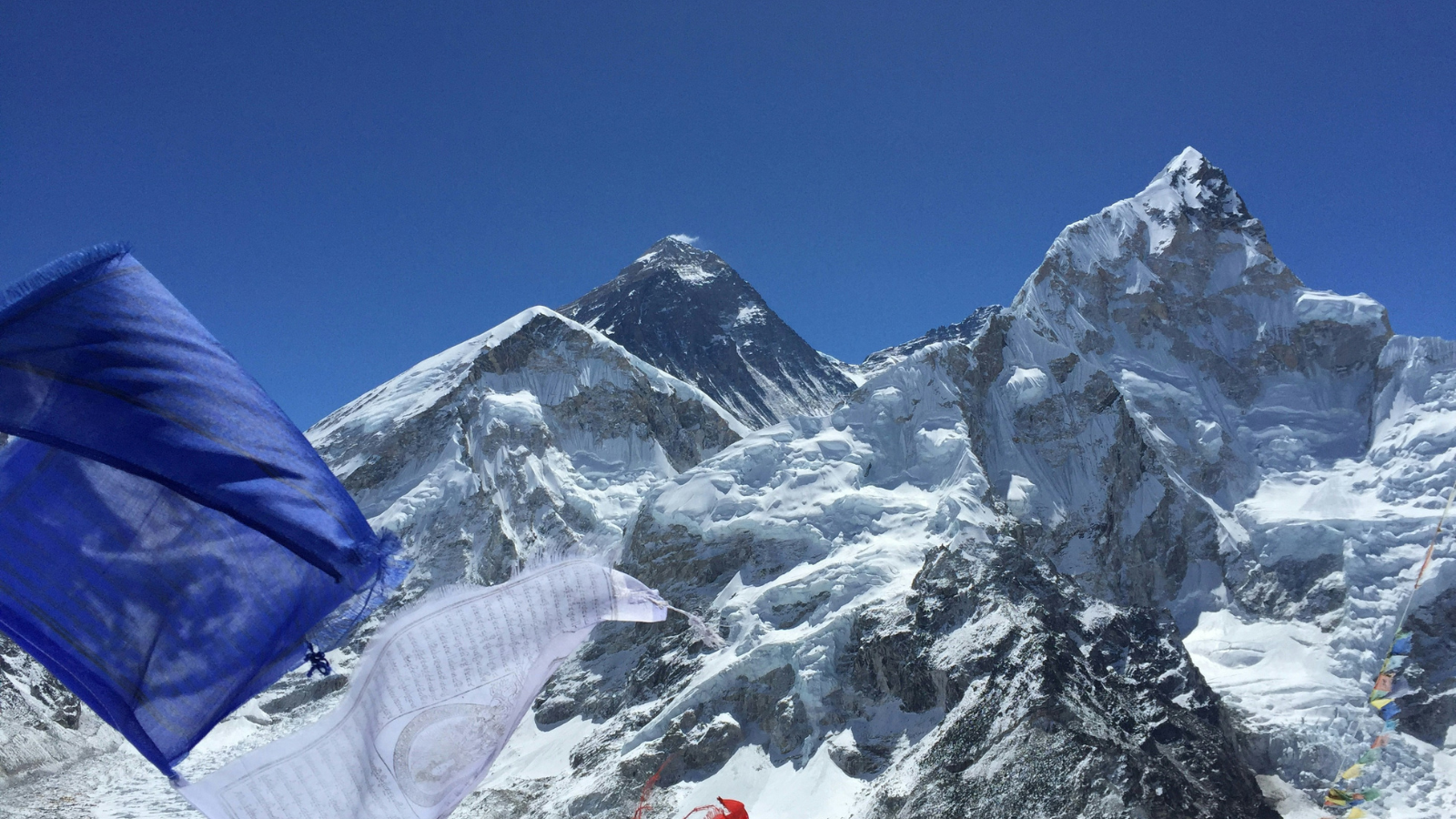
Everest Base Camp trek requires a moderate fitness level. Trekkers walk 130 km round trip over 12 to 14 days, gaining 400 to 600 m elevation daily, at altitudes reaching 5,364 m (17,598 ft). No technical climbing experience is required.
Moderate fitness means 5 to 7 hours of sustained aerobic output per day across 13 consecutive trekking days. Cardiovascular endurance, leg strength, core stability, and mental stamina are the 4 core fitness components. Beginners with 8 to 12 weeks of structured preparation complete the EBC trek.
Fitness level and trek difficulty are separate measurements. EBC is Grade B moderate difficulty in the Nepal trekking grading system. Altitude acclimatization at Namche Bazaar (3,440 m) and Dingboche (4,410 m) determines completion outcome, not fitness alone.
Oxygen saturation (SpO2) drops to 53% of sea level levels at 5,364 m. Acute Mountain Sickness (AMS), hypobaric hypoxia, and altitude-driven fatigue affect all trekkers regardless of fitness. Acclimatization days, Sherpa-paced ascent, and daily SpO2 monitoring reduce AMS risk and support safe altitude adaptation.
Cardiovascular endurance, leg strength, backpack tolerance, and mental resilience all improve with 8 to 12 weeks of progressive training. Age, beginner status, and gym-only fitness do not prevent EBC completion. Structured preparation, correct pacing, and acclimatization protocol convert EBC from a high physical risk into an achievable Himalayan objective.
What Fitness Level Is Required for the Everest Base Camp Trek?
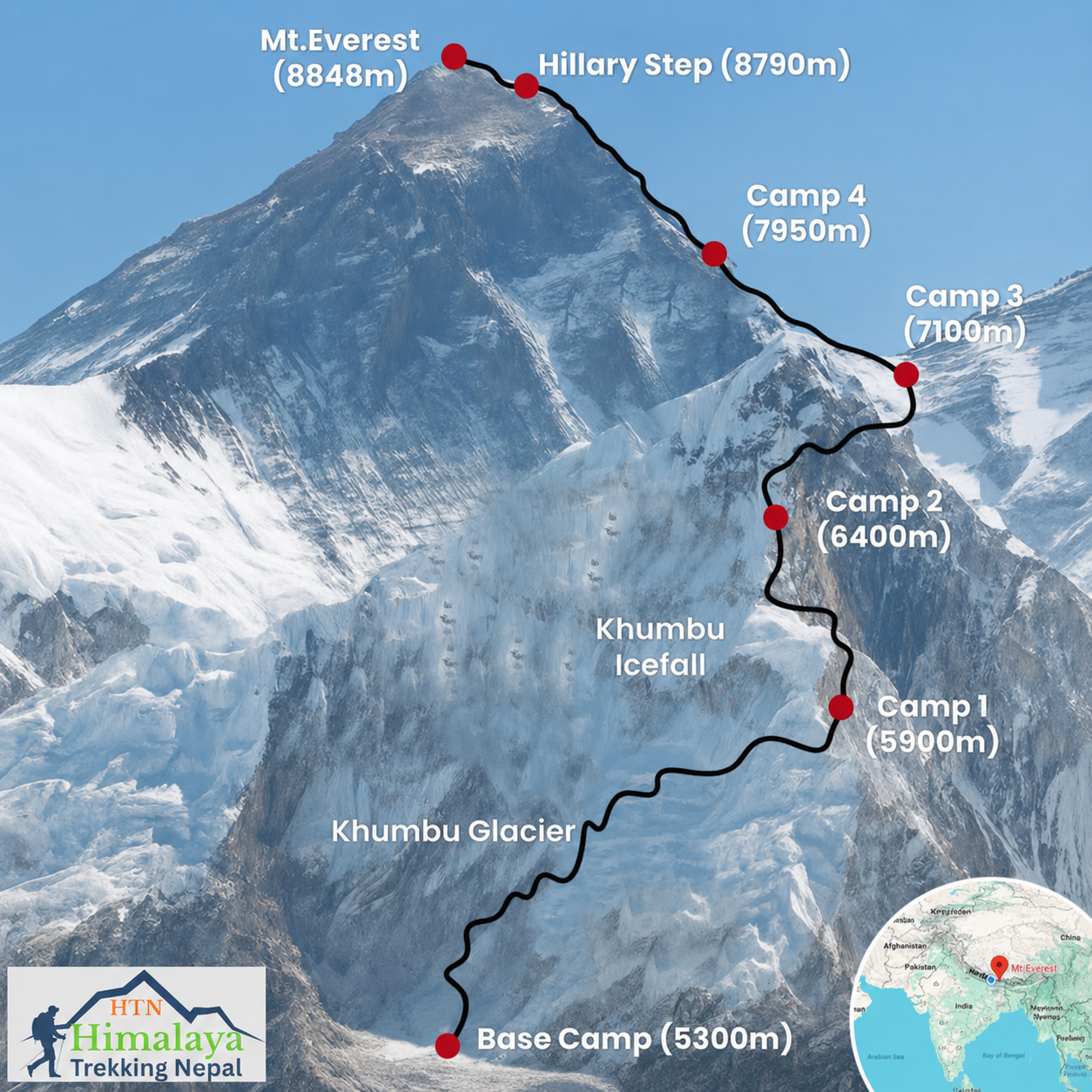
Everest Base Camp trek requires moderate fitness level. Trekkers walk 10 to 15 km per day for 12 to 14 consecutive days. Daily trekking duration ranges from 5 to 7 hours. Maximum altitude reaches 5,364 m (17,598 ft) at Everest Base Camp and 5,555 m (18,209 ft) at Kala Patthar.
Athletic performance is not required. Cardiovascular endurance, leg strength, and multi-day stamina are the 3 core physical requirements. Trekkers carry a daypack of 5 to 10 kg throughout the Khumbu Valley route.
Moderate fitness means completing a 10 km uphill hike comfortably, climbing stairs for 45 continuous minutes, and sustaining aerobic effort across 13 trekking days. Trekkers who meet these 3 benchmarks complete the EBC trek at a high success rate.
How Fit Do You Need to Be to Trek to Everest Base Camp?
To trek to Everest Base Camp, you walk 10 to 15 km per day, carry a 5 to 10 kg pack, and sustain effort for 5 to 7 hours daily across 12 to 14 consecutive days.
Fitness requirement focuses on endurance, not athletic speed. The 4 physical benchmarks for EBC readiness are:
-
Walk 10 to 12 km on uneven terrain without stopping
-
Carry a 7 kg backpack for 5 continuous hours
-
Climb 400 to 600 m of elevation gain in one session
-
Repeat the above effort across 13 consecutive days
Fitness and trekking experience are different assets. A trekker with 12 weeks of trail hiking adapts better than a gym athlete with no outdoor exposure. Multi-day endurance on uneven terrain is the specific fitness type EBC demands.
Can a Beginner with Average Fitness Do the Everest Base Camp Trek?
A beginner with average fitness completes the Everest Base Camp trek with 10 to 12 weeks of structured preparation.
Average fitness is defined as: completing a 5 km walk without fatigue, climbing 4 to 5 floors of stairs without stopping, and engaging in 3 to 4 aerobic sessions per week. Beginners who meet these 3 criteria are EBC-eligible with preparation.
Beginners fail the EBC trek for 4 common reasons:
-
Preparation starting less than 6 weeks before departure
-
Zero backpack training before the trek
-
No consecutive-day trekking practice
-
Underestimating altitude impact on breathing and pace
Beginner success rate rises significantly with a guide-led itinerary. According to Nepal Mountain Academy certified operators, guided trekkers with acclimatization days built into the itinerary achieve higher summit reach rates than self-guided beginners.
Himalaya Trekking Nepal guide-founded teams design itineraries with Namche Bazaar and Dingboche acclimatization rest days built in. This protocol reduces acute mountain sickness (AMS) risk for trekkers at all fitness levels.
What Are the Key Fitness Components Required for the EBC Trek?
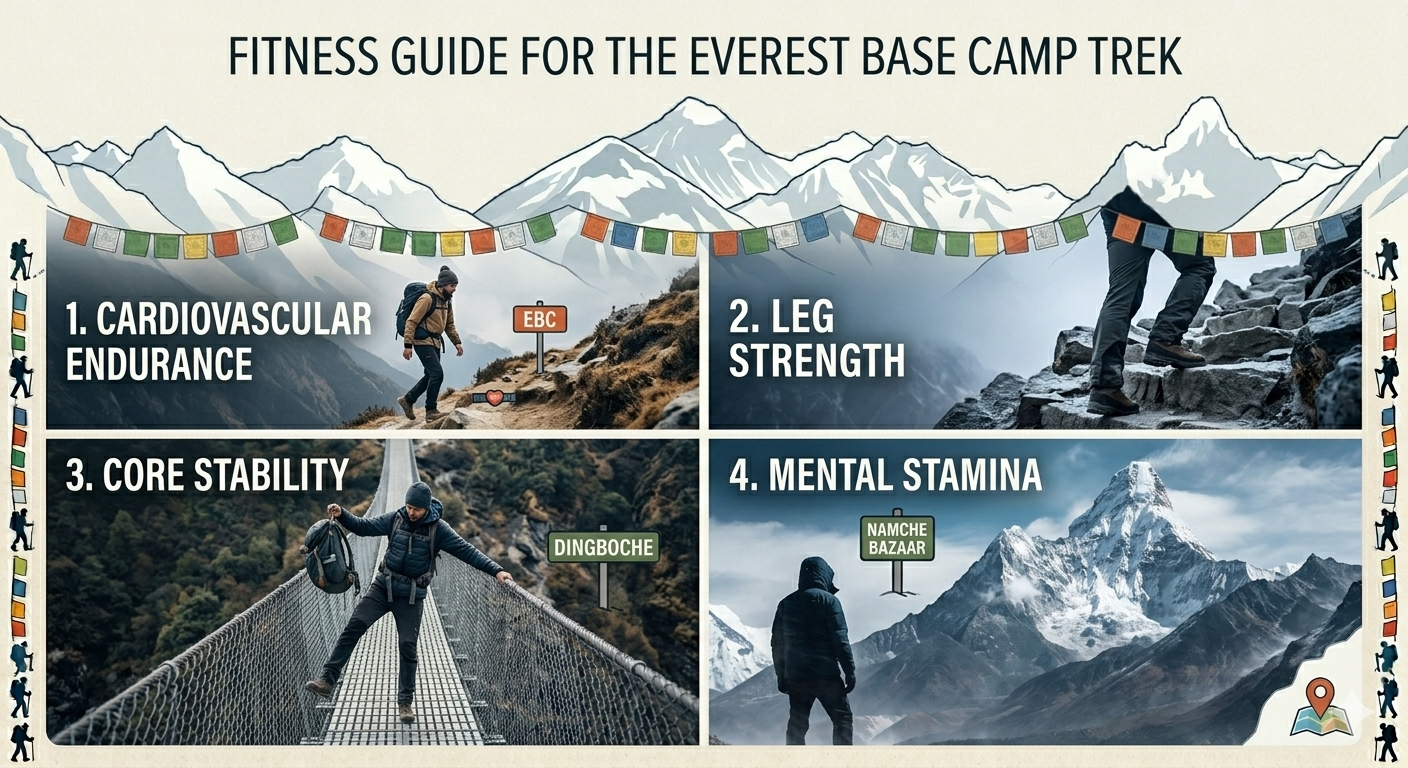
The 4 key fitness components for Everest Base Camp trekking are cardiovascular endurance, leg strength, core stability, and mental stamina.
Cardiovascular Endurance
Cardiovascular endurance determines how long your body sustains aerobic output. EBC trekking operates at 60 to 75% of maximum heart rate for 5 to 7 hours daily.
VO2 max is the measure of maximum oxygen consumption during aerobic effort. At 5,364 m altitude, available oxygen drops to approximately 53% of sea level concentration. Higher VO2 max improves oxygen utilization efficiency at altitude. Running 5 km in under 35 minutes indicates sufficient cardiovascular endurance for EBC preparation.
Aerobic capacity benchmarks for EBC readiness:
-
Run 5 km continuously at moderate pace
-
Cycle 45 minutes at steady resistance
-
Hike uphill for 90 continuous minutes
Leg Strength and Muscular Endurance
Leg strength supports uphill climbing on rocky Himalayan terrain and descent control on steep sections between Lobuche and Gorak Shep. Muscular endurance allows sustained leg output across 13 consecutive trekking days.
Fatigue resistance matters more than peak strength. The Khumbu Valley trekking route includes suspension bridges, rock staircases, and moraine paths where ankle stability and quadricep endurance prevent injury.
The 3 terrain types that stress leg muscles most on EBC:
-
Ascent from Namche Bazaar (3,440 m) to Tengboche (3,860 m)
-
Rocky moraine path from Lobuche (4,940 m) to Gorak Shep (5,164 m)
-
Descent from Kala Patthar (5,555 m) to Pheriche (4,371 m)
Core Stability and Balance
Core stability reduces injury risk when carrying a 5 to 10 kg daypack across uneven terrain. Weak core muscles shift load stress to the lower back and knees. Core training improves posture under pack weight and reduces fatigue accumulation.
Balance training prepares trekkers for suspension bridges, narrow rocky paths, and river crossing zones in the Khumbu region.
Mental Stamina and Resilience
Mental stamina is defined as sustained cognitive and motivational output under physical stress, cold, and altitude discomfort. Long trekking days at altitude increase psychological fatigue. Cold nights in teahouses at Dingboche and Gorak Shep compound mental load.
Mental resilience training reduces perceived exertion and prevents early turnaround. Meditation practice and extended solo hiking sessions build this capacity before departure.
How Does Altitude Affect Fitness on the Everest Base Camp Trek?
Altitude reduces aerobic performance by lowering available oxygen. Above 3,000 m, the human body begins acclimatization response. At 5,364 m, oxygen availability drops to 53% of sea level levels.
Hypobaric hypoxia is the condition where reduced atmospheric pressure decreases oxygen partial pressure in the lungs. This condition affects all trekkers regardless of fitness level. Fit trekkers recover faster from hypoxia symptoms but are not immune to altitude sickness.
Acclimatization is the physiological process by which the body adapts to reduced oxygen by increasing red blood cell production and adjusting respiratory rate. This process takes 24 to 48 hours per significant altitude gain.
The 3 altitude thresholds that affect trekking performance:
-
Above 3,000 m: Initial breathlessness and reduced pace
-
Above 4,000 m: Sleep disruption, reduced appetite, and headache risk
-
Above 5,000 m: Significant oxygen saturation (SpO2) drop and fatigue increase
Acute Mountain Sickness is a condition triggered by rapid altitude gain. Symptoms include headache, nausea, dizziness, and fatigue. AMS is not prevented by fitness. AMS is prevented by gradual ascent, hydration, and acclimatization rest days.
High Altitude Cerebral Edema (HACE) is severe AMS causing brain swelling. High Altitude Pulmonary Edema (HAPE) is fluid accumulation in the lungs at altitude. Both conditions require immediate descent and emergency evacuation. Helicopter rescue in Nepal operates from Lukla Airport and Kathmandu.
Fitness improves recovery speed from altitude exertion. Fitness does not replace acclimatization.
How Many Hours Do You Walk Daily on the EBC Trek?
Daily trekking on the Everest Base Camp route averages 5 to 7 hours. Three hardest trekking days each exceed 6 hours of walking.
The EBC trek covers approximately 130 km round trip from Lukla to Everest Base Camp. Total trekking days number 13 on a standard itinerary.
The following table shows daily trekking data for key EBC stages:
|
Stage |
Elevation (m) |
Daily Distance (km) |
Trekking Hours |
|
Lukla to Phakding |
2,610 to 2,652 |
8 |
3 to 4 |
|
Phakding to Namche Bazaar |
2,652 to 3,440 |
11 |
5 to 6 |
|
Namche to Tengboche |
3,440 to 3,860 |
10 |
5 to 6 |
|
Tengboche to Dingboche |
3,860 to 4,410 |
12 |
5 to 6 |
|
Dingboche to Lobuche |
4,410 to 4,940 |
11 |
5 to 6 |
|
Lobuche to Gorak Shep (EBC) |
4,940 to 5,164 (5,364) |
14 |
7 to 8 |
|
Gorak Shep to Kala Patthar |
5,164 to 5,555 |
4 |
2 to 3 |
Terrain type affects fatigue more than distance. The rocky moraine path from Lobuche to Gorak Shep (4,940 m to 5,164 m) produces more fatigue per kilometer than lower sections. Elevation gain per day averages 400 to 600 m on ascending stages.
What Is a Realistic Fitness Test Before Attempting EBC?
The 4-part EBC fitness self-test measures cardiovascular endurance, leg strength, load-carrying capacity, and multi-day recovery.
Complete all 4 tests without significant fatigue before booking:
Test 1: Trail Hike Test Hike 10 to 12 km on uneven terrain with 300 m elevation gain. Complete this in under 4 hours. Recovery time by next morning indicates fitness adequacy.
Test 2: Stair Climb Test Climb stairs continuously for 45 to 60 minutes. Maintain steady pace without stopping. Leg fatigue level after 30 minutes indicates quadricep endurance.
Test 3: Load Carry Test Carry a 7 to 8 kg backpack for 5 consecutive hours on a trail. Back and shoulder fatigue level reveals pack-carrying readiness.
Test 4: Consecutive Day Test Repeat a 2-hour hike on 3 consecutive days. Recovery quality on Day 3 reveals multi-day endurance, which is the most specific predictor of EBC completion.
Trekkers who pass all 4 tests demonstrate sufficient fitness for the EBC trek with proper acclimatization protocol.
How to Train for Everest Base Camp Trek Fitness
To train for Everest Base Camp trek fitness, build cardiovascular endurance, leg strength, stair-climbing capacity, and pack-carrying tolerance across 8 to 12 weeks.
Cardio Training Plan
Cardio training builds the aerobic base for 5 to 7 hour daily trekking. The 3 most effective cardio modalities for EBC preparation are running, cycling, and incline walking.
Weekly cardio progression model:
-
Weeks 1 to 4: 3 sessions per week, 30 to 45 minutes each at moderate pace
-
Weeks 5 to 8: 4 sessions per week, 45 to 60 minutes with 2 hill sessions
-
Weeks 9 to 12: 4 to 5 sessions per week, including 90-minute long trail sessions
Running frequency of 3 times per week at 5 to 8 km per session produces measurable VO2 max gains within 8 weeks. Cycling substitutes effectively for trekkers with knee sensitivity.
Strength Training Plan
Strength training targets the 4 primary muscle groups used in EBC trekking: quadriceps, hamstrings, glutes, and calves.
The 5 most functional strength exercises for EBC preparation:
-
Squats (3 sets of 15 reps, 2 times per week)
-
Reverse lunges (3 sets of 12 reps per leg, 2 times per week)
-
Step-ups on a 40 cm box (3 sets of 15 reps per leg)
-
Romanian deadlifts (3 sets of 12 reps for posterior chain)
-
Single-leg calf raises (3 sets of 20 reps per leg)
Strength sessions pair with cardio on alternating days. Overtraining risk increases when strength and long cardio sessions occur on the same day consecutively.
Stair Climbing and Hiking Simulation
Stair climbing is the single best sea-level simulation for Himalayan ascent. A 45-minute stair session at a hotel or stadium replicates the uphill demand of Namche Bazaar to Tengboche.
Incline treadmill walking at 8 to 12% grade for 60 minutes simulates sustained uphill trekking pace. Trekkers in flat-terrain cities use incline treadmill as primary altitude simulation.
Backpack Training
Backpack training is essential preparation that most beginners skip. Start with a 5 kg pack during Week 3. Increase to 7 kg by Week 7. Reach 8 to 10 kg by Weeks 10 to 12.
Gradual load increase progression:
-
Week 3 to 4: 5 kg on all hikes
-
Week 5 to 7: 6 to 7 kg on all trail hikes
-
Week 8 to 12: 8 to 10 kg on weekend long hikes
Real trail simulation with a loaded pack produces biomechanical adaptation. This adaptation prevents shoulder, hip, and knee strain on the Khumbu Valley route.
8 to 12 Week Everest Base Camp Fitness Training Plan
An 8 to 12 week EBC training plan follows progressive overload across 3 phases: base endurance (Weeks 1 to 4), stamina building (Weeks 5 to 8), and trek simulation (Weeks 9 to 12).
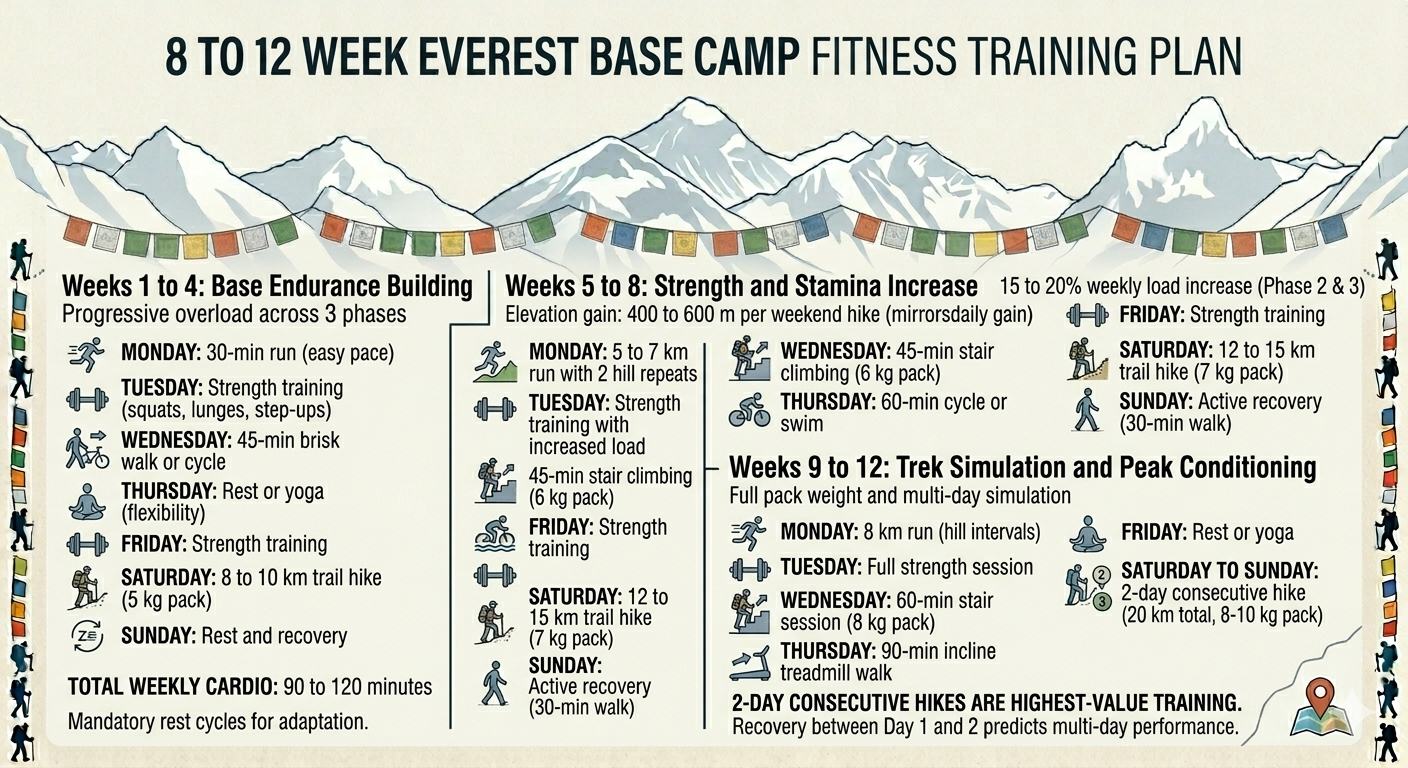
Weeks 1 to 4: Base Endurance Building
Phase 1 establishes aerobic base, joint conditioning, and pack tolerance.
Weekly structure:
-
Monday: 30-minute run at easy pace
-
Tuesday: Strength training (squats, lunges, step-ups)
-
Wednesday: 45-minute brisk walk or cycle
-
Thursday: Rest or yoga for flexibility
-
Friday: Strength training
-
Saturday: 8 to 10 km trail hike with 5 kg pack
-
Sunday: Rest and recovery
Total weekly cardio: 90 to 120 minutes. Rest cycles are mandatory in Weeks 1 to 4 for aerobic adaptation.
Weeks 5 to 8: Strength and Stamina Increase
Phase 2 increases training load by 15 to 20% per week. Stair climbing replaces Wednesday walk.
Weekly structure:
-
Monday: 5 to 7 km run with 2 hill repeats
-
Tuesday: Strength training with increased load
-
Wednesday: 45-minute stair climbing with 6 kg pack
-
Thursday: 60-minute cycle or swim
-
Friday: Strength training
-
Saturday: 12 to 15 km trail hike with 7 kg pack
-
Sunday: Active recovery (30-minute walk)
Elevation gain per weekend hike targets 400 to 600 m. This mirrors the daily gain on EBC trekking stages.
Weeks 9 to 12: Trek Simulation and Peak Conditioning
Phase 3 simulates consecutive trekking days and full pack weight.
Weekly structure:
-
Monday: 8 km run with hill intervals
-
Tuesday: Full strength session
-
Wednesday: 60-minute stair session with 8 kg pack
-
Thursday: 90-minute incline treadmill walk
-
Friday: Rest or yoga
-
Saturday to Sunday: 2-day consecutive hike (20 km total) with 8 to 10 kg pack
Two-day consecutive hikes are the highest-value training activity in Phase 3. Recovery quality between Day 1 and Day 2 predicts EBC multi-day performance directly.
What Fitness Mistakes Should You Avoid Before the EBC Trek?
The 6 most common fitness mistakes before the EBC trek are late preparation, strength-only training, skipping backpack training, overtraining in Week 12, ignoring consecutive-day hiking, and underestimating altitude impact.
The 6 mistakes and their consequences:
-
Starting training 4 weeks before departure: Insufficient time for cardiovascular adaptation. Aerobic adaptation requires 8 to 12 weeks minimum.
-
Gym-only training without outdoor hiking: Gym strength does not transfer to uneven terrain balance and proprioception.
-
No backpack training: First use of a loaded pack on Day 1 in Lukla causes premature shoulder fatigue and gait change.
-
Overtraining in the final week: Fatigue entering the trek reduces Day 1 performance and slows acclimatization.
-
Skipping consecutive-day hiking: Single-day endurance does not predict multi-day recovery capacity.
-
Assuming fitness prevents altitude sickness: AMS strikes fit and unfit trekkers equally without proper acclimatization.
Who Should Not Attempt the Everest Base Camp Trek Based on Fitness?
Trekkers with sedentary lifestyles, severe cardiovascular conditions, uncontrolled respiratory disease, or extreme obesity without prior preparation face high medical risk on the EBC route.
4 categories of trekkers who require medical clearance before EBC:
-
Trekkers with diagnosed cardiovascular disease, arrhythmia, or recent cardiac events
-
Trekkers with chronic obstructive pulmonary disease (COPD) or severe asthma
-
Trekkers with zero walking habit (under 3,000 steps per day average)
-
Trekkers with body weight significantly above healthy BMI range without 6 months of aerobic conditioning
Medical clearance from a licensed physician is required for trekkers in the above categories. Nepal trekking permits do not screen for medical fitness. Himalaya Trekking Nepal recommends pre-trek health consultation for all trekkers over 60 years of age or with any chronic condition.
Mental readiness is a separate requirement. Trekkers with severe anxiety about altitude, isolation, or cold environments experience higher psychological fatigue on the Gorak Shep stage.
Is Gym Fitness Enough for Everest Base Camp Trekking?
Gym fitness alone is not sufficient for Everest Base Camp trekking. Gym training builds isolated muscle strength and cardiovascular base. It does not build the 3 outdoor-specific capacities EBC demands.
The 3 fitness gaps between gym training and EBC terrain:
-
Proprioception gap: Gym machines move on fixed planes. Rocky Himalayan terrain activates ankle stabilizers, hip abductors, and balance reflexes that gym training does not train.
-
Load distribution gap: Treadmill walking with no pack differs biomechanically from trail hiking with a 7 to 10 kg backpack on uneven ground.
-
Consecutive recovery gap: Gym workouts include rest days. EBC trekking requires 13 consecutive days of physical output with no rest days during the core route.
Gym training provides a useful aerobic and strength base. That base transfers to EBC performance when combined with 8 to 12 weeks of outdoor trail hiking and backpack training.
Does Age Matter for Everest Base Camp Fitness Level?
Age does not prevent Everest Base Camp completion. Trekkers from age 18 to 76 complete the EBC route each season with appropriate fitness preparation.
Fitness level matters more than age. A 58-year-old with consistent aerobic training completes EBC more comfortably than a 28-year-old with 4 weeks of preparation. Age-related factors that affect EBC performance include recovery rate, joint health, and altitude adaptation speed.
3 age-specific performance considerations:
-
Trekkers aged 50 to 65: Recovery between trekking days slows. Adding 1 extra rest day at Namche Bazaar or Dingboche improves summit reach rate.
-
Trekkers aged 65 and above: Medical clearance is required. Cardiovascular adaptation to altitude takes longer. Oxygen saturation monitoring via pulse oximeter is recommended daily.
-
Young trekkers aged 18 to 30: Higher baseline VO2 max improves altitude adaptation. Overconfidence increases pace errors and AMS risk.
Acclimatization follows the same protocol regardless of age. The "climb high, sleep low" principle applies to all age groups on the Everest Base Camp route.
How to Make the Everest Base Camp Trek Easier with Better Fitness
Making the Everest Base Camp trek easier requires 5 strategies: slow pacing, proper acclimatization, hydration management, load reduction via porter hire, and pre-trek fitness conditioning.
Slow Pacing Strategy
"Slowly, slowly" is the Sherpa pacing principle used on all Himalayan routes. Trekking at 60 to 70% effort on ascending sections preserves glycogen stores and reduces lactic acid buildup. Trekkers who pace aggressively on Day 1 accumulate fatigue debt that compounds by Day 6.
Proper Acclimatization
Acclimatization rest days at Namche Bazaar (3,440 m) and Dingboche (4,410 m) reduce AMS risk by 60% according to wilderness medicine protocols. The ascent rate above 3,000 m targets a maximum of 300 to 500 m per day to allow oxygen adaptation.
Hydration and Nutrition
Hydration supports oxygen efficiency at altitude. Daily fluid intake targets 3 to 4 liters on trekking days. Dehydration accelerates headache onset and reduces SpO2 levels. Dal Bhat (lentil rice), the traditional Nepali trekking meal, provides high-carbohydrate energy for sustained trekking output.
Porter Hire and Load Management
Porters in the Khumbu porter and duffel system carry loads up to 25 to 30 kg. Hiring a porter reduces trekker daypack weight from 10 kg to 3 to 4 kg. This single change reduces daily fatigue accumulation by 30 to 40% on ascending stages.
Himalaya Trekking Nepal provides licensed and TAAN-accredited guide-porter teams. Guide-founded trips include trained Sherpa guides who monitor SpO2 levels and manage pace throughout the route.
Everest Base Camp Fitness Level vs Difficulty: What Is the Difference?
Fitness level measures your physical capacity. Trek difficulty measures the demand the route places on that capacity. The guided EBC trek is physically demanding but non-technical.
Trek difficulty is defined by terrain type, altitude, duration, and weather exposure. EBC difficulty is rated as Grade B moderate in the Nepal trekking grading system. This rating means no technical climbing, no glacier crossing, and no rope work.
Fitness level is defined as your cardiovascular endurance, muscular strength, and recovery capacity. Moderate fitness level matches EBC's Grade B difficulty demand.
The confusion between fitness and difficulty produces 2 errors:
-
Fit trekkers underestimate altitude and pace too fast
-
Unfit trekkers overestimate difficulty and avoid preparation
EBC demands endurance over skill. A trekker with 12 weeks of cardio and hiking conditioning overcomes the physical demand. No climbing experience is required.
Frequently Asked Questions about Everest Base Camp Fitness Level
What Level of Fitness Do You Need for Everest Base Camp?
Moderate fitness level is required for Everest Base Camp. This means sustained aerobic capacity for 5 to 7 hours of daily walking, leg strength for 400 to 600 m daily elevation gain, and multi-day endurance across 13 consecutive trekking days.
Can an Unfit Person Do the Everest Base Camp Trek?
An unfit person completes the EBC trek with 10 to 12 weeks of dedicated preparation. Without preparation, trekkers with low fitness face high fatigue accumulation, AMS risk, and early turnaround probability above Namche Bazaar.
How Long Should I Train Before the EBC Trek?
Training time for EBC preparation is 8 to 12 weeks minimum. 8 weeks is sufficient for trekkers with existing aerobic fitness. 12 weeks is recommended for beginners and those starting from a sedentary baseline.
Is Running Necessary for Everest Base Camp Training?
Running is not required but accelerates cardiovascular adaptation. Brisk hiking, stair climbing, and cycling build equivalent aerobic capacity. Running 3 times per week improves VO2 max faster than low-impact alternatives.
How Much Weight Should I Carry During Training?
Training pack weight starts at 5 kg in Week 3 and progresses to 8 to 10 kg by Weeks 10 to 12. On the EBC trek itself, trekkers carry 5 to 8 kg daypacks. Porters carry remaining gear.
Is Everest Base Camp Harder Than a Marathon?
EBC and marathon demand different fitness types. A marathon requires peak cardiovascular output for 4 to 6 hours over 1 day. EBC requires moderate output for 5 to 7 hours across 13 consecutive days. Multi-day endurance and altitude adaptation make EBC harder for most runners who lack trekking conditioning.
Can I Train for Everest Base Camp at Sea Level?
Sea-level training builds 85% of the fitness required for EBC. Cardiovascular endurance, leg strength, and backpack tolerance all develop at sea level. Altitude adaptation (the remaining 15%) occurs only on the route itself through acclimatization.
What Is the Minimum Fitness Requirement for Beginners?
The minimum fitness requirement for beginners is: completing a 5 km walk without fatigue, climbing 3 to 4 floors continuously, and sustaining 30 minutes of aerobic activity 3 times per week. Beginners meeting this minimum with 12 weeks of training complete the EBC trek with a guided itinerary.
How Do I Know If I Am Fit Enough for the EBC Trek?
Fitness readiness is confirmed by passing the 4-part EBC fitness self-test: 10 km trail hike, 45-minute stair climb, 7 kg load carry for 5 hours, and 3 consecutive hiking days. Passing all 4 confirms readiness.
Does Gym Training Alone Prepare You for Everest Base Camp?
Gym training alone does not prepare trekkers for EBC terrain. Gym fitness builds base strength and cardiovascular capacity. Outdoor trail hiking with a loaded pack, consecutive day hiking, and stair climbing simulation are required additions.
More About Author

Khilak Budhathoki
Travel Director
Khilak Budhathoki is the co-founder and lead trekking guide at Himalaya Trekking Nepal, a locally owned and operated adventure company based in Kathmandu. Born and raised in the foothills of Nepal, Khilak developed a deep love for the mountains from an early age. With over a deca...

USD$1,600 pp
Our Recommendation
Related Blogs