- 03, Jul 2026 | Khilak Budhathoki
The Everest Base Camp (EBC) Trek and Annapurna Base Camp (ABC) Trek are Nepal's two most iconic Himalayan trekking experiences, attracting thousands of adventure travelers each year with world-class mountain scenery, authentic mountain cultures, and well-established tea house trails. Although both treks lead to the base of legendary Himalayan peaks, they deliver fundamentally different experiences in terms of altitude, landscape, trekking difficulty, cultural immersion, accessibility, and overall trekking style. Understanding these differences is essential because the right trek depends on your personal goals, fitness level, available time, budget, and previous high-altitude trekking experience rather than on popularity alone.
 This comprehensive comparison explores every major factor that influences the decision between the Everest Base Camp Trek and the Annapurna Base Camp Trek, including route characteristics, mountain views, altitude and acclimatization, physical demands, accommodation, weather, seasonal conditions, safety, costs, permits, local cultures, and beginner suitability. Whether your priority is standing beneath Mount Everest, trekking through the Annapurna Sanctuary, experiencing Sherpa, Gurung, and Magar communities, or choosing the best Himalayan adventure for your experience level, this guide provides the detailed insights needed to confidently select the trek that best matches your expectations and travel objectives.
What Are the Main Differences Between EBC Trek and Annapurna Base Camp?
The 4 defining differences between the EBC Trek and the Annapurna Base Camp Trek are altitude, duration, cost, and difficulty. EBC reaches 5,364m over 12–14 days at an average guided cost of $1,500–$3,500 USD. ABC reaches 4,130m over 7–12 days at $800–$2,000 USD.
The table below captures the core data points side by side:
|
Factor |
EBC Trek |
Annapurna Base Camp Trek |
|
Max Altitude |
5,364m (5,545m at Kala Patthar) |
4,130m |
|
Duration |
12–14 days |
7–12 days |
|
Starting Point |
Lukla (2,860m) via 35-min flight |
Nayapul/Phedi, ~1.5 hrs from Pokhara |
|
Guided Cost |
$1,500–$3,500 USD |
$800–$2,000 USD |
|
Permits Required |
2 permits |
2 permits |
|
Difficulty Level |
Moderate–Challenging |
Moderate |
|
Cultural Group |
Sherpa |
Gurung and Magar |
|
Best Fit |
Experienced, altitude-ready trekkers |
First-timers and intermediate trekkers |
These differences are not interchangeable. Treating one trek as a substitute for the other based purely on availability leads to underpreparation, specifically around altitude acclimatization on the EBC route.
Where Are Everest Base Camp and Annapurna Base Camp Located?
Everest Base Camp sits in the Khumbu region of Solukhumbu District, northeastern Nepal, within Sagarmatha National Park, inscribed by UNESCO in 1979 (UNESCO World Heritage Centre) and now home to more than 6,000 Sherpa residents across 20-plus villages.
Annapurna Base Camp lies in the Annapurna Conservation Area (ACA), spanning Kaski and Myagdi districts in north-central Nepal, established in 1986 and covering 7,629 km², or roughly 35.1% of Gandaki Province, according to the National Trust for Nature Conservation.
The two treks are geographically separated by roughly 200km. EBC begins from Lukla, accessed by a 20-minute flight from Ramechhap's Manthali Airport during peak seasons (requiring a 4-hour midnight drive from Kathmandu), or a 35-minute flight from Kathmandu during the off-season. ABC begins from Nayapul or Phedi, reachable by a 1.5-hour drive from Pokhara, a significantly easier and cheaper access point.
This access difference alone adds $150–$250 USD in flight costs to the EBC budget and introduces weather-related flight cancellation risks not present on the ABC approach. To visualize the full trail from Lukla to base camp, check our detailed Everest Base Camp trek route map.
What Makes Each Trek Unique?
EBC is unique for its proximity to the world's tallest mountain and deep immersion in Sherpa Buddhist culture. ABC is unique for its dramatic amphitheater setting, high scenic diversity, and the contrast between lush rhododendron forests and glacial terrain.
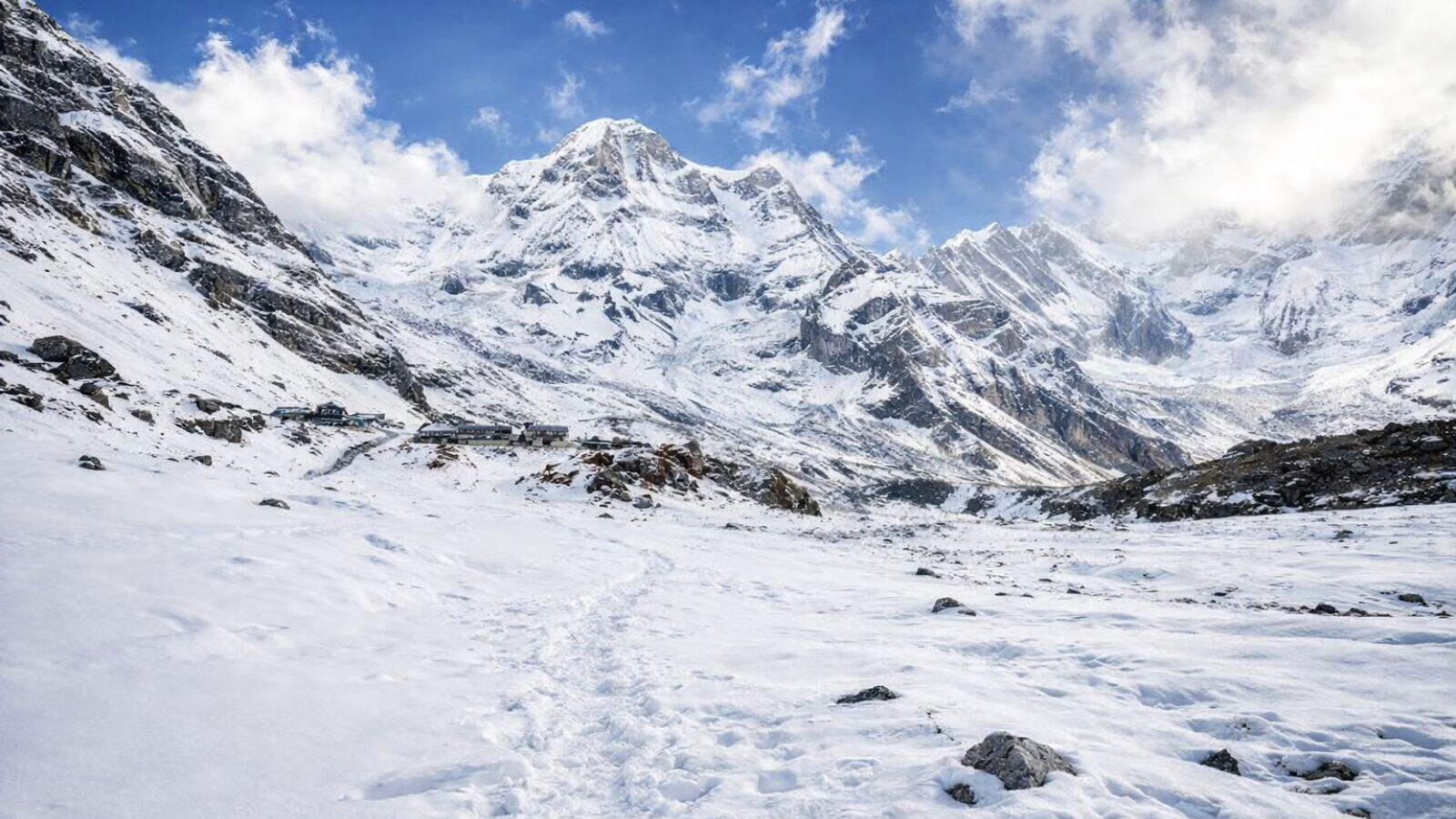
The Khumbu Icefall, visible from Everest Base Camp, is one of the most powerful natural sights on Earth. No other accessible trek puts you this close to an active glacier on the flanks of an 8,848.86m peak.
The ABC amphitheater, a natural bowl ringed by 7 peaks above 6,000m, creates a 360-degree panorama at the base camp that EBC does not replicate. Machhapuchhre (Fishtail Peak, 6,993m), sacred and officially unclimbed, dominates the ABC approach in a way that no single mountain dominates the EBC trail.
Which Trek Offers Better Mountain Views: EBC Trek or ABC Trek?
The EBC Trek delivers close-range views of 4 of the world's 14 eight-thousanders, while the ABC Trek offers an enclosed panoramic amphitheater of 7 Himalayan peaks above 6,000m. Neither is objectively superior, each delivers a distinct visual experience determined by geography, not quality.
Which Himalayan Peaks Can You See on the EBC Trek?
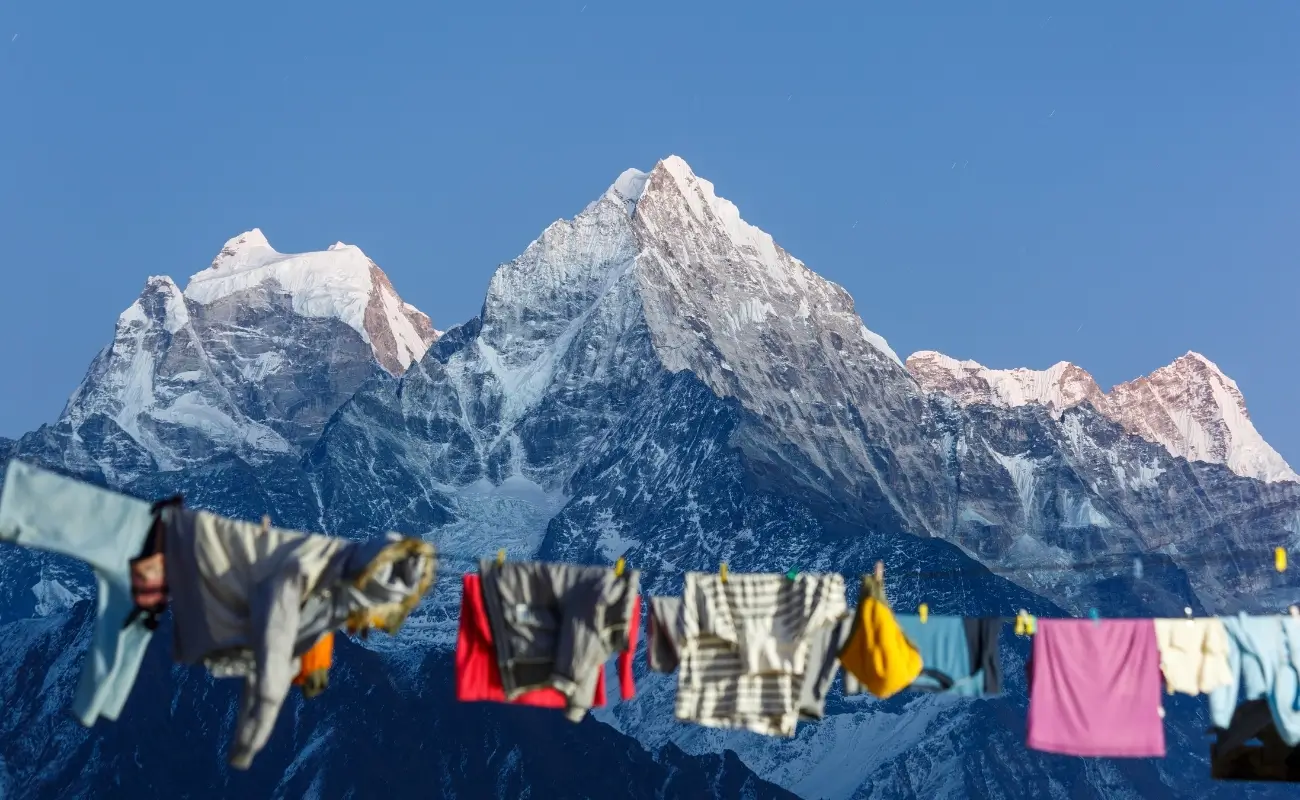 The EBC Trek reveals 4 eight-thousanders in clear conditions: Everest (8,848.86m), Lhotse (8,516m), Makalu (8,485m), and Cho Oyu (8,201m). From Kala Patthar (5,545m), the standard viewpoint above Gorak Shep, trekkers also see Nuptse (7,861m), Pumori (7,161m), and Ama Dablam (6,856m).
Ama Dablam is the standout aesthetic peak on the EBC route. Its distinctive pyramid shape appears from Tengboche onward and remains a constant trail companion across the upper Khumbu. Many experienced Himalayan trekkers rank the Ama Dablam views from Tengboche among the finest mountain viewpoints in Nepal, outside of Everest itself.
The summit view of Everest from Kala Patthar at sunrise is the single most photographed moment on the EBC Trek. Cloud cover typically clears by 8:00 AM in spring and autumn, giving a 2–3 hour window for unobstructed views.
Which Mountains Are Visible on the Annapurna Base Camp Trek?
The ABC Trek reveals Annapurna I (8,091m), Annapurna South (7,219m), Gangapurna (7,455m), Annapurna III (7,555m), Hiunchuli (6,441m), and Machhapuchhre (6,993m) from the base camp itself. This creates a circular mountain panorama that EBC's linear trail cannot replicate.
Machhapuchhre, officially closed to climbing since 1964 out of religious reverence, is the defining visual of the ABC Trek. Its double-summit fishtail shape is recognizable at every stage from Pokhara onward, offering continuous visual progression as you approach the base camp.
Poon Hill (3,210m), reached via the Ghorepani variant of the ABC route, provides sunrise views of Dhaulagiri (8,167m) and Annapurna I simultaneously, a view that many trekkers rank above the ABC base camp itself for photographic drama.
Which Trek Is More Difficult: Everest or Annapurna Trail?
The EBC Trek is harder than the Annapurna Base Camp Trek. EBC gains 2,504m in altitude above the starting point at Lukla (2,860m) and reaches 5,364m at base camp. ABC gains approximately 2,800m from Nayapul (1,070m) but peaks 1,234m lower than EBC.
How Do Altitude and Acclimatization Compare between EBC Trek and ABC Trek?
EBC requires 2 dedicated acclimatization days, one at Namche Bazaar (3,440m) and one at Dingboche (4,410m), to reduce the risk of Acute Mountain Sickness (AMS), High Altitude Cerebral Edema (HACE), and High Altitude Pulmonary Edema (HAPE). ABC rarely requires planned acclimatization days for healthy trekkers with moderate fitness.
At 5,364m, EBC sits well above the threshold where altitude sickness becomes a clinical risk: a 2021 Xtreme Everest field study of 332 trekkers ascending to 5,300m recorded AMS in 73.5% of participants, with just over half of all cases classified moderate-to-severe.
The standard EBC itinerary builds in 2 rest days precisely because the body requires 24–48 hours to produce additional red blood cells at altitude. Skipping these days is the leading cause of emergency evacuations on the Khumbu route.
ABC reaches 4,130m, a zone where mild AMS is possible but serious altitude illness is rare. Most physically prepared trekkers ascend and descend from ABC within the same day or with one overnight stay, reducing cumulative altitude exposure.
Which Trek Demands Better Physical Fitness: Annapurna or Everest Base Camp Trek?
The EBC Trek demands better physical fitness across 3 measurable dimensions: total trekking days (12–14 vs 7–12), daily elevation gain (400–700m per day vs 300–500m per day), and trail surface (rocky moraine paths vs forested stone steps).
The EBC trail above Namche Bazaar is uneven rocky terrain with minimal vegetation. Trekkers carry their weight over loose stones, glacial moraine, and exposed ridgelines for 6–8 hours per day. Knee stability and ankle strength are critical.
The ABC trail includes long sections of stone-cut stairs, particularly between Tikhedhunga and Ghorepani and on the descent from Chhomrong. These steps demand sustained lower body endurance rather than raw altitude fitness. Knee problems on the descent from ABC are the most common physical complaint, not altitude sickness.
A realistic preparation benchmark: complete 3 consecutive days of 6–8 hour hiking at 500m+ daily gain before attempting EBC. For ABC, 2 consecutive days at 400–500m daily gain constitutes adequate baseline preparation.
A training protocol that serves both treks: 8 weeks of consistent aerobic exercise (4 sessions per week), including 2 long hike days per week with a weighted pack of 7–10kg. Trekkers who complete this protocol before departure report measurably lower perceived exertion above 4,000m. Adding stair-climbing sessions to training specifically builds the quad endurance needed for the ABC descent, the most commonly underestimated physical demand on that route.
Which Trek Has Better Trails and Accommodation: Annapurna or Everest Base Camp Trek?
The EBC Trek has more developed but more expensive accommodation, while the ABC Trek offers better value tea houses with greater environmental variety. Both routes have established tea house networks, but the quality-to-price ratio favors ABC for budget-conscious trekkers.
What Are the Tea Houses Like on Annapurna and Everest Base Camp Trek?
EBC tea houses range from basic lodges in Lukla to increasingly well-appointed rooms in Namche Bazaar (3,440m), with heated dining rooms, attached bathrooms in some properties, and Wi-Fi available for a fee of NPR 200–500 (~$1.50–$4 USD) per hour. Above Namche, tea house quality stabilizes but prices rise with altitude.
A standard tea house room on the EBC route costs $5–$25 USD per night depending on altitude and season. Meals average $8–$15 USD per plate above Namche. The "meal deal", book accommodation and eat dinner and breakfast at the same lodge, remains the standard arrangement and gives leverage on room rates.
ABC tea houses in villages like Chhomrong (2,170m), Himalaya Hotel (2,920m), and Machhapuchhre Base Camp (3,700m) are clean, warm, and significantly cheaper at $4–$15 USD per night. The rhododendron forest section between Bamboo and Deurali is one of the most atmospheric stretches of trail accommodation in Nepal, small lodges embedded in ancient forest at 2,300–3,200m.
Which Route Offers Better Facilities and Connectivity: Everest or Annapurna Route?
The EBC route offers better connectivity below 4,000m, with mobile network coverage (NTC and Ncell) reaching Namche Bazaar and intermittent signal up to Dingboche. Above 4,200m, mobile data becomes unreliable and most trekkers rely on lodge Wi-Fi.
ABC has strong mobile connectivity between Pokhara and Ghorepani. Above Chhomrong, connectivity drops. The base camp at 4,130m has no reliable mobile network.
Emergency infrastructure differs significantly. The EBC route has the Himalayan Rescue Association (HRA) aid post in Pheriche (4,371m), staffed by licensed physicians during peak season, providing consultation and altitude sickness treatment within trekking distance. ABC has no equivalent staffed medical facility on the trail itself.
Which Trek Has Better Weather and the Best Seasons: Annapurna or Everest Base Camp Trek?
 Both treks share 2 optimal trekking windows: March–May (spring) and September–November (autumn). However, the ABC Trek is accessible in winter (December–February) with proper gear, while the EBC route above 4,500m carries a real risk of dangerous cold and snowfall in winter months.
When Is the Best Time to Trek to Everest Base Camp?
April and May are the best months for the EBC Trek because pre-monsoon conditions deliver stable weather, low wind, and maximum Himalayan clarity. The Khumbu region receives 600–700mm of annual precipitation, concentrated in the June–August monsoon window.
October and early November offer the second-best conditions: post-monsoon clarity and cooler temperatures. Night temperatures at Gorak Shep (5,140m) drop to -15°C to -20°C in October and reach -25°C to -30°C in January, conditions requiring serious cold-weather layering systems.
Avoid June, July, and August. Monsoon clouds obstruct views above 3,000m for days at a stretch, leeches infest lower trails, and trail conditions deteriorate.
When Is the Best Time to Trek to Annapurna Base Camp?
March and April are the best months for the ABC Trek because rhododendron forests bloom in full color between 2,000m and 3,500m, creating the most visually diverse trekking conditions in Nepal.
October and November deliver clear skies and stable conditions without the botanical spectacle. The ABC trail is walkable in December and January for trekkers with microspikes and insulated layers, though the section above Deurali (3,230m) can accumulate 30–50cm of snow after winter storms, creating avalanche risk on steep gully sections.
The monsoon (June–mid September) makes ABC more challenging than EBC due to the enclosed terrain. Avalanche and landslide risk increases on the narrow gorge above Bamboo during heavy rainfall.
Which Trek Is Safer: Annapurna Base Camp or Everest Base Camp Trek?
The EBC Trek carries higher objective risk due to altitude, flight dependency, and proximity to glacier hazards. The ABC Trek carries lower altitude risk but higher short-term weather-related risk in the upper gorge above 3,000m.
What Are the Main Risks on the EBC Trek?
The 4 main risks on the EBC Trek are altitude sickness (AMS, HACE, HAPE), flight cancellations at Lukla Airport (IATA: LUA), glacial debris on the Khumbu Icefall approach, and extreme cold above 4,500m.
Lukla Airport, officially Tenzing-Hillary Airport, operates under strict visual flight rules (VFR). A 3-day weather window closure strands trekkers and disrupts return schedules. Budget 2 buffer days in Kathmandu for the return flight when planning any EBC itinerary.
HAPE (High Altitude Pulmonary Edema) and HACE (High Altitude Cerebral Edema) are the two life-threatening altitude conditions on the EBC route. Symptoms include loss of coordination, confusion, and breathlessness at rest. Immediate descent of 500–1,000m resolves early cases. Helicopter evacuation from the Khumbu region averages $4,000–$6,000 USD, making comprehensive travel insurance with high-altitude evacuation coverage non-negotiable.
What Are the Main Risks on the Annapurna Base Camp Trek?
The 3 main risks on the ABC Trek are avalanche exposure in the Modi Khola gorge above Himalaya Hotel, altitude sickness above 3,500m, and rapid weather deterioration in the upper cirque.
While severe weather can occasionally impact the upper ABC gorge, the trail avoids the extreme avalanche and storm exposure that claimed at least 43 lives on the neighboring Annapurna Circuit (Thorong La Pass) during the October 2014 blizzard, as documented by BBC News's on-the-ground coverage of the rescue operation.
rekkers should still heed local guide judgment and Annapurna Conservation Area Authority (ACAA) updates during heavy precipitation. Trekkers who ignore early storm signs in the gorge face a narrow escape window. Local guide judgement and Annapurna Conservation Area Authority (ACAA) trail condition updates are the two most reliable safety resources.
Altitude sickness at ABC is less common than at EBC but not absent. Trekkers who ascend Poon Hill (3,210m) and continue directly to ABC without proper rest at Chhomrong sometimes experience AMS symptoms at 3,700–4,130m. For a complete breakdown of gorge-specific hazards and precautions, see our dedicated Annapurna Base Camp trek safety guide.
Both treks require travel insurance with high-altitude helicopter evacuation coverage. Review our guide to travel insurance and vaccinations before booking either route. The minimum recommended coverage ceiling is $100,000 USD for medical costs and $6,000 USD for helicopter evacuation. World Nomads, True Traveller, and IMG Global are 3 insurance providers with established claim records on Nepal Himalaya evacuations. Confirm that your policy explicitly covers trekking above 4,000m, standard adventure policies cap coverage at 3,000m or 4,000m and exclude the EBC route entirely.
Which Trek Costs More: Annapurna or Everest Base Camp Trek?
The EBC Trek costs more than the ABC Trek across every expense category. The cost gap ranges from $700–$1,500 USD for independent trekkers and $1,000–$2,000 USD for guided packages.
What Are the Typical Expenses for the EBC Trek?
The total cost of a self-organized EBC Trek with a licensed guide ranges from $1,500–$2,500 USD for 14 days, excluding international flights. The 5 main expense categories are flights, permits, guide and porter fees, food and accommodation, and travel insurance.
-
Kathmandu–Lukla round-trip flights: $360–$420 USD from Ramechhap, or ~$510 USD from Kathmandu (Tara Air, Summit Air, or Sita Air).
-
Sagarmatha National Park Entry Permit: NPR 3,000 (~$23 USD)
-
Khumbu Pasang Lhamu Rural Municipality Fee: ~$20 USD (Both permits are mandatory and checked at multiple checkpoints along the route, so trekkers should carry printed copies at all times. For a full breakdown of costs, processing steps, and where to apply, see our complete guide to the Everest Base Camp trek permit.)
-
Licensed guide fee: $25–$35 USD per day
-
Porter fee: $18–$25 USD per day (per 15kg bag)
-
Tea house accommodation: $5–$25 USD per night
-
Meals (3 per day): $15–$30 USD per day above Namche
-
Travel insurance with helicopter evacuation: $80–$150 USD
Avoid unregistered guides. Nepal Tourism Board–licensed guides carry official ID cards and provide documented emergency protocols, a protection absent with informal arrangements.
What Are the Typical Expenses for the Annapurna Base Camp Trek?
The total cost of a guided ABC Trek ranges from $800–$1,500 USD for 10 days, excluding international flights to Nepal. The 4 main expenses are permits, guide and porter fees, accommodation, and food.
-
Annapurna Conservation Area Permit (ACAP): NPR 3,000 (~$23 USD)
-
Licensed guide fee: NPR 3,000 (~$23 USD), obtainable in Kathmandu or Pokhara through TAAN or the Nepal Tourism Board office. Our full Annapurna Base Camp permit guide covers documentation, processing time, and checkpoint locations along the route.
-
Porter fee: $15–$22 USD per day
-
Tea house accommodation: $4–$15 USD per night
-
Meals (3 per day): $10–$20 USD per day
-
Pokhara–Nayapul transportation: $15–$25 USD round trip
No domestic flights are required for ABC. The $360–$510 USD flight cost alone makes EBC significantly more expensive before counting higher-altitude food and accommodation premiums.
Which Trek Is Better for Beginners?
The Annapurna Base Camp Trek is better for beginner trekkers. ABC's lower maximum altitude (4,130m vs 5,364m), shorter duration (7–12 days vs 12–14 days), road-accessible start point, and lower emergency risk create a safer and more manageable first Himalayan trekking experience.
Is Annapurna Base Camp Easier for First-Time Trekkers?
ABC is easier for first-time trekkers across 4 specific dimensions: altitude ceiling, trip duration, cost, and logistical complexity. A first-time trekker who completes ABC develops the altitude experience, tea house culture familiarity, and physical conditioning that directly prepares them for EBC on a subsequent trip.
The ABC trail includes training terrain. The 1,140m ascent from Tikhedhunga to Ghorepani, 3–4 hours of sustained stone-step climbing, teaches pacing discipline and tests baseline fitness without the consequences of underperformance at dangerous altitude. This section functions as a natural filter.
What most first-timers overlook: the emotional confidence gained from reaching a Himalayan base camp at 4,130m is the most important outcome of an ABC Trek. That confidence translates directly into realistic preparation for EBC.
Who Should Choose the Everest Base Camp Trek?
Trekkers who choose EBC are experienced hikers with prior multi-day trekking history at altitude above 3,500m, adequate fitness for 6–8 hours of daily walking on rocky terrain, flexibility for weather delays at Lukla, and a budget of $1,500 USD or more.
EBC is also the right choice for trekkers motivated specifically by the experience of walking to the foot of the world's tallest mountain, a goal that no other trek in Nepal fulfills. If standing on the Khumbu Glacier moraine with Everest's southwest face above you is the specific objective, no substitute exists.
Which Trek Offers a Better Cultural Experience: Annapurna or Everest Base Camp Trek?
Both treks deliver rich cultural experiences, but through entirely different ethnic traditions. The EBC Trek immerses trekkers in Sherpa Buddhist culture across 14 days in the Khumbu. The ABC Trek introduces Gurung and Magar village life in the mid-hills of the Annapurna region.
What Sherpa Culture Can You Experience on the EBC Trek?
The EBC Trek exposes trekkers to 5 direct Sherpa cultural touchpoints: Tengboche Monastery (3,867m), mani walls and prayer flags throughout the Khumbu, the Namche Bazaar weekly market, traditional lodge hospitality, and the mountaineering heritage displayed at the Sherpa Culture Museum in Namche.
Tengboche Monastery, the largest gompa in the Khumbu region, performs daily Buddhist rituals accessible to respectful visitors. The monastery was rebuilt in 1989 after a fire destroyed the original 1923 structure and stands as the spiritual center of Sherpa identity.
The Mani Rimdu festival at Tengboche (October–November) draws Sherpa communities from across the Khumbu and is one of the most authentic cultural spectacles in the Nepal Himalaya. Trekkers on the autumn EBC route witness it without special arrangement.
What Gurung and Magar Culture Can You Experience on the ABC Trek?
The ABC Trek offers cultural engagement with Gurung people in 3 primary villages: Ghandruk (1,940m), Chhomrong (2,170m), and Kimche, each with traditional stone architecture, cultural museums, and community-run tea houses operated by local families.
Ghandruk, a former Gurkha recruitment village, has the Ghandruk Gurung Museum, which documents Gurung military history, traditional costume, weaving techniques, and oral traditions. The village architecture of flat-roofed stone houses arranged on steep hillsides is distinctly different from both Kathmandu valley and the Khumbu.
Magar communities in lower villages like Landruk and Tolka maintain traditions around jhankri (shamanic healing), spring fertility rituals, and hand-loom weaving. Cultural interaction at this level is more accessible on ABC than on EBC, where the commercialization of Namche Bazaar has distanced the visible cultural layer from authentic community life.
Which Trek Should You Choose Based on Your Travel Goals: Annapurna or Everest Base Camp Trek?
Your travel goal is the primary determinant. Altitude challenge and proximity to the world's highest peak favor EBC. Scenic diversity, shorter duration, affordability, and cultural immersion in accessible terrain favor ABC.
Which Trek Is Better for Adventure and High-Altitude Challenges: Annapurna or Everest Base Camp Trek?
The EBC Trek is better for high-altitude adventure. It reaches 5,364m at base camp and 5,545m at Kala Patthar, placing trekkers in a zone where only 17% of the Earth's atmosphere sits below them. The Khumbu Icefall, visible at close range from base camp, is active glacial terrain that communicates geological scale and real mountaineering danger in a way no lower-altitude trek replicates.
Trekkers who extend the standard EBC route with the Gokyo Lakes variant, adding 2 days and the Renjo La Pass (5,360m), experience 4 of the world's six largest glaciers above 5,000m. This extension transforms EBC from a base camp trek into a genuine high-altitude circuit.
Which Trek Is Better for Scenic Variety and Shorter Itineraries: ABC Trek or EBC Trek?
The ABC Trek delivers superior scenic variety within a shorter 7–10 day itinerary. The trail passes through 5 distinct ecological zones, subtropical farmland, oak and rhododendron forest, bamboo jungle, alpine meadow, and glacial terrain, in a single directional push.
Trekkers who complete the Ghorepani–Poon Hill variant before entering the ABC cirque experience the full ecological spectrum across 8 days: Pokhara's subtropical valley (800m) to glacial amphitheater (4,130m) with sunrise views from Poon Hill (3,210m) in between.
ABC's shorter itinerary makes it the practical choice for trekkers with 10-day Nepal trips, professionals with limited leave, and travelers combining trekking with other Nepal activities like white-water rafting on the Trishuli River or wildlife safaris in Chitwan National Park.
How Can a Professional Trekking Agency Help You Choose the Right Trek?
A licensed Nepal trekking agency reduces trek selection risk by matching your fitness assessment, available days, budget, and altitude history to the correct route, permit timeline, and guide assignment before you arrive in Nepal. Agencies with Nepal Tourism Board (NTB) registration provide documented services, emergency protocols, and legally protected client arrangements that freelance guides cannot offer.
Can Our Trekking Agency Help You Plan the Best EBC or ABC Trek?
Yes. Our team plans both EBC and ABC itineraries for trekkers at every experience level, with custom day-by-day schedules, permit processing, NTB-licensed guides, and porter assignments included in every package.
The most common mistake we observe in client inquiries: trekkers choosing EBC based on brand recognition without assessing their altitude tolerance or fitness baseline. A trekker who develops HAPE at 4,800m on the EBC route faces a $5,000 helicopter evacuation bill and ends the trip early. A trekker who completes ABC first, then returns for EBC the following year with baseline altitude experience, completes both successfully.
We assess 4 client readiness factors before recommending an itinerary: prior high-altitude trekking history, current physical conditioning, available trek days, and medical history. This 20-minute consultation prevents the most common Nepal trekking failures.
Contact us to book a free itinerary consultation. Our agency holds Nepal Tourism Board registration, Trekking Agencies' Association of Nepal (TAAN) membership, and a decade of verifiable client reviews on TripAdvisor and Google.
What Are the Key Takeaways When Comparing EBC Trek vs Annapurna Base Camp?
The 6 key takeaways from the EBC Trek vs Annapurna Base Camp comparison are altitude difference, duration, cost, difficulty, beginner suitability, and cultural experience.
-
Altitude: EBC reaches 5,364m; ABC reaches 4,130m, a 1,234m difference that defines all difficulty and safety comparisons
-
Duration: EBC requires 12–14 days minimum; ABC completes in 7–12 days
-
Cost: EBC costs $1,500–$3,500 USD guided; ABC costs $800–$2,000 USD guided, with the domestic flight to Lukla accounting for $280–$350 USD of the EBC premium
-
Difficulty: EBC is moderate-to-challenging with mandatory acclimatization; ABC is moderate without structured rest days required
-
Beginner suitability: ABC is the correct first Himalayan trek; EBC suits trekkers with prior altitude experience above 3,500m
-
Cultural experience: EBC delivers Sherpa Buddhist immersion; ABC delivers Gurung and Magar community access in mid-hill village settings
Neither trek is universally better. The better trek is the one that matches your current physical capacity, budget, available days, and specific mountain experience goals. Both deliver experiences that remain reference points for any trekker's lifetime.
The right next step: assess your fitness honestly, confirm your available trek days, and consult a registered Nepal trekking agency before booking. Your trek outcome is determined by preparation, not by which route is more famous.
More About Author

Khilak Budhathoki
Travel Director
Khilak Budhathoki is the co-founder and lead trekking guide at Himalaya Trekking Nepal, a locally owned and operated adventure company based in Kathmandu. Born and raised in the foothills of Nepal, Khilak developed a deep love for the mountains from an early age. With over a deca...

USD$1,600 pp
Our Recommendation
Related Blogs