- 05, Jul 2026 | Khilak Budhathoki
Everest Base Camp Trek Route Map is the complete guide to planning one of Nepal's most iconic high-altitude trekking adventures. Understanding the route before starting the trek helps you prepare for daily elevation changes, acclimatization stops, trekking distances, village locations, trail conditions, and logistical decisions that directly affect both safety and success. Whether you are following the classic Lukla route, comparing alternative approaches from Jiri or Tham Danda, or choosing between the standard Everest Base Camp trek and longer routes through Gokyo Lakes or the Three Passes, a detailed route map provides the foundation for informed planning.
This guide explains every stage of the Everest Base Camp trekking route, from reaching Lukla and navigating the Khumbu Valley to passing Sherpa villages, suspension bridges, monasteries, glaciers, and panoramic viewpoints before arriving at Everest Base Camp and Kala Patthar. You'll also find a complete day-by-day itinerary, elevation profile, trekking distances, acclimatization strategy, permit requirements, seasonal considerations, route alternatives, and essential safety information, giving you a comprehensive understanding of the entire Everest Base Camp route before beginning your journey.
Where Does the Everest Base Camp Trek Begin?
The Everest Base Camp Trek begins in Lukla, a Sherpa village in Nepal's Solukhumbu District, Koshi Province, at 2,860 meters (9,383 feet). Most trekkers fly from Kathmandu's Tribhuvan International Airport to Tenzing-Hillary Airport in Lukla, which serves as the primary gateway to the entire Khumbu trekking corridor.
How Do You Reach Lukla?
Trekkers reach Lukla via a 35–40 minute scenic mountain flight from Kathmandu's domestic terminal. Flights depart between 6:00 AM and 9:00 AM, operating within the narrow morning weather window before valley clouds close the flight corridor. The one-way flight costs between USD 180–220 per person in 2026, depending on airline and season.
Tenzing-Hillary Airport ranks among the world's most technically demanding airports. Its 527-meter runway ends at a cliff edge and slopes at a 12-degree incline. Weather cancellations are common from December through February and throughout the June–August monsoon period. Booking 2 buffer days in Lukla before the trek begins is standard practice among experienced guides.
3 major airlines operate Kathmandu-to-Lukla flights: Tara Air, Summit Air, and Sita Air. Tara Air operates the largest fleet on this corridor. Trekkers flying during peak spring season (late April and May) benefit from departing from Ramechhap Airport (Manthali), located 132 km east of Kathmandu. Ramechhap flights take 20 minutes versus 40 minutes from Kathmandu and bypass congestion-related delays that affect 30–40% of Kathmandu-Lukla flights during April.
What Are the Main Starting Points for the Everest Base Camp Trek?
The 3 main starting points for the Everest Base Camp trek are Lukla, Tham Danda / Surke, and Jiri, each offering a distinct altitude gain profile and time commitment.
-
Lukla (2,860 m): The standard starting point, used by 90% of trekkers. The trail departs Lukla's main gate, descends briefly to the Dudh Koshi River valley, then follows the river northward through a series of pine and rhododendron forests.
-
Tham Danda / Surke (2,290 m): The entry point for trekkers who take overland transport from Kathmandu. Thanks to recent road extensions past Salleri, 4WD jeeps now drive all the way to Tham Danda or Surke (situated just below Lukla). This approach saves the Lukla flight cost and takes only 1 to 2 trekking days to join the main route at Phakding or Namche Bazaar but provides more gradual altitude gain for altitude-sensitive trekkers.
-
Jiri (1,905 m): The historic starting point used by Sir Edmund Hillary and Tenzing Norgay's 1953 expedition support team. The Jiri-to-Namche section adds 7–10 days, crosses 5 mountain ridges above 3,000 meters, and provides the most gradual acclimatization profile of any EBC approach. Jiri remains the preferred start for trekkers prioritizing maximum physiological preparation.
What Is the Complete Everest Base Camp Trek Route?
.webp) The complete EBC trek route follows a linear path from Lukla through the Khumbu valley, passing through Phakding, Namche Bazaar, Tengboche, Dingboche, Lobuche, and Gorak Shep before reaching Base Camp at 5,364 meters. The route traces the Dudh Koshi River to Namche, then follows the Imja Khola River system through the upper Khumbu toward the Khumbu Glacier.
The complete EBC trek route follows a linear path from Lukla through the Khumbu valley, passing through Phakding, Namche Bazaar, Tengboche, Dingboche, Lobuche, and Gorak Shep before reaching Base Camp at 5,364 meters. The route traces the Dudh Koshi River to Namche, then follows the Imja Khola River system through the upper Khumbu toward the Khumbu Glacier.
Which Villages Do You Pass Along the Everest Route?
The 11 primary villages along the EBC trek route, sequenced from Lukla to Base Camp:
-
Lukla (2,860 m): Start point; commercial hub with teahouses, gear shops, bakeries, and a pharmacy
-
Phakding (2,610 m): First overnight stop; situated in the Dudh Koshi River valley beneath forested ridgelines
-
Monjo (2,835 m): Entry checkpoint for Sagarmatha National Park; permits are verified here
-
Namche Bazaar (3,440 m): Khumbu's commercial capital; the mandatory primary acclimatization hub
-
Tengboche (3,860 m): Site of the largest active monastery in Khumbu; direct Everest views
-
Dingboche (4,410 m): Second mandatory acclimatization village; views of Ama Dablam and Island Peak
-
Periche (4,371 m): Alternative stop to Dingboche; hosts the Himalayan Rescue Association's high-altitude medical clinic
-
Thukla/Dughla (4,620 m): Memorial site for victims of the 1996 Khumbu avalanche and other Everest fatalities
-
Lobuche (4,940 m): Final significant overnight stop before Gorak Shep; sits on Khumbu Glacier moraine
-
Gorak Shep (5,164 m): Last permanent settlement before Base Camp; staging point for Kala Patthar
-
Everest Base Camp (5,364 m): Final destination on the Khumbu Glacier at the foot of the Khumbu Icefall
What Is the Day-by-Day Everest Base Camp Trekking Route?
The standard 12-day EBC trekking itinerary (excluding Kathmandu arrival and departure days) follows this sequence:
|
Day |
Route Segment |
Overnight Altitude |
Walking Time |
|
1 |
Fly Kathmandu → Lukla; trek to Phakding |
2,610 m |
3–4 hours |
|
2 |
Phakding → Namche Bazaar |
3,440 m |
5–6 hours |
|
3 |
Acclimatization day in Namche Bazaar |
3,440 m |
4-hour hike to Everest View Hotel |
|
4 |
Namche Bazaar → Tengboche |
3,860 m |
5–6 hours |
|
5 |
Tengboche → Dingboche |
4,410 m |
5–6 hours |
|
6 |
Acclimatization day in Dingboche |
4,410 m |
Hike to Nagarjun Hill (5,100 m) |
|
7 |
Dingboche → Lobuche |
4,940 m |
5–6 hours |
|
8 |
Lobuche → Gorak Shep → Everest Base Camp |
5,164 m |
7–8 hours |
|
9 |
Gorak Shep → Kala Patthar → Pheriche |
4,371 m |
7–8 hours |
|
10 |
Pheriche → Namche Bazaar |
3,440 m |
5–6 hours |
|
11 |
Namche Bazaar → Lukla |
2,860 m |
6–7 hours |
|
12 |
Fly Lukla → Kathmandu |
, |
Buffer flight day |
What most route guides omit: Day 3 in Namche is not passive recovery. The recommended acclimatization hike to Everest View Hotel (3,880 m) activates the body's erythropoietin (EPO) response, a hormone released by the kidneys that stimulates red blood cell production. Trekkers who complete this hike show measurably lower acute mountain sickness (AMS) incidence rates at Dingboche compared to trekkers who spend Day 3 entirely sedentary at Namche.
Where Does the Trek End?
The EBC trek ends at Everest Base Camp (5,364 m), located on the Khumbu Glacier within Sagarmatha National Park. The site is a seasonal mountaineering camp, occupied by expedition teams from March through early June. Outside expedition season, the terrain is raw glacial moraine, loose rocks, seracs, and prayer flags mark the endpoint on the ice. The return journey follows the same ascent route, and most trekkers complete the full round-trip in 12–14 days from Lukla.
What Are the Major Stops on the EBC Trek Route Map?
The 5 major stops on the EBC trek route map are Namche Bazaar (3,440 m), Tengboche (3,860 m), Dingboche (4,410 m), Lobuche (4,940 m), and Gorak Shep (5,164 m). Each location serves a distinct functional role, acclimatization hub, cultural landmark, resupply point, or final staging area, not simply an overnight village.
Why Is Namche Bazaar an Important Stop?
Namche Bazaar (3,440 m) is the single most critical stop on the EBC route for 3 distinct reasons: physiological acclimatization, logistical resupply, and permit verification.
Physiologically, Namche sits at the altitude threshold where AMS risk increases sharply. Spending 2 nights here triggers hemoglobin production and adjusts arterial oxygen saturation before the trail ascends above 4,000 meters. Trekkers who skip or compress Namche's acclimatization day account for a disproportionate share of helicopter evacuations above Tengboche, according to field data from the Himalayan Rescue Association (HRA) Kathmandu clinic.
Logistically, Namche is the last location on the route with reliable ATMs, a well-stocked trekking gear market, and consistent internet connectivity. A functional medical clinic (Khunde Hospital) is located in the neighboring village of Khunde, which requires a steep 45- to 60-minute uphill hike from Namche. Above Namche, these services become unavailable or severely limited.
The Sagarmatha National Park headquarters is located at Namche and displays current topographic maps of the full EBC route, free to consult. These maps provide more accurate current trail condition information than most digital mapping apps.
What Can You Expect at Tengboche?
Tengboche (3,860 m) delivers the most dramatic multi-peak panorama on the EBC route. From the monastery courtyard, trekkers view Everest (8,849 m), Lhotse (8,516 m), Nuptse (7,861 m), and Ama Dablam (6,812 m) simultaneously, a 4-summit view available at no other single point on the standard trail.
Tengboche Monastery, formally named Dawa Choling Gompa, is the largest active monastery in the Khumbu region. The monastery was founded in 1916 by Lama Gulu, rebuilt after a fire in 1934, and reconstructed again after a second fire in 1989. Afternoon puja ceremonies begin at 3:00 PM daily and are open to respectful visitors. Attendees remove footwear, maintain silence during chanting, and refrain from photography inside the prayer hall.
The elevation gain from Namche (3,440 m) to Tengboche (3,860 m) is 420 meters. The section from Phunki Tenga river crossing to Tengboche monastery involves a sustained 600-meter ascent taking 90–120 minutes at altitude, one of the single longest unbroken climbs on the entire EBC route.
Why Are Dingboche and Lobuche Key Acclimatization Points?
Dingboche (4,410 m) and Lobuche (4,940 m) are the 2 critical acclimatization checkpoints above 4,000 meters because both implement the "climb high, sleep low" protocol at the precise altitudes where AMS, HAPE, and HACE risk peaks.
At Dingboche, the standard acclimatization hike ascends to Nagarjun Hill (5,100 m), a 690-meter elevation gain, before returning to sleep at 4,410 m. This single-day altitude spike followed by descent is one of the most effective adaptation strategies on the EBC corridor. A more demanding acclimatization option ascends to Chhukung Ri (5,550 m), adding additional EPO stimulation for trekkers planning to summit Kala Patthar.
Lobuche (4,940 m) sits on the terminal moraine of the Khumbu Glacier. The 520-meter gain from Dingboche to Lobuche crosses the Thukla Pass (4,620 m), a section where the trail passes stone memorials dedicated to climbers who died on Everest, including memorials to Scott Fischer and Rob Hall from the 1996 disaster. Spending 1 night at Lobuche before the Gorak Shep-to-Base Camp push provides approximately 18 additional hours of altitude adaptation and reduces summit fever decision-making under cognitive impairment at altitude.
According to a peer-reviewed study of trekkers ascending the Everest Base Camp route (Physiological responses during ascent to high altitude and the incidence of acute mountain sickness), 73.5% of participants developed some degree of acute mountain sickness, with over half experiencing moderate-to-severe symptoms, underscoring why the intermediate night at Lobuche and disciplined pacing above Dingboche are not optional steps.
What Makes Gorak Shep the Final Village?
Gorak Shep (5,164 m) is the highest permanently occupied settlement on the EBC route, positioned on a dried glacial lake bed on the Khumbu Glacier terminal moraine. It serves as the final overnight base before both Everest Base Camp and Kala Patthar.
The village operates 4–5 teahouses during the trekking seasons (March–May and October–November). Accommodation quality at Gorak Shep drops significantly compared to Namche or Dingboche, mattresses are thin, heating is minimal, and meal options are limited. At 5,164 m, available oxygen is approximately 52% of sea-level concentration, and both trekkers and teahouse staff operate under measurable cognitive impairment.
Experienced guides recommend arriving at Gorak Shep by 1:00 PM, resting for 2–3 hours, then trekking to EBC in late afternoon. The 4 km trail from Gorak Shep to Base Camp crosses the Khumbu Glacier moraine, a technically non-demanding route over loose rock that takes 90–120 minutes in each direction at altitude walking pace.
How Long Is the Everest Base Camp Trek Route?
The Everest Base Camp trek route covers approximately 130 kilometers round-trip, with 65 kilometers from Lukla to Base Camp and 65 kilometers on the return journey. Total elevation gain on the one-way ascent from Lukla to EBC is approximately 2,504 meters.
How Many Kilometers Is the Everest Base Camp Trek?
Precise distance measurements for each major segment of the EBC route:
|
Route Segment |
One-Way Distance |
Net Elevation Change |
|
Lukla → Namche Bazaar |
18 km |
+580 m gain |
|
Namche Bazaar → Tengboche |
10 km |
+420 m gain |
|
Tengboche → Dingboche |
12 km |
+550 m gain |
|
Dingboche → Lobuche |
11 km |
+530 m gain |
|
Lobuche → Gorak Shep |
4.5 km |
+224 m gain |
|
Gorak Shep → Everest Base Camp |
4 km |
+200 m gain |
|
Total: Lukla → EBC |
~65 km |
+2,504 m gain |
These figures represent trail distance, not linear distance. The Khumbu terrain involves multiple switchbacks, river crossings, and undulating moraine sections that add 15–20% to any straight-line measurement shown on standard map applications. For a day-by-day breakdown of walking distance against elevation gained, see our daily distance and altitude chart. GPS track measurements from documented EBC completions consistently record 63–68 km one-way depending on the specific path taken.
How Many Days Does the Standard Route Take?
The standard EBC trek requires 12–14 days total, incorporating 2 mandatory acclimatization days (Namche Bazaar and Dingboche) and 1–2 buffer days for Lukla flight delays. Physically fit trekkers with prior high-altitude experience above 4,000 m complete the route safely in 12 days. First-time high-altitude trekkers perform best on a 14-day schedule.
Guides who market EBC completion in 10 days or fewer are compressing the acclimatization schedule below the safety threshold. The Wilderness Medical Society's 2024 altitude illness guidelines recommend ascending no more than 500 meters of sleeping altitude per day above 3,000 meters, with a rest day every 3 to 4 days. Any itinerary below 12 days violates this threshold between Dingboche and Lobuche.
What Is the Elevation Profile of the EBC Trek Route?
The EBC trek elevation profile rises from 2,860 meters at Lukla to a maximum of 5,545 meters at Kala Patthar, with a net elevation gain of 2,685 meters on the one-way route. The profile is not a smooth gradient, it includes 4 significant descent sections followed by steeper re-ascents, which is the component most trekkers underestimate during planning.
Which Locations Have the Highest Altitudes on EBC Route?
The 5 highest-altitude locations on the standard EBC route:
-
Kala Patthar: 5,545 m (highest accessible point on the standard route; 181 meters above Base Camp)
-
Everest Base Camp: 5,364 m (primary destination on the Khumbu Glacier)
-
Gorak Shep: 5,164 m (highest overnight stop on the standard route)
-
Lobuche: 4,940 m (second-highest overnight stop; moraine terrain)
-
Thukla Pass: 4,620 m (highest trail crossing between Dingboche and Lobuche)
Kala Patthar surpasses Base Camp by 181 meters in altitude and provides a clearer sightline to Everest's summit pyramid from the south. This is the primary reason experienced Himalayan trekkers prioritize Kala Patthar at sunrise over an afternoon Base Camp visit.
Where Should You Acclimatize on EBC Route?
The 2 mandatory acclimatization stops on the EBC route are Namche Bazaar (3,440 m) and Dingboche (4,410 m). A third optional acclimatization night at Lobuche (4,940 m) is recommended for trekkers showing slow oxygen saturation recovery rates at Dingboche.
The physiological principle applied at both stops is "climb high, sleep low", ascend 300–500 meters during the day, return to a lower sleeping altitude. This protocol triggers erythropoietin (EPO) release from the kidneys, stimulating red blood cell production over a 24–48 hour cycle. Hemoglobin levels measurably increase after 36–48 hours at altitude, improving oxygen delivery to muscles and the brain.
4 warning signs of acclimatization failure to monitor at altitude:
-
Persistent headache unresponsive to ibuprofen (400 mg) or paracetamol (500 mg) after 2 doses
-
Loss of appetite or nausea persisting beyond 12 hours at a new altitude
-
Ataxia (loss of coordination or difficulty walking in a straight line)
-
Confusion or altered consciousness at any altitude above 3,500 m
Any trekker displaying 2 or more of these signs at altitude requires immediate descent of at least 500 vertical meters.
What Are the Main Landmarks Along the EBC Route?
The 6 main landmarks along the EBC route are Tenzing-Hillary Airport, Hillary Suspension Bridge, Sagarmatha National Park Gate, Tengboche Monastery, Khumbu Icefall viewpoint at Base Camp, and Kala Patthar. Each marks a distinct transition in terrain, altitude, or cultural context.
Where Is Kala Patthar Located?
Kala Patthar (5,545 m) sits directly above Gorak Shep village on the southern ridge of Pumori mountain, approximately 45–60 minutes from Gorak Shep at altitude hiking pace. The name translates from Nepali as "Black Rock", referencing the dark volcanic rock formation at its summit.
The summit delivers the most comprehensive Everest view accessible without technical climbing equipment. On a clear day, the South Face, Khumbu Icefall, Western Cwm, Lhotse (8,516 m), Nuptse (7,861 m), and the entirety of Base Camp are visible simultaneously. Pre-dawn summiting (4:00–5:00 AM) provides optimal visibility before orographic cloud buildup, which typically obscures views between 9:00 AM and 11:00 AM. Trekkers planning the timing, gear, and photography settings for this climb can consult our full Kala Patthar sunrise hike guide.
Kala Patthar requires no technical gear. No ropes, crampons, or ice axes are needed on the standard approach. The challenge is purely physiological, at 5,545 m, available oxygen is approximately 50% of sea-level concentration, and trekkers' heart rates at rest often exceed 100 bpm.
Which Suspension Bridges, Monasteries, and Viewpoints Are on the Everest Route?
The EBC route features 8 major suspension bridges, 3 significant monasteries, and 4 primary panoramic viewpoints, each contributing a distinct experience along the trail.
8 Major Suspension Bridges on the EBC Route:
-
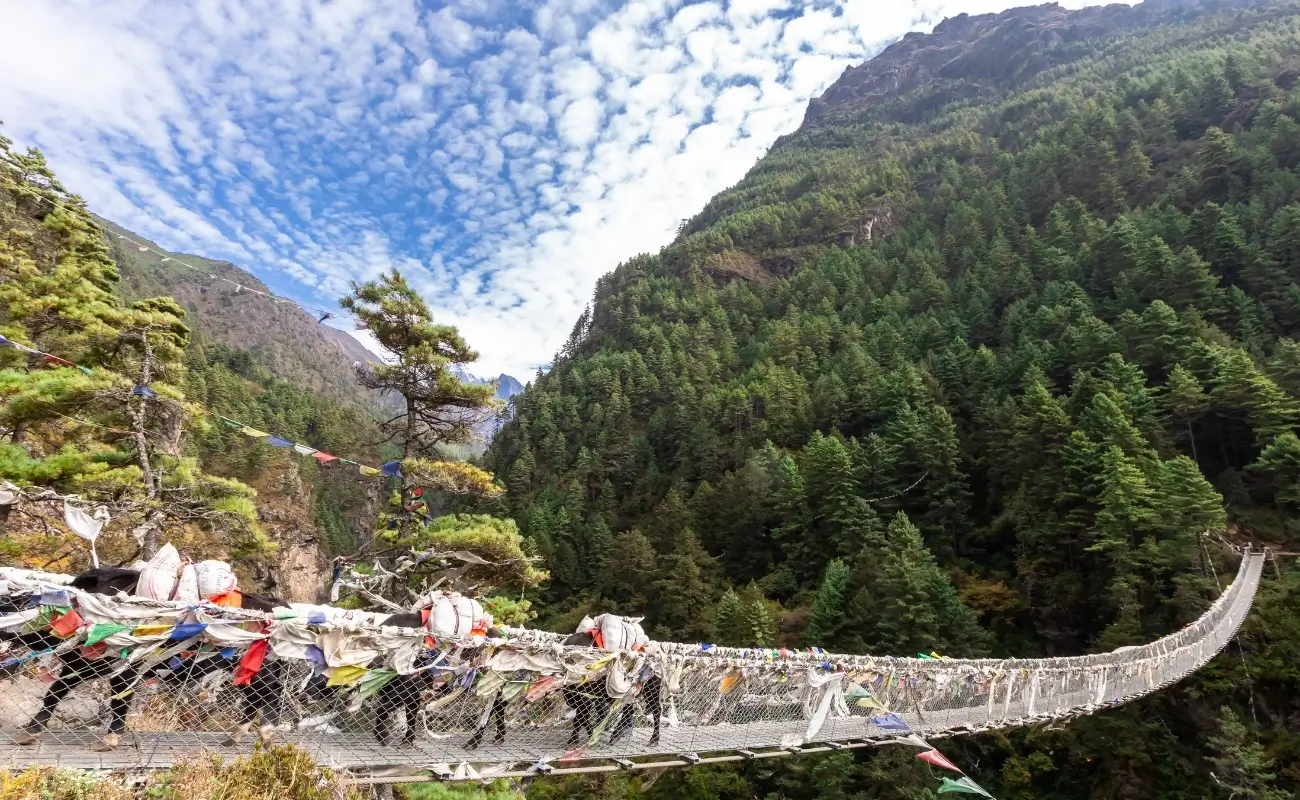
Hillary Suspension Bridge: Phakding (2,652 m); 60-meter span over the Dudh Koshi River; most photographed bridge on the trail
-
Tenzing-Norgay Bridge: Namche approach; high-wire crossing above the Dudh Koshi gorge at approximately 3,100 m
-
3 bridges between Monjo and Namche Bazaar: Rapid altitude gain section; bridges cross the Dudh Koshi River at different heights
-
2 bridges between Namche and Tengboche: Cross the Phunki Tenga tributary above forested gorges
-
1 bridge approaching Dingboche: Spans the Imja Khola River before the trail climbs to the upper Khumbu plateau
3 Significant Monasteries:
-
Tengboche Monastery (Dawa Choling Gompa): 3,860 m; largest active monastery in Khumbu; founded 1916; 3:00 PM daily puja open to visitors
-
Thyangboche Monastery: Shares the Tengboche site; houses resident lamas during non-festival periods
-
Pangboche Monastery: 3,901 m; oldest monastery in Khumbu, founded 1667; 45-minute detour off the main trail but highly recommended for cultural depth
4 Primary Viewpoints:
-
Everest View Hotel viewpoint: Namche acclimatization hike (3,880 m); first confirmed Everest view on the standard route
-
Tengboche Monastery courtyard: 3,860 m; best simultaneous 4-peak panorama (Everest, Lhotse, Nuptse, Ama Dablam)
-
Kala Patthar summit: 5,545 m; closest and clearest Everest view on the non-technical EBC route
-
Kala Patthar western ridge: 360-degree panorama including Cho Oyu (8,188 m), Makalu (8,485 m), and the full Khumbu Glacier
What Alternative Everest Base Camp Routes Can You Choose?
The 3 main alternative EBC routes are the Gokyo Lakes Route, the Three Passes Trek, and the Jiri overland approach. Each offers distinct advantages in terrain, crowd levels, altitude profile, or cultural experience compared to the standard Lukla-to-EBC corridor.
How Does the Gokyo Lakes Route Compare?
The Gokyo Lakes Route diverges from the standard EBC trail at Namche Bazaar, turning northwest through the Gokyo Valley. This route ascends to Gokyo Ri (5,357 m) and passes 5 pristine glacial lakes at altitudes between 4,700 and 5,000 meters before optionally crossing the Cho La Pass (5,420 m) to connect with the EBC trail near Lobuche.
Key differences between the standard route and the Gokyo Lakes alternative:
|
Factor |
Standard EBC Route |
Gokyo Lakes Route |
|
One-way distance |
~65 km |
~80 km |
|
Total duration |
12–14 days |
14–18 days |
|
Maximum altitude |
5,545 m (Kala Patthar) |
5,357 m (Gokyo Ri) |
|
Peak season trekker volume |
500–1,000/day (Namche–Tengboche) |
150–300/day |
|
Technical sections |
None on standard trail |
Cho La Pass: moderate technical |
|
Unique feature |
Direct EBC access |
5 glacial lakes; Ngozumpa Glacier views; 60% less crowded |
Trekkers who prioritize wilderness solitude, glacial lake photography, and less congested trails consistently rate the Gokyo Lakes route as the superior scenic experience in the Khumbu region.
The Ngozumpa Glacier, Nepal's longest glacier at approximately 36 km and reaching from 4,700 m to over 8,000 m in elevation (per field research published by ICIMOD, the International Centre for Integrated Mountain Development), is exclusively visible from the Gokyo Valley approach.
Those wanting both the lakes and Base Camp in one itinerary can combine them on the Everest Base Camp Gokyo Lake trek.
What Is the Three Passes Trek Route?
The Three Passes Trek is the most complete circuit of the Khumbu region, crossing 3 high mountain passes: Renjo La (5,360 m), Cho La (5,420 m), and Kongma La (5,535 m). The route visits both Gokyo Lakes and Everest Base Camp within a single 18–21 day itinerary and covers approximately 160 km of trail distance.
The Three Passes Trek requires:
-
Prior high-altitude trekking experience above 4,500 m
-
Microspikes or light crampons for Cho La Pass (ice-covered during early morning hours)
-
A minimum 18-day itinerary; no compression below 16 days
-
Emergency evacuation fund of USD 3,000–5,000 (or equivalent altitude-specific travel insurance)
This route eliminates trail repetition entirely, no section is trekked twice in the same direction. It is the preferred choice for returning Khumbu trekkers and those combining the EBC experience with maximum Himalayan circuit coverage.
Can You Trek to EBC Without Flying to Lukla?
Yes, 3 overland alternatives to the Lukla flight exist: the Jiri route, the Tham Danda / Surke route, and the Ramechhap-to-Phaplu jeep-and-trek combination.
The Jiri Route is the most historically significant overland approach. Starting at Jiri (1,905 m), the trail follows the path used by John Hunt's 1953 Everest expedition team. It takes 7–10 additional trekking days to reach Namche Bazaar from Jiri, crossing 5 distinct mountain ridges above 3,000 meters through the Solu-Khumbu hill districts. This route provides the most gradual altitude gain of any EBC approach, trekkers arrive at Namche Bazaar with measurably better acclimatization than those who fly directly to Lukla.
The Tham Danda / Surke Road Approach uses recently extended road infrastructure that pushes past Salleri deep into the Khumbu region. Jeeps now transport trekkers directly to Tham Danda or Surke (just below Lukla), placing you within a 1- to 2-day hike of Namche Bazaar. This approach saves the USD 180–220 Lukla flight cost while adding minimal trekking time, making it increasingly popular for budget-conscious trekkers and those avoiding flight delays.
What Should You Know Before Following the EBC Trek Route Map?
The 5 essential pre-trek requirements for the EBC route are timing selection, permit acquisition, physical fitness preparation, acclimatization planning, and altitude-specific travel insurance. Failing to address any one of these 5 areas accounts for the majority of premature trek terminations and medical evacuations.
When Is the Best Time to Trek Everest Base Camp Route?
The 2 optimal trekking seasons for the EBC route are pre-monsoon spring (March–May) and post-monsoon autumn (September–November).
-
Spring (March–May): Considered the best overall season. Daytime temperatures at Namche range between 8–15°C. Morning skies are clear, rhododendron forests below 4,000 m bloom in red and pink, and active Everest expedition camps at Base Camp create a unique high-altitude atmosphere in April and May. The primary drawback is peak congestion: Nepal's Department of National Parks and Wildlife Conservation reports that waste collected from the Everest region rose to nearly 14,000 kg in 2023 (State of Conservation Report of Sagarmatha National Park), prompting UNESCO to formally request a visitor carrying-capacity study for the park's peak season.
-
Autumn (September–November): Post-monsoon conditions deliver the clearest mountain views of the year. October produces the sharpest visibility, lowest precipitation, and most stable trail conditions. November temperatures drop rapidly, nighttime temperatures at Gorak Shep reach -20°C to -25°C. Warm sleeping bags rated to -20°C are mandatory for November treks.
-
Winter (December–February): Technically possible but cold. Gorak Shep drops to -25°C at night. Teahouse options above Dingboche thin out significantly. Recommended only for cold-weather-experienced trekkers with proper high-altitude gear.
-
Monsoon (June–August): Not recommended. Sections between Phakding and Namche face flooding risk. Leeches are active below 3,500 m from June through August. Cloud cover eliminates mountain views on 80–90% of trekking days during peak monsoon months.
What Permits Are Required for Everest Base Camp Trek?
Understanding the full EBC trek permit requirements before departure saves time in Kathmandu. Trekkers require 2 mandatory permits to complete the EBC route: the Sagarmatha National Park Entry Permit (NPR 3,000 for foreigners, per the Nepal Tourism Board's official park entry fee schedule) and the Khumbu Pasang Lhamu Rural Municipality Permit (NPR 2,000).
A TIMS card is NOT required for the Everest Base Camp trek.
1. Sagarmatha National Park Entry Permit Cost: NPR 3,000 (approximately USD 22) per person in 2026, Issued at: Nepal Tourism Board offices in Kathmandu or at the Monjo checkpoint, Required from: The Monjo gate entry point onward, Valid for: The entire duration of trekking within the national park boundary
2. Khumbu Pasang Lhamu Rural Municipality Permit Cost: NPR 2,000 (approximately USD 15) Issued at: The local municipality office in Lukla (or Monjo for trekkers arriving overland) Required from: Lukla onward, replacing the old TIMS card system for the Khumbu region.
Trekkers using TAAN-registered agencies have permit acquisition handled by their operator. Trekkers obtain their Khumbu Pasang Lhamu Rural Municipality Permit upon arrival at the Lukla municipality office, while the Sagarmatha National Park Entry Permit can be acquired in Kathmandu or at the Monjo checkpoint.
What Difficulty Level Should You Expect on Everest Base Camp Trek?
The EBC trek is rated moderate-to-strenuous difficulty, not a technical mountaineering route, but a physically demanding high-altitude trail requiring sustained aerobic output across 12–14 consecutive days.
4 physical benchmarks confirm EBC readiness:
-
Endurance: Comfortable trekking 6–8 hours per day with a 10–12 kg pack on consecutive days
-
Aerobic capacity: Maintaining a conversation at moderate hiking pace without gasping
-
Altitude experience: Completion of at least 2 multi-day treks above 3,000 m with no severe AMS history
-
Medical clearance: No history of high-altitude cerebral edema (HACE) or high-altitude pulmonary edema (HAPE)
The route requires no technical climbing skills, ice axe use, or rope work on the standard EBC trail. Kala Patthar involves Grade 1 rock scrambling near its summit. The Cho La Pass on the Three Passes variant requires microspikes and hands-on scrambling over mixed terrain.
How Can You Stay Safe Along Everest Base Camp Trek Route?
The 5 primary safety practices for the EBC route are disciplined acclimatization, daily AMS monitoring, active hydration management, altitude-specific travel insurance, and communication device preparation.
-
Acclimatization: Follow the "climb high, sleep low" protocol. Ascend no more than 400–500 meters of sleeping altitude per day above 3,000 m. Never skip the mandatory rest days at Namche Bazaar and Dingboche.
-
AMS Monitoring: Apply the Lake Louise Scoring System for daily self-assessment. A score above 3 (headache plus any 2 of: fatigue, dizziness, nausea, or disturbed sleep) at altitude warrants a rest day without further ascent. A score above 5 requires immediate descent of at least 500 vertical meters. For a full breakdown of causes, symptoms, and emergency response, see our detailed guide to EBC altitude sickness.
-
Hydration: Drink 3–4 liters of water per day throughout the trek. Dehydration accelerates AMS symptoms and reduces cognitive performance at altitude. Water purification tablets or a filter are essential above Namche, where tap water quality is inconsistent.
-
Travel Insurance: Select a policy that explicitly covers helicopter evacuation from altitudes above 5,000 m. Standard travel insurance policies exclude this coverage. Dedicated trekking/adventure insurance from providers such as World Nomads, Global Rescue, or CTIP (Certificate of Travel Insurance for Permits) covers evacuation costs averaging USD 3,500–5,000 per helicopter flight.
-
Communication: Ncell and NTC Nepal SIM cards with Khumbu data plans provide cellular coverage to Gorak Shep. Above Gorak Shep, satellite communicators, specifically the Garmin inReach Mini 2 or SPOT Gen4, provide the only reliable emergency communication capability at Base Camp altitude.
What Are the Key Takeaways About the Everest Base Camp Trek Route Map?
The Everest Base Camp Trek route map defines one of the most structured and navigable high-altitude trekking corridors in the world. The complete round-trip covers 130 kilometers, reaches a maximum of 5,545 meters at Kala Patthar, passes 11 villages, and requires 12–14 days on the standard Lukla-based itinerary.
The 6 critical decisions every trekker makes using the EBC route map:
-
Starting point: Lukla by flight (standard, 90% of trekkers), Tham Danda/Surke by jeep (budget-friendly, 1–2 extra days), or Jiri overland (maximum acclimatization, 7–10 extra days).
-
Route variant: Standard EBC corridor, Gokyo Lakes alternative (60% less crowded), or Three Passes full circuit (18–21 days)
-
Season: Spring (March–May) for expedition atmosphere and blooming valleys; Autumn (October–November) for optimal mountain clarity
-
Acclimatization compliance: 2 mandatory rest days minimum; no compression below 12 total trekking days from Lukla
-
Permit acquisition: Sagarmatha National Park Entry Permit (NPR 3,000) and Khumbu Pasang Lhamu Rural Municipality Permit Card (NPR 2,000)
-
Emergency preparedness: Altitude-specific helicopter evacuation insurance and satellite communicator above Gorak Shep
Trekkers who reach Everest Base Camp and return safely are not necessarily the fittest, they are the best-prepared.
The Himalayan Rescue Association's clinical experience is reinforced by a peer-reviewed survey of Everest Base Camp trekkers (Companion Rescue and Risk Management of Trekkers on the Everest Trek, Solu Khumbu Region, Nepal), which found that 40.5% of trekkers experienced at least one medical incident, nearly half of them related to acute mountain sickness, identifying rushed acclimatization and inadequate preparation as the leading preventable causes of serious incidents on the EBC route.
A thorough understanding of the EBC trek route map, combined with disciplined acclimatization and proper preparation, is the single most reliable predictor of trek completion. Begin with a detailed day-by-day itinerary review, consult a TAAN-registered trekking agency in Kathmandu, and build a structured training plan at least 3 months before your departure date. Ready to put this route map into action? Explore our guided Everest Base Camp Trek package for a fully supported 14-day itinerary. The route rewards systematic preparation over raw physical ambition.
More About Author

Khilak Budhathoki
Travel Director
Khilak Budhathoki is the co-founder and lead trekking guide at Himalaya Trekking Nepal, a locally owned and operated adventure company based in Kathmandu. Born and raised in the foothills of Nepal, Khilak developed a deep love for the mountains from an early age. With over a deca...

USD$1,600 pp
Our Recommendation
Related Blogs