- 07, Nov 2025 | Khilak Budhathoki
The Mardi Himal Trek is a moderate-altitude Himalayan trek in Nepal that requires good physical preparation but no technical climbing experience. The route reaches about 4,500 meters at Mardi Himal Base Camp and combines long walking days, steep stone staircases, uneven forest trails, and an exposed high-altitude ridge above High Camp. Its difficulty changes significantly with ascent speed, itinerary length, weather conditions, and backpack weight, making a well-paced 5- to 7-day trek considerably more manageable than a compressed itinerary. The trail is harder than Ghorepani Poon Hill but generally less demanding than longer routes such as Annapurna Base Camp and Everest Base Camp.
Mardi Himal is accessible to fit beginners and experienced trekkers who can handle 5–8 hours of walking on consecutive days, with altitude becoming the biggest challenge near High Camp and Base Camp. The trek demands cardiovascular endurance for sustained climbs, leg strength for steep stairs and descents, altitude awareness above 3,000 meters, and appropriate preparation for rain, snow, cold, and changing trail conditions. This guide explains the Mardi Himal Trek difficulty through its altitude profile, daily distances, hardest sections, fitness requirements, training, weather, gear, accommodation, pack weight, and itinerary options, helping you determine how challenging the trek is for your experience, fitness level, and travel season.
What Makes the Mardi Himal Trek Difficult?
Four factors drive Mardi Himal's difficulty: altitude gain to 4,500 meters, steep stone-stair sections above Forest Camp, unpredictable high-altitude weather, and daily walking stretches of 5 to 7 hours on uneven ground. None of these individually reaches extreme territory, but they compound on summit day.
Unlike treks that spread elevation gain evenly across two weeks, Mardi Himal packs its climb into a short window. Trekkers rise from around 1,770 meters at Kande to 4,500 meters at Base Camp in as few as three days on accelerated itineraries. That compression is the trek's defining characteristic. It rewards trekkers with a fast, high-impact Himalayan experience, but it also means the body has less time to adapt than it would on longer routes.
What most people overlook is that the difficulty isn't constant along the trail, it escalates in distinct stages. The lower forest sections between Kande and Forest Camp are a steady, moderate climb through rhododendron woodland. The middle section, from Forest Camp to High Camp, introduces the trek's steepest and most repetitive stone staircases. The final push to Base Camp is a narrow, exposed ridge walk where thin air and wind become the limiting factors rather than the gradient itself. Trekkers who prepare only for "a long walk" are usually caught off guard by this final stage.
How Long Does the Mardi Himal Trek Take?
The Mardi Himal Trek takes 4 to 7 days for most itineraries, though fit trekkers occasionally complete it in 3 days and cautious itineraries extend to 8 or 9 days when combined with Poon Hill. The 5-day plan is the most common balance of pace, acclimatization, and cost.
Itinerary length changes the difficulty rating more than almost any other factor. A 3-day itinerary compresses roughly 2,500 meters of net elevation gain into two ascending days, which demands strong cardiovascular fitness and leaves minimal buffer for altitude headaches, bad weather, or an off day. A 6- or 7-day itinerary spreads the same elevation gain over more days, adds a natural acclimatization rhythm, and turns a demanding trek into a comfortably moderate one.
We generally steer first-time high-altitude trekkers toward 5 or 6 days. The extra day doesn't just reduce fatigue, it lowers Acute Mountain Sickness (AMS) risk substantially, since the body gets an additional night to produce more red blood cells and adjust to reduced oxygen availability. Trekkers combining Mardi Himal with the Poon Hill route extend the trip to 10–13 days and roughly 85–90 km total, which turns two moderate treks into one longer, more physically rounded journey.
What Is the Typical Daily Trekking Distance?
Daily distances on Mardi Himal range from 4 km to 15 km, with most trekking days covering 8 to 14 km and taking 5 to 8 hours on foot. Walking speed matters less here than elevation change, a 9 km day with 1,000 meters of climbing feels far harder than a flat 14 km day.
A typical 5-day itinerary breaks down like this:
|
Day |
Route |
Distance |
Walking Time |
|
1 |
Kande to Forest Camp |
13–14 km |
6–7 hours |
|
2 |
Forest Camp to High Camp |
7–9 km |
5–6 hours |
|
3 |
High Camp to Base Camp and back to Low Camp |
14–15 km |
7–8 hours |
|
4 |
Low Camp to Siding |
10–12 km |
5–6 hours |
|
5 |
Siding to Pokhara |
drive |
— |
Day 3 is consistently the hardest on the itinerary. It combines the steepest sustained ascent, the highest altitude, and the longest day, all before descending back down for the night. Trekkers who underestimate this day, treating it like "just another hiking day", are the ones who struggle most with fatigue and mild altitude symptoms.
What Is the Mardi Himal Trek Altitude Profile?
The altitude profile climbs from roughly 820 meters in Pokhara to 4,500 meters at Mardi Himal Base Camp, gaining most of that height over the final three trekking days. The route passes through five broad elevation zones: subtropical valley, rhododendron forest, alpine meadow, high-altitude scrubland, and finally exposed rocky ridge.
|
Location |
Elevation |
|
Pokhara |
820 m |
|
Kande (trailhead) |
1,770 m |
|
Forest Camp |
2,600 m |
|
Low Camp |
2,970 m |
|
High Camp |
3,580 m |
|
Mardi Himal Upper Viewpoint |
4,200 m |
|
Mardi Himal Base Camp |
4,500 m |
The jump from High Camp (3,580 m) to Base Camp (4,500 m), a gain of roughly 900 meters in one push, is the profile's steepest single stretch and the section most responsible for the trek's difficulty rating. Trekkers typically start this leg before sunrise, both to catch clear mountain views before clouds build and to manage the cold at that elevation.
What Is the Highest Point of the Mardi Himal Trek?
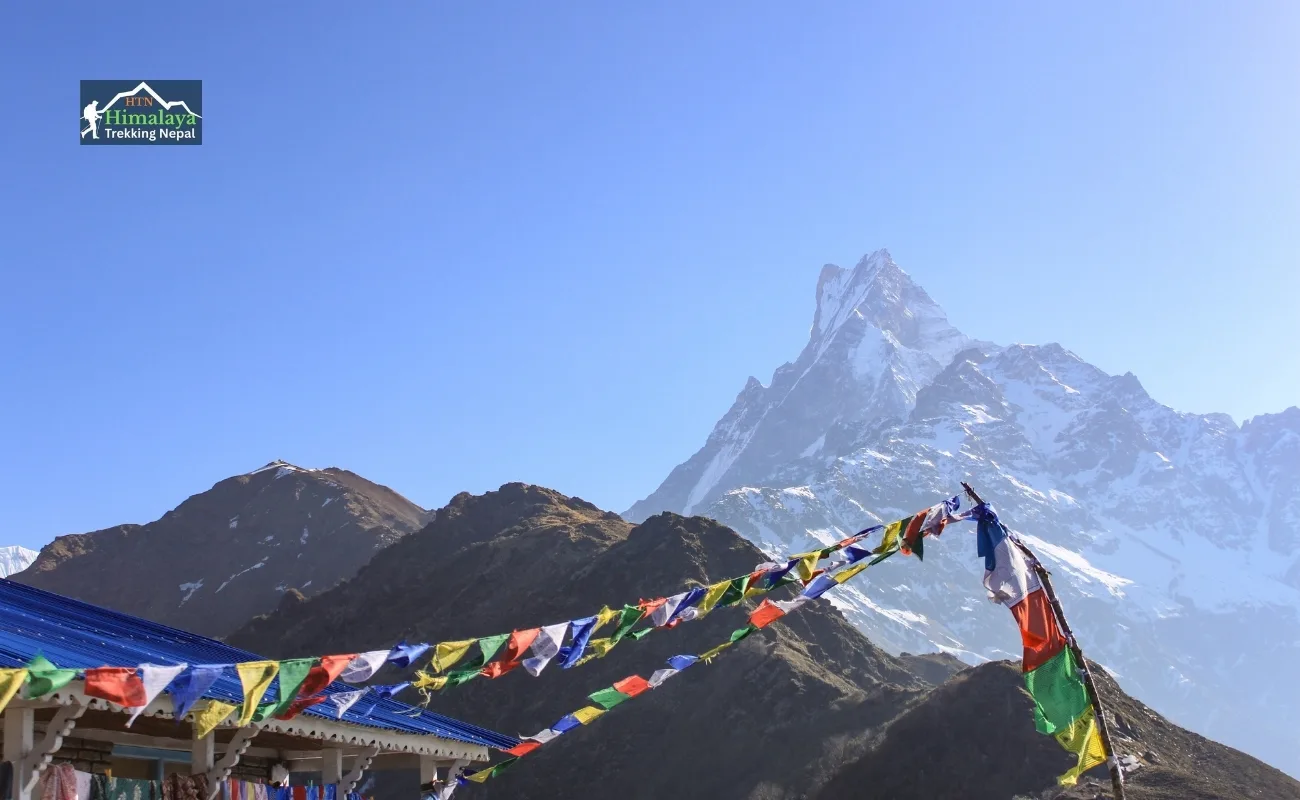
Mardi Himal Base Camp, at approximately 4,500 meters (14,764 feet), is the trek's highest point. Some itineraries stop at the Upper Viewpoint around 4,200 meters instead, which offers nearly identical views of Machhapuchhre (Fishtail) and the Annapurna range with slightly less altitude exposure.
It's worth being precise here, because online sources use "Mardi Himal" loosely. The actual summit of Mardi Himal peak reaches 5,587 meters, but that summit is a technical mountaineering objective requiring climbing permits, ropes, and glacier travel, it is not part of the standard trekking route. The trekking trail's endpoint, commonly marketed as "Base Camp," is a viewpoint ridge at 4,500 meters, not the mountain's true base camp in the mountaineering sense. Confirming this distinction before booking avoids a mismatch between expectation and itinerary.
How Much Elevation Gain Should Trekkers Expect?
Trekkers gain roughly 2,700 to 2,800 meters of net trekking elevation from the Kande trailhead to Base Camp, with around 900 meters of that gain concentrated in the final ascent from High Camp. Daily gains average 500–800 meters on climbing days, which sits within standard high-altitude trekking guidelines when spread across 5 or more days.
The commonly cited acclimatization guideline, limiting sleeping altitude gain to 300–500 meters per night above 3,000 meters, is difficult to follow exactly on shorter Mardi Himal itineraries, since Low Camp to High Camp alone gains over 600 meters. This is precisely why itinerary length functions as a difficulty lever: a 6-day plan can insert an acclimatization walk or a slower ascent between Low Camp and High Camp, while a compressed 4-day plan cannot.
How Does Altitude Affect Mardi Himal Trek Difficulty?
Altitude is the single biggest difficulty multiplier on Mardi Himal, since oxygen availability at 4,500 meters drops to roughly 60% of sea-level concentration, slowing pace, increasing breathlessness, and raising the risk of Acute Mountain Sickness. AMS symptoms, headache, nausea, fatigue, and disturbed sleep, typically appear above 3,000 meters and become more likely the faster a trekker ascends.
In real-world use, we see AMS incidence on Mardi Himal stay well below 20% when trekkers follow three practices: ascend gradually, hydrate consistently (3–4 liters daily), and avoid alcohol at altitude. Trekkers curious how these same risks escalate on longer, higher routes can see our detailed breakdown of Everest Base Camp altitude sickness, including AMS, HACE, and HAPE. The trek's short duration is a double-edged sword for altitude management. It limits total exposure time, which is protective, but it also compresses the ascent rate, which is the opposite. Trekkers arriving from sea-level countries without prior high-altitude experience benefit most from choosing the 6-day itinerary over the 3- or 4-day options specifically for this reason.
A licensed guide's value becomes most apparent here, not for navigation, since the trail is well-marked, but for recognizing early AMS symptoms and making the call to slow down, rest, or descend before a mild headache becomes a serious problem.
How Fit Do You Need to Be for the Mardi Himal Trek?
Moderate cardiovascular fitness is sufficient for Mardi Himal, specifically, the ability to walk 5 to 6 hours on uneven, inclined terrain across consecutive days while carrying a 5–8 kg daypack. Trekkers do not need mountaineering experience, technical climbing skills, or elite endurance conditioning.
This is a trek built for genuinely fit beginners and moderately experienced hikers, not for people starting from a sedentary baseline. The stone staircases between Forest Camp and High Camp are the practical fitness test: they are steep, repetitive, and unrelenting for stretches of 30–60 minutes at a time. Someone who struggles to climb several flights of stairs without stopping will find these sections genuinely difficult, regardless of how the trek is rated overall.
Is Mardi Himal Trek Suitable for Beginners?
Yes, Mardi Himal Trek suits beginners with reasonable fitness and some pre-trek preparation. The trail is well-marked, requires no technical skills, and teahouse accommodation is available at every overnight stop, which removes the logistical difficulty that deters many first-time trekkers.
Beginners succeed on this trek more often when they choose a 5- or 6-day itinerary rather than the accelerated 3-day version, lean on their mandatory licensed guide for pacing, and complete at least 4–6 weeks of preparatory conditioning beforehand. First-time trekkers who skip preparation entirely still often finish the trek, but they typically describe the High Camp to Base Camp section as considerably harder than expected.
What Fitness Level Is Recommended for Mardi Himal?
A recommended baseline is the ability to hike 10–15 km with 600–800 meters of elevation gain in a single day without significant difficulty. Regular hikers, runners, and cyclists usually meet this threshold already; those without a consistent exercise routine benefit from 6–8 weeks of targeted preparation before departure.
How Can You Train for the Mardi Himal Trek?
Effective training combines three elements: cardiovascular conditioning, stair-focused leg strength, and load-bearing practice hikes.
-
Build cardiovascular base with 3–4 sessions per week of hiking, running, or cycling for 45–60 minutes.
-
Train on stairs or hills twice weekly, since Mardi Himal's steepest sections closely resemble sustained stair-climbing rather than gradual trail walking.
-
Practice with a loaded daypack (5–8 kg) on weekend hikes to condition the shoulders and lower back for multi-hour carrying.
-
Add one long hike weekly of 3–4 hours to build the muscular endurance needed for consecutive trekking days.
-
Incorporate core and balance work, since the exposed ridge sections near Base Camp reward stability on uneven footing.
Six to eight weeks of this routine, done consistently, prepares most moderately active people well beyond the trek's actual physical demands.
What Are the Most Difficult Parts of the Mardi Himal Trek?
The three hardest sections of Mardi Himal are the stone staircases between Forest Camp and High Camp, the exposed ridge walk from High Camp to Base Camp, and the descent back through Low Camp on tired legs. Each tests a different kind of fitness, muscular endurance, altitude tolerance, and joint resilience, respectively.
Which Sections Have the Steepest Ascents Of Mardi Himal Trek?
The steepest ascent lies between Low Camp and High Camp, where the trail gains roughly 600 meters over a series of stone and root staircases with few flat resting stretches. Trekkers commonly describe this section as more physically taxing than the higher, thinner-air sections above it, simply because the gradient is unrelenting.
A common mistake we see is trekkers pacing this section like a flat trail, pushing hard early and running out of energy halfway up. The more effective approach is a slow, metronomic pace ("rest step" style), taking short breaks every 20–30 minutes rather than sprinting between camps.
How Challenging Is the High-Altitude Section Of Mardi Himal Trek?
The high-altitude section from High Camp to Base Camp is challenging primarily because of thin air and exposure, not steepness, the trail itself is a manageable ridge walk, but reduced oxygen slows pace significantly and wind chill can make conditions feel far colder than the thermometer suggests. This is the trek's most technically demanding stretch, involving 4 km of narrow, exposed trail above 3,580 meters where footing, wind, and altitude combine.
Most trekkers cover this section in 2.5–3.5 hours one way, roughly double the pace they'd manage at lower altitude for the same distance. Starting before dawn is standard practice here, both for weather (clouds typically build by mid-morning) and for temperature (the trail is easier to grip when frozen than when afternoon sun softens loose scree).
How Difficult Are the Trails and Descents Of Mardi Himal Trek?
Descents on Mardi Himal are technically easier than ascents but harder on the joints, particularly the steep, root-covered stretches between High Camp and Forest Camp where loose stones and tree roots create a real slip risk on tired legs. Trekking poles reduce knee strain meaningfully on these sections and are considered essential gear rather than optional.
What most guides don't mention upfront: descent-day fatigue is often underestimated because trekkers assume "downhill means easy." In practice, the eccentric muscle loading of steep descent causes more next-day soreness than the ascent itself, especially in the quadriceps and knees.
How Does Weather Affect Trekking Difficulty?
Weather is a major variable in Mardi Himal's difficulty, since rain, snow, and cold temperatures directly affect trail traction, visibility, and physical exertion at altitude. The trek is doable across most of the year, but conditions swing considerably by season. For a season-by-season comparison across the country's major routes, see our guide to the best time to trek in Nepal.
What Factors Can Make the Mardi Himal Trek More Challenging?
Four seasonal factors most commonly increase difficulty beyond the baseline rating:
-
Monsoon rainfall (June–August) turns lower forest trails muddy and increases leech activity, slowing pace and adding slip risk.
-
Winter cold (December–February) drops overnight temperatures at High Camp to -10°C or lower, and occasional snowfall can close the High Camp to Base Camp section entirely.
-
Post-monsoon cloud cover (early September) can obscure mountain views even on otherwise clear-feeling days.
-
Sudden wind at High Camp and above, which occurs year-round and amplifies the effective cold far more than temperature alone suggests.
How Do Snow and Rain Affect Mardi Himal Trail Conditions?
Snow above High Camp can make the final ridge to Base Camp genuinely difficult without microspikes, since packed snow on a narrow, exposed trail significantly raises slip risk, while rain during monsoon season turns lower forest trails slick and muddy rather than dangerous. The practical distinction matters: monsoon mud slows trekkers down but rarely stops them, while winter snow above 3,500 meters can turn a moderate trek into a genuinely technical one, occasionally requiring a guide's decision to turn back.
How Does Cold Weather Influence Mardi Himal Trekking Difficulty?
Cold weather increases difficulty primarily through its effect on sleep quality and morning starts, since High Camp and Base Camp regularly drop below freezing overnight even outside winter, and a poor night's sleep at altitude compounds next-day fatigue. A sleeping bag rated to -10°C or lower is a non-negotiable piece of gear for this reason, not a suggestion.
How Does Accommodation Affect the Mardi Himal Trekking Experience?
Teahouse accommodation on Mardi Himal is basic but consistently available at every overnight stop, and this reliability meaningfully reduces trek difficulty compared to routes requiring camping or long stretches between lodges. Rooms above High Camp are simple, often unheated, with shared or basic facilities, which means the "difficulty" here shifts from physical exertion to comfort tolerance.
What most first-time trekkers don't anticipate is how much sleep quality at altitude, in a cold, thin-walled teahouse room, affects perceived difficulty the following day. Packing a good sleeping bag liner and earplugs addresses this more effectively than any amount of physical training.
How Does Trekking With a Backpack Affect Difficulty?
Carrying your own full pack (10–15 kg) rather than a lighter daypack (5–8 kg) noticeably increases difficulty on Mardi Himal's steep sections, since the added weight compounds fatigue on already steep, uneven terrain. Most organized treks include a porter for the main duffel, leaving trekkers to carry only a daypack with water, layers, and daily essentials, this is the setup we recommend for anyone concerned about difficulty.
Trekkers who choose to carry their own full pack rather than hiring a porter should expect roughly 20–30% more exertion on the Forest Camp to High Camp staircases specifically, since that section rewards a light, balanced load over raw strength.
How Can You Prepare for the Mardi Himal Trek?
Effective preparation for Mardi Himal combines physical training, proper gear, gradual altitude exposure, and a realistic itinerary choice, the four levers that most directly control difficulty. None of these require expert-level outdoor experience; they require consistency in the weeks before departure.
What Training Should You Do Before Mardi Himal?
Beyond the general fitness routine outlined earlier, trekkers preparing specifically for Mardi Himal benefit from:
-
Hiking with a loaded pack on consecutive weekend days to simulate multi-day fatigue.
-
Practicing pole technique on downhill sections beforehand, since poor pole use is a common source of knee strain.
-
Building comfort with early starts, since summit-day departures often begin before 5 a.m.
What Trekking Gear Helps Reduce the Difficulty?
The right gear doesn't reduce the trail's gradient, but it meaningfully reduces how hard that gradient feels:
-
Trekking poles reduce knee load on descents by a significant margin.
-
Broken-in, ankle-supporting boots prevent blisters and improve footing on loose stone sections.
-
Layered clothing system (base layer, insulating layer, wind/waterproof shell) manages the wide temperature swing between valley and ridge.
-
Microspikes, useful in winter or after snowfall above High Camp.
-
A -10°C or lower sleeping bag, essential for sleep quality at High Camp and Base Camp.
How Can You Prepare for High Altitude?
Altitude preparation centers on ascent pace, hydration, and symptom awareness rather than any special training regimen, walking slowly, drinking 3–4 liters of water daily, and avoiding alcohol above 3,000 meters are the three most effective, evidence-supported strategies. Trekkers with a history of AMS on previous trips can discuss preventive medication with a travel doctor before departure, though this is a personal medical decision rather than a standard requirement.
What Should You Pack for Mardi Himal Trek?
A focused, weather-appropriate packing list matters more here than sheer volume of gear:
-
Sturdy trekking boots with good ankle support
-
Daypack (25–35 liters) with rain cover
-
Down jacket and insulating fleece layer
-
Waterproof/windproof outer shell
-
Thermal base layers (top and bottom)
-
Trekking poles
-
Sleeping bag rated to -10°C or lower
-
Headlamp, sunglasses, sun hat, and high-SPF sunscreen
-
Water purification tablets or filter
-
Basic first-aid kit and personal medications
Is the Mardi Himal Trek Difficult Compared With Other Nepal Treks?
Mardi Himal ranks as moderate difficulty, positioned above short walks like Poon Hill but below longer, higher-altitude treks like Annapurna Base Camp and Everest Base Camp. Its short duration is what sets it apart on this scale, it delivers meaningful altitude exposure and genuine Himalayan scenery in roughly half the time of comparable routes.
Is Mardi Himal Easier Than the Annapurna Base Camp Trek?
Mardi Himal is generally easier than the Annapurna Base Camp Trek in total duration and distance, though Mardi Himal reaches a higher maximum altitude (4,500 meters) compared to Annapurna Base Camp (4,130 meters). ABC typically runs 7–12 days and 60–115 km, giving the body more time to acclimatize, while Mardi Himal compresses comparable altitude exposure into fewer days, which can make Mardi Himal feel more intense despite being the shorter trek overall.
Is Mardi Himal Harder Than the Ghorepani Poon Hill Trek?
Yes, Mardi Himal is noticeably harder than the Ghorepani Poon Hill Trek, which tops out around 3,210 meters over 4–5 days with gentler daily distances. Poon Hill is often recommended as a warm-up trek for trekkers testing their readiness for something like Mardi Himal the following season.
How Does Mardi Himal Compare With Everest Base Camp?
The Everest Base Camp Trek is substantially more demanding than Mardi Himal, reaching 5,364 meters over 12–14 days with a longer cumulative altitude exposure and a mandatory flight into Lukla's short mountain airstrip. Mardi Himal makes a sensible stepping-stone trek for anyone building toward EBC in a future season, since it tests altitude tolerance and daily trekking stamina at a fraction of the time commitment.
How Can Our Trekking Agency Help With the Mardi Himal Trek?
We support Mardi Himal trekkers with licensed, high-altitude-experienced guides, itinerary planning that prioritizes safe acclimatization over speed, and pre-trip guidance on fitness and gear. While the trail itself is well-marked, Nepalese law mandates that all foreign trekkers must be accompanied by a licensed guide. Therefore, our role goes beyond trail navigation to making the critical judgment calls that matter at altitude: pacing, weather reading, and recognizing early symptoms before they become problems.
Can Our Trekking Agency Help You Prepare for Mardi Himal?
Yes. We work with trekkers ahead of departure on itinerary selection based on fitness and available time, a tailored training and packing checklist, and honest guidance on whether a 4-day or 6-day plan better fits your situation. If you're weighing Mardi Himal against another Annapurna-region trek, we're glad to walk through the trade-offs with you before you book. Browse the full Mardi Himal Trek itinerary for day-by-day routing, pricing, and departure dates.
What Are the Key Takeaways About Mardi Himal Trek Difficulty?
Mardi Himal Trek is a moderate-difficulty trek accessible to fit beginners and comfortable for experienced hikers, with three factors deciding how hard it actually feels: itinerary length, season, and pack weight. The trail itself requires no technical skill, but the compressed altitude gain to 4,500 meters, the steep stone staircases above Forest Camp, and the exposed high-altitude ridge to Base Camp mean it rewards genuine preparation rather than casual assumption.
Choose a 5- or 6-day itinerary over the accelerated 3-day version if this is your first high-altitude trek, train on stairs and inclines for 6–8 weeks beforehand, and pack for a temperature swing that runs from warm forest trails to sub-freezing ridge camps. Do that, and Mardi Himal delivers one of the best reward-to-effort ratios of any trek in the Annapurna region, genuine Himalayan scale in under a week, without technical climbing and without months of preparation.
More About Author

Khilak Budhathoki
Travel Director
Khilak Budhathoki is the co-founder and lead trekking guide at Himalaya Trekking Nepal, a locally owned and operated adventure company based in Kathmandu. Born and raised in the foothills of Nepal, Khilak developed a deep love for the mountains from an early age. With over a deca...
USD$620 pp
Our Recommendation
Related Blogs