- 01, Jan 2026 | Khilak Budhathoki
The Annapurna Base Camp Trek is a Himalayan trekking journey through the Annapurna Sanctuary of Nepal, leading from the lower hills near Pokhara through Gurung and Magar villages, rhododendron and bamboo forests, alpine landscapes, and the Modi Khola valley to Annapurna Base Camp at 4,130 meters (13,550 feet). The route brings trekkers into a dramatic mountain amphitheater surrounded by some of the Himalayas’ most prominent peaks, including Annapurna I (8,091 m), Annapurna South (7,219 m), Hiunchuli (6,441 m), and Machapuchare (6,993 m). Along the journey, highlights such as Ghorepani, Poon Hill, Chhomrong, Machapuchare Base Camp, and the Annapurna Sanctuary combine mountain scenery with Himalayan culture, forest ecosystems, and traditional teahouse communities. The trek requires no technical climbing, but its changing terrain, long walking days, steep stone staircases, and ascent to 4,130 meters make appropriate preparation and altitude awareness essential.

Planning an Annapurna Base Camp Trek involves more than choosing a route and booking accommodation. Trekkers need to understand the best trekking seasons, daily distances, itinerary options, altitude profile, fitness requirements, acute mountain sickness prevention, required permits, packing and clothing systems, teahouse accommodation, trail food, transportation, trekking costs, travel insurance, and emergency procedures. This guide brings those elements together to explain how the ABC route works from the trailhead to base camp, what conditions to expect at different elevations and seasons, and how to prepare for a safe and well-organized trek. Whether you are planning a standard 10-day itinerary, adding Poon Hill and Jhinu Danda, or evaluating the trek for your first Himalayan adventure, the following sections provide the practical route, logistics, safety, and preparation information needed to reach Annapurna Base Camp with confidence.
Where Is Annapurna Base Camp Located?
Annapurna Base Camp sits at 4,130 meters (13,550 feet) in the Modi Khola river valley, deep inside the Annapurna Sanctuary in the Kaski District of Gandaki Province, Nepal. It lies roughly 40 kilometers north of Pokhara, the gateway city most trekkers reach by a 25-minute domestic flight or 6-hour overland journey from Kathmandu.
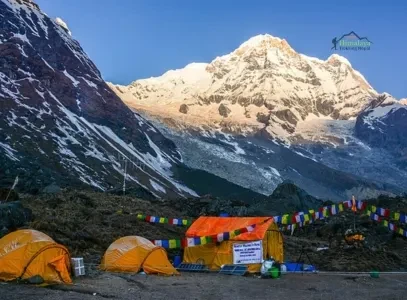
The Annapurna Sanctuary is a natural glacial amphitheater enclosed by 12 Himalayan peaks, including Annapurna I (8,091 m), Annapurna South (7,219 m), Hiunchuli (6,441 m), and Machapuchare (6,993 m). This formation creates a protected bowl that gives the base camp its dramatic, 360-degree mountain panorama, a view no other base camp in Nepal replicates at this altitude.
The entire trek falls within the Annapurna Conservation Area, the largest protected area in Nepal at 7,629 square kilometers. This conservation status directly shapes the trail infrastructure, teahouse density, porter regulations, and waste management practices trekkers encounter along the route.
What Makes the Annapurna Base Camp Trek Special?
The ABC trek delivers a mountain amphitheater experience unique in the Himalayas: trekkers ascend through 5 distinct ecological zones, subtropical forest, rhododendron belt, alpine meadow, sub-alpine scrub, and glacial moraine, all within a single 55-kilometer one-way trail.
3 specific features separate the ABC trek from every other Himalayan route:
-
The Annapurna Sanctuary view: A 360-degree wall of 7,000–8,000-meter peaks visible from the base camp floor, impossible to replicate from any road or short hike.
-
Machapuchare (Fishtail Mountain): A sacred, never-summited peak that dominates the approach corridor. Its vertical south face rises 3,293 meters above Machapuchare Base Camp in a single unbroken wall.
-
Cultural immersion through living Gurung villages: The trail passes through traditional Gurung and Magar settlements where indigenous Himalayan architecture, rituals, and hospitality are authentic, not staged for tourists.
The trail also connects with the Ghorepani Poon Hill route, creating a loop option that eliminates most backtracking and adds the famous Poon Hill sunrise viewpoint at 3,210 meters. This connectivity makes the ABC trek one of the most versatile multi-day itineraries available in the Himalayas.
How Difficult Is the Annapurna Base Camp Trek?

The Annapurna Base Camp trek is rated moderate to moderately challenging. It requires no technical climbing, ropes, or specialized mountaineering skills, but demands consistent daily hiking across 7 to 12 days, with cumulative elevation gain exceeding 3,800 meters from Nayapul (1,070 m) to base camp (4,130 m).
The 3 primary difficulty factors are:
-
Elevation gain: Rapid ascent from 1,070 meters at Nayapul to 4,130 meters at ABC increases acute mountain sickness (AMS) risk above 3,000 meters.
-
Terrain variability: The trail includes ancient stone staircases (the famous 3,280-step Ulleri ascent), narrow river-gorge paths, bamboo forest tracks, and open glacial morain.
-
Daily mileage under load: Trekkers cover 8 to 18 kilometers daily, with ascent-heavy stages totaling 1,000–1,400 meters of vertical gain in a single day.
What Fitness Level Do You Need for Annapurna Base Camp?
Trekkers who complete 5–6 hours of continuous walking over hilly terrain at least 3 times per week for 8 weeks before departure successfully finish the ABC trek without medically forced turnarounds at standard acclimatization pacing.
Preparation activities that build the necessary fitness profile:
-
Cardiovascular endurance: Running or cycling 30–45 minutes, 4 times weekly, for 3 months prior to departure.
-
Leg-strength conditioning: Stair climbing with a 7–10 kg daypack, 3 times weekly, starting 8 weeks out.
-
Flexibility and balance training: Yoga or targeted stretching routines for hip flexors, calves, and ankles.
Desk-based professionals with no regular walking habit require a minimum 10-week conditioning program to finish the full route comfortably. What most trekkers overlook: the descent is where knee injuries occur most frequently. Trekkers without prior experience on stone-stepped downhill terrain use trekking poles throughout all descents from Deurali to Nayapul.
What Trekking Experience Is Required for ABC Trekking?
ABC trekking is accessible to first-time Himalayan trekkers, but 2–3 prior multi-day hiking experiences of 3+ days each, in any mountain region, reduce altitude-related dropout risk significantly.
Experienced mountain walkers from the Alps, Andes, or Cascades adapt to Himalayan trail conditions faster than complete beginners because they understand the discipline of pacing, layering, and reading their own energy output. The trail itself is fully marked and served with teahouse accommodation at regular intervals, eliminating the need for camping skills, navigation tools, or cooking equipment on guided treks.
How Long Does the Annapurna Base Camp Trek Take?
The standard Annapurna Base Camp trek takes 7 to 12 days round trip from Nayapul, depending on fitness level, route variation, and rest days for acclimatization. Most guided groups complete the trek in 10 days, which includes 1 buffer day for weather and health management.
The 3 primary itinerary formats are:
-
7-day express itinerary: Suitable for very fit trekkers with prior high-altitude experience; covers 15–20 km daily at altitude.
-
10-day standard itinerary: The recommended format for most trekkers, balancing acclimatization with full trail and cultural coverage.
-
12–14 day extended itinerary: Includes Poon Hill sunrise, Jhinu Danda natural hot springs, additional rest days, and more cultural engagement in Gurung villages.
What Is the Recommended Annapurna Base Camp Itinerary?
The recommended 10-day itinerary starts in Pokhara, ascends through Ghorepani, Tadapani, and Chhomrong to reach ABC on Day 7, then descends the same primary route with a hot spring detour at Jhinu Danda, returning to Pokhara by Day 10. This pacing provides adequate rest at 3 critical altitude checkpoints, Chhomrong (2,170 m), Himalaya Hotel (2,920 m), and Machapuchare Base Camp (3,700 m).
What Is the 10-Day Annapurna Base Camp Itinerary?
The 10-day Annapurna Base Camp itinerary below is the standard acclimatization-safe schedule used by licensed Nepali trekking operators in 2026:
|
Day |
Route |
Altitude |
Distance |
|
1 |
Pokhara → Nayapul → Tikhedhunga |
1,540 m |
12 km |
|
2 |
Tikhedhunga → Ghorepani |
2,860 m |
13 km |
|
3 |
Ghorepani → Poon Hill Sunrise → Tadapani |
2,520 m |
14 km |
|
4 |
Tadapani → Chhomrong |
2,170 m |
9 km |
|
5 |
Chhomrong → Bamboo |
2,310 m |
8 km |
|
6 |
Bamboo → Himalaya Hotel |
2,920 m |
9 km |
|
7 |
Himalaya Hotel → MBC → Annapurna Base Camp |
4,130 m |
14 km |
|
8 |
ABC → Bamboo (Descent begins) |
2,310 m |
17 km |
|
9 |
Bamboo → Jhinu Danda Hot Springs → Nayapul |
1,070 m |
16 km |
|
10 |
Nayapul → Pokhara (vehicle transfer) |
822 m |
Drive |
What Are the Typical Trekking Distances Each Day?
Daily trekking distances on the ABC route range from 8 kilometers on short connecting stages to 17 kilometers on the primary descent day. Average walking time per day is 5 to 7 hours at moderate, conversational pace.
Key distance and time benchmarks by trail segment:
-
Nayapul → Tikhedhunga: 12 km / 4 hours
-
Tikhedhunga → Ghorepani: 13 km / 6 hours (includes the 3,280-step stone staircase above Ulleri)
-
Ghorepani → Chhomrong via Tadapani: 23 km over 2 days
-
Chhomrong → ABC: 30 km over 3 days
-
ABC → Nayapul on descent: 52 km over 2 days for fit trekkers
When Is the Best Time to Trek to Annapurna Base Camp?

The best times to trek to Annapurna Base Camp are October–November (autumn) and March–May (spring). These 5 months provide stable weather windows, clear mountain visibility, and safe trail conditions with minimal snowfall risk below 3,500 meters. For a month-by-month breakdown of temperatures, crowds, and trail conditions, see our full guide to the best time to trek ABC.
Is Spring a Good Season for Annapurna Base Camp?
Spring (March, April, May) is the most visually spectacular season for the ABC trek because the rhododendron forests between 2,000–3,500 meters bloom in red, pink, and white across the Ghorepani–Chhomrong corridor. The Annapurna Conservation Area records peak rhododendron bloom between mid-March and mid-April annually, with over 30 rhododendron species in flower simultaneously.
Spring advantages:
-
Temperatures at ABC range from -5°C at night to +5°C during the day, cold but manageable with correct layering.
-
Trail visibility exceeds 80% of trekking days in March–April before pre-monsoon haze builds in late May.
-
Birdlife activity peaks, with Himalayan monal, blood pheasant, and red panda sightings highest between Bamboo and Dovan.
The 1 trade-off: April and May trails are significantly more crowded. Daily trekker counts on the Chhomrong–ABC corridor exceed 200 people on peak spring days. Reserve teahouses 2–3 days in advance during April.
Is Autumn a Good Season for Annapurna Base Camp?
Autumn (October and November) delivers the clearest mountain visibility of the year on the ABC trail, with post-monsoon atmospheric clarity producing 90%+ clear summit days at base camp. Temperatures at ABC in October average -2°C at night and +8°C midday.
Autumn advantages:
-
Mountain photography conditions peak in October: fresh post-monsoon snow on peaks, deep blue skies, no haze.
-
Trail conditions are firm and well-compacted after summer monsoon, reducing mud and slippery surfaces.
-
October is Nepal's peak trekking month, teahouses are fully staffed, menus are complete, and trail conditions are at their best.
Expect full teahouses at popular stops like Ghorepani, Chhomrong, and Himalaya Hotel. Book accommodation 2 days in advance throughout October.
Can You Trek to Annapurna Base Camp During Winter?
Winter trekking (December, January, February) to ABC is achievable for experienced cold-weather hikers, but carries significantly higher risk because snowfall above 3,000 meters frequently closes the Deurali–MBC–ABC corridor between December 15 and February 28. The trail above Bamboo receives snowfall on an average of 18 days per month in January.
Temperature at ABC drops to -15°C to -20°C at night in January. Trekkers who complete the full ABC route in winter report exceptional isolation and pristine snow landscapes, but this requires:
-
A licensed guide with winter mountain experience.
-
A sleeping bag rated to -20°C.
-
Micro-spikes or lightweight crampons for the MBC–ABC glacial approach.
-
Full flexibility to descend if snowfall closes the upper route.
The standard winter alternative: trek to Chhomrong or Himalaya Hotel, which remains accessible on most January days without snow equipment.
Is the Monsoon Season Suitable for the Trek?
Monsoon season (June, July, August) is the least suitable period for the ABC trek. The Annapurna region receives 4,000–5,000 mm of annual rainfall, with 70% concentrated between June and September. This produces:
-
Daily trail closures due to landslides above Bamboo and Dovan on the upper gorge sections.
-
Dense leech populations throughout the forest zones from Nayapul to Chhomrong.
-
Zero mountain visibility at ABC for stretches of 4–10 consecutive days.
The 1 advantage of monsoon trekking: trail solitude is absolute, with teahouse occupancy below 10% across most ABC stages. Trekkers who choose the monsoon period carry waterproof gear rated to 5,000 mm hydrostatic head, hire a licensed guide, and accept partial or complete summit view obscuration.
What Is the Annapurna Base Camp Trek Route?

The Annapurna Base Camp trek route follows the Modi Khola river valley northward from Nayapul, ascending through Gurung villages, rhododendron forests, and bamboo groves before entering the Annapurna Sanctuary above Deurali at 3,200 meters. The classic route covers 110–115 kilometers round trip and gains 3,060 meters of net elevation from Nayapul to ABC.
Where Does the Annapurna Base Camp Trek Start?
The ABC trek starts at Nayapul (1,070 m), a roadhead village 42 kilometers from Pokhara accessible by a 1.5-hour taxi or public bus. Most licensed trekking operators in Pokhara use Nayapul as the standard trailhead for the full 10-day ABC experience.
An alternative starting point is Kande (1,780 m), reached by taxi via Phedi, which reduces the first day's walking by 3 hours by joining the main trail at Tolka. A second variation departs from Siwai by jeep, joining the route at Deurali below Ghorepani and cutting 1 full trekking day from the outbound journey.
The Nayapul start provides the fullest cultural and ecological experience, traversing all 5 ecological zones in sequence without skipping any transition.
Which Villages Are Located Along the ABC Route?
The ABC route passes through 12 primary villages, each serving as accommodation and resupply points with teahouses, restaurants, and permit checkpoints:
-
Tikhedhunga (1,540 m): First-night stop; riverside teahouses with hot showers.
-
Ulleri (1,960 m): Gurung village at the top of the famous 3,280-step stone staircase.
-
Banthanti (2,250 m): Dense rhododendron rest stop.
-
Nayathanti (2,460 m): Transition into upper rhododendron zone.
-
Ghorepani (2,860 m): Largest trail village; Poon Hill access; 40+ teahouses.
-
Tadapani (2,520 m): Junction village for the ABC-via-Chhomrong route.
-
Chhomrong (2,170 m): Largest traditional Gurung village on the trail; key acclimatization stop.
-
Sinuwa (2,360 m): Descent into the Modi Khola gorge begins here.
-
Bamboo (2,310 m): Named for the 15-meter bamboo groves surrounding it; home to red pandas.
-
Dovan (2,600 m): Important gorge rest stop with seasonal landslide exposure.
-
Himalaya Hotel (2,920 m): Last major teahouse cluster before high-altitude zones.
-
Machapuchare Base Camp (3,700 m): Final staging point before Annapurna Base Camp.
What Are the Main Highlights Along the Annapurna Trail?
The 5 main highlights along the ABC trail are the Poon Hill sunrise panorama, Chhomrong village cultural immersion, the bamboo forest corridor, Machapuchare's unclimbed south face, and the Annapurna Sanctuary amphitheater sunrise at base camp.
-
Poon Hill (3,210 m): A 45-minute pre-dawn ascent from Ghorepani reveals a 180-degree Dhaulagiri–Annapurna panorama over 11 peaks above 7,000 meters. The platform fills with 50–150 trekkers at dawn in peak season, arrive 30 minutes early for the best photography position.
-
Chhomrong Village: Traditional Gurung stone architecture, terraced millet and barley fields, and a village layout unchanged over 150 years. Local tongba (hot millet beer) served here marks the transition from lower-altitude village life to mountain wilderness.
-
Bamboo Forest Corridor (2,100–2,600 m): 4 kilometers of trail through dense 15-meter bamboo. Red pandas inhabit the bamboo-rhododendron transition zone. Himalayan monal pheasant sightings peak in early morning.
-
Machapuchare South Face: The unclimbed summit rises 3,293 vertical meters above Machapuchare Base Camp in a single unbroken alpine wall: one of the most dramatic mountain faces in Asia. While a British expedition attempted it in 1957, it has been officially off-limits to climbers since 1964 by Nepali government decree.
-
ABC Sunrise: The first rays strike Annapurna I's summit at 8,091 meters while the sanctuary floor remains in darkness. The light progression from summit to base takes exactly 22 minutes and produces some of the most photographed Himalayan images in the world.
What Is the Annapurna Base Camp Trek Altitude?
The ABC Trek altitude profile spans from 822 meters in Pokhara to 4,130 meters at base camp, a total elevation range of 3,308 meters. The critical altitude gain concentrates in the upper 30 kilometers of the route, with the final 900 vertical meters from Himalaya Hotel to ABC completed in a single 14-kilometer day.
How High Is Annapurna Base Camp?
Annapurna Base Camp stands at 4,130 meters (13,550 feet) above sea level. At this altitude, atmospheric oxygen concentration measures approximately 60% of sea-level values, meaning every breath delivers significantly less oxygen to working muscles and the brain.
The altitude progression by key checkpoint:
-
Pokhara: 822 m
-
Nayapul: 1,070 m
-
Ghorepani: 2,860 m
-
Chhomrong: 2,170 m
-
Himalaya Hotel: 2,920 m
-
Machapuchare Base Camp: 3,700 m
-
Annapurna Base Camp: 4,130 m
How Can You Prevent Altitude Sickness During ABC Trek?
Altitude sickness prevention on the ABC trek relies on 3 evidence-based strategies: ascending no faster than 300–500 meters per day above 2,500 meters, hydrating with 3–4 liters of water daily, and using acetazolamide (Diamox) at 125–250 mg twice daily when prescribed by a physician before departure.
The Wilderness Medical Society defines acute mountain sickness (AMS) as a headache combined with at least 1 of 4 additional symptoms: nausea, fatigue, dizziness, or sleep disruption. AMS onset begins at 2,500 meters in susceptible individuals and increases in severity above 3,500 meters.
Practical acclimatization habits that experienced Himalayan guides implement on every ABC trek:
-
Maintain a conversational walking pace: Breathing that prevents normal conversation indicates excessive exertion at altitude.
-
Avoid alcohol above 3,000 meters: Alcohol accelerates dehydration and masks early AMS warning signals.
-
Apply the "climb high, sleep low" principle: Ascending to a high point during the day then descending to sleep at a lower altitude reduces overnight hypoxic stress on the body.
What Should You Do If Altitude Sickness Symptoms Appear?
Immediate descent is the definitive treatment for worsening altitude sickness above Deurali on the ABC route. Descending 500–1,000 meters eliminates AMS symptoms within 1–6 hours in 95% of affected trekkers.
AMS symptom response protocol by severity:
-
Mild headache, fatigue, minor nausea: Stop ascending. Rest 24 hours at the same altitude. Hydrate. Take ibuprofen (400 mg) for headache relief.
-
Persistent or worsening headache combined with vomiting: Descend immediately to Himalaya Hotel or below. Do not sleep at current altitude.
-
Ataxia (loss of coordination), confusion, or severe breathlessness at rest: High-altitude cerebral edema (HACE) or high-altitude pulmonary edema (HAPE) emergency. Descend immediately with guide assistance. Administer supplemental oxygen if available. Contact rescue services without delay.
Helicopter evacuation from ABC to Pokhara takes 15–20 minutes and typically costs between USD 2,500 and USD 3,500, depending on the charter company and weather conditions. Because costs at this scale are rarely paid out of pocket, confirming you have helicopter rescue insurance is non-negotiable documentation for the ABC route.
What Permits Are Required for Annapurna Base Camp Trek?
The Annapurna Base Camp trek requires 2 mandatory permits: the Annapurna Conservation Area Permit (ACAP) and the TIMS (Trekkers' Information Management System) card. Both are obtained in Pokhara before departure from the Nepal Tourism Board office or through a licensed trekking agency. For the full fee breakdown, required documents, and checkpoint list, see our ABC permit requirements guide.
What Is the Annapurna Conservation Area Permit?
The Annapurna Conservation Area Permit (ACAP) is a conservation entry document issued by the National Trust for Nature Conservation (NTNC) of Nepal, granting access to the 7,629 km² Annapurna Conservation Area, which contains the entire ABC trek route.
2026 ACAP fee structure:
-
Foreign nationals: NPR 3,000 (approximately USD 22) per person.
-
SAARC nationals: NPR 1,000 (approximately USD 7.50) per person.
-
Nepali nationals: No fee.
ACAP permits face inspection at 4 checkpoints along the ABC route: Birethanti (trail entry), Chhomrong, Sinuwa, and Himalaya Hotel. Carry the physical permit card throughout the trek, digital copies are not accepted at checkpoints.
Do You Need a TIMS Card for the ABC Trek?
Yes. A TIMS (Trekkers' Information Management System) card is mandatory for the ABC trek. The TIMS card is a personal safety registration document that logs each trekker's identity, emergency contacts, and planned route, enabling search-and-rescue coordination for missing or injured trekkers.
2026 TIMS card fees:
-
Group (trekkers registered with licensed agencies): NPR 1,000 (approximately USD 7.50) per person.
Total permit cost for a foreign trekker (ACAP and agency TIMS): approximately USD 29.50 for both documents, though solo trekking without a guide is no longer permitted. Trekkers without both documents face on-site fines and mandatory permit purchase at checkpoint rates, always higher than Pokhara office rates.
What Should You Pack for the Annapurna Base Camp Trek?

The ABC trek packing list centers on 3 functional categories: a 4-layer clothing system rated to -15°C overnight at base camp, trekking-specific footwear and safety equipment, and a personal medical kit for altitude and trail emergencies. Total pack weight for a guided trekker with porter support is 10–12 kg. For a complete gear checklist organized by category, see our full ABC packing list.
What Clothing and Footwear Should You Bring?
Pack a 4-layer clothing system designed for the -15°C to +25°C temperature range experienced between Pokhara and ABC:
-
Base layer: Merino wool or synthetic moisture-wicking top and leggings (2 sets minimum).
-
Mid layer: 200-weight fleece jacket or light synthetic insulation jacket.
-
Insulation layer: Down jacket rated to -10°C for evenings and high-altitude mornings.
-
Outer layer: Waterproof and windproof hardshell jacket and trousers, minimum 20,000 mm waterproofing rating (Gore-Tex or equivalent).
Footwear essentials:
-
Waterproof trekking boots: Mid-cut ankle support, Vibram-type lug sole. Break in for 6–8 weeks before departure, new boots cause blisters on stone staircases.
-
Camp sandals or lightweight shoes: For teahouse evenings.
-
Merino wool trekking socks: 4–5 pairs (Darn Tough or Smartwool for durability and blister prevention).
What Trekking Equipment and Essentials Are Needed?
7 non-negotiable equipment items for the ABC trek:
-
Trekking poles: Collapsible, with wrist loops, essential for the Ulleri staircase ascent and all descents from ABC to Nayapul.
-
Headlamp with spare batteries: For pre-dawn Poon Hill ascent and frequent teahouse power outages above 2,500 meters.
-
Backpack (20–30L for guided trek): Guided trekkers carry a small daypack for daily essentials (water, layers, camera), while porters carry the main duffel or trekking pack (up to 15 kg).
-
Sleeping bag: Rated to -10°C minimum for spring and autumn; -20°C for winter.
-
Water purification: SteriPen UV purifier or iodine/chlorine tablet, treat all tap and stream water above Chhomrong.
-
Trekking map: Himalayan MapHouse 1:50,000 Annapurna trekking map or offline digital maps via Gaia GPS or Maps.me.
-
Sun protection kit: SPF 50+ sunscreen, UV-blocking glacier sunglasses (wraparound style above 3,500 m), and a wide-brim sun hat.
What Personal and Medical Supplies Should You Pack?
A complete personal medical kit for the ABC trek contains 12 essential items:
-
Acetazolamide (Diamox): altitude sickness prevention; obtain a physician prescription before departure.
-
Ibuprofen (400 mg tablets): headache and muscle pain relief.
-
Loperamide: traveler's diarrhea management.
-
Oral rehydration salts (ORS): electrolyte replacement after exertion and GI illness.
-
Antibiotic (ciprofloxacin or azithromycin): physician-prescribed backup for GI infection.
-
Blister treatment kit: moleskin, medical tape, sterile needles.
-
Elastic compression bandage: ankle and knee support after injury.
-
Antiseptic wound wipes and adhesive bandages: trail cut and abrasion treatment.
-
Throat lozenges: dry high-altitude air causes persistent throat irritation above 3,000 meters.
-
SPF 50 lip balm: sun exposure at altitude causes rapid chapping.
-
Anti-nausea medication (ondansetron or dimenhydrinate): for altitude and motion sickness.
-
Personal prescription medications: carry 150% of the required supply to account for itinerary extensions.
Where Do You Stay and Eat During the Annapurna Base Camp Trek?
Trekkers stay in teahouses, locally owned mountain guesthouses, at each village stop along the entire ABC route. Teahouse accommodation and food are continuously available from Nayapul to ABC, eliminating any need for tents, camping stoves, or food-carry on guided treks.
What Are Teahouses Like Along the ABC Route?
ABC route teahouses are fixed-roof, privately owned guesthouses ranging from basic 2-person rooms with shared bathrooms in lower villages to mid-range rooms with attached toilets and better insulation at Ghorepani and Chhomrong. Accommodation standards follow altitude, higher altitude means simpler facilities.
Room and facility profile by trail zone:
-
Lower trail (Nayapul to Ghorepani): Wooden twin beds, cotton mattresses, shared squat or Western toilets, hot showers (NPR 200–300 extra), electricity for device charging (NPR 200–500 per session via solar).
-
Mid-trail (Tadapani to Himalaya Hotel): Similar structure. WiFi coverage becomes sporadic above Chhomrong. Hot water from solar heating available most days.
-
Upper trail (MBC and ABC): Basic twin or dormitory rooms. Shared drop toilets. No hot showers. Charging available at NPR 300–500. Blankets provided, but personal sleeping bag is still required for -10°C overnight temperatures.
Room bookings at lower-altitude teahouses are free or included with meal purchase: the universal teahouse business model in Nepal. At MBC and ABC, paying for a room separately from meals is standard practice during peak season.
What Food and Drinks Are Available During the ABC Trek?
The ABC teahouse menu includes 25–35 items across 6 categories: Nepali dal bhat, international trekking food, baked goods, hot beverages, cold drinks, and altitude-specific supplementary items. Menu prices increase by 15–25% per altitude band above Chhomrong, reflecting porter-carry costs.
Common menu items and 2026 price ranges at mid-trail (Bamboo to Himalaya Hotel):
-
Dal bhat (rice, lentil soup, seasonal vegetables, pickle): NPR 500–650: unlimited rice refills included.
-
Pasta or noodles: NPR 400–550.
-
Garlic soup: NPR 300–400: present on every ABC teahouse menu as the standard altitude acclimatization meal; widely believed to improve circulation at high altitude.
-
Pancakes with honey or jam: NPR 300–450.
-
Fried rice or noodles: NPR 400–600.
-
Ginger lemon honey tea: NPR 150–250.
-
Purified or boiled water: NPR 100–200 per liter above Chhomrong.
What most trekkers overlook: dal bhat is the highest-calorie, most nutritionally complete meal on the trail. The cultural practice of unlimited rice refills for a single price means trekkers consuming 4,000–5,000 calories daily on high-output stages replace energy most efficiently by ordering dal bhat twice daily.
How Much Does the Annapurna Base Camp Trek Cost?
The total cost of an Annapurna Base Camp trek ranges from USD 700 to USD 1,800 per person for a 10-day guided package, depending on group size, accommodation standard, and included services. While previously popular, independent trekking without a guide is no longer permitted in the Annapurna region; all foreign trekkers must budget for a licensed guide.
What Is Included in a Typical ABC Trek Package?
A standard 10-day guided ABC trek package from a licensed Nepali operator in 2026 includes 9 items:
-
Airport pick-up and drop-off in Pokhara.
-
ACAP and TIMS permit fees.
-
Licensed government-registered English-speaking guide.
-
1 porter per 2 trekkers (carrying up to 15 kg per load).
-
Teahouse accommodation (twin-sharing) throughout the route.
-
Breakfast and dinner daily on trail.
-
All surface transportation (Pokhara–Nayapul–Pokhara).
-
Staff insurance and trekking equipment.
-
Trek completion certificate.
Package prices by group size in 2026:
-
Solo trekker: USD 1,400–1,800 per person.
-
2-person group: USD 1,100–1,400 per person.
-
4+ person group: USD 800–1,100 per person.
What Additional Expenses Should You Budget For ABC Trek?
Budget an additional USD 350–500 per person for 7 categories of out-of-package expenses:
-
Lunch on trail: NPR 400–700 per meal × 10 days = approximately USD 35–55 total.
-
Hot showers and device charging fees: USD 20–40 total across the trip.
-
Purified or bottled water above Chhomrong: USD 15–30 total.
-
Guide and porter tips: USD 100–150 total is the industry standard (USD 15–20 per guide per day; USD 10–12 per porter per day).
-
Personal gear and medications: USD 100–200 for trekkers without existing mountain gear.
-
Travel insurance with helicopter evacuation coverage: USD 80–150 depending on nationality and policy provider.
-
Incidentals (snacks, trail souvenirs, extra meals): USD 30–60.
How Can Himalaya Trekking Nepal Help You Prepare for Annapurna Base Camp?
Himalaya Trekking Nepal is a licensed Nepali trekking operator specializing in Annapurna region treks, providing fully guided ABC packages with acclimatization-safe itineraries, wilderness-trained guides, and end-to-end logistics management from permit procurement to trailhead transport.
Organizing an Annapurna Base Camp trek requires coordinating 11 separate logistics elements: domestic transfers, permit procurement through registered channels, accommodation sequencing, licensed guide and porter assignment, insurance verification, gear preparation, acclimatization schedules, emergency protocols, return transport, and post-trek logistics.
Himalaya Trekking Nepal manages all 11 elements within a single package structure, freeing trekkers to focus entirely on the physical experience and cultural richness of the journey.
Can Himalaya Trekking Nepal Organize a Safe Annapurna Base Camp Trek?

Yes. Himalaya Trekking Nepal organizes ABC treks year-round with licensed guides trained in Wilderness First Responder (WFR) protocols, acclimatization-aware scheduling, and real-time weather monitoring. Every guide carries a pulse oximeter for daily blood oxygen saturation monitoring above 3,000 meters.
4 safety commitments built into every Himalaya Trekking Nepal ABC trek:
-
Daily SpO2 checks: Readings below 85% at altitude trigger mandatory rest or descent protocols without exception.
-
Flexible itinerary authority: Guides carry authority to extend rest days, modify altitude gains, or reroute based on weather, trekker health, or trail conditions, at no additional cost.
-
Emergency evacuation coordination: Direct operational relationships with helicopter rescue operators in Pokhara reduce evacuation response time to under 45 minutes from ABC.
-
Pre-departure briefing: Every trekker receives a 45-minute altitude awareness and packing briefing in Pokhara 24 hours before trail departure.
Ready to start planning? Explore our guided 10-day ABC package to receive a customized itinerary, permit guidance, and packing checklist aligned with your fitness level and travel dates.
What Are the Key Takeaways About the Annapurna Base Camp Trek?
The Annapurna Base Camp trek is a 110-kilometer round-trip journey to a 4,130-meter glacial amphitheater enclosed by 12 Himalayan peaks. The 8 essential facts every trekker needs before booking:
-
Location: Annapurna Sanctuary, Kaski District, Gandaki Province, Nepal, 40 km north of Pokhara.
-
Difficulty: Moderate to moderately challenging. No technical climbing. Accessible to fit first-time Himalayan trekkers with 8–10 weeks of preparation.
-
Duration: 7–12 days round trip. The standard recommended itinerary is 10 days.
-
Best seasons: October–November and March–May deliver the most reliable weather, trail conditions, and mountain visibility.
-
Mandatory permits: ACAP (USD 22) + TIMS card (USD 7.50). Obtain both in Pokhara through your registered agency before reaching Nayapul.
-
Altitude risk: AMS risk increases above 3,000 meters. Descend immediately on worsening symptoms. Carry travel insurance with helicopter evacuation coverage, non-negotiable.
-
Cost: USD 700–1,800 for a 10-day guided package, plus USD 350–500 in personal expenses.
-
Logistics: Teahouse accommodation, cooked food, and trail marking exist continuously from Nayapul to ABC. No camping, tents, or navigation expertise are required on guided treks.
The Annapurna Base Camp trek rewards preparation. Trekkers who invest 8–12 weeks in fitness conditioning, pack the correct gear for a -15°C environment, and choose an experienced guide arrive at base camp not merely safely, but fully present to stand inside one of the most remarkable mountain landscapes on Earth.
More About Author

Khilak Budhathoki
Travel Director
Khilak Budhathoki is the co-founder and lead trekking guide at Himalaya Trekking Nepal, a locally owned and operated adventure company based in Kathmandu. Born and raised in the foothills of Nepal, Khilak developed a deep love for the mountains from an early age. With over a deca...
USD$1,400 pp
Our Recommendation
Related Blogs

Nov 12, 2025
What Makes Annapurna Base Camp Beautiful?

Jan 07, 2026
Budget for Annapurna Base Camp Trek: Full Guide 2026
Mar 24, 2026
Kali Gandaki Gorge: The World's Deepest Canyon Guide
