- 22, Apr 2026 | Khilak Budhathoki
Nepal tourist visa is required for the Everest Base Camp trek for citizens of most countries. The 30-day visa costs USD 50 and is obtained on arrival at Tribhuvan International Airport. Indian citizens are exempt. SAARC nationals receive preferential entry terms.
Nepal visa is issued by the Department of Immigration Nepal and grants entry authorization for 15, 30, or 90-day durations at costs of USD 30, USD 50, and USD 125 respectively. The visa on arrival process at Tribhuvan International Airport takes 15 to 45 minutes. Completing the online visa application before arrival reduces this to under 10 minutes.
Nepal visa and EBC trekking permits are 2 separate document systems. The visa grants entry to Nepal. The Sagarmatha National Park Entry Permit (USD 23) and the Khumbu Pasang Lhamu Rural Municipality Permit (USD 15) grant access to the Khumbu trekking zone. Total mandatory entry cost for EBC trekkers is USD 88 using the 30-day visa.
The 30-day visa is the correct choice for EBC trekking. Standard trekking days number 12 to 14. Adding Kathmandu arrival and departure days plus 3 to 5 buffer days for Lukla Airport weather delays produces a realistic 18 to 22 day Nepal stay. The 15-day visa creates overstay risk during common Lukla flight disruptions.
Visa extension is available at the Department of Immigration Nepal in Kathmandu at USD 45 for 15 days minimum. Overstay penalty is USD 5 per day. Restricted nationalities including Nigerian, Ghanaian, and Zimbabwean citizens require pre-approved embassy visa before arrival. Citizens of restricted nationalities arriving without pre-approval face entry denial at Tribhuvan International Airport.
Nepal visa for Everest Base Camp trek requires a valid passport with 6 months remaining validity, 1 passport photograph, and USD cash for the fee. The 30-day visa, Sagarmatha National Park Permit, and Khumbu Pasang Lhamu Permit form the complete legal entry and trekking authorization system for the EBC route.
Do You Need a Visa for the Everest Base Camp Trek?
Yes, most international travelers require a Nepal tourist visa for the Everest Base Camp trek. Indian citizens are exempt. SAARC nationals receive preferential visa terms. All other nationalities obtain a tourist visa on arrival at Tribhuvan International Airport or through the Nepal online visa portal.
Nepal tourist visa is defined as a travel authorization issued by the Department of Immigration Nepal that permits entry and stay within Nepal for a specified duration. The tourist visa is separate from trekking permits. A visa grants entry to Nepal. Trekking permits grant access to specific trekking zones within Nepal.
The 2 documents required for Everest Base Camp trekking are:
-
Nepal tourist visa (entry authorization)
-
Trekking permits (zone-specific access authorization)
Trekking permits for the EBC route include the Sagarmatha National Park Entry Permit and the Khumbu Pasang Lhamu Rural Municipality Permit. Neither permit replaces the visa. Both are required in addition to the visa for legal trekking in the Khumbu region.
Can You Get a Nepal Visa on Arrival?
Yes, Nepal visa on arrival is available at Tribhuvan International Airport in Kathmandu for citizens of most countries. The process takes 15 to 45 minutes at the airport immigration counter. The kiosk system allows digital form completion before reaching the immigration desk.
Tribhuvan International Airport is Nepal's primary international entry point, located 6 km east of central Kathmandu. The Department of Immigration Nepal operates the visa on arrival counter at the airport arrivals hall.
Eligibility for Nepal Visa on Arrival
Citizens of 175 countries are eligible for Nepal visa on arrival. Restricted nationalities requiring pre-approval include citizens of Nigeria, Ghana, Zimbabwe, Afghanistan, and a small number of other countries designated by the Department of Immigration Nepal.
Step-by-Step Nepal Visa on Arrival Process
The Nepal visa on arrival process at Tribhuvan International Airport follows 5 steps:
-
Complete the visa application form at the kiosk terminal in the arrivals hall
-
Print the application confirmation from the kiosk
-
Attach 1 passport-size photograph to the printed form
-
Proceed to the payment counter with USD cash or card
-
Receive the entry stamp and visa receipt at the immigration desk
Processing time at the immigration counter averages 5 to 10 minutes per traveler. Peak trekking season queue time (October and November) reaches 30 to 45 minutes.. Completing the online visa application before arrival reduces airport processing time to under 10 minutes.
Gautam Buddha International Airport in Pokhara and multiple land border points including Sunauli, Birgunj, Kakarbhitta, and Nepalgunj also provide visa on arrival services.
How Much Does a Nepal Visa Cost?
Nepal visa costs USD 30 for 15 days, USD 50 for 30 days, and USD 125 for 90 days. The 30-day visa at USD 50 is the recommended option for the Everest Base Camp trek. Payment is accepted in USD cash at all entry points.
The following table shows Nepal visa duration options, costs, and suitability for EBC trekking:
|
Visa Duration |
Cost (USD) |
Suitable For |
|
15 days |
USD 30 |
Short trips only, not recommended for EBC |
|
30 days |
USD 50 |
Standard EBC trek with buffer days |
|
90 days |
USD 125 |
Extended stay, multi-trek itineraries |
The above table shows visa options issued by the Department of Immigration Nepal. The 30-day visa covers a standard 12 to 16 day EBC itinerary plus arrival, departure, and weather delay buffer days.
Which Visa Duration Is Best for the Everest Base Camp Trek?
The 30-day visa at USD 50 is the correct choice for EBC trekking. A standard 14-day Khumbu Valley itinerary runs 12 to 14 days on the trail. Adding 2 days in Kathmandu before departure, 1 day return to Kathmandu, and 3 to 5 buffer days for weather delays and flight disruptions at Lukla Airport produces a realistic 18 to 22 day total Nepal stay. The 30-day visa covers this window with margin.
The 15-day visa at USD 30 is insufficient for EBC. Flight delays at Lukla are common. Lukla Airport is subject to closure for 2 to 5 days during adverse weather in October and November. A 15-day visa creates overstay risk.
How Do You Apply for a Nepal Visa Online Before Arrival?
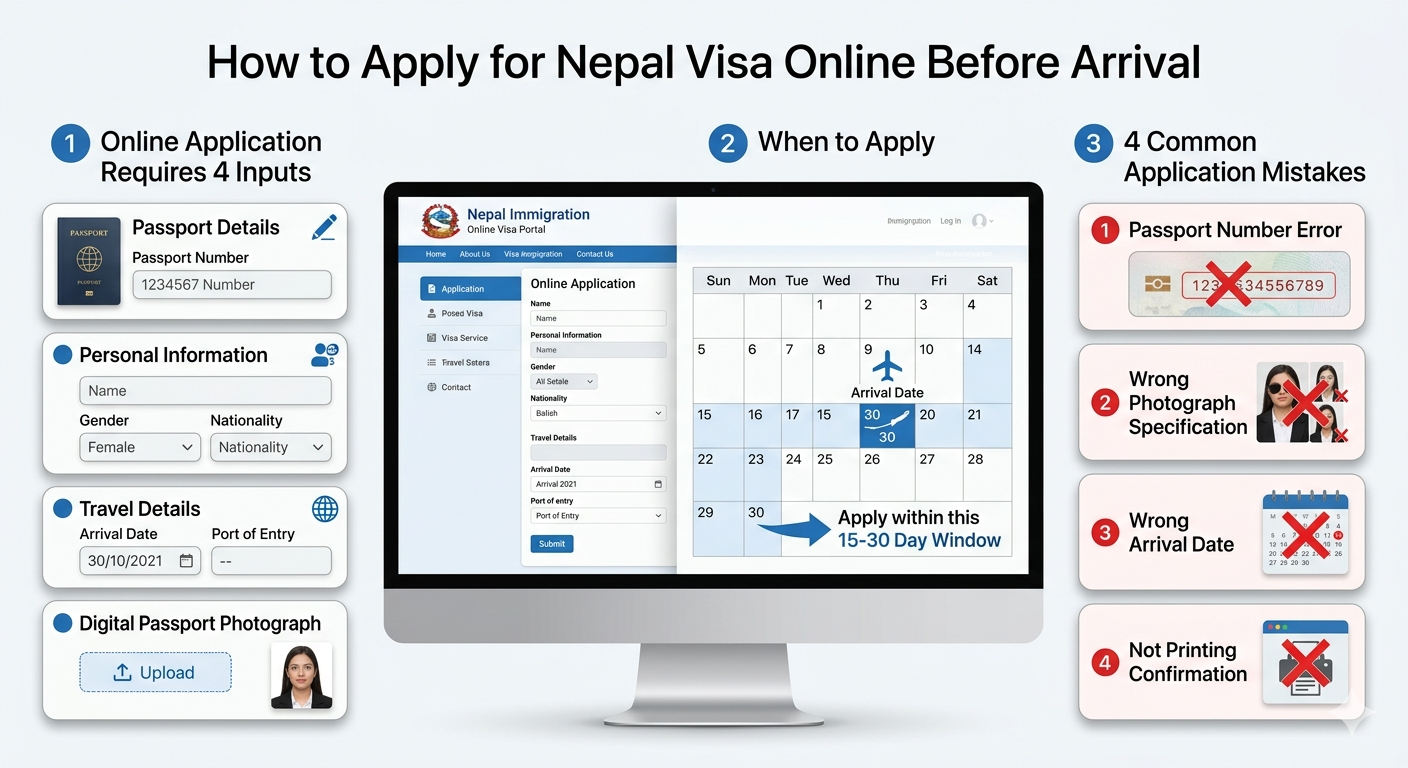
To apply for a Nepal visa online before arrival, submit the application through the official Nepal online visa portal at least 15 days before departure. Print the confirmation on arrival. Pay the visa fee at the airport counter after landing.
The Nepal online visa application reduces airport queue time from 30 to 45 minutes to under 10 minutes. The online system pre-registers applicant data with the Department of Immigration Nepal.
Official Online Visa Application Process
The online application requires 4 inputs:
-
Passport details (number, expiry date, issuing country)
-
Personal information (full name, date of birth, nationality)
-
Travel details (arrival date, entry point, purpose)
-
Digital passport photograph upload
The online portal issues a confirmation number. Print this confirmation and carry it to the airport. The confirmation does not replace the visa. Payment and final visa issuance occur at the airport immigration counter on arrival.
When to Apply for Nepal Visa Online
Submit the online application 15 to 30 days before arrival. Applications submitted less than 72 hours before arrival may not process fully in the government system. Peak trekking season (September to November) produces higher application volumes and slower processing.
Common Online Visa Application Mistakes
The 4 most common online Nepal visa application errors:
-
Passport number entry errors causing document mismatch at immigration
-
Photograph upload not meeting the 35mm x 45mm white background specification
-
Selecting wrong arrival date causing system validation failure
-
Not printing the confirmation before departure
What Documents Are Required for a Nepal Visa?
Nepal visa requires a valid passport with 6 months minimum remaining validity and at least 2 blank pages, 1 passport-size photograph with white background, and the visa fee in USD. Additional supporting documents strengthen the application but are not mandatory for tourist visa.
Passport Requirements
Passport validity rule: the expiry date must be at least 6 months beyond the intended Nepal departure date. A trekker arriving in Nepal on 1 October must hold a passport valid until at least 1 April of the following year.
Blank passport pages: 2 blank pages are required for the entry stamp and visa sticker. Passports with fewer than 2 blank pages are rejected at immigration.
Photograph Requirements
1 passport-size photograph is required at the visa on arrival counter. Photograph specifications: 35mm x 45mm, white or light background, face forward, taken within the past 6 months. Photographs on phones are not accepted at immigration counters.
Payment Requirements
Visa fee payment is accepted in USD cash at all Nepal entry points. NPR (Nepali Rupees) and major foreign currencies are accepted at some counters. Credit card payment is available at Tribhuvan International Airport visa counter. Carrying exact USD cash amounts eliminates change and card machine availability risk.
Exact USD amounts by visa duration: USD 30 for 15 days, USD 50 for 30 days, USD 125 for 90 days.
Supporting Documents
The following supporting documents are not mandatory but reduce the risk of entry complications:
-
Return flight ticket or onward travel proof
-
Hotel booking confirmation for first night in Kathmandu
-
Travel insurance policy covering trekking and emergency evacuation
-
Emergency contact details
How Long Should Your Nepal Visa Be for the Everest Base Camp Trek?
The 30-day Nepal visa is the correct duration for the Everest Base Camp trek. A standard EBC itinerary takes 12 to 14 trekking days. Adding pre-trek Kathmandu days, post-trek return, and Lukla flight delay buffer produces a realistic 18 to 22 day Nepal stay.
Trek Duration vs Visa Duration Logic
EBC trek duration breakdown for visa planning:
-
Kathmandu arrival and pre-trek preparation: 1 to 2 days
-
Trekking days Lukla to EBC and return: 12 to 14 days
-
Post-trek Kathmandu stay: 1 day
-
Lukla flight delay buffer: 3 to 5 days
-
Total realistic Nepal stay: 17 to 22 days
The 15-day visa covers only the minimum trekking days with zero buffer. Lukla Airport (2,840 m) records weather-related closures averaging 3 to 7 days per season. Flight disruptions force trekkers to wait in Lukla or Namche Bazaar (3,440 m) with no schedule certainty. A 15-day visa during a 5-day Lukla closure produces automatic overstay.
Buffer Days Strategy
Buffer days for the EBC itinerary are planned extra visa days beyond the expected trek duration to absorb weather delays, illness recovery time, and flight rescheduling. A 30-day visa provides 8 to 13 buffer days beyond a standard 17-day Nepal stay. This buffer covers all common disruption scenarios without requiring a visa extension.
Can You Extend a Nepal Tourist Visa During the Trek?
Yes, Nepal tourist visa extension is processed at the Department of Immigration office in Kathmandu, Pokhara, or border points. Extension cost is USD 45 for the first 15 days minimum, plus USD 3 per additional day. Overstay penalty is USD 5 per day beyond the visa expiry date.
Nepal tourist visa extension is defined as the process of adding days to an existing valid tourist visa before its expiry date. Extensions are not processed on the trekking route. Trekkers requiring an extension return to Kathmandu or Pokhara before the current visa expires.
Where to Extend a Nepal Tourist Visa
The Department of Immigration Nepal processes visa extensions at 3 locations:
-
Maitighar, Kathmandu (main office)
-
Pokhara Immigration Office
-
Major land border crossing points
Extension processing time is 1 to 2 business days at the Kathmandu office.
Visa Extension Cost Breakdown
Extension cost structure from the Department of Immigration Nepal:
-
Minimum extension: 15 days at USD 45 base fee
-
Additional days beyond 15: USD 3 per day
-
Example: 30-day extension costs USD 45 plus (15 x USD 3) = USD 90 total
Maximum cumulative stay in Nepal on a tourist visa: 150 days per calendar year.
Overstay Penalties
Overstay is defined as remaining in Nepal beyond the visa expiry date without a valid extension. Overstay penalty rate: USD 5 per day. Overstay consequences include:
-
Financial penalty paid at the immigration exit counter
-
Entry into the immigration violation record
-
Potential restrictions on future Nepal visa applications
-
Possible legal action for extended overstays exceeding 30 days
What Permits Do You Need Besides a Nepal Visa for the EBC Trek?
Everest Base Camp trekkers require 2 permits in addition to the Nepal visa: the Sagarmatha National Park Entry Permit and the Khumbu Pasang Lhamu Rural Municipality Permit. These permits are separate from the visa and are not substitutes for it.
Sagarmatha National Park Entry Permit
Sagarmatha National Park Entry Permit is defined as the mandatory conservation fee for trekkers entering Sagarmatha National Park, the protected area containing Everest Base Camp. The park entry point is at Monjo (2,840 m) on the standard Lukla route.
Sagarmatha National Park Entry Permit cost: NPR 3,000 (approximately USD 23) for foreign nationals. The permit is issued at the Nepal Tourism Board office in Kathmandu or at the Monjo park entry checkpoint.
Khumbu Pasang Lhamu Rural Municipality Permit
Khumbu Pasang Lhamu Rural Municipality Permit is defined as the local government access permit for the Khumbu region, issued by the Khumbu Pasang Lhamu Rural Municipality. This permit replaced the TIMS card (Trekkers' Information Management System card) in the Everest region.
Khumbu Pasang Lhamu Permit cost: NPR 2,000 (approximately USD 15) per trekker. The permit is issued in Lukla or Namche Bazaar at the municipality checkpoint.
Visa vs Permit: Key Distinction
Nepal visa grants legal entry to Nepal as a country. Trekking permits grant legal access to specific protected zones within Nepal. A trekker without a valid visa cannot legally enter Nepal. A trekker with a valid visa but without trekking permits cannot legally trek in the Khumbu region. Both are required and listed in the pre-departure document checklist, checked at separate checkpoints.
What Is the Total Cost of Nepal Visa and Everest Base Camp Permits?
Total mandatory entry and permit cost for trekking in the Everest region is USD 88 to USD 163, depending on visa duration choice. The 30-day visa at USD 50 combined with both trekking permits produces a total entry cost of approximately USD 88.
The following table shows the complete cost breakdown for Nepal visa and EBC trekking permits for international trekkers:
|
Document |
Cost |
|
Nepal tourist visa (30 days) |
USD 50 |
|
Sagarmatha National Park Entry Permit |
USD 23 (NPR 3,000) |
|
Khumbu Pasang Lhamu Municipality Permit |
USD 15 (NPR 2,000) |
|
Total mandatory entry cost |
USD 88 |
The above table shows 2025 rates from the Department of Immigration Nepal and the Nepal Tourism Board. Rates are subject to annual revision.
Optional additions to the total cost:
-
90-day visa instead of 30-day: add USD 75 (total becomes USD 163)
-
Visa extension (if required): add USD 45 minimum plus USD 3 per additional day
-
Overstay fine (if applicable): add USD 5 per overstay day
What Are the Nepal Visa Rules by Nationality?
Nepal visa rules vary by nationality. Indian citizens are exempt from visa requirements under the Indo-Nepal Treaty of Peace and Friendship. SAARC nationals from Bangladesh, Bhutan, Maldives, Pakistan, and Sri Lanka receive visa-free or discounted entry. Citizens of Nigeria, Ghana, Zimbabwe, and Afghanistan require pre-approved embassy visa.
Indian Citizens
Indian citizens do not require a Nepal visa. Entry is permitted with a valid Indian passport or government-issued photo identity card. This exemption is governed by the Indo-Nepal Treaty of Peace and Friendship, a bilateral agreement defining free movement between the 2 countries. Indian citizens still require trekking permits for the EBC route.
SAARC Nationals
SAARC is defined as the South Asian Association for Regional Cooperation, a political union of 8 South Asian nations including Bangladesh, Bhutan, India, Maldives, Nepal, Pakistan, and Sri Lanka. SAARC nationals excluding Indians receive Nepal visa at no cost or at reduced rates depending on bilateral agreements at the time of travel. Current SAARC visa terms require verification with the Department of Immigration Nepal before travel.
Restricted Nationalities
Citizens of the following countries require pre-approval from the Department of Immigration Nepal before arrival: Nigeria, Ghana, Zimbabwe, Afghanistan, Cameroon, Iraq, and a small number of additional nationalities on the restricted list. Pre-approval is obtained through the nearest Nepalese Embassy or Nepalese Consulate. Arriving without pre-approval produces entry denial at Tribhuvan International Airport.
UK, US, Australian, and European Citizens
UK citizens, US citizens, Australian citizens, and citizens of all EU and Schengen area countries are eligible for Nepal visa on arrival at Tribhuvan International Airport. No pre-approval is required. The standard visa on arrival process applies.
What Happens If You Overstay Your Nepal Visa?
Nepal visa overstay incurs a fine of USD 5 per day, payable at the immigration exit counter. Extended overstay produces an immigration violation record, potential legal action, and risk of future Nepal visa refusal. Exit from Nepal is blocked until all fines are paid.
Overstay is a violation of Nepal immigration law. The Department of Immigration Nepal records all overstay violations in its immigration database. Trekkers overstaying due to Lukla flight delays or medical emergencies receive no automatic exemption. The overstay fine applies regardless of the cause.
Overstay Fine Structure
Overstay fine: USD 5 per day for each day beyond the visa expiry date. Payment currency: NPR or USD at the exit immigration counter.
Overstay fine examples:
-
3-day overstay: USD 15 fine
-
7-day overstay: USD 35 fine
-
14-day overstay: USD 70 fine
Legal Consequences of Extended Overstay
Overstays exceeding 30 days trigger formal immigration investigation. The Department of Immigration Nepal issues a written warning for overstays between 30 and 60 days. Overstays exceeding 60 days produce a formal legal case under Nepal immigration law. Future Nepal visa applications from travelers with overstay records face increased scrutiny and possible refusal.
Emergency Overstay Situations
Medical emergencies including altitude sickness on the Khumbu route, natural disasters, and documented flight cancellations provide grounds for overstay fine appeal. Trekkers in this situation contact the Department of Immigration Nepal directly with supporting documentation including hospital records, airline cancellation notices, or weather authority reports. Fine reduction or waiver is granted at the discretion of immigration authorities, not automatically.
What Are the Most Common Nepal Visa Mistakes Trekkers Make?
The 6 most common Nepal visa mistakes trekkers make are choosing the wrong visa duration, arriving without USD cash, confusing visa with trekking permits, incorrect passport photograph, passport with less than 6 months validity, and failing to check nationality-specific restrictions before arrival.
The 6 mistakes and their direct consequences:
-
Choosing a 15-day visa for an EBC trek: Lukla flight delays produce overstay. The 30-day visa eliminates this risk.
-
Arriving without USD cash: Card machines at immigration counters malfunction during peak season. USD cash guarantees payment processing.
-
Assuming the visa covers trekking zone access: The visa grants Nepal entry only. Sagarmatha National Park Entry Permit and Khumbu Pasang Lhamu Permit are required separately.
-
Submitting non-compliant photograph: Photographs with colored backgrounds, phone-screen photos, or images not meeting the 35mm x 45mm specification are rejected at the immigration counter.
-
Traveling with a passport expiring within 6 months of Nepal departure: Immigration denies entry to travelers with insufficient passport validity.
-
Not checking restricted nationality status: Citizens of restricted countries arriving without pre-approval are denied entry at Tribhuvan International Airport.
What Are the Pro Tips for Smooth Nepal Entry for EBC Trekkers?
4 actions produce the smoothest Nepal entry experience: completing the online visa application before arrival, carrying exact USD cash for the visa fee, bringing 2 printed passport photographs, and keeping both printed and digital copies of all travel documents.
Pre-fill the Online Visa Application
The Nepal online visa portal pre-registers applicant data with the Department of Immigration. Trekkers who complete the online application before arrival skip the kiosk queue entirely. The airport kiosk queue during October and November peak season holds 50 to 150 travelers. Online pre-registration reduces arrival processing to under 10 minutes.
Carry Exact USD Visa Fee
Carry USD 50 in exact cash for the 30-day visa. Immigration counters do not always provide change. Card payment machines experience outages during peak hours. Exact cash eliminates 2 transaction failure risks in a single action.
Arrive During Off-Peak Hours
Tribhuvan International Airport processes peak visa volumes between 8:00 AM and 2:00 PM. Flights arriving between 2:00 PM and 10:00 PM encounter shorter immigration queues. Arrival time is determined by flight schedule, but trekkers with booking flexibility select afternoon or evening arrivals during October and November.
Keep Printed and Digital Document Copies
Carry 2 printed copies of the following documents: passport photo page, visa confirmation (if pre-applied), travel insurance policy, and return flight ticket. Store 1 digital copy on phone and 1 in cloud storage. Document loss on the trekking route is resolved faster with pre-stored copies.
Frequently Asked Questions about Nepal Visa for the Everest Base Camp Trek
Can I Get a Nepal Visa on Arrival for the Everest Base Camp Trek?
Yes, Nepal visa on arrival is available at Tribhuvan International Airport for citizens of 175 countries. The process requires a passport, 1 photograph, and visa fee in USD. Processing takes 15 to 45 minutes. Citizens of restricted nationalities require pre-approved embassy visa before arrival.
How Much Does a Nepal Visa Cost for Trekking?
Nepal visa costs USD 30 for 15 days, USD 50 for 30 days, and USD 125 for 90 days. The 30-day visa at USD 50 is the recommended choice for EBC trekking. It covers the standard 12 to 14 day itinerary plus buffer days for Lukla flight delays.
Is a Nepal Visa Enough for the Everest Base Camp Trek?
No, a Nepal visa alone is not sufficient for EBC trekking. The visa grants entry to Nepal. Trekkers additionally require the Sagarmatha National Park Entry Permit (USD 23) and the Khumbu Pasang Lhamu Rural Municipality Permit (USD 15) for legal access to the Khumbu trekking zone.
How Long Should My Visa Be for the EBC Trek?
The 30-day visa is the correct duration for EBC trekking. Standard trek duration is 12 to 14 days. Adding Kathmandu pre and post days plus 3 to 5 buffer days for Lukla weather delays produces an 18 to 22 day total Nepal stay. The 30-day visa covers this range with margin.
Can I Extend My Nepal Tourist Visa During the Trek?
Yes, Nepal tourist visa extension is available at the Department of Immigration Nepal offices in Kathmandu and Pokhara. Extension processing takes 1 to 2 business days. Minimum extension is 15 days at USD 45, plus USD 3 per additional day. Extensions are not processed on the trekking route.
Do I Need a Visa Traveling from India to Nepal?
No, Indian citizens do not require a Nepal visa. Entry is permitted under the Indo-Nepal Treaty of Peace and Friendship using a valid Indian passport or government photo ID. Indian citizens still require the Sagarmatha National Park Permit and Khumbu Pasang Lhamu Permit for EBC trekking.
What Happens If I Overstay My Nepal Visa?
Overstay incurs a fine of USD 5 per day, paid at the immigration exit counter. Nepal does not waive overstay fines automatically for weather or flight delays. Overstays exceeding 30 days trigger formal immigration investigation. Extended overstays create a violation record affecting future Nepal visa applications.
Can I Pay Nepal Visa Fees by Card or Only Cash?
Card payment is accepted at Tribhuvan International Airport visa counters. Cash in USD is the most reliable payment method. Card machine outages occur during peak season. Carrying exact USD cash for the visa fee eliminates payment failure risk at the immigration counter.
More About Author

Khilak Budhathoki
Travel Director
Khilak Budhathoki is the co-founder and lead trekking guide at Himalaya Trekking Nepal, a locally owned and operated adventure company based in Kathmandu. Born and raised in the foothills of Nepal, Khilak developed a deep love for the mountains from an early age. With over a deca...

USD$1,600 pp
Our Recommendation
Related Blogs
Jul 08, 2026
Is Nepal Safe to Travel? 2026 Tourist Safety Guide
.jpg)
Oct 30, 2025
Best Time for Annapurna Base Camp Trek
Jul 29, 2026
How Long Is the Annapurna Base Camp Trek? 7–12 Days
