- 22, Apr 2026 | Khilak Budhathoki
A passport is mandatory for all international trekkers on the Everest Base Camp trek. The passport must have a minimum of 6 months' validity beyond the Nepal departure date. It is required for Nepal visa issuance, Sagarmatha National Park entry permit, and Khumbu Pasang Lhamu Rural Municipality permit.
Passport verification occurs at 4 points on the EBC route: Tribhuvan International Airport on arrival, Lukla Airport checkpoint, Monjo National Park entry gate, and Namche Bazaar permit verification. Trekkers carry the original passport throughout the Khumbu Valley route. Photocopies are submitted at permit checkpoints but do not replace the original at any verification point.
The 6-month validity rule applies to all nationalities. Passports expiring within 6 months of the planned Nepal departure date are rejected at Tribhuvan International Airport. The Nepal visa on arrival requires 2 blank passport pages, 1 passport-sized photograph (35mm x 45mm, white background), and the visa fee of USD 50 for the recommended 30-day duration.
Trekkers carry 4 to 5 passport photocopies for permit submissions at Monjo and Namche Bazaar. They carry 2 to 4 passport photographs for visa and permit applications. Digital copies stored on phone and cloud storage support emergency replacement when the original passport is lost or stolen on the route.
Indian nationals are exempt from Nepal visa requirements under the Indo-Nepal Treaty of Peace and Friendship. SAARC nationals receive simplified visa terms. All other nationalities obtain the tourist visa on arrival at Tribhuvan International Airport. Restricted nationalities from Nigeria, Ghana, Zimbabwe, and Afghanistan require pre-approved embassy visa before arrival.
Passport requirements for the Everest Base Camp trek form a 3-layer document system: passport proves identity, Nepal visa grants country entry, and trekking permits grant Khumbu zone access. All 3 layers are legally required. Missing any one produces trek termination at the relevant checkpoint on the EBC route.
Do You Need a Passport for the Everest Base Camp Trek?
Yes, a passport is mandatory for all international trekkers on the Everest Base Camp trek. The passport is required at 3 stages: Nepal visa processing at Tribhuvan International Airport, trekking permit applications, and identity verification at trekking checkpoints throughout the Khumbu region.
Passport is defined as an internationally recognized travel document issued by a government authority that proves the holder's identity and nationality. Passports are the primary identity document accepted by the Department of Immigration Nepal at all entry and verification points.
The passport serves 4 mandatory functions on the EBC trek:
-
Visa issuance at Tribhuvan International Airport immigration counter
-
Sagarmatha National Park Entry Permit application at Monjo checkpoint
-
Khumbu Pasang Lhamu Rural Municipality Permit application at Lukla or Namche Bazaar
-
Identity verification at trekking checkpoints throughout the Khumbu Valley route
No alternative identity document replaces a passport for international trekkers at any of these 4 stages. Indian nationals are exempt from Nepal visa requirements but still carry a passport or valid government-issued photo identity card for permit verification.
What Passport Validity Is Required for Nepal Entry?
Nepal entry requires a passport with minimum 6 months validity beyond the intended departure date from Nepal. A trekker departing Nepal on 15 November must hold a passport valid until at least 15 May of the following year. Passports failing this requirement are rejected at immigration.
Passport validity is defined as the period between the current date and the passport expiry date during which the document is legally accepted for international travel and identity verification.
The 6-month validity rule applies to all nationalities entering Nepal. The Department of Immigration Nepal enforces this rule at Tribhuvan International Airport, Gautam Buddha International Airport in Pokhara, and all active land border crossing points including Sunauli, Birgunj, Kakarbhitta, and Nepalgunj.
Why 6 Months Validity Is Required
Nepal visa and trekking permit issuance systems link directly to passport expiry dates. A passport expiring within 6 months of Nepal entry creates 3 processing failures:
-
Nepal visa cannot be issued beyond the passport expiry date
-
Trekking permit validity cannot extend beyond the passport validity period
-
Emergency evacuation and consular support processes require a valid travel document
Trekkers whose passports expire within 6 months of the planned Nepal departure date renew their passport before booking flights. Passport renewal processing times vary by country: UK passports take 3 to 10 weeks, US passports take 6 to 8 weeks standard and 2 to 3 weeks expedited, Australian passports take 4 to 6 weeks.
Passport Validity Calculation for EBC Trekkers
EBC trekkers calculate passport validity using this 4-step method:
-
Identify the Nepal departure date (last day in Nepal)
-
Add 6 months to that date
-
Check passport expiry against the resulting date
-
Renew the passport before booking travel when the expiry falls before the calculated date
Example: Nepal departure on 1 November requires passport validity until at least 1 May of the following year.
Can You Trek Everest Base Camp Without a Passport?
No, trekking Everest Base Camp without a passport is not permitted for foreign nationals. The passport is required for Nepal visa issuance, Sagarmatha National Park Entry Permit, and Khumbu Pasang Lhamu Rural Municipality Permit. Trekking without these documents is illegal under Nepal immigration and conservation law.
Foreign nationals without a valid passport face entry denial at Tribhuvan International Airport before reaching the guided EBC trekking route. The Department of Immigration Nepal requires passport presentation at the visa on arrival counter as the first step of the Nepal entry process.
Trekking permit applications for the EBC route require the passport at 2 additional checkpoints beyond the airport. The Sagarmatha National Park Entry Permit application at Monjo (2,840 m) requires original passport presentation and a passport-sized photograph. The Khumbu Pasang Lhamu Rural Municipality Permit issued at Lukla or Namche Bazaar (3,440 m) requires passport number and nationality details.
A photocopy of the passport is not accepted as a substitute for the original at any of these 3 permit and visa stages. Photocopies serve as backup documents only.
Special Case: Indian Nationals
Indian nationals do not require a Nepal visa. Entry is permitted under the Indo-Nepal Treaty of Peace and Friendship using a valid Indian passport or government-issued photo identity card such as an Aadhaar card or voter identity card. Indian nationals still present identity documents at trekking permit checkpoints in the Khumbu region.
What Are the Passport Requirements for Nepal Visa on Arrival?
Nepal visa on arrival at Tribhuvan International Airport requires a passport with 6 months minimum validity, at least 2 blank pages for the visa sticker and entry stamp, and a passport-size photograph. The passport is verified against the visa application form data before stamp issuance.
The visa on arrival process uses the passport for 3 verification functions:
-
Machine Readable Zone (MRZ) scan for identity authentication
-
Biometric data verification against the passport chip where applicable
-
Manual data matching between the passport details and the visa application form
Machine Readable Zone (MRZ) is defined as the 2-line printed strip at the bottom of the passport photo page containing encoded identity data read by immigration scanning systems. Immigration officers scan the MRZ at the Tribhuvan International Airport counter to populate the visa record automatically.
Blank Pages Requirement
The Nepal visa requires 1 blank page for the visa sticker. The entry stamp requires 1 additional blank page. Passports with fewer than 2 blank pages are rejected at the immigration counter. Trekkers with full passports add pages through a passport amendment process at their national passport office before travel.
Passport Photo Page Requirements
The passport photo page must be legible and undamaged. Passports with water damage, torn pages, or illegible photograph pages are rejected. Immigration officers verify that the passport photograph matches the traveler presenting the document.
How Many Passport Copies Do You Need for the Everest Base Camp Trek?
EBC trekkers carry 4 to 5 photocopies of the passport photo page. Copies are submitted at permit checkpoints, retained at teahouses for trekker registration, and used as backup identification when the original passport is stored securely.
The 5 locations where passport copies are used or submitted on the EBC trek:
-
Sagarmatha National Park Entry Permit application at Monjo (1 copy submitted)
-
Khumbu Pasang Lhamu Permit application at Lukla or Namche Bazaar (1 copy submitted)
-
Teahouse registration records at major stops including Namche Bazaar, Tengboche, Dingboche, and Lobuche (1 to 2 copies used)
-
Trekking agency documentation for guide and porter coordination (1 copy retained)
-
Emergency backup copy stored separately from the original passport (1 copy kept by trekker)
Photocopies are printed before departure from Kathmandu. Printing facilities are available in Thamel, Kathmandu. Printing in the Khumbu region above Namche Bazaar is not reliably available.
Digital Copies as Supplementary Backup
A digital scan of the passport photo page is stored on the trekker's phone and in cloud storage such as Google Drive or email. Digital copies serve as supplementary backup and speed up emergency replacement processing at the nearest embassy or consulate. Digital copies do not replace physical photocopies at permit checkpoints.
What Passport Photos and Supporting Documents Are Required for the EBC Trek?
EBC trekkers carry 2 to 4 passport-sized photographs for trekking permit applications. Photograph specification: 35mm x 45mm, white or light background, full face forward, taken within 6 months. Additional supporting documents include travel insurance, flight ticket, and emergency contact details.
Passport-sized photograph is defined as a standardized photo format measuring 35mm wide by 45mm tall, with a white or light-colored background, showing the full face from hairline to chin with no head coverings except for religious purposes.
Photograph Distribution Across EBC Permits
The 3 permit and registration points requiring passport-sized photographs:
-
Nepal visa on arrival: 1 photograph submitted at immigration counter
-
Sagarmatha National Park Entry Permit: 1 photograph submitted at Monjo checkpoint
-
Khumbu Pasang Lhamu Rural Municipality Permit: 1 photograph submitted at Lukla or Namche Bazaar
Carrying 4 photographs covers all 3 mandatory submissions with 1 emergency spare. Trekkers with guide-arranged permits submit photographs through their trekking agency in Kathmandu before departure.
Supporting Documents Checklist
The following table shows all supporting documents required or recommended for the EBC trek, their purpose, and submission point:
|
Document |
Purpose |
Submission Point |
|
Original passport |
Visa and permit identity verification |
Airport, Monjo, Namche Bazaar |
|
4 to 5 passport photocopies |
Permit submission and backup |
Multiple checkpoints |
|
2 to 4 passport photographs |
Visa and permit applications |
Airport, Monjo, Namche Bazaar |
|
Travel insurance policy |
Emergency evacuation coverage proof |
Agency or guide briefing |
|
Return flight ticket |
Proof of onward travel |
Immigration counter |
|
Accommodation booking |
Proof of first night stay |
Immigration counter |
|
Emergency contact details |
Rescue coordination data |
Guide registration |
The above table shows the complete supporting document set for EBC trekkers entering Nepal and trekking the Khumbu Valley route.
Where Is Your Passport Checked During the EBC Trek?
The passport is checked at 4 points during the Everest Base Camp trek: Tribhuvan International Airport on arrival, Lukla or Namche Bazaar for the Khumbu Pasang Lhamu Permit, Monjo for the Sagarmatha National Park Entry Permit, and random spot checks at trekking checkpoints throughout the Khumbu Valley trekking region.
Lukla Airport Checkpoint
Lukla Airport (Tenzing-Hillary Airport, 2,840 m) is the standard air entry point for EBC trekkers. Trekkers landing at Lukla present their passport and Nepal visa at the arrival checkpoint. The Khumbu Pasang Lhamu Rural Municipality Permit is issued at Lukla using passport details.
Monjo Checkpoint
Monjo (2,840 m) is the official entry gate to Sagarmatha National Park. All trekkers present their passport, Nepal visa, and Khumbu Permit at Monjo for park entry verification. The Sagarmatha National Park Entry Permit is purchased or verified at this checkpoint. Trekkers without valid permits are turned back at Monjo.
Namche Bazaar Checkpoint
Namche Bazaar (3,440 m) functions as the secondary permit verification point. Park authorities conduct permit and passport cross-checks at Namche Bazaar. Trekkers who bypassed Monjo or have documentation issues are identified at this checkpoint.
Internal Khumbu Valley Checkpoints
Internal checkpoints at Tengboche (3,860 m), Dingboche (4,410 m), and Lobuche (4,940 m) conduct spot identity and permit verification. These checkpoints use the trekker tracking system maintained by the Khumbu Pasang Lhamu Rural Municipality to monitor trekker movement for safety and search-and-rescue coordination.
Do You Need to Carry the Original Passport on the EBC Trek?
Yes, the original passport is required at all times on the Everest Base Camp trek. Original passport presentation is mandatory at 4 checkpoints including Monjo and Namche Bazaar. Emergency evacuation processing and consular assistance both require the original passport.
Carrying the original passport on the trekking route creates a loss or damage risk. The 2 accepted strategies for managing this risk are:
-
Carry the original passport in a waterproof document pouch worn on the body
-
Store the original passport in the teahouse room safe at night stops
Leaving the original passport at a hotel in Kathmandu is not recommended for EBC trekkers. Checkpoint authorities at Monjo and Namche Bazaar require original passport presentation, not photocopies.
Passport Security on the Trek
Waterproof document pouches protect passports from sweat, rain, and river crossing splash on suspension bridges. The Khumbu Valley route crosses multiple suspension bridges including the Hillary Suspension Bridge near Phakding (2,610 m). Water exposure risk is present throughout the lower Khumbu section.
Document damage on the trek produces 3 consequences:
-
Rejection at checkpoint verification points
-
Complications at Tribhuvan International Airport on exit
-
Delayed emergency evacuation processing
How Should You Store a Digital Copy of Your Passport for the EBC Trek?
Store a digital copy of the passport photo page in 3 locations: phone gallery, cloud storage (Google Drive or email), and a secure copy sent to an emergency contact at home. Digital copies accelerate embassy replacement processing and support lost passport procedures.
Digital passport copy is defined as a high-resolution scan or photograph of the passport photo page that captures all printed identity data, photograph, and document number legibly on a digital device.
Cloud Storage Method
Upload the passport scan to Google Drive, Dropbox, or email before departure. Access these platforms via mobile data or teahouse WiFi at Namche Bazaar and Dingboche (4,410 m). Cloud storage ensures the copy remains accessible even if the phone is lost along with the original passport.
Emergency Contact Storage
Send 1 digital copy to a trusted contact in the home country. The home contact provides the document number and identity data to the nearest Nepalese Embassy or consulate when emergency passport replacement is needed. This reduces replacement processing time from 5 to 7 days to 2 to 3 days in documented cases.
Digital copies do not substitute for the original passport at Nepal immigration, permit checkpoints, or emergency evacuation processing. Digital copies support the replacement process only.
What Is the Difference Between Passport Requirements and EBC Trekking Permits?
The passport is an identity document proving nationality and authorizing international travel. Trekking permits are access documents authorizing entry to specific protected zones. The passport is required to obtain both the Nepal visa and all trekking permits. Permits do not replace the passport at any checkpoint.
Passport and trekking permits operate as a 3-layer document system on the EBC trek:
-
Layer 1: Passport proves identity and nationality
-
Layer 2: Nepal tourist visa grants legal entry to Nepal
-
Layer 3: Trekking permits grant legal access to protected zones within Nepal
Sagarmatha National Park Entry Permit
Sagarmatha National Park Entry Permit is defined as the conservation access document required for entry into Sagarmatha National Park, the UNESCO World Heritage Site containing Everest Base Camp. Permit cost: NPR 3,000 (approximately USD 23) for foreign nationals. The permit is issued using passport identity data at the Nepal Tourism Board office in Kathmandu or at Monjo checkpoint.
Khumbu Pasang Lhamu Rural Municipality Permit
Khumbu Pasang Lhamu Rural Municipality Permit is defined as the local government access document issued by the Khumbu Pasang Lhamu Rural Municipality for trekking in the Khumbu region. This permit replaced the TIMS card (Trekkers' Information Management System card) in the Everest region. Cost: NPR 2,000 (approximately USD 15). Issued using passport details at Lukla or Namche Bazaar.
The passport number links both permits to the trekker's identity in the Nepal trekking authority database. Checkpoint authorities cross-reference the passport against permit records at Monjo and Namche Bazaar.
What Are the Most Common Passport Mistakes EBC Trekkers Make?
The 6 most common passport mistakes EBC trekkers make are insufficient passport validity, insufficient blank pages, not carrying photocopies, losing the passport on the trek, passport and visa detail mismatch, and relying on a digital copy as a primary document.
The 6 mistakes and their direct consequences:
-
Passport with less than 6 months validity: Nepal visa is rejected at Tribhuvan International Airport. Entry denied.
-
Fewer than 2 blank pages: Visa sticker and entry stamp cannot be applied. Entry denied.
-
No photocopies carried: Permit applications at Monjo and Namche Bazaar cannot be completed without a copy for submission.
-
Passport lost during the trek: Emergency evacuation and exit from Nepal requires emergency travel document processing through the trekker's embassy or consulate in Kathmandu. Processing takes 3 to 7 business days.
-
Passport name not matching flight ticket or visa application: Document mismatch triggers immigration delay and potential secondary screening.
-
Using digital copy as the primary document at checkpoints: Checkpoint authorities at Monjo and Namche Bazaar require the original passport. Digital copies are rejected as primary identification.
What Are the Passport Rules for Different Nationalities on the EBC Trek?
Passport rules for EBC trekking vary by nationality across 3 categories: standard international trekkers requiring Nepal visa on arrival, SAARC nationals with simplified visa terms, and Indian nationals with visa exemption but ongoing passport or ID requirements for permit verification.
Standard International Trekkers
UK, US, Australian, Canadian, and all EU and Schengen area citizens present a valid passport at Tribhuvan International Airport for visa on arrival processing. Standard requirements apply: 6 months validity, 2 blank pages, 1 passport photograph, and visa fee in USD.
SAARC Nationals
SAARC is defined as the South Asian Association for Regional Cooperation. SAARC nationals from Bangladesh, Bhutan, Maldives, Pakistan, and Sri Lanka receive visa-free or reduced-cost entry to Nepal. A valid passport remains mandatory for all SAARC nationals at immigration and permit checkpoints. Visa exemption does not exempt SAARC nationals from passport presentation.
Indian Nationals
Indian nationals are exempt from Nepal visa requirements under the Indo-Nepal Treaty of Peace and Friendship. Entry is permitted with a valid Indian passport or a government-issued photo identity card. At trekking permit checkpoints in the Khumbu region, Indian nationals present either their passport or an accepted alternative identity document for permit registration.
Restricted Nationalities
Citizens of Nigeria, Ghana, Zimbabwe, Afghanistan, and a small number of additional restricted countries require pre-approved embassy visa before arrival. A valid passport is required for the pre-approval application at the nearest Nepalese Embassy or Nepalese Consulate.
What Happens If You Lose Your Passport During the EBC Trek?
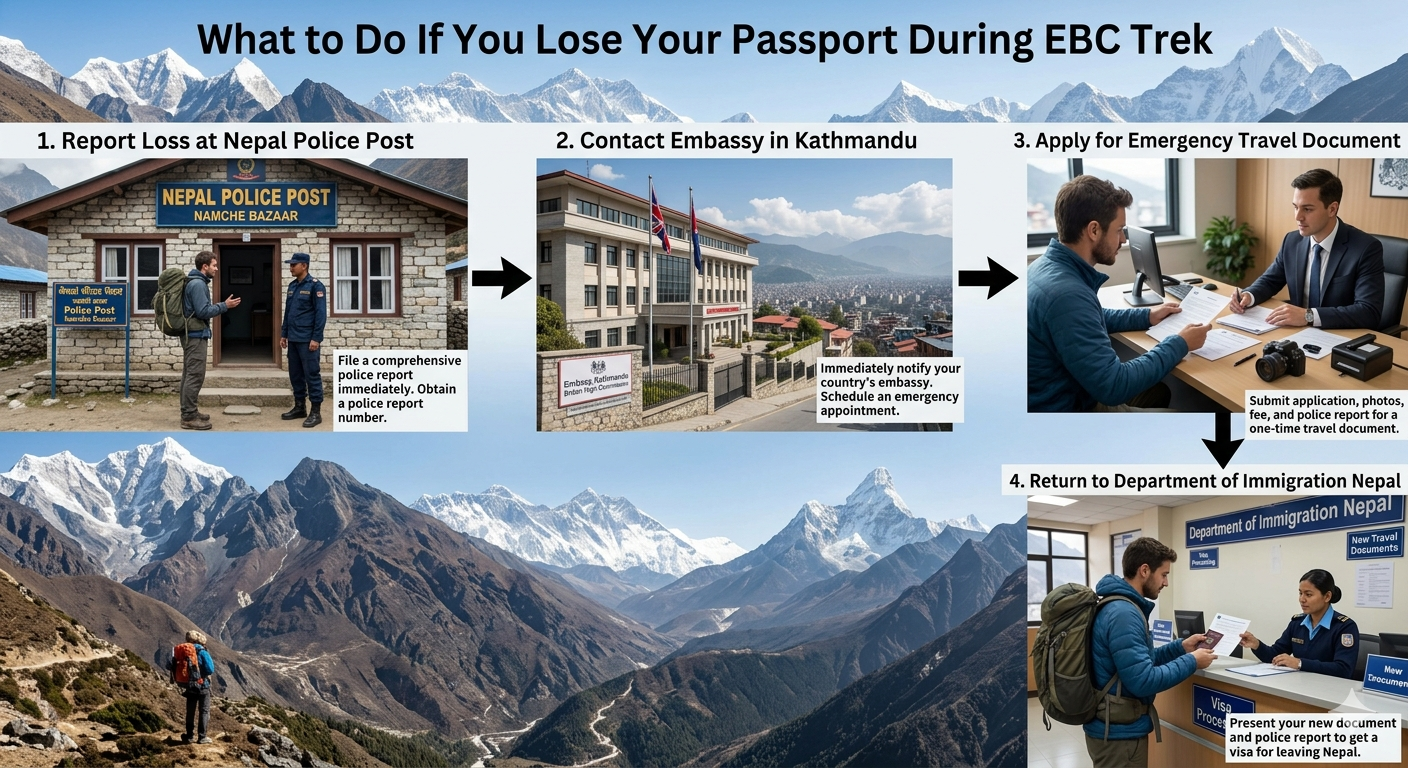
A lost passport on the EBC trek requires 4 actions: report the loss to the nearest Nepal police post, contact your country's embassy or consulate in Kathmandu, apply for an emergency travel document, and obtain replacement permit documentation before exiting Nepal.
Lost passport is defined as the condition where the original passport is no longer in the trekker's possession due to theft, misplacement, or accidental damage beyond use. Nepal law requires foreign nationals to hold a valid travel document at all times.
Step-by-Step Lost Passport Procedure on the Trek
The 4-step lost passport procedure for EBC trekkers:
-
Report the loss at the nearest Nepal Police post. Police posts are located in Namche Bazaar, Tengboche, Dingboche, and Lobuche. The police report is required for the embassy replacement application.
-
Descend to Kathmandu or the nearest city with embassy access. The closest embassy or consulate is located in Kathmandu for most nationalities. Emergency descent from Namche Bazaar to Kathmandu via Lukla flight takes 1 day minimum.
-
Apply for an emergency passport or emergency travel document at the embassy or consulate. Processing time ranges from 2 to 7 business days depending on nationality and the availability of identity backup documents.
-
Return to the Department of Immigration Nepal with the replacement document to update the exit record and pay any outstanding visa compliance fees.
Embassy Assistance in Kathmandu
The British Embassy, US Embassy, Australian High Commission, and most EU country embassies maintain offices in Kathmandu. Emergency consular support includes emergency passport issuance, repatriation assistance, and liaison with Nepal immigration authorities.
Digital copies of the passport stored in cloud storage or sent to a home contact reduce emergency processing time by providing verified identity data to the embassy without requiring physical document submission.
Frequently Asked Questions about Passport Requirements for the Everest Base Camp Trek
Do I Need a Passport for the Everest Base Camp Trek?
Yes, a passport is mandatory for all international trekkers on the EBC trek. The passport is required for Nepal visa issuance, Sagarmatha National Park Entry Permit, and Khumbu Pasang Lhamu Rural Municipality Permit. All 3 documents require passport identity data. Indian nationals present a passport or accepted government photo ID.
How Much Passport Validity Is Required for Nepal?
Nepal requires minimum 6 months passport validity beyond the intended departure date from Nepal. A passport expiring within 6 months of the planned Nepal exit date is rejected at Tribhuvan International Airport immigration. Trekkers renew passports before booking travel when validity falls below this threshold.
Can I Trek Everest Base Camp with a Copy of My Passport?
No, a photocopy does not replace the original passport at any stage of the EBC trek. Copies are submitted at permit checkpoints but the original passport is required for visa issuance, checkpoint identity verification, and emergency evacuation processing. The original passport must be carried on the trek.
Is a Passport Required at Lukla Airport?
Yes, the passport is checked at Lukla Airport (Tenzing-Hillary Airport, 2,840 m) on arrival. The Khumbu Pasang Lhamu Rural Municipality Permit is issued at Lukla using passport details. Trekkers arriving without a valid passport cannot complete permit registration at Lukla.
Do I Need Passport Photos for Everest Base Camp Permits?
Yes, EBC trekking requires 2 to 4 passport-sized photographs measuring 35mm by 45mm. 1 photograph is submitted with the Nepal visa application. 1 photograph is submitted at the Sagarmatha National Park Entry Permit application at Monjo. 1 photograph is submitted with the Khumbu Pasang Lhamu Permit. Carrying 4 covers all requirements plus 1 spare.
Can I Use a Digital Passport Copy During the Trek?
A digital passport copy is a backup document only. It is not accepted as a substitute for the original passport at Nepal immigration, trekking permit checkpoints, or identity verification points. Digital copies speed up emergency replacement processing at the embassy when the original passport is lost or stolen.
What Happens If I Lose My Passport in Nepal?
Losing a passport in Nepal requires reporting the loss to the Nepal Police, contacting the home country embassy or consulate in Kathmandu, and applying for an emergency travel document. Processing takes 2 to 7 business days. Storing a digital copy in cloud storage and with an emergency home contact reduces replacement processing time.
Is a Passport Required for Nepal Visa on Arrival?
Yes, the original passport is required at the Nepal visa on arrival counter at Tribhuvan International Airport. The Machine Readable Zone (MRZ) is scanned for identity authentication. The passport photo page is verified against the applicant. The visa sticker is applied to a blank passport page. No alternative document replaces the passport at this stage.
More About Author

Khilak Budhathoki
Travel Director
Khilak Budhathoki is the co-founder and lead trekking guide at Himalaya Trekking Nepal, a locally owned and operated adventure company based in Kathmandu. Born and raised in the foothills of Nepal, Khilak developed a deep love for the mountains from an early age. With over a deca...

USD$1,600 pp
Our Recommendation
Related Blogs