- 22, Apr 2026 | Khilak Budhathoki
Travel documents for Everest Base Camp trek include 5 mandatory items: a valid passport, Nepal visa, Sagarmatha National Park permit, Khumbu Pasang Lhamu Rural Municipality permit, and travel insurance with helicopter evacuation coverage to 6,000 m. Missing any single mandatory document blocks entry at Nepal immigration, Monjo checkpoint, or Namche Bazaar.
Supporting documents include 6 passport photos, flight tickets, trek itinerary, medical prescriptions, and an emergency contact list. Documents are verified at Tribhuvan International Airport, Lukla airstrip, Monjo entry gate, and 4 additional checkpoints between Namche Bazaar and Gorak Shep. Nepal visa costs USD 30 to USD 125.
Sagarmatha permit costs NPR 3,000. Khumbu permit costs NPR 2,000. Trekking permits are obtainable at the Tourist Service Center in Kathmandu or at checkpoint offices on the trail. Carry 3 physical photocopies and 1 digital backup set stored in Google Drive with offline access. Travel insurance for Everest Base Camp trek must be arranged before departure from your home country.
What Travel Documents Are Required for Everest Base Camp Trek?
Everest Base Camp trek requires 5 mandatory documents: a valid passport, Nepal visa, Sagarmatha National Park permit, Khumbu Pasang Lhamu Rural Municipality permit, and travel insurance with helicopter evacuation coverage.
Supporting documents include 2 passport-size photos, flight tickets, trek itinerary, medical prescriptions, and emergency contact records. Documents are checked at Tribhuvan International Airport (Kathmandu), Lukla airstrip, Monjo entry checkpoint, and multiple trail stations between Namche Bazaar and Gorak Shep. Missing any mandatory document blocks entry or trek progression.
Trekkers on organized packages receive permit assistance from licensed trekking agencies. Independent trekkers obtain permits from the Tourist Service Center in Kathmandu or Namche Bazaar. Carry 3 physical photocopies of each mandatory document plus digital backups stored in Google Drive or Dropbox.
The following table shows every document, its category, where it is issued, and where it is checked.
|
Document |
Category |
Issued By |
Checked At |
|
Passport |
Mandatory identity |
Home country |
Airport, all checkpoints |
|
Nepal Visa |
Mandatory entry |
Nepal Immigration / Embassy |
Tribhuvan Airport |
|
Sagarmatha National Park Permit |
Mandatory trekking |
Tourist Service Center / Agencies |
Monjo checkpoint |
|
Khumbu Pasang Lhamu Permit |
Mandatory trekking |
Khumbu Municipality / Agencies |
Monjo, Namche |
|
Travel Insurance |
Mandatory safety |
Insurance provider |
Trekking company briefing |
|
Passport Photos |
Supporting |
Photo studio |
Permit offices |
|
Flight Tickets |
Supporting |
Airline |
Lukla airstrip |
|
Trek Itinerary |
Supporting |
Agency or self-prepared |
Namche checkpoint |
|
Medical Prescriptions |
Supporting |
GP or specialist |
Health posts |
|
Emergency Contacts |
Supporting |
Self-prepared |
Insurance, guide |
Every document listed above serves a distinct checkpoint or legal function on the EBC route.
What Are the Mandatory Documents for Everest Base Camp Trek?
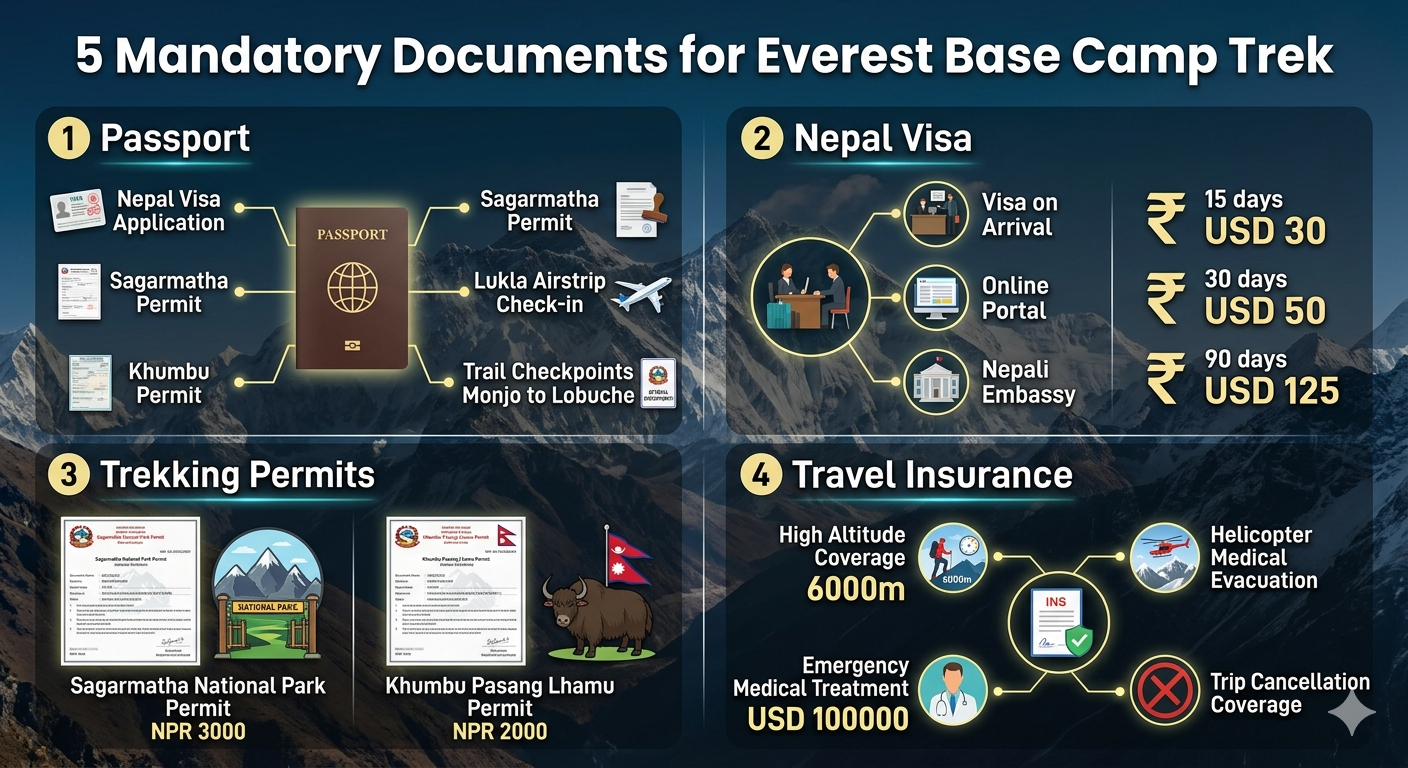
5 documents are legally mandatory for Everest Base Camp trek. Absence of any single document results in entry denial, permit rejection, or forced trek abandonment.
Do You Need a Passport for Everest Base Camp Trek?
A valid passport meeting 6-month validity requirements is required for every stage of the Everest Base Camp trek.
According to Nepal Immigration Department regulations, passports with less than 6 months validity at entry are rejected at Tribhuvan International Airport immigration.
Passport requirements by use:
-
Nepal visa application: requires passport data page
-
Sagarmatha National Park permit: requires passport copy
-
Khumbu Pasang Lhamu permit: requires passport copy
-
Lukla airstrip check-in: requires original passport
-
All trail checkpoints between Monjo and Lobuche: require passport
Trekkers carry the original passport throughout the trek. Leaving the passport at a Kathmandu hotel creates problems at Lukla airstrip check-in and trail checkpoints.
A government-issued national ID card does not substitute for a passport at Nepal immigration.
Do You Need a Nepal Visa for Everest Base Camp Trek?
A Nepal visa for trekking is required for all international travelers except Indian nationals. Nepal issues visas through 3 channels: visa on arrival at Tribhuvan International Airport, online via the Nepal Online Visa Portal, and through Nepali embassies abroad.
According to the Department of Immigration Nepal, visa fees are structured as:
-
15-day single entry: USD 30
-
30-day single entry: USD 50
-
90-day multiple entry: USD 125
Visa on arrival at Tribhuvan International Airport requires: completed immigration form, passport-size photo (1 copy), and cash payment in USD, EUR, GBP, or AUD. Credit cards are not accepted at all visa-on-arrival counters.
Online visa application through the Nepal Online Visa Portal (nepal.gov.np) requires: digital passport photo, passport scan, and advance fee payment. Processing takes 3 to 5 business days.
Indian nationals enter Nepal without a visa using a valid Indian passport or Voter ID card.
SAARC country nationals (Bangladesh, Bhutan, Maldives, Pakistan, Sri Lanka) receive free visas with different validity terms.
What Permits Are Required for Everest Base Camp Trek?
2 trekking permits are required for the Nepal-side Everest Base Camp route: the Sagarmatha National Park entry permit and the Khumbu Pasang Lhamu Rural Municipality permit.
According to the Nepal Tourism Board, both permits are compulsory for all trekkers entering the Khumbu trekking region above Monjo checkpoint.
Sagarmatha National Park permit:
-
Fee: NPR 3,000 for SAARC nationals, USD 30 equivalent for others
-
Issued by: Department of National Parks and Wildlife Conservation
-
Obtained at: Tourist Service Center (Kathmandu) or Monjo checkpoint
-
Required documents: passport copy, 1 passport photo, completed form
-
Checked at: Monjo entry gate (primary), multiple stations beyond
Khumbu Pasang Lhamu Rural Municipality permit:
-
Fee: NPR 2,000 (approximately USD 15)
-
Issued by: Khumbu Pasang Lhamu Rural Municipality office
-
Obtained at: Lukla, Phakding, or Namche Bazaar office
-
Required documents: passport copy, 1 passport photo
-
Checked at: Namche Bazaar area checkpoint
TIMS card (Trekkers' Information Management System) was previously required and is issued by TAAN (Trekkers' Association of Nepal) and Nepal Tourism Board. Current trekking agency-organized groups may not need a separate TIMS card as the Khumbu permit system overlaps its function. Independent trekkers confirm current TIMS requirements at the Tourist Service Center before departure.
Licensed trekking agencies obtain both permits on behalf of clients as part of standard package services.
Do You Need Travel Insurance for Everest Base Camp Trek?
Travel insurance with high-altitude medical coverage and helicopter evacuation to at least 6,000 m is required for Everest Base Camp trek. Most licensed trekking agencies in Nepal will not confirm a booking without insurance documentation.
According to the Himalayan Rescue Association, helicopter evacuation from Gorak Shep to Kathmandu costs USD 3,000 to USD 8,000 per flight. Evacuation from higher points exceeds USD 10,000 without insurance coverage.
Insurance policy requirements for EBC trek:
-
High-altitude coverage: minimum 6,000 m elevation
-
Medical evacuation: helicopter rescue included
-
Emergency medical treatment: minimum USD 100,000 coverage
-
Trip cancellation and interruption: recommended
Required insurance documentation to carry:
-
Insurance certificate (printed copy)
-
Policy number (written separately from the certificate)
-
24-hour insurance helpline number
-
Emergency contact at the insurer's local or regional office
Trekkers submit insurance details to their guide or trekking agency at the pre-trek briefing in Kathmandu. The guide retains a copy for emergency coordination.
UK trekkers use providers including World Nomads, True Traveller, and BMC Travel Insurance. US trekkers use IMG Global, Ripcord, and World Nomads. Australian trekkers use Cover-More and World Nomads.
What Supporting Documents Should You Carry for Everest Base Camp Trek?
6 supporting document categories strengthen the EBC trek process: passport photos, flight tickets, trek itinerary, medical certificates, prescriptions, and emergency contacts. None are legally mandatory for entry, but all resolve operational and safety problems on the trail.
How Many Passport Photos Do You Need for EBC Trek Permits?
Bring 6 passport-size photos for the Everest Base Camp trek permit process. Each permit requires 1 to 2 photos, and spare copies prevent delays at remote permit offices.
Photo distribution by permit:
-
Sagarmatha National Park permit: 1 photo
-
Khumbu Pasang Lhamu permit: 1 photo
-
Nepal visa on arrival: 1 photo
-
TIMS card (independent trekkers): 1 photo
-
Spare for loss or damage: 2 photos
Photos must meet standard passport specifications: white background, 35 mm x 45 mm, face clearly visible, taken within 6 months.
Passport photos are available at studios near Thamel in Kathmandu for NPR 200 to NPR 400 per set.
Do You Need Flight Tickets and Trek Itinerary Copies?
Carry printed copies of your international flight ticket, Kathmandu to Lukla domestic flight ticket, and trek itinerary. These documents verify travel plans at Lukla airstrip and support permit applications.
Kathmandu to Lukla flights operate on Tara Air and Summit Air. Flight tickets are required at Tribhuvan International Airport domestic terminal and at Lukla airstrip for boarding confirmation.
The trek itinerary, prepared by your trekking agency or self-prepared for independent trekkers, is presented at Monjo checkpoint and Namche Bazaar registration.
Booking confirmation from your trekking agency serves as secondary identification at hotel and teahouse check-ins along the route from Phakding to Gorak Shep.
Should You Carry Medical Certificates or Prescriptions for Trekking?
Carry printed prescriptions for all medications in your first aid kit, especially Acetazolamide (Diamox), antibiotics, and controlled substances. Medical certificates are not legally required but resolve issues at health posts and during emergency evacuations.
Diamox (Acetazolamide) for altitude prevention requires a doctor's prescription. Health posts at Phakding, Namche Bazaar, and Pheriche request prescription documentation when treating prescription medications.
Medical documents to carry:
-
Prescription for Acetazolamide (Diamox)
-
Prescription for Ciprofloxacin or Azithromycin (antibiotic)
-
Blood group record (written on a card, not just in a passport)
-
Allergy documentation
The Himalayan Rescue Association aid post at Pheriche (4,371 m) requests medical history information during altitude sickness consultations. A printed medical summary prepared by your GP speeds this process.
Do You Need Emergency Contact and Insurance Documents?
Carry a physical emergency contact list separate from your phone. Phone batteries fail at altitude. The physical list provides contact access when devices are unavailable.
Emergency contact list contents:
-
Family or next-of-kin name, phone number, and country
-
Insurance policy number and 24-hour helpline number
-
Trekking agency emergency number in Kathmandu
-
Nearest embassy or consulate in Kathmandu (with address and phone)
-
Himalayan Rescue Association Pheriche post: +977-1-4440292
-
CIWEC Hospital Kathmandu: +977-1-4424111
Write this list on waterproof paper or laminate it. Store 1 copy in your daypack and 1 copy in your main duffel bag.
Where Are Documents Checked During Everest Base Camp Trek?
Documents are checked at 5 main points during the Everest Base Camp trek: Tribhuvan International Airport (Kathmandu), Lukla airstrip, Monjo entry gate, Namche Bazaar registration point, and occasional trail stations beyond Namche.
Are Documents Checked at Lukla Airport?
Lukla airstrip (Tenzing-Hillary Airport, 2,845 m) requires your original passport and Kathmandu to Lukla flight ticket for boarding confirmation. No permit check occurs at Lukla.
Tara Air and Summit Air ground staff check boarding passes and passport identity before allowing passengers onto the tarmac. Passport must match the name on the flight ticket exactly.
Luggage weight limits on Lukla flights are strictly enforced: 15 kg checked bag and 5 kg carry-on per passenger. Document organizers and daypacks count toward the 5 kg carry-on allowance.
What Documents Are Checked at Monjo Entry Point?
Monjo checkpoint (2,835 m) is the primary permit verification point for the Sagarmatha National Park. Rangers check the Sagarmatha National Park permit and passport at this gate.
Trekkers without a valid Sagarmatha permit are refused entry beyond Monjo. No alternative route bypasses this checkpoint into the national park.
The Khumbu Pasang Lhamu permit is also checked near Monjo or at the Namche Bazaar entry point. Rangers record permit numbers in a logbook at each checkpoint.
Document inspection at Monjo takes 5 to 15 minutes per group. Organized trekking groups with agency-obtained permits move through faster than independent trekkers obtaining permits at the checkpoint.
Do You Need Documents at Every Checkpoint on the EBC Trail?
Documents are checked at 6 main checkpoints between Monjo and Gorak Shep. Rangers record permit numbers at each station. Trekkers do not surrender documents at any point.
Checkpoint sequence and documents required:
-
Monjo (2,835 m): Sagarmatha permit, Khumbu permit, passport
-
Namche Bazaar (3,440 m): Khumbu permit, trek registration
-
Tengboche (3,860 m): Permit inspection (occasional)
-
Dingboche (4,410 m): Permit recording
-
Lobuche (4,940 m): Permit confirmation
-
Gorak Shep (5,170 m): Final permit recording before Base Camp
Kala Patthar (5,644 m) and Everest Base Camp (5,364 m) have no formal checkpoints, but rangers record trekker details at Gorak Shep.
How Many Copies of Travel Documents Should You Carry for EBC Trek?
Carry 3 physical photocopies of each mandatory document and 1 complete digital backup set. This 3-plus-1 system protects against document loss at any stage from Kathmandu to Base Camp.
Physical copy distribution system:
-
Copy 1: Document organizer in daypack (carried on your person daily)
-
Copy 2: Main duffel bag carried by your porter
-
Copy 3: Left at your hotel safe in Kathmandu
Digital backup system:
-
Scan all documents before departure
-
Upload scans to Google Drive or Dropbox in a clearly labeled folder
-
Share folder access with a trusted family member or friend at home
-
Download offline copies to your phone (accessible without internet above Namche)
Wi-Fi availability on the EBC route is limited above Namche Bazaar. Offline document access through downloaded Google Drive files or a phone photo gallery works without internet connection.
Waterproof protection is essential. Store physical documents in Ziplock bags inside your document organizer. Monsoon rain, river crossings, and teahouse condensation damage unprotected paper documents.
What Happens If You Lose Your Documents During the Everest Base Camp Trek?
Passport loss during the EBC trek requires contacting your home country's embassy in Kathmandu and trekking to the nearest town with communication access. Above Namche Bazaar, embassy contact requires phone or satellite communication.
Passport loss protocol:
-
Report loss to your trekking guide immediately
-
Contact your home country embassy in Kathmandu (phone numbers in your emergency contact list)
-
Trek or descend to Namche Bazaar for stable phone connection
-
Embassy issues an Emergency Travel Document (ETD) for exit from Nepal
-
Nepal Immigration Office in Kathmandu processes exit with the ETD
US Embassy Kathmandu: +977-1-423-4000. UK Embassy Kathmandu: +977-1-423-7100. Australian Embassy New Delhi (covers Nepal): +91-11-4139-9900.
Permit loss protocol:
Sagarmatha National Park permits cannot be reissued on the trail. A lost permit requires returning to the checkpoint where it was last recorded. Rangers cross-reference logbook entries with passport number. Present your passport copy and entry stamp record to resolve the situation.
Travel insurance loss protocol:
Contact your insurer's 24-hour helpline using the policy number written in your emergency contact list. Insurers provide digital policy copies by email within 2 to 4 hours for emergency situations.
Can You Trek to Everest Base Camp Without Complete Documents?
Trekking to Everest Base Camp without complete mandatory documents is blocked at specific checkpoints. Nepal immigration denies entry without a valid visa. Monjo checkpoint denies access to the national park without a Sagarmatha permit.
Entry denial scenarios by document:
-
No valid passport: blocked at Tribhuvan International Airport
-
No Nepal visa: blocked at immigration, Tribhuvan International Airport
-
No Sagarmatha permit: blocked at Monjo gate
-
No Khumbu permit: blocked at Namche Bazaar area checkpoint
-
No travel insurance: blocked by trekking agency at pre-trek briefing in Kathmandu
Trekking without insurance is not an immigration or permit violation, but licensed Khumbu trekking operators refuse to operate treks for clients without evacuation coverage. Independent trekkers face risk exposure of USD 3,000 to USD 10,000 in evacuation costs without insurance.
Rangers record passport numbers at every checkpoint. Trekkers attempting entry with incomplete documents are escorted back to the permit office or nearest checkpoint.
What Is the Recommended Document Setup for Everest Base Camp Trek?
The optimal EBC document setup uses a 3-layer system: original documents in a waterproof organizer, photocopies distributed across bags, and digital backups accessible offline.
What Should You Keep in Your Daypack vs Main Luggage?
Keep originals and 1 photocopy set in your daypack. Keep 1 photocopy set in your porter-carried duffel bag. Porters carry duffel bags on a separate route during some stages. Originals stay with you at all times.
Daypack document contents:
-
Original passport
-
Original permits (in permit sleeve provided at checkpoint)
-
Insurance certificate (original)
-
Emergency contact list (laminated)
-
Cash (USD and NPR)
-
Phone with offline document scans
Main duffel bag document contents:
-
Photocopy set of all mandatory documents
-
Ziplock-sealed from moisture
Never pack original documents in a porter-carried duffel bag. Porters and trekkers travel separately on some trail sections, particularly between Namche Bazaar and Tengboche.
How Should You Organize Documents for Quick Access on the Trail?
Use a waterproof document organizer with labeled sections for fast checkpoint access. Checkpoint rangers request permits during group pauses. Organized documents prevent 10 to 15 minute delays per checkpoint.
Document organizer section layout:
-
Section 1: Passport (original)
-
Section 2: Permits (Sagarmatha and Khumbu, in permit sleeves)
-
Section 3: Insurance certificate
-
Section 4: Photocopy set (backup)
-
Section 5: Emergency contacts and cash
Ripstop nylon or PVC document organizers with zipper closure survive Khumbu weather conditions. Standard paper folders deteriorate within 3 to 5 days of trail humidity.
Travel Documents Checklist for Everest Base Camp Trek (Printable)
Mandatory Documents Checklist
The following 5 mandatory documents are required before departure and at trail checkpoints.
-
Passport: valid for minimum 6 months beyond Nepal entry date, original carried throughout trek
-
Nepal visa: obtained online, at embassy, or on arrival at Tribhuvan International Airport, fee USD 30 to USD 125 depending on duration
-
Sagarmatha National Park permit: fee NPR 3,000 or USD 30 equivalent, obtained at Tourist Service Center Kathmandu or Monjo checkpoint
-
Khumbu Pasang Lhamu Rural Municipality permit: fee NPR 2,000, obtained at Lukla, Phakding, or Namche offices
-
Travel insurance certificate: high-altitude coverage to 6,000 m minimum, helicopter evacuation included, policy number recorded separately
All 5 documents confirmed before boarding your Kathmandu to Lukla flight.
Supporting Documents Checklist
The following 6 supporting document categories resolve operational and safety situations on the EBC trail.
-
Passport-size photos: 6 copies, white background, 35 mm x 45 mm format
-
International flight ticket: printed copy of outbound and return booking
-
Kathmandu to Lukla domestic flight ticket: printed e-ticket with booking reference
-
Trek itinerary: agency-prepared or self-prepared route plan with accommodation details
-
Medical prescriptions: Acetazolamide (Diamox), antibiotics, any personal medications
-
Emergency contact list: family contact, embassy number, insurance helpline, Himalayan Rescue Association contact, CIWEC Hospital number
Documents stored in waterproof Ziplock bags, 3 physical copies of each, 1 digital backup set uploaded to Google Drive with offline access enabled on phone.
FAQs About Everest Base Camp Travel Documents
What documents are required for Everest Base Camp trek?
You need a valid passport (6+ months validity), Nepal visa, Sagarmatha National Park permit, Khumbu Pasang Lhamu permit, and travel insurance covering helicopter evacuation up to 6,000m.
Do I need travel insurance for Everest Base Camp trek?
Yes, insurance is mandatory through trekking agencies. It must cover high-altitude trekking and helicopter evacuation. Without it, rescue costs can exceed USD 3,000–8,000.
How many permits are required for Everest Base Camp trek?
Two permits are required: Sagarmatha National Park permit and Khumbu Pasang Lhamu permit. Both are checked at Monjo and Namche checkpoints.
Can I get all documents on arrival in Nepal?
Yes. Nepal visa is issued at the airport. Trek permits can be obtained in Kathmandu or on the trail. However, insurance must be arranged before arriving in Nepal.
Do I need to carry my original passport during the trek?
Yes. The original passport is required for flights, checkpoints, and permit verification. Keep it safely in a waterproof pouch inside your daypack.
What happens if I lose my passport during EBC trek?
Report immediately to your guide and embassy in Kathmandu. You’ll need an Emergency Travel Document to exit Nepal. Keep scanned copies as backup.
More About Author

Khilak Budhathoki
Travel Director
Khilak Budhathoki is the co-founder and lead trekking guide at Himalaya Trekking Nepal, a locally owned and operated adventure company based in Kathmandu. Born and raised in the foothills of Nepal, Khilak developed a deep love for the mountains from an early age. With over a deca...

USD$1,600 pp
Our Recommendation
Related Blogs
Mar 30, 2026
Ghorepani: Gateway to Poon Hill Trek
Jul 06, 2026
How to Train for the Everest Base Camp Trek
