- 23, Jan 2026 | Khilak Budhathoki
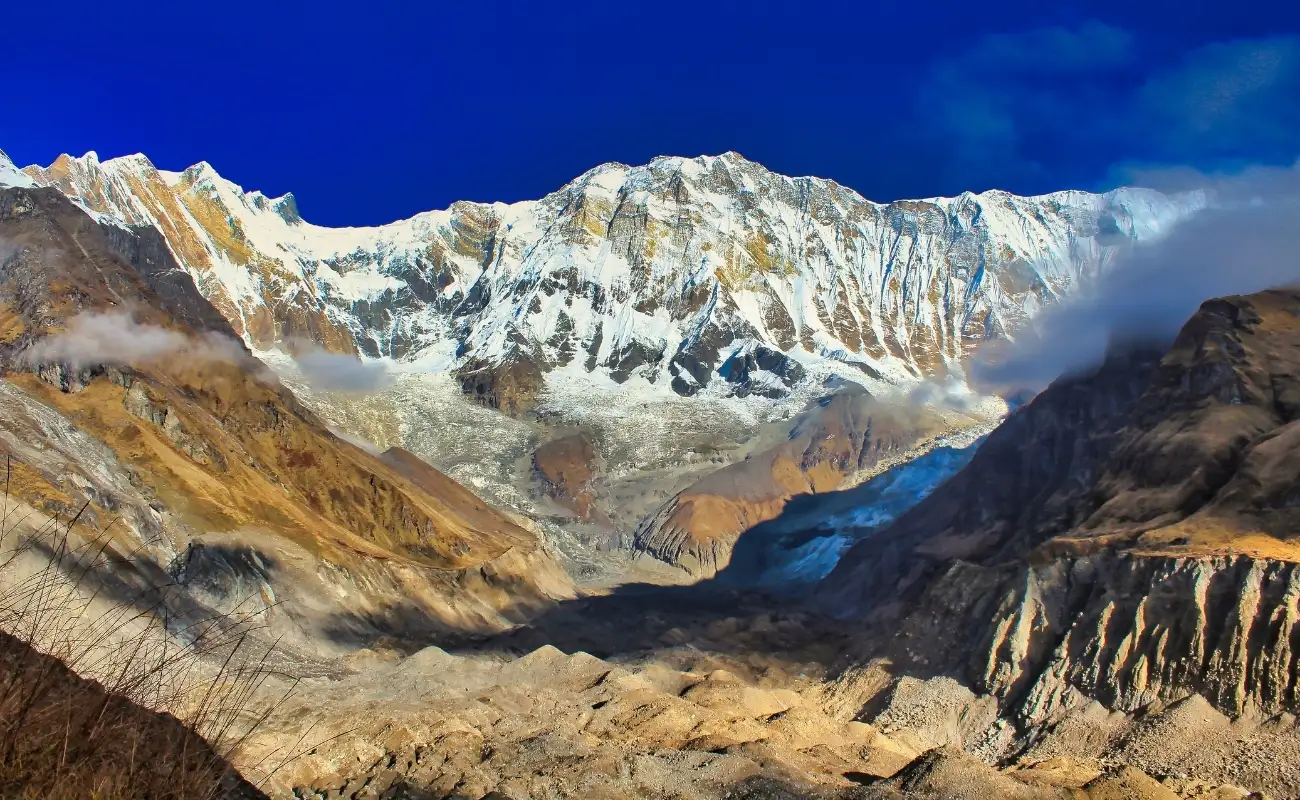
Annapurna Sanctuary is a high-altitude Himalayan basin in central Nepal where the Annapurna Base Camp trek reaches 4,130 meters beneath a spectacular ring of mountains. Located in the Annapurna Conservation Area north of Pokhara, the sanctuary lies at the upper end of the Modi Khola valley and is surrounded by some of the region’s most prominent peaks, including Annapurna I (8,091 m), Annapurna III, Annapurna South, Gangapurna, Hiunchuli, and Machapuchare. The journey to this glacial amphitheater crosses Gurung villages, terraced farmland, bamboo and rhododendron forests, alpine landscapes, and glacial moraines, creating a rapid transition from subtropical foothills to an exposed high-mountain environment.
The Annapurna Sanctuary trek is a moderate-to-strenuous Himalayan trek that combines a 4,130-meter altitude, long daily walking stages, steep stone staircases, changing weather, and snow-covered terrain with exceptional mountain scenery and cultural encounters. Trekking conditions vary significantly between spring, monsoon, autumn, and winter, while route selection, acclimatization, physical conditioning, appropriate gear, ACAP and TIMS permits, altitude awareness, weather assessment, and emergency planning directly influence the experience. This 2026 guide brings those elements together, covering the complete ABC route and itinerary, trek duration and difficulty, seasons and weather, villages and landscapes, wildlife and Gurung culture, fitness and packing requirements, permits and accommodation, altitude sickness and trail safety, and the practical considerations involved in completing Annapurna Sanctuary with a guide or trekking agency.
Where Is Annapurna Sanctuary Located?
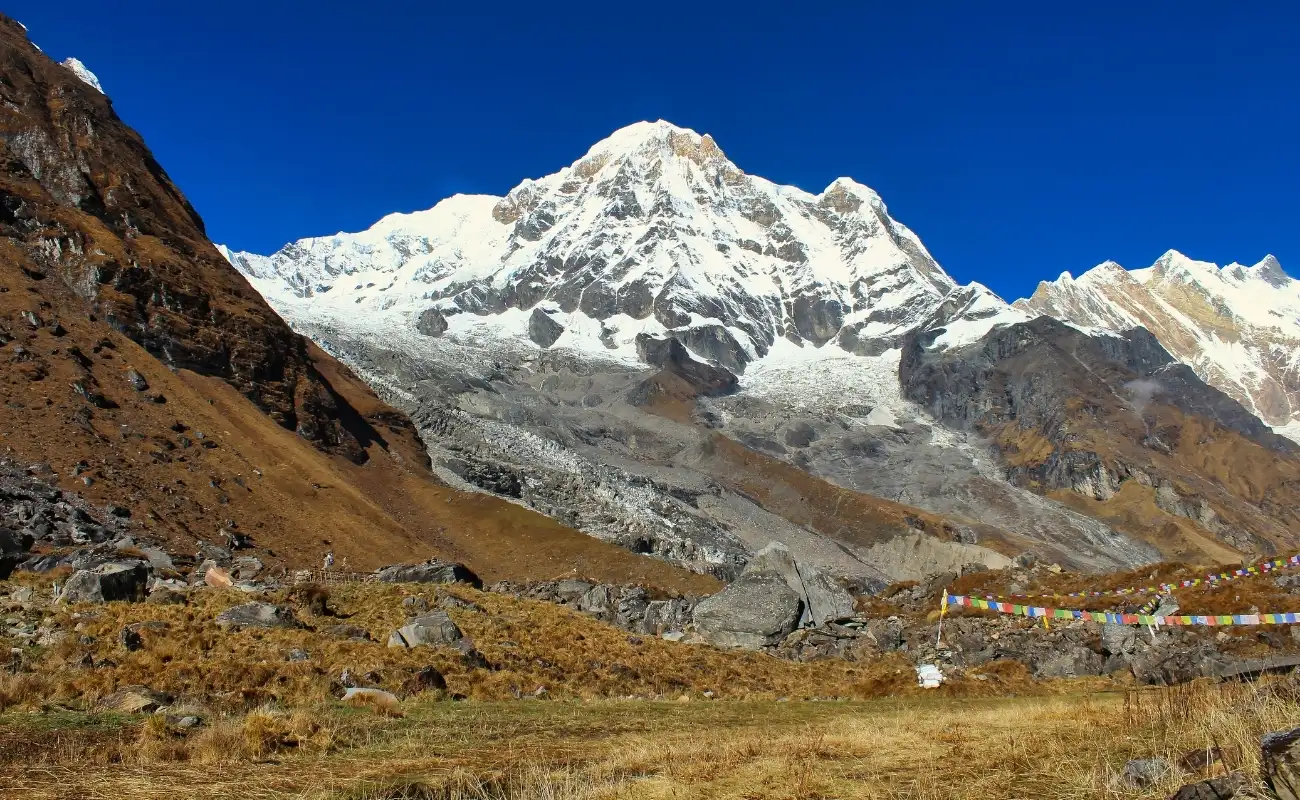
Annapurna Sanctuary sits in Kaski District, Gandaki Province, central Nepal, approximately 40 kilometers north of Pokhara city. The sanctuary occupies a naturally enclosed glacial amphitheater at the base of the Annapurna Massif, within the Annapurna Conservation Area, Nepal's largest protected zone at 7,629 square kilometers.
The sanctuary's coordinates place it at approximately 28.5314°N, 83.8770°E. It lies inside the Modi Khola river valley, a deep gorge that serves as the only natural corridor into the sanctuary's interior. This geographic confinement, walls of ice and rock rising on all sides, is what gives the sanctuary its defining character.
The nearest major city is Pokhara, 200 kilometers west of Kathmandu by road. Trekkers arrive in Pokhara by flight (25 minutes from Kathmandu) or tourist bus (6–8 hours), then drive to the trailhead at Nayapul or Phedi.
What Is the Annapurna Sanctuary Known For?
Annapurna Sanctuary is known for its 360-degree panorama of 11 peaks above 6,000 meters, including Annapurna I (8,091 m), the world's tenth-highest mountain, forming a near-complete ring of Himalayan ice and rock around the basin floor.
3 defining characteristics make the sanctuary globally recognized:
-
The glacial amphitheater: A natural enclosure formed by glacial retreat over millennia, unique in the Himalayas for its accessibility and completeness.
-
Annapurna I proximity: At 4,130 meters, trekkers stand within 7 kilometers of the 8,091-meter summit, closer than most base camps get to their respective peaks.
-
Sacred Gurung geography: The Gurung people consider the sanctuary the abode of the deity Annapurna (Sanskrit: "full of food"), and traditionally restricted access to hunters and herders only.
The sanctuary also carries historical mountaineering significance. The first ascent of Annapurna I on June 3, 1950, by Maurice Herzog and Louis Lachenal marked the first time humanity climbed an 8,000-meter peak. The Annapurna ABC trek route, developed for tourism from the 1970s onward, now hosts approximately 70,000 trekkers annually, making it Nepal's second most-trekked route after the Everest Base Camp trail.
Which Mountains Can You See From Annapurna Sanctuary?
From Annapurna Sanctuary's basin floor at 4,130 meters, trekkers see 11 major peaks forming a near-complete ring: Annapurna I (8,091 m), Annapurna South (7,219 m), Annapurna III (7,555 m), Gangapurna (7,455 m), Hiunchuli (6,441 m), Machapuchare (6,993 m), Annapurna IV (7,525 m), Khangsar Kang (7,485 m), Tarke Kang (7,202 m), Singu Chuli (6,501 m), and Tent Peak (5,663 m).
The table below maps each peak with its elevation and position relative to the sanctuary:
|
Peak |
Elevation |
Position from Sanctuary |
|
Annapurna I |
8,091 m |
North |
|
Annapurna III |
7,555 m |
Northeast |
|
Gangapurna |
7,455 m |
Northeast |
|
Annapurna IV |
7,525 m |
North |
|
Khangsar Kang |
7,485 m |
Northwest |
|
Tarke Kang |
7,202 m |
Northwest |
|
Annapurna South |
7,219 m |
South |
|
Hiunchuli |
6,441 m |
South |
|
Machapuchare |
6,993 m |
South |
|
Singu Chuli |
6,501 m |
West |
|
Tent Peak |
5,663 m |
East |
Machapuchare (Fish Tail Mountain) deserves specific mention. Its double-summit fishtail shape, visible from the Modi Khola valley well before reaching the sanctuary, serves as the trek's visual landmark throughout the approach. Nepal officially closed Machapuchare to climbing in 1964, it remains one of the few Himalayan peaks permanently off-limits, which preserves its sacred Gurung status.
What Is the Annapurna Sanctuary Trek Like?
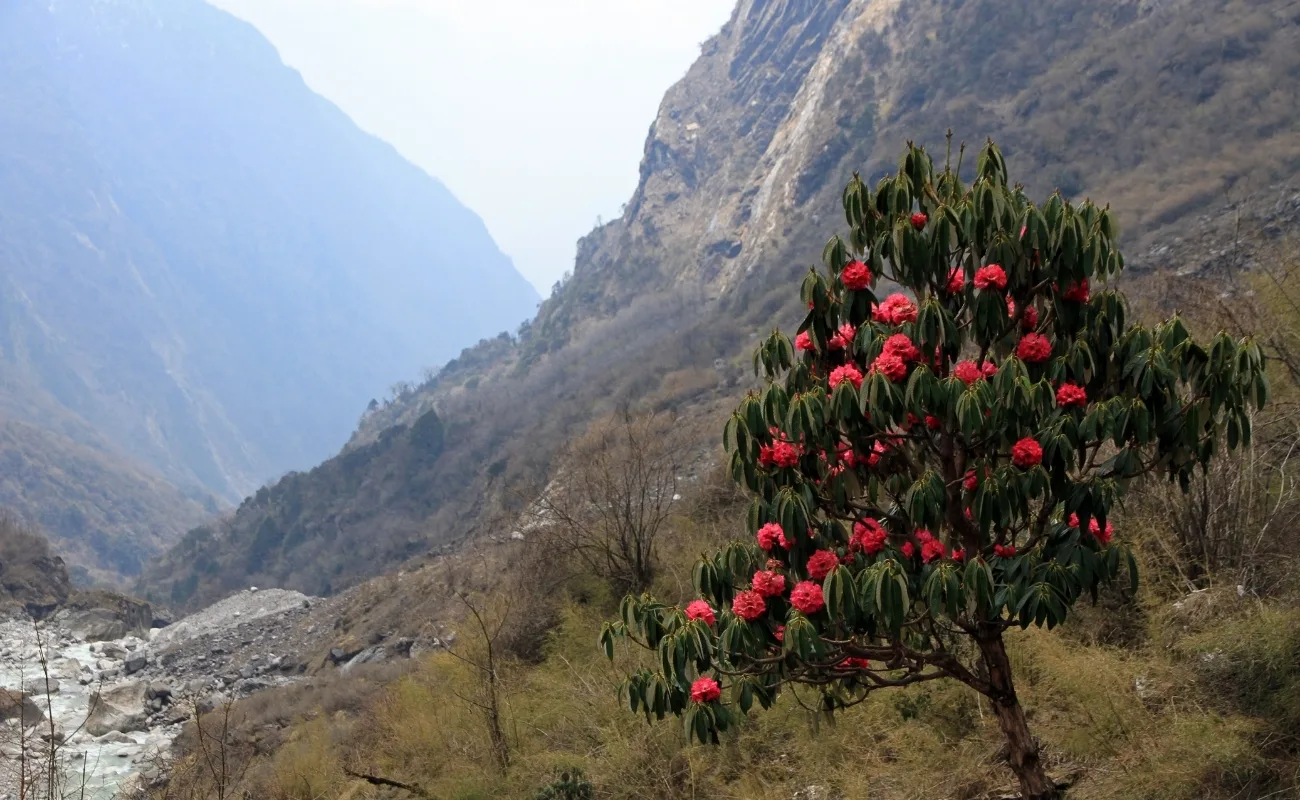
The Annapurna Sanctuary trek is a 7-to-14-day round-trip journey through subtropical jungle, rhododendron forest, alpine meadows, and glacial moraines, ending at the snow-ringed basin of Annapurna Base Camp (4,130 m). The trail follows the Modi Khola river valley northward from Nayapul (1,070 m), gaining 3,060 meters of elevation across roughly 110 kilometers of trail distance round-trip.
The experience divides into 3 distinct zones:
-
Lower valley (1,070–2,170 m): Dense subtropical forest, terraced rice fields, stone-paved trails through Gurung villages. Warm temperatures, high humidity in monsoon, excellent birdwatching.
-
Mid-valley (2,170–3,230 m): Rhododendron and oak forest, bamboo groves, alpine streams. Chhomrong village marks the gateway to the upper sanctuary.
-
Upper sanctuary (3,230–4,130 m): Open moraines, snow-covered ground from October onward, glacial ice visible on surrounding walls, sub-zero nighttime temperatures.
What competitors consistently underreport: the Modi Khola gorge between Himalayan Hotel and Deurali is the route's most technically demanding section, not because of altitude, but because of narrow trail width (as little as 50 centimeters in places), steep drop-offs, and avalanche run-out zones that genuinely require caution in winter and early spring. Guides with local knowledge navigate this section confidently; uninformed solo trekkers misjudge its severity.
How Long Does the Annapurna Sanctuary Trek Take?
The standard Annapurna Sanctuary trek takes 10–13 days from Pokhara, covering approximately 110 kilometers round-trip with a net elevation gain of 3,060 meters from Nayapul to Annapurna Base Camp.
Trek length varies by 3 primary factors:
-
Starting point: Beginning from Nayapul adds 2 days compared to starting from Jhinu Danda (accessible by jeep).
-
Acclimatization days: Responsible trekkers add 1–2 rest days at Chhomrong (2,170 m) or Deurali (3,230 m) to reduce altitude sickness risk.
-
Fitness level: Physically conditioned trekkers complete the route in 7–8 days (fast pace, no extra rest days). Leisure trekkers take 12–14 days.
The most common itinerary for international trekkers runs 10 days: Day 1 drive to Nayapul and hike to Tikhedhunga, Day 2 Ghorepani, Day 3 Tadapani, Day 4 Chhomrong, Day 5 Sinuwa/Bamboo, Day 6 Himalayan Hotel/Deurali, Day 7 ABC, Day 8 descend to Bamboo, Day 9 Ghandruk, Day 10 Nayapul and Pokhara.
Adding the Poon Hill detour (3,210 m sunrise viewpoint) extends the trip by 1 day but adds one of Nepal's most-photographed Himalayan panoramas, practically essential for first-time visitors.
What Is the Typical Annapurna Sanctuary Trek Route?
The standard Annapurna Sanctuary trek route starts at Nayapul (1,070 m), passes through Ghorepani (2,860 m), Tadapani (2,630 m), Chhomrong (2,170 m), Sinuwa, Bamboo, Dovan, Himalayan Hotel, Deurali (3,230 m), Machhapuchhre Base Camp (3,700 m), and terminates at Annapurna Base Camp (4,130 m).
The full route with daily stages:
|
Day |
Stage |
Elevation |
Hours |
|
1 |
Pokhara → Nayapul → Tikhedhunga |
1,540 m |
4–5 hrs |
|
2 |
Tikhedhunga → Ghorepani |
2,860 m |
5–6 hrs |
|
3 |
Ghorepani (Poon Hill sunrise) → Tadapani |
2,630 m |
5 hrs |
|
4 |
Tadapani → Chhomrong |
2,170 m |
4–5 hrs |
|
5 |
Chhomrong → Sinuwa → Bamboo |
2,310 m |
5 hrs |
|
6 |
Bamboo → Dovan → Himalayan Hotel |
2,920 m |
4–5 hrs |
|
7 |
Himalayan Hotel → Deurali → MBC |
3,700 m |
5–6 hrs |
|
8 |
MBC → Annapurna Base Camp |
4,130 m |
2–3 hrs |
|
9 |
ABC → Bamboo (descent) |
2,310 m |
6–7 hrs |
|
10 |
Bamboo → Ghandruk → Nayapul |
1,070 m |
7 hrs |
An alternative return route via Ghandruk village (1,950 m), a classic Gurung settlement with traditional stone houses, a Gurung museum, and panoramic views of Annapurna South, provides a culturally richer descent than retracing the ascent route.
What Is the Highest Point of the Annapurna Sanctuary Trek?
The highest point of the Annapurna Sanctuary trek is Annapurna Base Camp (ABC) at 4,130 meters (13,549 feet) above sea level. Machhapuchhre Base Camp (MBC) at 3,700 meters serves as the final teahouse stop before ABC, located approximately 2.5 kilometers south.
4,130 meters places ABC well within the altitude zone where acclimatization matters. Acute Mountain Sickness (AMS) symptoms become clinically significant above 3,500 meters for approximately 25–30% of trekkers who ascend too rapidly. While standard acclimatization protocols advise ascending no more than 500 meters per day above 3,000 meters, the ABC route's geography requires a 900-meter push from Deurali to the sanctuary floor. To mitigate altitude risks during this necessary push, trekkers must ascend at half-pace, maintain peak hydration, and be prepared to descend immediately to MBC if acute symptoms appear.
For comparison: Everest Base Camp sits at 5,364 meters, making ABC 1,234 meters lower and substantially more accessible for trekkers without high-altitude experience.
How Difficult Is the Annapurna Sanctuary Trek?
The Annapurna Sanctuary trek rates as moderate-to-strenuous difficulty, requiring 5–8 hours of walking per day on trails that include stone staircases, river crossings, narrow gorge paths, and snow-covered terrain above 3,500 meters in winter months.
4 factors determine individual difficulty:
-
Elevation: The 4,130-meter summit elevation causes altitude fatigue in most trekkers above 3,500 m.
-
Daily distance: 10–18 kilometers per day on trails with significant elevation change (400–900 meters daily gain).
-
Trail surface: Stone-paved lower sections require knee strength on descent; upper moraines require ankle stability on loose rock and snow.
-
Weather exposure: The upper sanctuary receives snowfall from October through April, requiring microspike crampons and gaiters.
The trek is not technically demanding, no ropes, harnesses, or climbing equipment are required. A trekker who walks 4–5 hours per week at home, performs 2 lower-body strength sessions weekly, and has no serious cardiovascular conditions completes the ABC trek without exceptional difficulty.
What most guides underemphasize: descending the 3,500-plus stone steps between Ghorepani and Tikhedhunga creates more knee stress than any single ascent section. Trekking poles reduce knee joint loading by 22–25% on downhill terrain, according to biomechanical research published in the Journal of Biomechanics.
When Is the Best Time to Trek to Annapurna Sanctuary?
The best times to trek to Annapurna Sanctuary are March–May (spring) and October–November (autumn), when trail visibility exceeds 50 kilometers, daily temperatures range from 5°C to 20°C at teahouse altitudes, and precipitation is minimal.
Nepal's climate divides the trekking year into 4 distinct windows: spring, monsoon, autumn, and winter, each with specific advantages and limitations for the ABC route.
Why Is Spring a Popular Season for Annapurna Sanctuary?
Spring (March–May) is the most visually spectacular season for Annapurna Sanctuary, with rhododendron forests in full bloom between 2,000 and 3,500 meters, temperatures warming from freezing nights to comfortable afternoons, and snow-dusted peaks reflecting clear morning light.
March through May delivers 3 converging advantages for trekkers:
-
Rhododendron bloom: Over 30 species of rhododendron flower along the trail, creating pink, red, and white canopies through the forest zones, a visual experience unique to Nepal's spring trekking season.
-
Stable weather windows: Morning skies remain clear through April before afternoon cloud buildup. The clearest sunrise panoramas from ABC and Poon Hill occur in March and early April.
-
Moderate trail crowding: Teahouses operate at 70–90% capacity, requiring booking 1–2 days ahead in peak weeks (late March to mid-April).
The trade-off in spring: snow at MBC and ABC remains consolidated and icy through March, requiring microspike crampons above 3,700 meters. Trail teams from Himalaya Trekking Nepal confirm that experienced guides carry and distribute crampons to trekkers at Deurali during the March–April window.
Why Is Autumn Ideal for the Annapurna Sanctuary Trek?
Autumn (October–November) provides the clearest atmospheric visibility of the trekking year on the Annapurna Sanctuary route, with post-monsoon air washed clean of dust and haze, delivering unobstructed views of all 11 surrounding peaks and a stable weather pattern that lasts 6–8 weeks.
October and November offer 4 specific advantages:
-
Maximum visibility: Post-monsoon air clarity enables peak views from the teahouse at Bamboo (2,310 m), a vantage point obscured by haze in spring.
-
Dry trail conditions: Zero precipitation, firm trail surfaces, and fully accessible upper gorge sections.
-
Peak biodiversity: Migrating birds pass through the sanctuary corridor in October, with Himalayan monals and pheasants active along the forest trail.
-
Stable teahouse operations: All lodges from Nayapul to ABC operate at full capacity with stocked kitchens and functioning heating systems.
The practical challenge in autumn is crowding. November weekends see teahouses at Deurali and MBC at full capacity by 3 PM. Booking accommodation at Himalayan Hotel, Deurali, and MBC 48 hours in advance is standard practice for independent trekkers in October–November.
Can You Trek Annapurna Sanctuary During Winter?
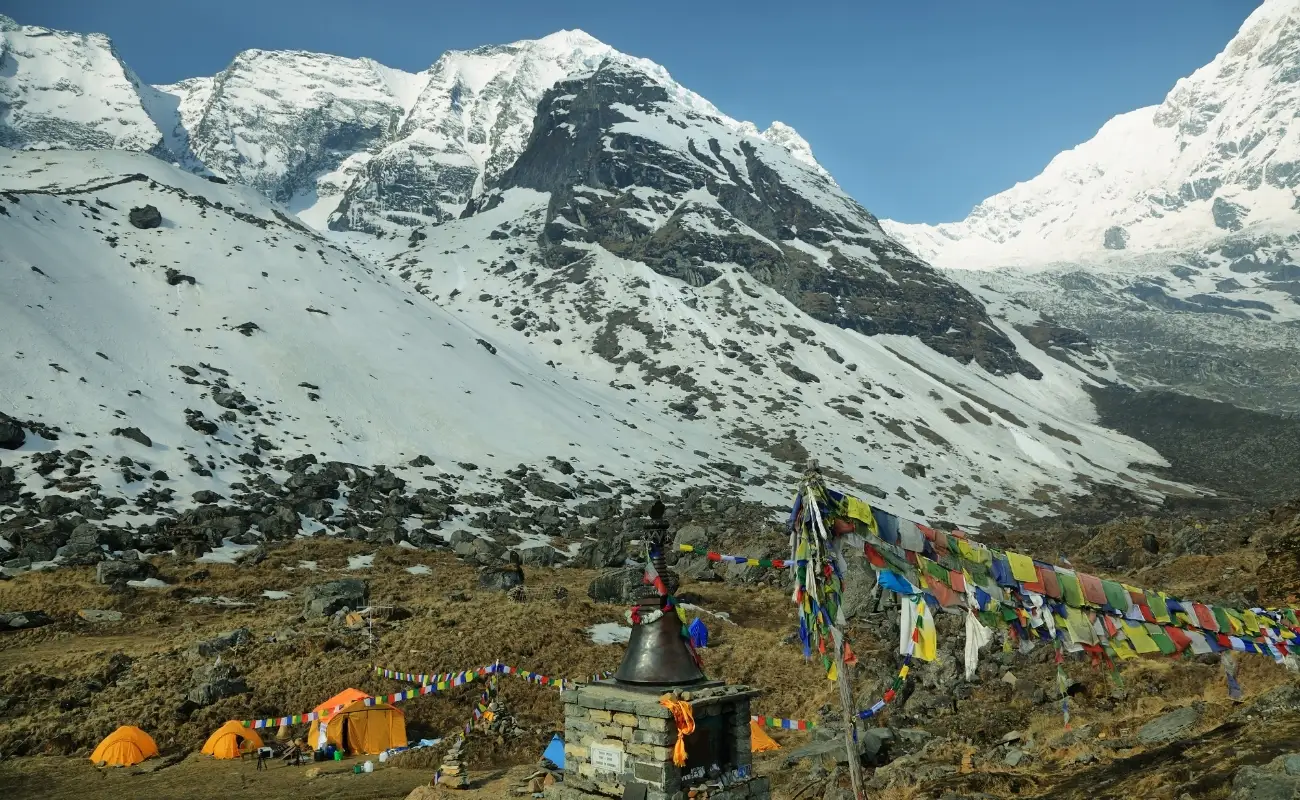
Winter trekking to Annapurna Sanctuary (December–February) is possible but requires cold-weather gear, snow traction equipment, and acceptance that the trail above Deurali closes temporarily after heavy snowfall, which occurs 3 to 6 times per season.
Winter delivers 2 genuine advantages:
-
Solitude: December and January see trail traffic drop by 80% compared to October peaks. Trekkers experience empty trails, silent teahouses, and unshared summit mornings at ABC.
-
Hard-frozen snow: Consolidated snow above 3,500 meters provides stable footing with crampons, superior to the soft, unconsolidated spring snow that forms posthole conditions.
The winter limitation to plan around: temperatures at ABC drop to −15°C to −20°C on clear nights from December through February. Sleeping bag ratings of −20°C comfort are mandatory above MBC, and teahouse heating (wood or gas burner in the dining room only) does not extend to bedrooms above 3,000 meters.
What Is the Monsoon Season Like in Annapurna Sanctuary?
Monsoon season (June–August) brings 80–90% of the Annapurna region's annual rainfall to the lower trail zones, reducing mountain visibility to near-zero on most days, increasing leech density along the forest trail below Chhomrong, and creating waterfall-flooded conditions across stream crossings in the gorge section.
Monsoon trekking is undertaken by experienced hikers with specific motivations, typically Nepali trekkers, photography-focused international visitors seeking waterfall and cloud landscapes, or budget travelers taking advantage of teahouse rates 30–40% lower than peak season pricing.
The trail above Chhomrong (2,170 m) receives less rainfall than the lower valley due to its position in the rain shadow of the Annapurna massif. The Modi Khola gorge between Himalayan Hotel and Deurali, however, presents real risk during monsoon: seasonal waterfalls cross the trail directly, and rock debris on the path after heavy rainfall requires careful footing.
What Should You Expect Along the Annapurna Sanctuary Trek?
The Annapurna Sanctuary trek delivers a layered experience, not just altitude and peaks, but living culture, biological diversity, and landscape transitions that unfold across 7 to 14 days of walking.
What Are the Main Villages on the Annapurna Sanctuary Route?
The main villages on the Annapurna Sanctuary route are Tikhedhunga (1,540 m), Ghorepani (2,860 m), Tadapani (2,630 m), Chhomrong (2,170 m), Ghandruk (1,940 m), and the high-altitude teahouse settlements of Sinuwa, Bamboo, Dovan, Himalayan Hotel, Deurali, and MBC.
Chhomrong is the most significant village on the route. At 2,170 meters, it serves as the last permanent Gurung settlement before the wilderness gorge. Chhomrong operates a ACAP checkpoint, 12+ teahouses with hot showers, a bakery, and a pharmacy with basic altitude medications. Spending a rest night here, rather than pushing through in a single day from Ghorepani, gives the body meaningful acclimatization time before the upper sanctuary.
Ghandruk (1,940 m) is the most culturally intact Gurung village on any major Nepal trekking route. Its stone-paved lanes, traditional slate-roofed houses, and Gurung Museum (open 9 AM–5 PM, entry NPR 100) give trekkers direct context for the living culture the Annapurna Conservation Area was designed to protect.
What Landscapes Can You Experience on the Trek?
The Annapurna Sanctuary trek passes through 5 distinct landscape zones: subtropical terraced farmland (1,000–1,500 m), broadleaf forest (1,500–2,400 m), rhododendron and oak forest (2,400–3,200 m), alpine shrubland and bamboo (3,200–3,700 m), and glacial moraine with permanent snowfields (3,700–4,130 m).
The transition from bamboo forest to open moraine, occurring between Deurali and MBC over approximately 4 kilometers, is the trek's most disorienting landscape shift. Vegetation disappears completely. The valley opens. The surrounding walls of ice rise 2,000–4,000 meters above the trail. Trekkers uniformly describe this moment as the psychological centerpiece of the journey, the point where the scale of the Himalaya becomes physically comprehensible.
What Wildlife and Plants Can You Encounter?
The Annapurna Conservation Area hosts 102 mammal species and 474 bird species, with trek-accessible wildlife including Himalayan tahr (Hemitragus jemlahicus), red panda (Ailurus fulgens), common langur monkeys, barking deer, and, rarely, snow leopard (Panthera uncia) tracks at elevations above 3,500 meters.
Specific wildlife observation zones along the route:
-
Lower forest (1,500–2,400 m): Common langur monkeys feed in banyan and fig trees near Jhino and Landruk. Nepali trekkers encounter 4–6 individuals per troop routinely in early morning.
-
Rhododendron zone (2,400–3,200 m): Red panda habitat. Sightings occur between Tadapani and Chhomrong at dawn between November and March, when deciduous foliage thins and visibility through the forest improves.
-
Alpine zone (3,500+ m): Himalayan tahr herds of 8–20 individuals graze on the rocky slopes above Deurali. The blue sheep (Pseudois nayaur) is regularly observed on cliffs between MBC and ABC.
The sanctuary's 30-plus rhododendron species form Nepal's most accessible high-altitude rhododendron forest. Rhododendron arboreum (Nepal's national flower) reaches tree height of 10–15 meters at 2,500 meters elevation, creating a genuine canopy trail rather than the low-shrub experience common at lower altitudes.
What Cultural Experiences Are Found Along the Trail?
The Annapurna Sanctuary trek corridor passes through the traditional territory of the Gurung people, one of Nepal's hill indigenous nationalities, whose animist and Buddhist cultural practices, including mani stone walls, prayer flag arrays, water-powered prayer wheels, and village gompa (monasteries), are integrated throughout the trail.
4 authentic cultural interactions define the experience:
-
Gurung village homestays: Ghandruk and Landruk offer authentic homestays (distinct from teahouses) where local families serve traditional Gurung food, including chiura (beaten rice), tongba (millet beer), and sel roti (rice doughnut).
-
Mani wall etiquette: Stone mani walls (inscribed with "Om Mani Padme Hum") line the trail at village approaches. The culturally correct practice is to pass to the left, keeping the wall on your right, which most trail guides explain proactively.
-
Newari and Gurung festivals: Trekking during Dashain (October) or Tihar (October–November) coincides with active festival celebrations in trail villages, including animal sacrifice rituals, family reunion gatherings, and village-wide decorations.
-
Puja ceremonies at ABC: Mountaineering expeditions departing from ABC conduct Buddhist puja (blessing ceremony) led by a lama before attempting summit bids. Independent trekkers present during these ceremonies are typically welcomed to observe.
How Should You Prepare for the Annapurna Sanctuary Trek?
Preparation determines whether the trek is a transformative experience or an emergency evacuation. The 4 preparation dimensions, fitness, gear, permits, and acclimatization knowledge, each carry equal weight.
What Fitness Level Is Needed for Annapurna Sanctuary?
Annapurna Sanctuary demands a base fitness level of 4–5 hours continuous walking on hilly terrain, repeated across 8–12 consecutive days, with the capacity to gain 600–900 meters of elevation in a single day at altitude.
A preparation protocol 8 weeks before departure:
-
Weeks 1–2: Walk 45–60 minutes daily on flat terrain. Introduce 2 lower-body strength sessions (squats, lunges, step-ups).
-
Weeks 3–5: Increase to 90-minute hikes with 300+ meters elevation gain. Add loaded backpack (6–8 kg).
-
Weeks 6–8: Complete 2 multi-day hikes of 3–4 days, covering 15–20 kilometers per day with 400+ meters daily elevation change.
Trekkers who arrive at Pokhara without hill-hiking experience routinely abort the trek at Chhomrong (Day 4) or Deurali (Day 6) due to knee pain from the stone staircase sections. The staircase descent from Ghorepani to Ulleri (3,300 steps in 2.5 kilometers) is a reliable early indicator of whether a trekker's knees are prepared for the full route.
What Trekking Gear Should You Pack?
Essential gear for the Annapurna Sanctuary trek includes layered clothing for −15°C temperatures, waterproof boots with ankle support, trekking poles, a −20°C sleeping bag, headlamp, water purification tablets or a UV pen, and microspike crampons for travel above 3,700 meters from October through April.
The complete packing list divides into 3 categories:
Clothing (8 essential items):
-
Moisture-wicking base layer (top and bottom)
-
Insulating mid-layer (300-weight fleece or down jacket)
-
Waterproof hardshell jacket and trousers
-
Trekking trousers (convertible zip-off style)
-
Wool or synthetic trekking socks (3 pairs minimum)
-
Waterproof trekking boots (broken in before departure)
-
Warm hat and liner gloves
-
UV-blocking sunglasses (Category 3 or 4 lens)
Equipment (6 essential items):
-
35–45-liter daypack (porters carry the main duffel)
-
Trekking poles (2 poles, collapsible)
-
Headlamp with spare batteries
-
Water bottles (2 × 1-liter, or a 2-liter hydration bladder)
-
Water purification (UV pen or iodine tablets)
-
Microspike crampons (winter/spring trekking)
Medical kit (minimum 5 components):
-
Acetazolamide (Diamox), prescribed by doctor, 125–250 mg twice daily as AMS prevention
-
Ibuprofen or paracetamol for pain management
-
Oral rehydration salts
-
Blister treatment (Compeed or moleskin)
-
Antiseptic wound spray
What most gear lists omit: gaiters. Above Deurali in November through April, trail snow compacts into boot-top-deep sections. Low gaiters prevent snow from packing around boot collars and soaking wool socks, a comfort detail that becomes a safety detail at −10°C.
What Permits Are Required for Annapurna Sanctuary?
2 permits are mandatory for the Annapurna Sanctuary trek: the Annapurna Conservation Area Permit (ACAP) at NPR 3,000 (approximately USD 23) for international trekkers, and the Trekkers' Information Management System card (TIMS) at NPR 2,000 (approximately USD 15) for all foreign trekkers, which is now exclusively issued through registered trekking agencies.
Permit facts every trekker needs:
-
Where to obtain: Both permits are issued at the Nepal Tourism Board offices in Kathmandu (Bhrikutimandap) and Pokhara (Damside or Lakeside). Trekking agencies collect permits on behalf of booked clients.
-
Proof of identity: Passport copy required for both permits. Carry 2 passport photos.
-
Checkpoint controls: 5 ACAP checkpoints exist between Nayapul and ABC. Rangers scan permits at each, non-compliance results in on-site fines or trek termination.
-
Children under 10: They are exempt from permit fees. Children aged 10 and older pay the standard adult rate based on their nationality (foreign or SAARC).
-
SAARC nationals (Indian, Pakistani, Sri Lankan, Bangladeshi, Bhutanese, Maldivian citizens): Pay NPR 1,000 for the ACAP and NPR 1,000 for the TIMS card.
As of 2026, Nepal Tourism Board has proposed an integrated digital permit system (e-permit) to replace paper permits, with pilot testing on the Annapurna Circuit. ABC trekkers still use paper permits as of the current trekking season.
How Can You Prepare for High-Altitude Trekking?
High-altitude preparation for the Annapurna Sanctuary trek involves 3 physiological strategies: pre-trek cardiovascular conditioning, a gradual ascent schedule above 3,000 meters, and preventive medication with Acetazolamide when prescribed by a physician.
The "climb high, sleep low" principle governs safe ascent above 3,000 meters. On the ABC route, this means ascending from Deurali (3,230 m) to MBC (3,700 m) and ABC (4,130 m) in a single morning, then sleeping at MBC on the return, rather than pushing to ABC and camping there on the ascent.
Hydration at altitude is non-negotiable. Trekkers at 3,500+ meters require 3–4 liters of water daily, twice the volume most people consume at sea level. Dehydration and AMS share overlapping symptoms (headache, fatigue, nausea), making hydration the first differential to rule out when symptoms appear.
What Accommodation and Meals Are Available?
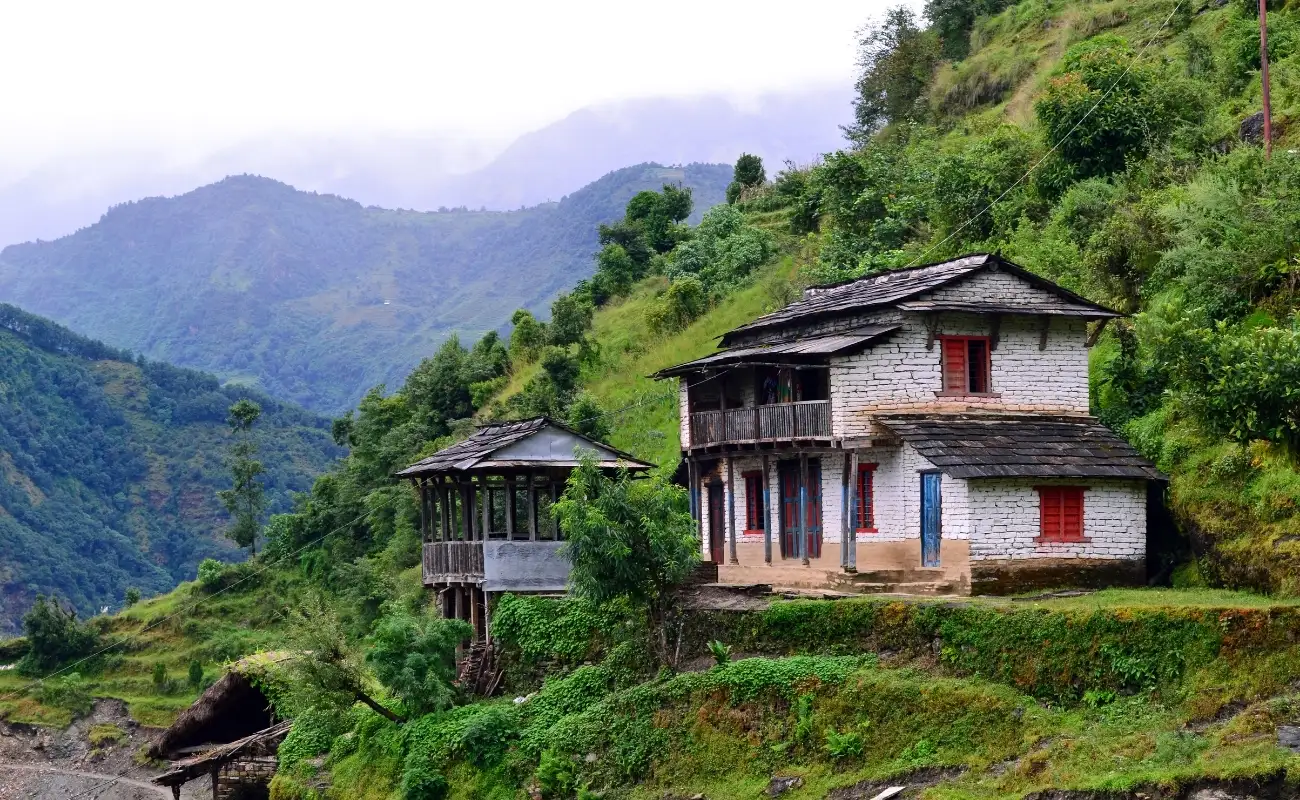
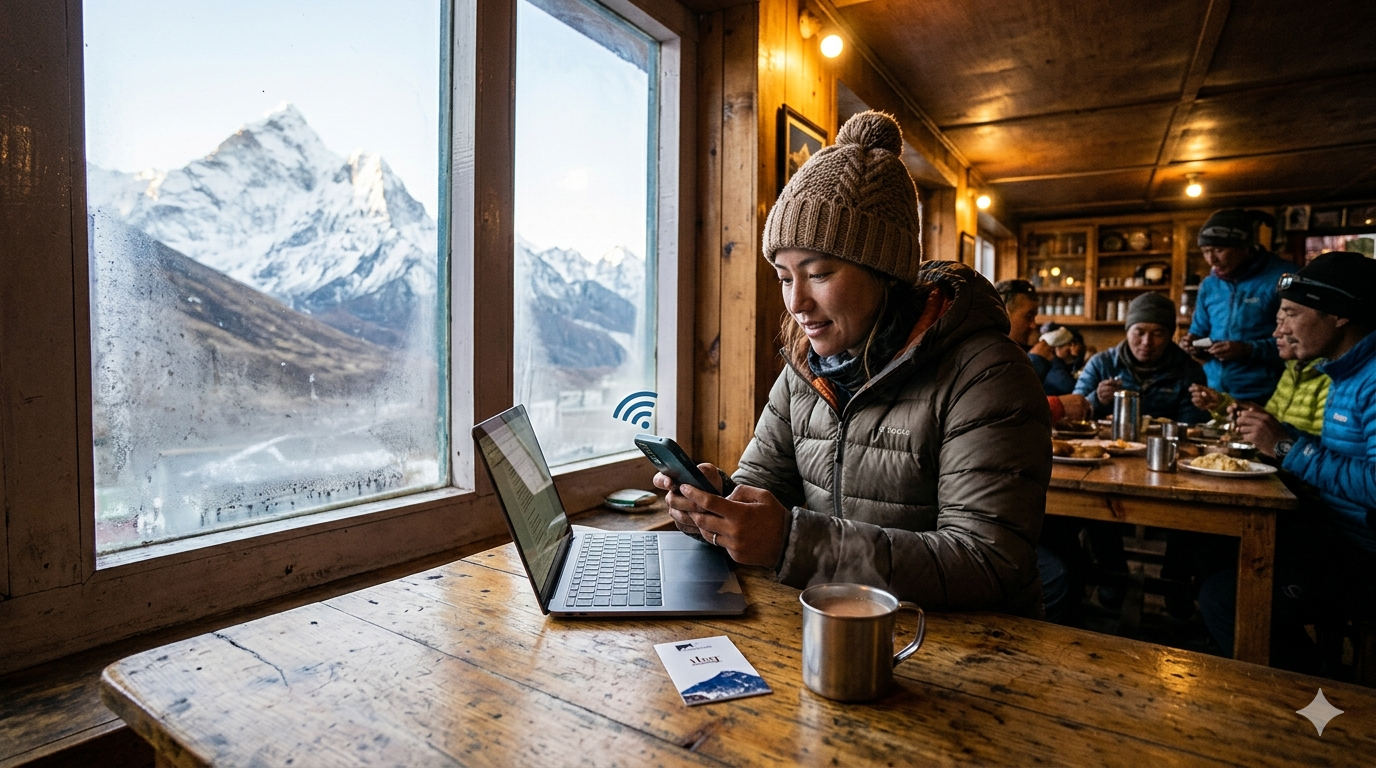
The Annapurna Sanctuary route has 35+ teahouses (locally called lodges or guesthouses) from Nayapul to ABC, offering private double rooms at NPR 400–1,200 per night (USD 3–9), with meals priced at NPR 300–900 per dish and WiFi available at major villages up to and including Deurali.
Teahouse accommodation above Bamboo is basic: twin beds with foam mattresses, shared squat or Western toilets, and no private hot shower above Chhomrong. The trade-off is the location, waking inside the sanctuary's glacial bowl, with 8,000-meter peaks visible from the dining room window, is a legitimate experience that more expensive alternatives cannot replicate.
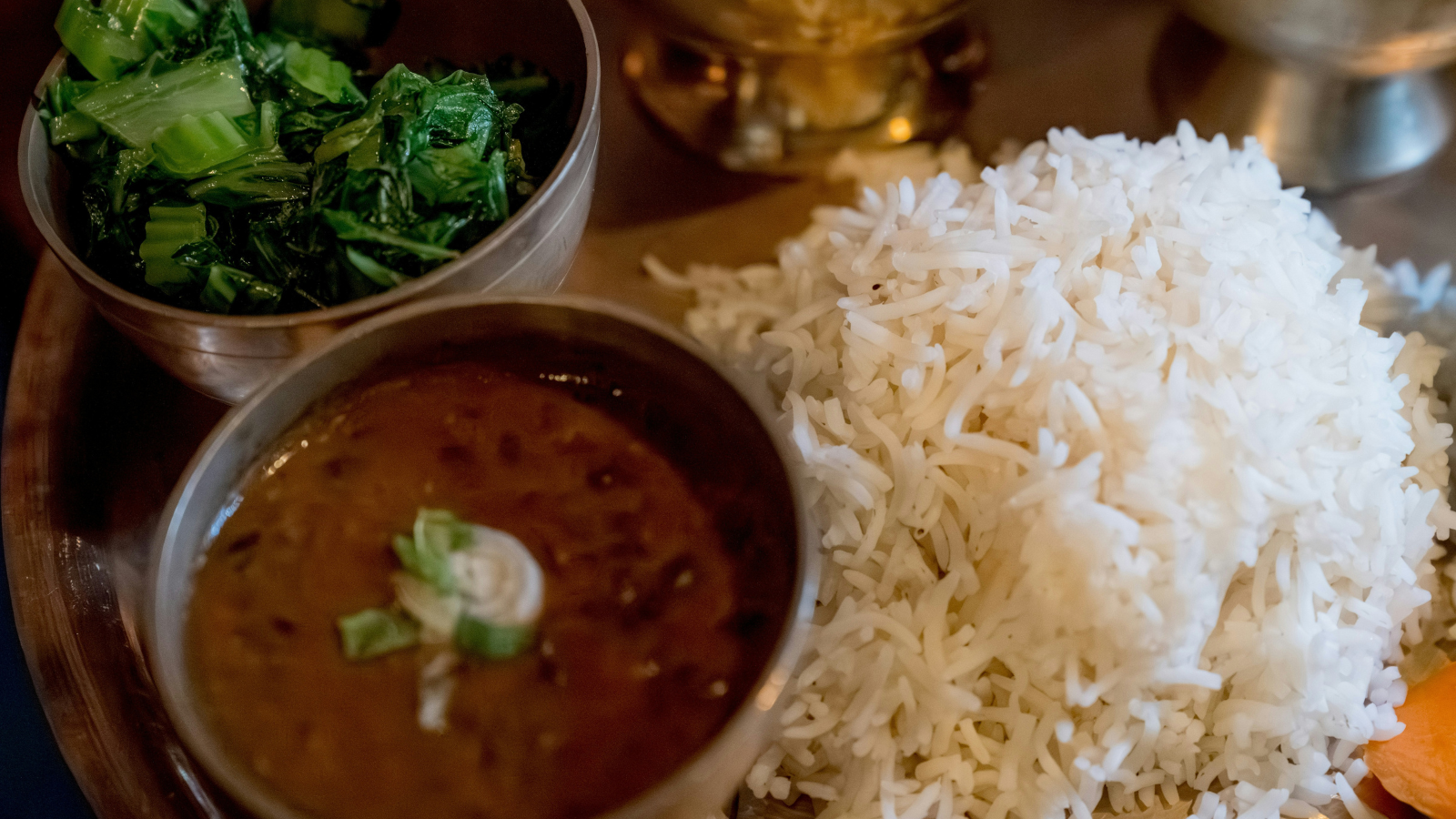
Food on the trail is standardized across teahouses, a safety feature as much as a commercial limitation. Dal bhat (lentil soup, rice, vegetables, pickled mustard) provides carbohydrate-dense fuel that Nepali porters and guides consume twice daily. Pasta, noodles, soup, pancakes, eggs, and Tibetan bread (roti) are universally available. Meat dishes above Chhomrong are unreliable in freshness; experienced trekkers eat vegetarian above 3,000 meters as standard practice.
What Safety Considerations Matter on the Annapurna Sanctuary Trek?
Safety on the ABC route involves 3 distinct risk categories: altitude sickness, weather exposure, and trail hazards in the Modi Khola gorge.
How Can You Reduce the Risk of Altitude Sickness?
Altitude sickness risk on the Annapurna Sanctuary trek is reduced by ascending no more than 500 meters per sleeping altitude per day above 3,000 meters, maintaining hydration above 3 liters daily, avoiding alcohol above 3,000 meters, and descending immediately if symptoms of High Altitude Pulmonary Edema (HAPE) or High Altitude Cerebral Edema (HACE) appear.
AMS symptoms requiring immediate descent: persistent headache unresponsive to ibuprofen, ataxia (loss of balance), confusion, productive cough with pink or frothy sputum, and deteriorating night vision. These 5 symptoms indicate potential HAPE or HACE, life-threatening conditions that require evacuation within hours, not days.
Helicopter evacuation from ABC costs USD 2,500–4,500 per flight without travel insurance, and USD 0 out-of-pocket with a comprehensive policy covering emergency evacuation. Travel insurance with a minimum USD 200,000 evacuation coverage is the single most important safety preparation for the ABC trek.
What Weather Challenges Can Affect the Trek?
The Annapurna Sanctuary is one of Nepal's highest-precipitation regions, with the Modi Khola valley receiving 3,800–4,000 mm of annual rainfall and the upper sanctuary subject to sudden whiteout snowstorms lasting 12–48 hours, particularly between December and March.
Avalanche risk in the gorge section between Himalayan Hotel and Deurali is the most underreported hazard on the ABC route. Avalanche run-out zones cross the trail in 3 locations in this corridor. Responsible trekking agencies and experienced guides transit these sections during the pre-dawn window (5–7 AM) before solar warming destabilizes snow slopes. Solo trekkers who arrive at these sections midday face significantly elevated risk in heavy snowpack years.
A weather app specifically for the region, Windy.com with the Annapurna area pinned, provides 72-hour forecast resolution useful for timing the upper gorge transit and the ABC summit morning.
Why Are Guides and Porters Helpful on the Trail?
Guides and porters are helpful on the Annapurna Sanctuary trek for 4 specific reasons: route-finding in snowfall above Deurali, negotiating accommodation during peak-season crowding, early recognition of altitude sickness symptoms in group members, and physical load reduction that prevents overexertion-related exhaustion.
A licensed guide earns NPR 2,000–3,000 (USD 15–23) per day; a porter earns NPR 1,500–2,000 (USD 11–15) per day carrying a maximum of 25 kilograms. Hiring both through a registered agency ensures guide licensing verification, insurance coverage, and compliance with the Nepal government's porter welfare guidelines (which prohibit porters from carrying loads above 30 kg without extra compensation).
Beyond practical support, a guide provides interpretive value that fundamentally changes the trek experience. Trail signs and teahouse menus give trekkers data; a guide gives trekkers meaning, explaining which ridge hosted the 1950 Herzog expedition, which deity the sanctuary's name honors, and why the Gurung elder at Chhomrong ties prayer flags at the specific tree before the gompa each Losar.
How Can You Experience Annapurna Sanctuary With Himalaya Trekking Nepal?
Himalaya Trekking Nepal offers fully guided Annapurna Base Camp trek packages designed for both Nepali and international trekkers, including licensed English-speaking guides, experienced porters, pre-arranged ACAP and TIMS permits, teahouse accommodation bookings, and emergency evacuation protocol planning.
Their ABC trek itineraries range from 10-day standard routes to 14-day extended programs incorporating Ghorepani Poon Hill, Ghandruk village, and optional acclimatization days at Chhomrong. Group departures operate every Saturday from October through May. Private departures run on any date by arrangement.
Himalaya Trekking Nepal guides hold certification from the Nepal Academy of Tourism and Hotel Management (NATHM) and carry wilderness first-aid training, a qualification relevant to the 4,130-meter summit environment where evacuation delays of 2–6 hours are routine.
Can Himalaya Trekking Nepal Arrange a Guided Annapurna Sanctuary Trek?
Himalaya Trekking Nepal arranges guided Annapurna Sanctuary treks with end-to-end logistics, including airport transfers, Pokhara hotel bookings, all trail permits, porter and guide services, and rescue insurance coordination.
Their programs are structured for both budget-conscious trekkers (teahouse standard packages) and comfort-focused clients (premium teahouse selections at Chhomrong and Ghandruk with private room guarantees and hot shower priority). Himalaya Trekking Nepal offers custom itinerary planning, useful for trekkers combining ABC with the Annapurna Circuit, Mardi Himal, or the Royal Trek around Pokhara.
Both agencies operate in compliance with the Nepal Tourism Board's registered trekking agency framework, which requires liability insurance, licensed guide employment, and transparent pricing disclosures.
What Are the Key Takeaways About the Annapurna Sanctuary Trek?
The Annapurna Sanctuary trek is Nepal's most accessible high-Himalayan basin experience, a 10-to-13-day moderate-to-strenuous trek reaching 4,130 meters elevation inside a glacial amphitheater of 11 peaks, with best conditions in March–May and October–November, requiring 2 permits totaling NPR 5,000 and preparation for sub-zero temperatures above 3,700 meters.
The 6 facts that determine a successful ABC trek:
-
Season selection: Spring and autumn provide 90% of the year's viable trekking days. Winter is possible with cold-weather preparation; monsoon is manageable above 2,000 meters.
-
Acclimatization: Spending 2 nights at Chhomrong (2,170 m) and pausing at Deurali (3,230 m) reduces AMS incidence significantly compared to a fast-push ascent.
-
Guide hire: As of April 2023, the Nepal Tourism Board legally mandates that all foreign trekkers must hire a licensed trekking guide through a registered agency; independent (solo) trekking is strictly prohibited across all TIMS-required routes, including the Annapurna Conservation Area.
-
Permit compliance: ACAP and TIMS permits are verified at 5 checkpoints. Unpermitted trekkers face fines at each point.
-
Insurance: Travel insurance with a minimum USD 200,000 helicopter evacuation coverage is non-negotiable for a 4,130-meter destination.
-
Physical preparation: 8 weeks of structured hill-hiking with loaded pack is the minimum preparation that ensures the trek is completed, rather than abandoned at Chhomrong.
Annapurna Sanctuary is not simply a viewpoint. It is a place where the scale of the Himalayan landscape becomes physically present, where 8,000-meter summits stand close enough to project cold air downvalley, where silence above the treeline is broken only by wind and the occasional serac collapse on the glacier above. Trekkers who arrive prepared experience it fully. Those who arrive underprepared experience the evacuation version.
Plan your Annapurna Sanctuary trek with a licensed Nepali agency, walk at your own pace, and carry the right gear. The sanctuary rewards the prepared.
More About Author

Khilak Budhathoki
Travel Director
Khilak Budhathoki is the co-founder and lead trekking guide at Himalaya Trekking Nepal, a locally owned and operated adventure company based in Kathmandu. Born and raised in the foothills of Nepal, Khilak developed a deep love for the mountains from an early age. With over a deca...
USD$1,400 pp
Our Recommendation
Related Blogs