- 23, Apr 2026 | Khilak Budhathoki
Down jacket rental for the Everest Base Camp trek costs NPR 100 to 300 (USD 0.75 to 2.25) per day in Kathmandu. Total rental cost for a 14-day trek ranges from NPR 1,400 to 4,200 (USD 10 to 32). Thamel, Kathmandu is the primary rental hub with 50 to 80 gear shops.
A down jacket is mandatory for EBC trekking. Night temperatures at Gorak Shep (5,164 m) drop to minus 10°C to minus 15°C in autumn and spring. Minimum fill power requirement is 600 for spring and autumn treks, 700 to 800 for winter treks (December to February). The jacket functions as outer insulation during rest stops, evenings, and cold mornings. Active hiking generates sufficient body heat to make jacket wearing unnecessary.
Renting suits first-time EBC trekkers with baggage weight limits and single-trek plans. Buying suits winter trekkers, cold-sensitive trekkers, and those planning multiple Himalayan trips. Rental jackets from premium Thamel shops with 700 fill power provide reliable warmth. Budget rental shops carry replica and degraded jackets that create cold stress risk above Dingboche (4,410 m).
The 3-layer trekking clothing system uses a thermal base layer, fleece mid layer, and down jacket as outer insulation. Rental bundles covering the sleeping bag, gloves, beanie, base layers, and trekking poles from a single Thamel shop reduce total rental cost by 15 to 25% through bundle pricing.
Down jacket rental for the Everest Base Camp trek combines cost efficiency, weight saving, and adequate thermal protection when the 5-point pre-rental checklist covers fill power, fit, loft test, DWR coating, and zipper condition. Renting from trekking agencies accredited by Nepal Tourism Board and TAAN provides quality accountability and on-trek replacement support.
Should You Rent or Bring Your Own Down Jacket for the Everest Base Camp Trek?
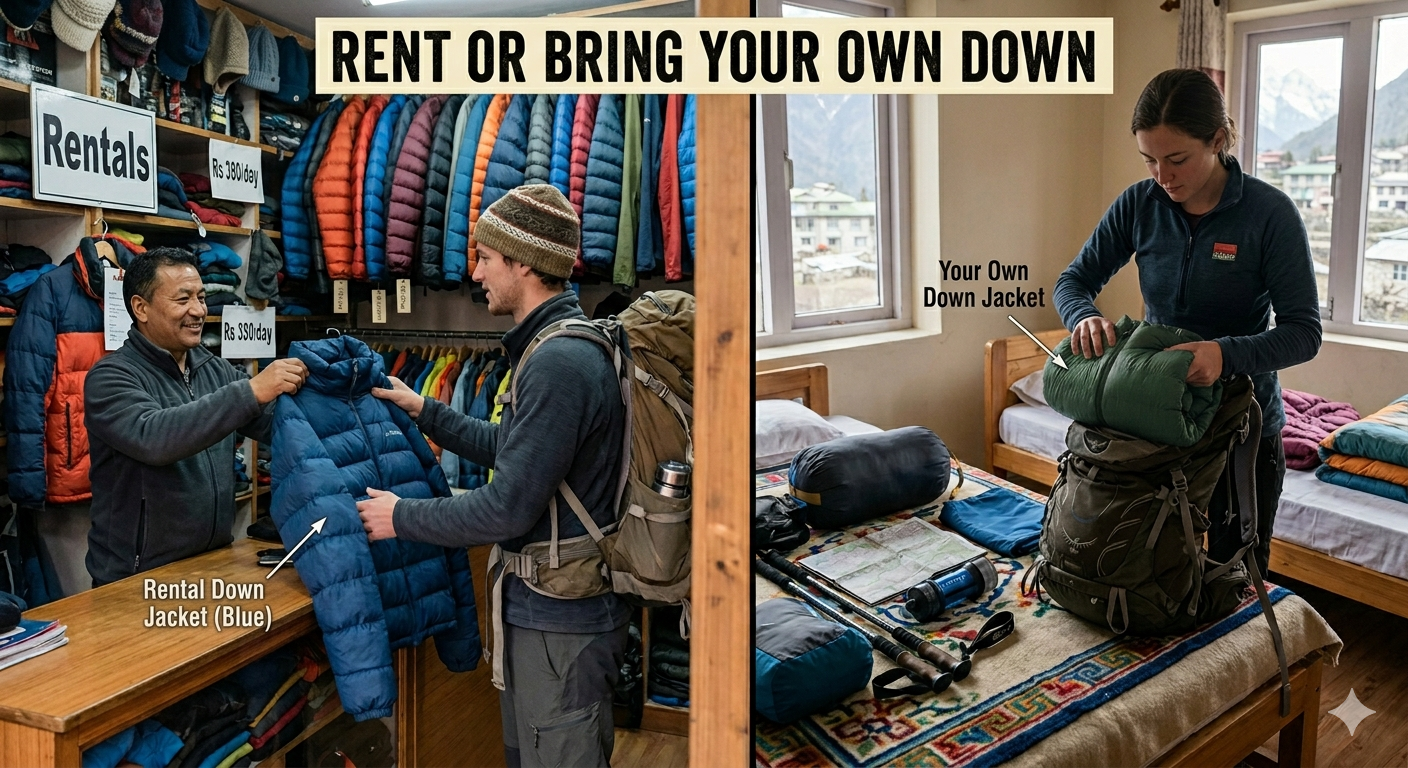
Renting a down jacket in Kathmandu is the right choice for first-time EBC trekkers traveling with baggage weight limits and no plans for future high-altitude treks. Bringing a personal jacket is better for winter treks, cold-sensitive trekkers, and those with multiple future Himalayan trek plans.
Down jacket is defined as an insulated outer garment filled with goose or duck down clusters that trap body heat through a high warmth-to-weight ratio. On the Everest Base Camp trek, a down jacket protects against temperatures ranging from 0°C (32°F) at Namche Bazaar (3,440 m) to minus 15°C (5°F) at Gorak Shep (5,164 m) during autumn and spring trekking seasons.
When Renting a Down Jacket Makes More Sense
Renting is the practical choice in 3 specific situations:
-
One-time trek: A quality down jacket purchase costs USD 80 to USD 300. Renting at NPR 100 to 300 (approximately USD 0.75 to USD 2.25) per day for a 14-day trek costs NPR 1,400 to 4,200 (approximately USD 10 to USD 32) total. Rental cost is 90% lower than purchase cost for a single-use decision.
-
Baggage weight limit: Lukla flight and porter duffel weight rules allow 10 to 15 kg per person. International airline baggage allowances average 20 to 23 kg for economy class. A heavyweight down jacket weighs 600 g to 1,200 g. Renting in Kathmandu frees this weight for essential safety and personal gear.
-
Cost efficiency for budget trekkers: Total rental cost for a 14-day trek stays below USD 35 even at premium Thamel rental shops.
When Bringing Your Own Down Jacket Is Better
Bringing a personal down jacket is the superior choice in 3 situations:
-
Winter treks (December to February): Temperatures at Gorak Shep drop to minus 20°C (minus 4°F) in January. Rental jackets at budget Thamel shops offer inconsistent insulation quality. Personal jackets with 800 fill power provide reliable thermal protection at these temperatures.
-
Fit and insulation certainty: Rental jackets are worn by multiple trekkers and lose 15 to 25% insulation loft over time through compression and washing cycles. A personal jacket maintains original insulation performance.
-
Multiple future Himalayan trek use: Trekkers planning Annapurna Base Camp, Manaslu Circuit, or other treks in the Everest region recover the purchase cost across 3 to 4 rental cycles.
Where Can You Rent a Down Jacket in Kathmandu?
Thamel, Kathmandu is the primary rental hub for down jackets and all EBC trekking gear. Thamel contains 50 to 80 gear rental shops within a 1 km radius. Rental shops, trekking agencies, and hotel partners all provide down jacket rental services in Kathmandu.
Thamel is defined as the main tourist and trekking gear district in Kathmandu, located 3 km north of Tribhuvan International Airport. The Thamel gear rental market operates year-round with peak season availability from September to November and March to May.
Rental Shops in Thamel
Independent gear rental shops in Thamel offer the widest selection of down jackets across budget, mid-range, and premium quality tiers. High-end rental shops in Thamel stock original brand jackets including The North Face, Marmot, and Mountain Hardwear rental units alongside locally manufactured alternatives.
Budget rental shops stock local brand jackets and replica jackets. Replica jackets are defined as non-licensed copies of international brand designs manufactured in Nepal or China that mimic the appearance but not the certified insulation performance of original products.
Trekking Agencies
Licensed trekking agencies in Kathmandu include down jacket rental in guided trek packages or offer it as a paid add-on. Agency-provided jackets are pre-checked for fit and condition as part of the pre-trek gear briefing. Trekking agencies accredited by the Nepal Tourism Board and TAAN maintain higher gear quality standards than independent budget shops.
Hotel Rental Partners
Some mid-range and budget hotels in Thamel partner with gear shops to offer in-house rental services alongside luggage storage for non-trek bags. Hotel rental prices average 10 to 20% higher than direct shop rental for the convenience factor.
Rental Availability in Namche Bazaar
Down jacket rental is available in Namche Bazaar (3,440 m) at limited shops. Namche Bazaar rental prices are 40 to 60% higher than Kathmandu rates due to transport logistics. Namche rental selection is significantly smaller than Thamel. Renting in Kathmandu before departure is more reliable and more cost-effective.
How Much Does Down Jacket Rental Cost for the Everest Base Camp Trek?
Down jacket rental in Kathmandu costs NPR 100 to 300 (USD 0.75 to USD 2.25) per day. Total rental cost for a standard 14-day EBC trek ranges from NPR 1,400 to 4,200 (USD 10 to USD 32). Premium brand jackets rent at the upper end of this range.
The following table shows down jacket rental cost estimates by quality tier for the Kathmandu rental market:
|
Jacket Quality Tier |
Daily Rate (NPR) |
Daily Rate (USD) |
14-Day Total (USD) |
|
Budget local brand |
100 to 150 |
0.75 to 1.15 |
10 to 16 |
|
Mid-range local brand |
150 to 200 |
1.15 to 1.50 |
16 to 21 |
|
Premium original brand |
200 to 300 |
1.50 to 2.25 |
21 to 32 |
The above table shows 2025 approximate rental rates in Thamel, Kathmandu. Rates fluctuate by 10 to 20% during October and November peak season due to high demand.
What Affects Rental Price?
The 4 factors that determine down jacket rental price in Kathmandu:
-
Jacket quality and fill power: Higher fill power (800FP) jackets rent at higher daily rates than lower fill power (600FP) alternatives.
-
Brand origin: Original brand jackets (The North Face, Marmot) command premium rates. Local brand and replica jackets rent at budget rates.
-
Season demand: Peak trekking season (October to November, March to May) increases rental prices by 10 to 20% due to high demand and limited supply.
-
Rental duration: Some shops offer discounts of 10 to 15% for rentals exceeding 20 days.
Deposit Requirement
Most Thamel rental shops require a refundable deposit of NPR 2,000 to 5,000 (USD 15 to 38) per jacket. The deposit is returned on jacket return in original condition. Damage fees apply for zipper failure, torn seams, or significant insulation damage. Replacement cost for a lost rental jacket ranges from NPR 3,000 to 15,000 (USD 23 to 115) depending on the jacket tier.
What Type of Down Jacket Is Required for the Everest Base Camp Trek?
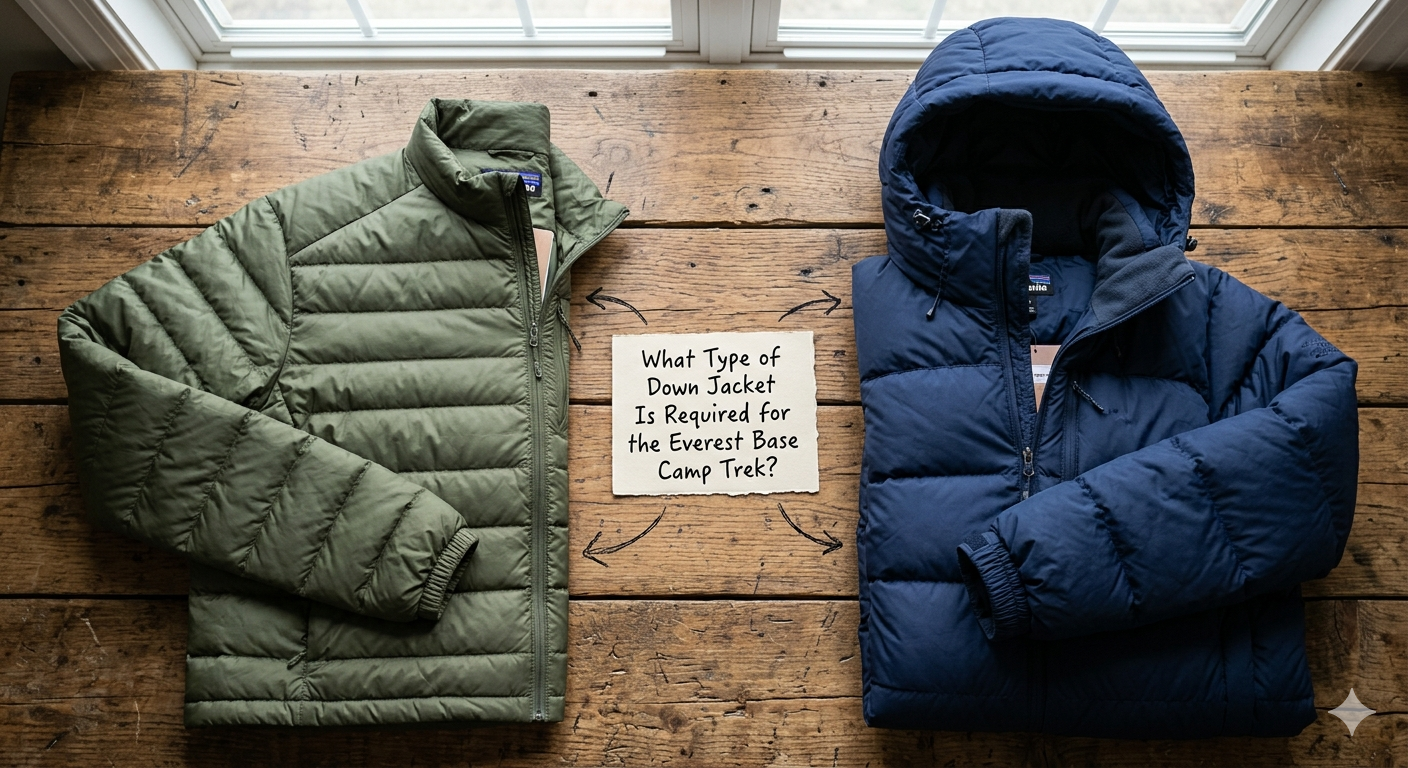
EBC trekking requires a down jacket with minimum 600 fill power for autumn and spring trekking seasons, 700 to 800 fill power for winter. The jacket must include a hood, draft collar, and wind-resistant nylon or ripstop outer shell. Weight targets 400 g to 800 g for the mid-weight category suitable for EBC conditions.
Fill power is defined as the measurement of down insulation quality, expressed as the volume in cubic inches that 1 ounce of down occupies. Higher fill power means greater insulation per unit of weight. The 3 relevant fill power tiers for EBC trekking are:
-
600 fill power: Adequate insulation for rest stops and evenings in autumn (October to November) and spring (March to May) at temperatures as low as minus 5°C (23°F)
-
700 fill power: Reliable warmth at temperatures down to minus 10°C (14°F), suitable for all non-winter EBC seasons including high-altitude stops at Lobuche and Gorak Shep
-
800 fill power: Maximum warmth-to-weight ratio, required for winter treks (December to February) at temperatures reaching minus 20°C (minus 4°F)
Key jacket features for EBC trekking performance:
-
Hood: Adjustable insulated hood adds 15 to 20% additional heat retention at the head and neck zone
-
Draft collar: Internal neck baffle prevents warm air from escaping at the collar
-
Elastic cuffs: Seal wrist heat loss without requiring glove layering
-
Inner pocket: Stores electronics and snacks against body heat to prevent cold damage
-
Compression capability: Packable jackets compress to 20 to 30% of their worn volume for storage in a daypack
Down vs Synthetic Jackets: Which Is Better for EBC?
Down jackets and synthetic insulated jackets each suit different conditions on the EBC route.
Down jackets provide a superior warmth-to-weight ratio. A 700 fill power down jacket weighing 500 g provides equivalent warmth to a synthetic jacket weighing 750 to 900 g. Down jackets compress more efficiently and fit standard trekking daypacks without bulk.
Synthetic insulated jackets maintain 70 to 80% insulation efficiency when wet. Down loses up to 90% insulation capacity when saturated with moisture. The Khumbu Valley receives monsoon precipitation from June to August and unpredictable rain in shoulder seasons. For autumn and spring treks with DWR-coated shell fabric, down jackets outperform synthetic alternatives in warmth-to-weight terms.
Most rental jackets in Thamel are down-filled with a DWR (Durable Water Repellent) coated nylon shell. DWR coating is defined as a chemical treatment applied to the outer fabric that causes water to bead and roll off rather than saturate the shell, protecting the down insulation from moisture penetration.
How Do You Check Quality Before Renting a Down Jacket?
To check rental down jacket quality before accepting it, test insulation loft by compressing and releasing the jacket, inspect all zippers for smooth operation, check seams for separation, and verify that the jacket fits over 2 to 3 layers of base and mid-layer clothing.
The 4-point quality check for rental down jacket inspection:
Insulation Loft Test
Loft is defined as the ability of down insulation to expand and trap air after compression. High loft indicates intact down clusters with strong insulation capacity. Compressed loft indicates aged, washed, or damaged down that has lost insulation efficiency.
Test method: Compress the jacket body firmly with both hands for 5 seconds, then release. A high-quality jacket expands back to full volume within 3 to 5 seconds. Slow recovery (10 to 15 seconds) or incomplete recovery indicates degraded insulation.
Zipper and Seam Inspection
Run the main zip, chest zip, and pocket zips through their full range. Stiff, skipping, or jamming zippers fail in cold conditions at altitude. Inspect all seam lines for thread separation or fabric tears. Baffle stitching failures allow down to migrate out of compartments, creating cold spots.
Fit for Layering
The down jacket functions as the outer insulation layer in the EBC thermal layering system. Fit testing requires wearing the base layer (thermal undershirt) and mid layer (fleece jacket) before trying the rental jacket. The jacket must allow full arm movement without restriction when all 3 layers are worn together.
Shell Fabric Check
Run a finger across the outer shell. A functioning DWR coating produces a slightly waxy surface texture. Worn DWR coating produces a soft, fabric-like texture that absorbs rather than repels water. Jackets with degraded DWR coating require re-treatment before the trek or selection of a replacement rental unit.
Are Rented Down Jackets in Kathmandu Good Enough for EBC?
Rented down jackets from reputable Thamel shops are good enough for autumn and spring EBC treks. Premium-tier rental jackets with 700 to 800 fill power provide reliable protection at temperatures down to minus 15°C. Budget-tier rentals with degraded insulation create cold stress risk above Dingboche (4,410 m).
Quality variation across Kathmandu rental shops is significant. High-end rental shops in Thamel rotate their jacket stock every 2 to 3 seasons, maintaining insulation loft and DWR performance. Budget shops retain jackets for 4 to 6 seasons until insulation loft degrades below safe performance thresholds.
Original vs Replica Jacket Risk
Original brand rental jackets provide certified fill power and construction quality. Replica jackets marketed as "700 fill power" in Thamel shops frequently test below 450 to 550 fill power due to lower-grade fill material or insufficient fill weight. A replica jacket with degraded fill power provides inadequate warmth at Lobuche (4,940 m) and Gorak Shep (5,164 m) during cold nights.
According to outdoor gear testing standards used by the Outdoor Industry Association, fill power below 550 in a mid-weight jacket produces insufficient warmth at temperatures below minus 5°C. Night temperatures at Gorak Shep drop to minus 10°C to minus 15°C in October and November.
Risk of Cheap Rentals at High Altitude
Poor insulation at altitude produces cold stress. Cold stress is defined as the physiological condition where core body temperature begins declining due to insufficient heat retention, increasing the risk of hypothermia. Hypothermia onset at altitude occurs faster than at sea level due to reduced oxygen availability and increased wind chill.
The 3 consequences of renting an inadequate jacket for EBC:
-
Cold stress during rest stops and evenings above 4,000 m
-
Disrupted sleep at Lobuche and Gorak Shep teahouses
-
Increased fatigue accumulation through overnight temperature drops
How Do You Layer Clothing with a Down Jacket for the EBC Trek?
The EBC trekking clothing system uses 3 layers: thermal base layer for moisture management, fleece or softshell mid layer for active insulation, and down jacket as outer insulation during rest stops and cold evenings. The down jacket is not worn during active uphill hiking.
Thermal layering system is defined as the clothing strategy of combining multiple specialized garment layers to manage body heat, moisture, and wind exposure during variable activity levels and temperature conditions.
Base Layer Function
Thermal base layer is a moisture-wicking synthetic or merino wool garment worn directly against the skin. Base layer function: move sweat away from the skin surface to prevent evaporative cooling. Base layer weight for EBC: 150 to 200 g per square meter for autumn and spring seasons, 200 to 250 g per square meter for winter.
Mid Layer Function
Fleece jacket or softshell jacket is worn over the base layer as the active insulation layer during trekking. Fleece maintains 60 to 70% insulation efficiency when damp from perspiration. The mid layer is the primary insulation during active hiking hours when body heat generation is high.
Down Jacket Function and Timing
Down jacket is worn over both the base and mid layers during 4 specific situations on the EBC trek:
-
Rest stops and lunch breaks at teahouses (body heat drops within 2 to 3 minutes of stopping)
-
Early morning departure from teahouses before body temperature rises
-
Evening hours at teahouses from 5:00 PM onward
-
Camp nights and pre-sleep hours in teahouse rooms
Active hiking generates sufficient body heat to make down jacket wearing unnecessary and counterproductive. Overheating during hiking causes sweating. Sweat penetrates the base layer and reduces mid-layer insulation efficiency. The correct practice: remove the down jacket before beginning each trekking stage and pack it in the daypack.
Shell Layer Positioning
Waterproof shell jacket worn over the down jacket during rain and high wind exposure. Shell jacket is defined as a waterproof and windproof outer garment with no significant insulation value. The shell protects the down insulation from moisture and wind penetration.
Should You Rent a Down Jacket from a Trekking Agency?
Trekking agencies in Kathmandu include down jacket rental in guided EBC trek packages or offer rental as a paid add-on at NPR 150 to 250 per day. Agency rental is more convenient than independent shop rental and provides quality accountability through the agency's gear briefing process.
Included Package Gear
Some guided EBC trek packages from licensed operators include a down jacket as part of the gear package. Package-included jackets are pre-selected by the agency for fill power, fit range, and condition suitability. Trekkers confirm jacket quality at the pre-trek gear briefing in Kathmandu before departure.
Paid Agency Add-On Rental
Trekking agencies charging separately for down jacket rental average NPR 150 to 250 per day, slightly above independent Thamel shop rates. The price premium reflects convenience, quality guarantee, and on-trek replacement service if the rental jacket fails during the route.
Pros and Cons of Agency Rental
Agency rental produces 3 advantages over independent shop rental:
-
Pre-checked jacket condition before departure reduces checkpoint rejection risk
-
Agency accountability for jacket quality throughout the trek
-
On-trek gear replacement coordination through guide networks
Agency rental produces 1 disadvantage: less selection variety. Independent Thamel shops carry 10 to 30 jacket options per quality tier. Trekking agencies carry 3 to 8 options. Trekkers with specific fit requirements benefit from independent shop selection.
What Other Gear Should You Rent with a Down Jacket?
Trekkers renting a down jacket in Kathmandu also rent a sleeping bag, thermal base layers, gloves, and a beanie in a bundle rental strategy that reduces total gear cost by 15 to 25% compared to individual item rental.
Sleeping Bag
Sleeping bag is defined as an insulated portable bedding unit rated for specific temperature ranges. EBC teahouses provide blankets, but trekkers sleeping in teahouse rooms at Lobuche (4,940 m) and Gorak Shep (5,164 m) need a sleeping bag rated to minus 10°C (14°F) minimum for reliable warmth. Sleeping bag rental in Thamel costs NPR 100 to 200 per day. A sleeping bag liner adds 5°C to 8°C effective temperature rating to any rental sleeping bag.
Supporting Gear Rental Items
The 5 supporting gear items available for rental alongside the down jacket in Thamel:
-
Thermal base layer set (top and bottom): NPR 50 to 100 per day
-
Insulated gloves: NPR 30 to 80 per day
-
Wool beanie: NPR 20 to 50 per day
-
Neck gaiter: NPR 20 to 40 per day
-
Trekking poles: NPR 50 to 100 per day
Bundle Rental Strategy
Renting all 5 supporting items together with the down jacket and sleeping bag from 1 Thamel shop produces bundle discount rates of 15 to 25%. Single-shop bundle rental also simplifies return logistics at the end of the trek.
Total estimated bundle rental cost for 14-day EBC trek (all 7 items): NPR 3,500 to 7,000 (USD 26 to 53) depending on quality tier selected.
What Is the Final Checklist Before Renting a Down Jacket for the EBC Trek?
Before accepting a rental down jacket, verify 5 criteria: fill power rating of 600 minimum (700 recommended), proper fit over 3 layers, intact DWR coating, full zipper operation, and rental price within NPR 150 to 300 per day for the quality tier selected.
The 5-point pre-rental verification checklist:
-
Warmth rating: Confirm fill power. Ask the shop staff for the jacket specification. 700 fill power covers all non-winter EBC conditions. 600 fill power is marginal above 4,500 m in October.
-
Fit test: Wear all 3 layers before accepting fit. Restrict arm movement test: raise both arms fully. The jacket must not pull tight across the shoulders or restrict arm elevation.
-
Condition check: Perform the loft compression test. Check all zippers. Inspect seams for damage.
-
DWR coating test: Run a finger across the outer shell to confirm water-repellent surface texture.
-
Price confirmation: Confirm daily rate, deposit amount, and damage fee terms in writing before signing the rental agreement.
Frequently Asked Questions about Down Jacket Rental for the Everest Base Camp Trek
Can You Rent a Down Jacket in Kathmandu?
Yes, down jackets rent in Kathmandu from 50 to 80 gear shops in Thamel. Daily rental rates range from NPR 100 to 300 (USD 0.75 to 2.25). Availability is highest during the September to November and March to May trekking seasons. High-end shops stock original brand jackets. Budget shops carry local brand and replica alternatives.
How Much Does Down Jacket Rental Cost for the EBC Trek?
Down jacket rental costs NPR 100 to 300 (USD 0.75 to 2.25) per day in Kathmandu. Total rental cost for a 14-day EBC trek ranges from NPR 1,400 to 4,200 (USD 10 to 32). A refundable deposit of NPR 2,000 to 5,000 (USD 15 to 38) is required at most Thamel shops.
Are Rented Down Jackets Warm Enough for the EBC Trek?
Premium-tier rental jackets with 700 to 800 fill power are warm enough for autumn and spring EBC treks at temperatures down to minus 15°C. Budget rental jackets with degraded insulation create cold stress risk above 4,500 m. The loft compression test identifies insulation degradation before acceptance.
Do Trekking Companies Provide Down Jackets?
Some guided EBC trek packages include down jacket rental as part of the gear package. Others offer jacket rental as a paid add-on at NPR 150 to 250 per day. Trekkers confirm gear inclusion terms with the trekking agency during the pre-trek briefing in Kathmandu.
Can You Rent a Down Jacket in Namche Bazaar?
Yes, down jacket rental is available in Namche Bazaar (3,440 m) at limited shops. Namche Bazaar rental prices are 40 to 60% higher than Kathmandu rates. Selection is significantly smaller. Renting in Kathmandu before departure provides better value, wider selection, and lower cost.
More About Author

Khilak Budhathoki
Travel Director
Khilak Budhathoki is the co-founder and lead trekking guide at Himalaya Trekking Nepal, a locally owned and operated adventure company based in Kathmandu. Born and raised in the foothills of Nepal, Khilak developed a deep love for the mountains from an early age. With over a deca...

USD$1,600 pp
Our Recommendation
Related Blogs