- 22, Apr 2026 | Khilak Budhathoki
Sleeping bag rental for Everest Base Camp trek is available in Thamel, Kathmandu, at NPR 100 to NPR 300 per day. A 14-day EBC trek rental costs NPR 1,400 to NPR 4,200 (USD 10 to USD 31). The minimum required sleeping bag comfort rating is -15°C for spring and autumn trekking and -20°C for the winter season.
Teahouses above Namche Bazaar (3,440 m) drop to minus 5°C to minus 15°C at night with no room heating. Renting suits first-time trekkers on a single trip with tight Lukla flight baggage limits (15 kg total). Buying suits trekkers completing 3 or more Himalayan treks.
A sleeping bag liner (silk or fleece, NPR 500 to NPR 1,500) is essential alongside any rental for hygiene protection and a 3°C to 8°C warmth addition. TAAN-accredited trekking agencies include sleeping bags in standard guided packages or offer rentals at NPR 150 to NPR 250 per day.
Namche Bazaar rental stock is limited and priced 50% to 100% higher than Thamel. Poor insulation in low-quality rental bags contributes to sleep disruption, fatigue, and acute mountain sickness risk above 4,000 m. Inspect the loft, hygiene, and neck baffle fit before accepting any rental sleeping bag for Everest Base Camp trek.
Should You Rent or Bring Your Own Sleeping Bag for Everest Base Camp Trek?
Renting a sleeping bag in Kathmandu is the right choice for most first-time EBC trekkers doing a single trip. Rental bags rated to minus 15°C to minus 20°C are available in Thamel for NPR 100 to NPR 300 per day. A 14-day rental costs NPR 1,400 to NPR 4,200 (USD 10 to USD 31) versus USD 150 to USD 400 to buy the same specification bag.
Trekking agencies accredited by TAAN include sleeping bag rental in guided package pricing or offer it as a paid add-on. The Lukla domestic flight enforces a 15 kg total baggage limit, making carrying a bulky personal sleeping bag from home a weight management problem. Renting eliminates 1.2 kg to 2.5 kg of international travel luggage.
Is Renting a Sleeping Bag a Good Idea for EBC Trek?
Renting a sleeping bag for EBC trek is a good choice in 4 scenarios: single-trip travel, tight airline baggage limits, budget-focused planning, and trekkers who do not own high-altitude gear.
Rental sleeping bags in Thamel cover the minimum minus 15°C comfort rating required for teahouse trekking between Namche Bazaar (3,440 m) and Gorak Shep (5,170 m). Reputable rental shops stock down sleeping bags with 600 to 700 fill power and synthetic alternatives with equivalent insulation ratings.
A sleeping bag liner (silk or fleece, 150 g to 300 g) used alongside a rental bag resolves hygiene concerns and adds 3°C to 8°C of warmth for NPR 500 to NPR 1,500.
When Should You Bring Your Own Sleeping Bag Instead?
Bring your own sleeping bag for EBC trek in 4 situations: cold sensitivity requiring a personal minus 20°C or colder rated bag, winter trekking (December to February), multi-trek travel across Nepal, and trekkers who prioritize gear familiarity.
Winter night temperatures inside teahouses at Dingboche (4,410 m) and Lobuche (4,940 m) drop to minus 10°C to minus 15°C. Cold-sensitive trekkers require a sleeping bag rated below the comfort threshold, not at its limit.
Buying a quality minus 20°C down sleeping bag costs USD 150 to USD 400. For 3 or more Himalayan treks, ownership reaches break-even against cumulative rental costs.
What Do Experienced Trekkers Usually Do?
Experienced EBC trekkers with 2 or more prior Himalayan treks use a personal sleeping bag paired with a silk or fleece liner. First-time trekkers in spring and autumn seasons rent in Thamel and add their own liner for hygiene control.
The hybrid approach (own liner plus rented bag) is the most common practice among guided trek clients in Kathmandu. Licensed EBC guides from TAAN-accredited agencies recommend this system for the majority of first-time trekkers.
Where Can You Rent a Sleeping Bag for Everest Base Camp Trek?
Sleeping bag rental for EBC trek is available at 4 locations: trekking gear shops in Thamel, TAAN-accredited trekking agency offices, hotel-arranged partner shop rentals, and limited supply in Namche Bazaar.
The following table shows all 4 rental sources, pricing, quality range, and practical suitability.
|
Rental Source |
Daily Cost |
Quality Range |
Availability |
Best For |
|
Thamel trekking shops |
NPR 100 to NPR 300 |
Budget to branded |
High |
All trekker types |
|
Trekking agency (package) |
Included or NPR 150 to NPR 250 |
Standard to good |
High |
Guided trek clients |
|
Hotel partner shop |
NPR 200 to NPR 350 |
Variable |
Limited |
Late planners |
|
Namche Bazaar shops |
NPR 300 to NPR 500 |
Budget |
Low stock |
Emergency only |
Thamel is the primary rental hub for EBC sleeping bags. Kathmandu rental infrastructure is more developed, more competitive on price, and offers wider quality inspection options than any point on the trek route.
Can You Rent Sleeping Bags from Trekking Shops in Thamel?
Yes, trekking gear shops in Thamel rent sleeping bags rated to minus 15°C to minus 20°C at NPR 100 to NPR 300 per day. Thamel concentrates 50 to 80 gear rental shops within a 500 m radius, creating competitive pricing and the ability to compare quality before committing.
Branded sleeping bags from The North Face, Marmot, and Mountain Hardwear are available at the upper pricing tier (NPR 200 to NPR 300 per day). Local manufacturer bags rated to minus 15°C are available at NPR 100 to NPR 150 per day.
Physical inspection before rental is the main advantage of Thamel shops over agency or hotel arrangements. Check loft, fill distribution, zipper function, and odor before signing the rental agreement.
Do Trekking Agencies Provide Sleeping Bag Rental?
Yes, TAAN-accredited trekking agencies in Kathmandu provide sleeping bag rental as a package inclusion or paid add-on at NPR 150 to NPR 250 per day. Guided EBC packages from mid-range to premium agencies include a sleeping bag as standard. Budget packages list it as an optional rental.
Agency-provided sleeping bags are pre-selected for minus 15°C to minus 20°C rating and inspected before client handover. Quality is consistent within agency stock but offers less choice than Thamel shop browsing.
Ask 3 questions before accepting an agency sleeping bag: What is the temperature comfort rating? When was it last washed? What is the fill type (down or synthetic)?
Can Hotels Arrange Sleeping Bag Rentals?
Yes, hotels in Thamel arrange sleeping bag rentals through partner gear shops, typically at NPR 200 to NPR 350 per day. Hotel-arranged rentals are convenient for trekkers who arrive in Kathmandu with limited preparation time.
Quality control is reduced compared to direct Thamel shop inspection. Hotels arrange the rental without the trekker physically checking the bag's loft, cleanliness, and zipper condition in advance.
Hotel rental suits trekkers flying in 1 to 2 days before the Lukla departure with no time to visit Thamel shops independently.
Is It Possible to Rent Sleeping Bags Near Lukla or Namche Bazaar?
Sleeping bag rental in Namche Bazaar is available but limited to 5 to 10 shops, with higher pricing at NPR 300 to NPR 500 per day and lower quality stock. Lukla has no dedicated gear rental infrastructure.
Peak season (October to November and March to May) creates stock shortages in Namche Bazaar. Trekkers relying on Namche Bazaar for rental risk finding no minus 15°C rated bags available.
Kathmandu remains the correct and reliable point for sleeping bag rental. Namche Bazaar rental is for emergency situations only.
What Temperature Rating Sleeping Bag Is Required for Everest Base Camp Trek?
A sleeping bag with a comfort rating of minus 15°C (5°F) is the minimum for standard autumn and spring EBC treks. Winter trekkers require minus 20°C (minus 4°F) or colder.
What Is the Minimum Temperature Rating for EBC?
The minimum sleeping bag temperature rating for EBC trek is minus 15°C comfort rating, not limit or survival rating. Temperature rating systems use 3 values: comfort, limit, and survival.
Comfort rating defines the temperature at which an average sleeper feels warm. Limit rating defines the point where a cold sleeper survives without hypothermia risk. Survival rating defines the extreme lower boundary without guaranteeing warmth.
A sleeping bag marketed at minus 15°C survival rating performs at minus 5°C comfort. Using a survival-rated bag at minus 15°C actual teahouse temperature causes cold stress, poor sleep, and energy depletion above 4,000 m.
How Does Season Affect Sleeping Bag Choice?
Season determines the required sleeping bag rating across 4 trekking windows: spring (March to May), autumn (September to November), winter (December to February), and monsoon (June to August).
The following table shows minimum sleeping bag ratings by season and location on the EBC route.
|
Season |
Namche Bazaar (3,440 m) |
Dingboche (4,410 m) |
Lobuche (4,940 m) |
|
Spring (March to May) |
Minus 10°C comfort |
Minus 15°C comfort |
Minus 15°C comfort |
|
Autumn (Sept to Nov) |
Minus 10°C comfort |
Minus 15°C comfort |
Minus 15°C comfort |
|
Winter (Dec to Feb) |
Minus 15°C comfort |
Minus 20°C comfort |
Minus 20°C comfort |
|
Monsoon (June to Aug) |
Minus 5°C comfort |
Minus 10°C comfort |
Minus 15°C comfort |
Winter trekkers above Namche Bazaar require a minus 20°C comfort rated bag. Standard rental stock in Thamel covers spring and autumn requirements. Winter-rated rental bags are available from premium Thamel shops at NPR 250 to NPR 400 per day.
How Cold Do Teahouses Get at Night?
Teahouse room temperatures at night drop to minus 5°C to minus 15°C above Namche Bazaar in standard trekking season. Teahouses do not provide room heating. A dining hall stove operates for 2 to 3 hours in the evening and is extinguished before midnight.
Teahouse blankets provide supplementary insulation but are thin and insufficient as a primary sleep warmth source above Dingboche. A sleeping bag rated to minus 15°C comfort is the primary thermal protection for 8 to 10 hours of overnight cold exposure.
How Much Does Sleeping Bag Rental Cost for Everest Base Camp Trek?
Sleeping bag rental for EBC trek costs NPR 100 to NPR 300 per day in Thamel, totaling NPR 1,400 to NPR 4,200 for a standard 14-day trek. Premium branded bags cost up to NPR 400 per day in peak season.
What Is the Average Rental Cost Per Day?
The average daily sleeping bag rental cost in Thamel is NPR 150 to NPR 200 for standard minus 15°C rated bags. Budget local-brand bags cost NPR 100 to NPR 150 per day. Branded down sleeping bags (The North Face, Marmot) cost NPR 200 to NPR 300 per day.
The following table shows complete rental cost projections by quality tier and trek duration.
|
Bag Quality |
Daily Rate |
12-Day Trek |
14-Day Trek |
USD Equivalent (14 days) |
|
Budget local |
NPR 100 to NPR 150 |
NPR 1,200 to NPR 1,800 |
NPR 1,400 to NPR 2,100 |
USD 10 to USD 16 |
|
Standard minus 15°C |
NPR 150 to NPR 200 |
NPR 1,800 to NPR 2,400 |
NPR 2,100 to NPR 2,800 |
USD 16 to USD 21 |
|
Premium branded |
NPR 250 to NPR 400 |
NPR 3,000 to NPR 4,800 |
NPR 3,500 to NPR 5,600 |
USD 26 to USD 42 |
Most deposits on rental sleeping bags range from NPR 2,000 to NPR 5,000 and are fully refunded on return.
What Affects the Rental Price?
4 factors determine sleeping bag rental pricing in Kathmandu: insulation type (down versus synthetic), brand versus local manufacturer, season demand, and temperature rating.
Down sleeping bags command 30% to 50% higher rental rates than synthetic equivalents at the same temperature rating. Peak season (October and April) creates 10% to 20% price increases in Thamel. Branded bags with fill power above 700 carry a premium over unbranded equivalents.
Is It Cheaper to Rent or Buy for EBC Trek?
Renting is cheaper for 1 to 2 treks. Buying is cheaper from the 3rd trek onward. A quality minus 15°C down sleeping bag costs USD 150 to USD 400 to purchase new.
Rental costs for 2 x 14-day treks: NPR 4,200 to NPR 11,200 (USD 31 to USD 84). Purchase cost for equivalent quality: USD 150 to USD 400.
Hidden buying costs add USD 30 to USD 80 in airline excess baggage fees for international travelers carrying a sleeping bag. Hidden rental costs include deposit (refunded) and liner purchase (NPR 500 to NPR 1,500, kept).
What Should You Check Before Renting a Sleeping Bag?
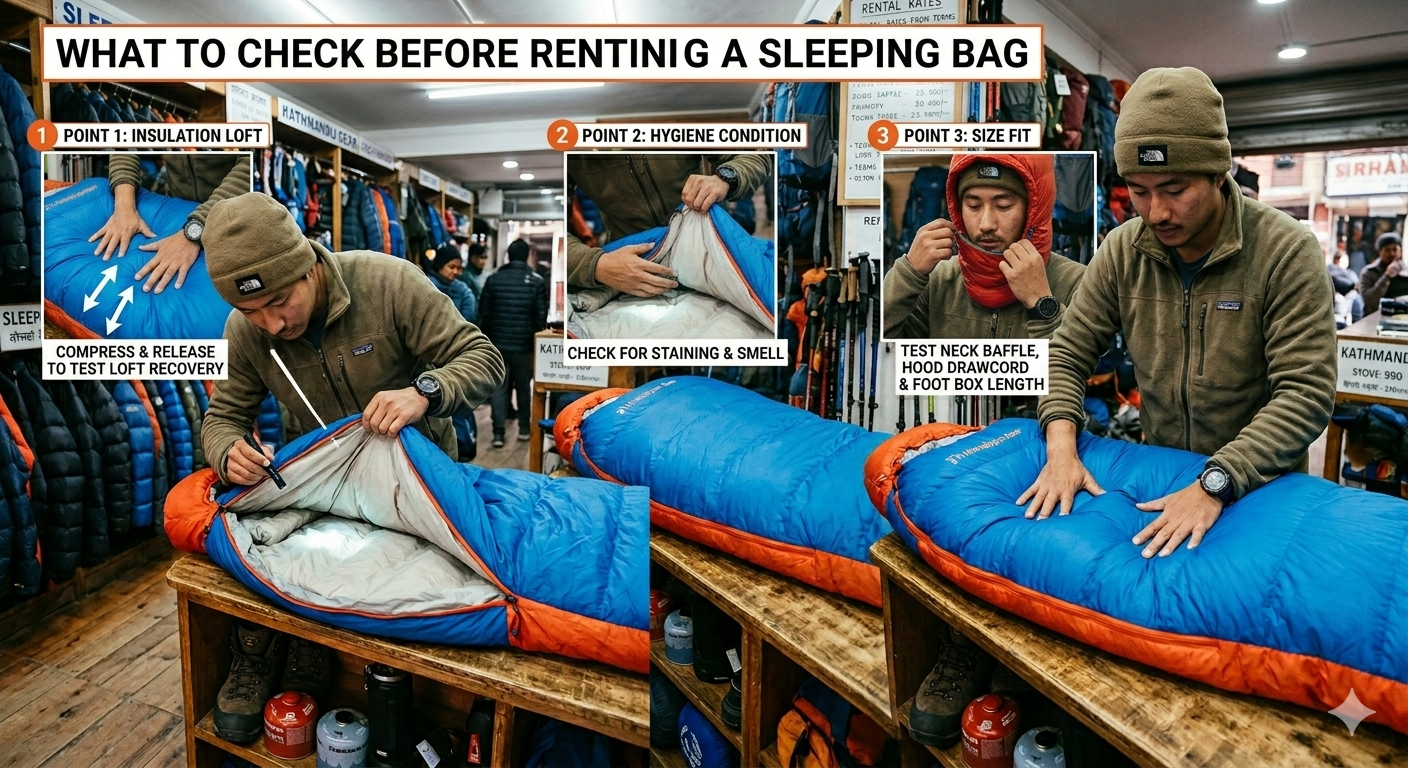
Check 3 quality factors before signing any sleeping bag rental agreement in Thamel: insulation loft, hygiene condition, and size fit.
How Do You Check Insulation and Warmth Quality?
Check sleeping bag insulation quality by compressing and releasing the bag. A well-maintained down bag rated to minus 15°C lofts back to its original volume within 3 to 5 seconds of release. A worn-out bag with degraded insulation lofts slowly or incompletely.
Flatten the bag and check fill distribution. Cold spots (areas with no visible fill loft) indicate insulation migration and reduced warmth in those sections. Cold spots above the shoulder or chest zone create hypothermia risk above 4,000 m.
How to Inspect Cleanliness and Hygiene?
Inspect rental sleeping bag hygiene through 3 physical checks: smell, visible staining, and moisture retention.
Open the bag fully and smell the interior. A musty or sour odor indicates inadequate drying between uses and bacterial growth. Check the interior shell for visible staining at the head zone and foot box. Press the insulation between your fingers to check for residual moisture from inadequate drying.
Ask the rental shop staff when the bag was last washed. High-turnover shops wash bags every 5 to 10 rentals. Low-turnover shops wash less frequently.
How to Choose the Right Size and Fit?
Choose a sleeping bag length matching your height plus 15 cm to 20 cm for foot box clearance. A bag too long loses heat to the empty foot box volume. A bag too short compresses insulation at the feet, reducing thermal performance.
Check the hood draw cord and neck baffle (the padded collar at shoulder level). A neck baffle that seals fully around the neck prevents cold air infiltration at the bag's most vulnerable heat loss point. Shoulder girth must allow comfortable arm movement without compressing the insulation.
Are Rented Sleeping Bags Clean and Safe to Use?
Rented sleeping bags in Thamel are safe to use with a sleeping bag liner. Hygiene quality varies significantly between budget and premium rental shops.
How Clean Are Rental Sleeping Bags in Kathmandu?
Premium trekking gear shops in Thamel wash and dry rental sleeping bags after every 2 to 5 uses. Budget shops wash every 10 to 15 uses or on visible soiling.
Down sleeping bags require gentle washing at 30°C with specialist down detergent and full tumble drying with tennis balls to restore loft. Improper drying leaves moisture in the fill, creating mold and bacteria within 48 hours.
Realistic expectation: a rented sleeping bag from a budget Thamel shop shows light odor and minor staining after 10 to 20 rental cycles. A reputable shop with visible washing equipment and a documented cleaning schedule provides significantly cleaner stock.
What Are the Risks of Using Rental Sleeping Bags?
3 health and performance risks affect low-quality rental sleeping bags: bacterial exposure through inadequate cleaning, insulation degradation through moisture retention, and reduced sleep quality from odor and cold spots.
Degraded insulation in a rental bag reduces effective warmth by 3°C to 7°C below the stated rating. At Lobuche (4,940 m) with minus 12°C teahouse temperatures, a minus 15°C bag performing at minus 8°C creates cold stress and disrupted sleep.
Poor sleep above 4,000 m increases Acute Mountain Sickness (AMS) risk. According to the Himalayan Rescue Association, sleep disruption at altitude is a contributing factor in AMS progression.
How Do Trekkers Manage Hygiene Concerns?
Use a sleeping bag liner as a hygiene barrier on every rented bag. A silk liner (150 g) creates a complete physical separation between the trekker and the rental bag interior. A fleece liner (300 g) adds 5°C to 8°C of warmth alongside the hygiene barrier.
Choose rental shops with visible laundering infrastructure, ask for recently cleaned stock, and inspect before finalizing. Premium Thamel shops offer the same inspection quality as purchasing from an outdoor retailer.
Should You Use a Sleeping Bag Liner for Everest Base Camp Trek?
Yes, a sleeping bag liner is standard equipment for EBC trek, particularly with rental bags. A liner adds 3°C to 8°C of warmth, provides a complete hygiene barrier, and weighs 150 g to 300 g with negligible Lukla flight impact.
Why Is a Sleeping Bag Liner Important?
A sleeping bag liner serves 2 critical functions on EBC trek: hygiene barrier against rented bag contamination and warmth augmentation at high-altitude teahouses.
A liner extends the effective lifespan of insulation in rented bags by preventing body oil and perspiration from absorbing into the fill. This benefit is relevant to rental shops, which is why quality Thamel shops often provide a disposable liner with rental or reduce rates for trekkers bringing their own.
How Much Warmth Does a Liner Add?
A sleeping bag liner adds 3°C to 8°C of effective warmth depending on liner material. Silk liners add 3°C to 5°C. Fleece liners add 5°C to 8°C. Cotton liners add 2°C to 4°C but retain moisture and are not recommended above 4,000 m.
A standard minus 15°C rental bag paired with a fleece liner performs at an effective minus 20°C to minus 23°C comfort range. This combination covers all standard EBC trekking seasons, including cold autumn nights at Lobuche and Gorak Shep.
What Type of Liner Should You Choose?
A silk liner is the best choice for EBC trek with a rental sleeping bag. Silk weighs 150 g to 180 g, compresses to the size of a fist, adds 3°C to 5°C of warmth, and creates a smooth hygiene barrier.
Fleece liners are appropriate for winter trekkers (December to February) requiring maximum warmth addition. Cotton liners retain moisture and are unsuitable above 4,000 m where rapid temperature drops prevent cotton from drying overnight.
What Type of Sleeping Bag Is Best for Everest Base Camp Trek?
A mummy-shaped down sleeping bag rated to minus 15°C comfort with 600 to 700 fill power is the best sleeping bag for standard EBC seasons. This specification covers the Khumbu teahouse temperature range across spring and autumn.
Mummy vs Rectangular Sleeping Bags for EBC?
A mummy sleeping bag is the correct choice for EBC trek. Mummy bags minimize dead air volume, maximizing heat retention efficiency. A rectangular bag loses 20% to 30% more body heat through unused volume at the foot box and shoulder areas.
Mummy bags weigh 0.8 kg to 1.5 kg for a minus 15°C down version. Rectangular bags of equivalent rating weigh 1.5 kg to 2.5 kg. The weight difference affects Lukla flight baggage compliance for trekkers carrying their own bag.
Down vs Synthetic Sleeping Bags?
Down sleeping bags provide a superior warmth-to-weight ratio for EBC trek. A 700 fill power down bag rated to minus 15°C weighs 900 g to 1.2 kg. A synthetic bag with equivalent thermal performance weighs 1.4 kg to 1.8 kg.
Synthetic bags perform better in wet conditions, retaining 70% to 80% of insulation efficiency when damp versus 20% to 30% for down. Teahouse condensation above Namche Bazaar creates minor moisture exposure, but does not reach the level where synthetic outperforms dry-stored down.
Hydrophobic down combines moisture resistance with the warmth-to-weight advantage of standard down at a 20% to 30% premium on rental and purchase pricing.
What Features Matter Most for High-Altitude Trekking?
4 sleeping bag features determine high-altitude trekking performance: hood design, draft collar (neck baffle), zipper insulation baffles, and compression packability.
A contoured hood with an adjustable drawcord seals around the head, preventing 25% to 35% of total body heat loss that occurs through the head zone during sleep. A neck baffle seals the shoulder opening against cold air infiltration. Zipper baffles prevent cold spots along the full-length zip. Compression sack capacity determines duffel bag volume use.
Can You Rent Sleeping Bags as Part of a Trekking Package?
Yes, EBC trekking packages from TAAN-accredited agencies in Kathmandu include sleeping bag rental as standard or optional at NPR 150 to NPR 250 per day. Package inclusion varies by agency tier.
What Gear Is Usually Included in Trekking Packages?
Standard EBC guided trek packages include sleeping bag and down jacket rental as the 2 primary gear inclusions. Some mid-range packages add trekking poles. Premium packages include a full gear kit covering sleeping bag, down jacket, trekking poles, and duvet jacket.
Budget EBC packages (USD 700 to USD 1,200 per person for a standard 14-day guided trek) list sleeping bag as a paid add-on at NPR 150 to NPR 250 per day. Mid-range packages (USD 1,200 to USD 2,000) include sleeping bag in the base package price.
Is Agency-Provided Gear Good Enough?
Agency-provided sleeping bags from TAAN-accredited operators are adequate for standard spring and autumn EBC treks. Quality inconsistencies exist between agencies. Budget operators use older stock with 3 to 5 year rental histories. Premium operators replace sleeping bag stock annually.
Ask your guide 2 direct questions at the pre-trek briefing: What is the bag's comfort rating? Has the bag been washed since its last rental? Unsatisfactory answers indicate a Thamel shop alternative is worth the NPR 150 to NPR 300 per day additional cost.
Should You Rent Separately Instead of Using Agency Gear?
Rent separately from a Thamel shop when hygiene or quality concerns arise at the pre-trek briefing. Physical inspection of bag loft, smell, and fit is possible only at a gear shop. Agency gear is handed over at the briefing without prior inspection opportunity.
The cost difference between agency rental (NPR 150 to NPR 250 per day) and a quality Thamel shop rental (NPR 200 to NPR 300 per day) is under USD 0.50 per day. Quality and hygiene assurance justifies this cost difference.
What Are the Risks of Renting a Low-Quality Sleeping Bag?
A low-quality rental sleeping bag creates 3 interconnected risks on EBC trek: cold exposure during sleep, reduced physical recovery, and indirect altitude sickness contribution.
How Does Poor Insulation Affect Your Trek?
Poor sleeping bag insulation causes 4 to 6 hours of disrupted sleep per night above 4,000 m. Cold-disrupted sleep reduces muscle recovery by 20% to 30% compared to full rest cycles. Reduced recovery slows trekking pace by 15% to 25% and increases cumulative fatigue above Dingboche.
A rental bag with degraded insulation performing 5°C below its stated rating fails at night temperatures of minus 10°C inside Lobuche teahouses during peak autumn season.
Can a Bad Sleeping Bag Increase Altitude Risk?
Poor sleep quality at altitude is a contributing factor to Acute Mountain Sickness progression. According to the Himalayan Rescue Association, trekkers with 3 or more consecutive nights of poor sleep above 4,000 m show higher AMS incidence rates than fully rested trekkers at the same elevation.
Cold stress through inadequate insulation reduces the body's ability to regulate oxygen absorption. Sleep deprivation impairs the respiratory acclimatization response required above 5,000 m.
What Backup Options Exist If Your Sleeping Bag Is Not Warm Enough?
3 backup options address inadequate sleeping bag warmth on the trail: using teahouse blankets as supplementary layers, wearing full thermal base layers inside the bag, and purchasing a liner in Namche Bazaar.
Teahouse blankets add 2°C to 4°C of additional warmth. Wearing a thermal base layer, mid layer, and beanie inside the bag adds 4°C to 6°C. A fleece liner purchased in Namche Bazaar (NPR 800 to NPR 1,500) adds 5°C to 8°C and is the most effective emergency backup.
What Other Gear Should You Rent Along with a Sleeping Bag?
Rent 2 items alongside the sleeping bag for a complete EBC trekking gear system: a down jacket and trekking poles.
Should You Rent a Down Jacket for EBC Trek?
Yes, a down jacket rental in Thamel is essential for high-altitude warmth on EBC trek at NPR 100 to NPR 250 per day. Down jackets rated to minus 15°C with 600 fill power or above are the standard teahouse-to-teahouse outer insulation layer above Namche Bazaar.
Buying a quality down jacket costs USD 100 to USD 300. For a single EBC trek, rental at NPR 100 to NPR 250 per day costs NPR 1,400 to NPR 3,500 for a 14-day trek (USD 10 to USD 26). Rental breaks even against purchase cost at 2 to 3 treks.
What Supporting Gear Improves Sleep Quality?
3 items improve sleep quality alongside the sleeping bag at EBC teahouses:
-
Sleeping bag liner (silk, 150 g): hygiene barrier plus 3°C to 5°C warmth addition
-
Inflatable travel pillow (90 g to 150 g): neck support at altitude where headache is common
-
Thermal base layer set: worn inside the bag for 4°C to 6°C additional warmth
All 3 items are lightweight and fit in the daypack or outer pocket of the porter duffel.
What Gear Combinations Reduce Overall Cost?
Bundle sleeping bag and down jacket rental from 1 Thamel shop for 10% to 15% total rental discount. Single-shop bundles reduce negotiation time and simplify return logistics at the end of the trek.
Negotiate the full 14-day rental upfront. Day-by-day rental pricing does not receive bundle discounts. Pay the deposit (NPR 2,000 to NPR 5,000) and confirm the return process at rental. Most Thamel shops return the deposit in full within 30 minutes of gear inspection on return.
What Is the Final Checklist Before Renting a Sleeping Bag for Everest Base Camp Trek?
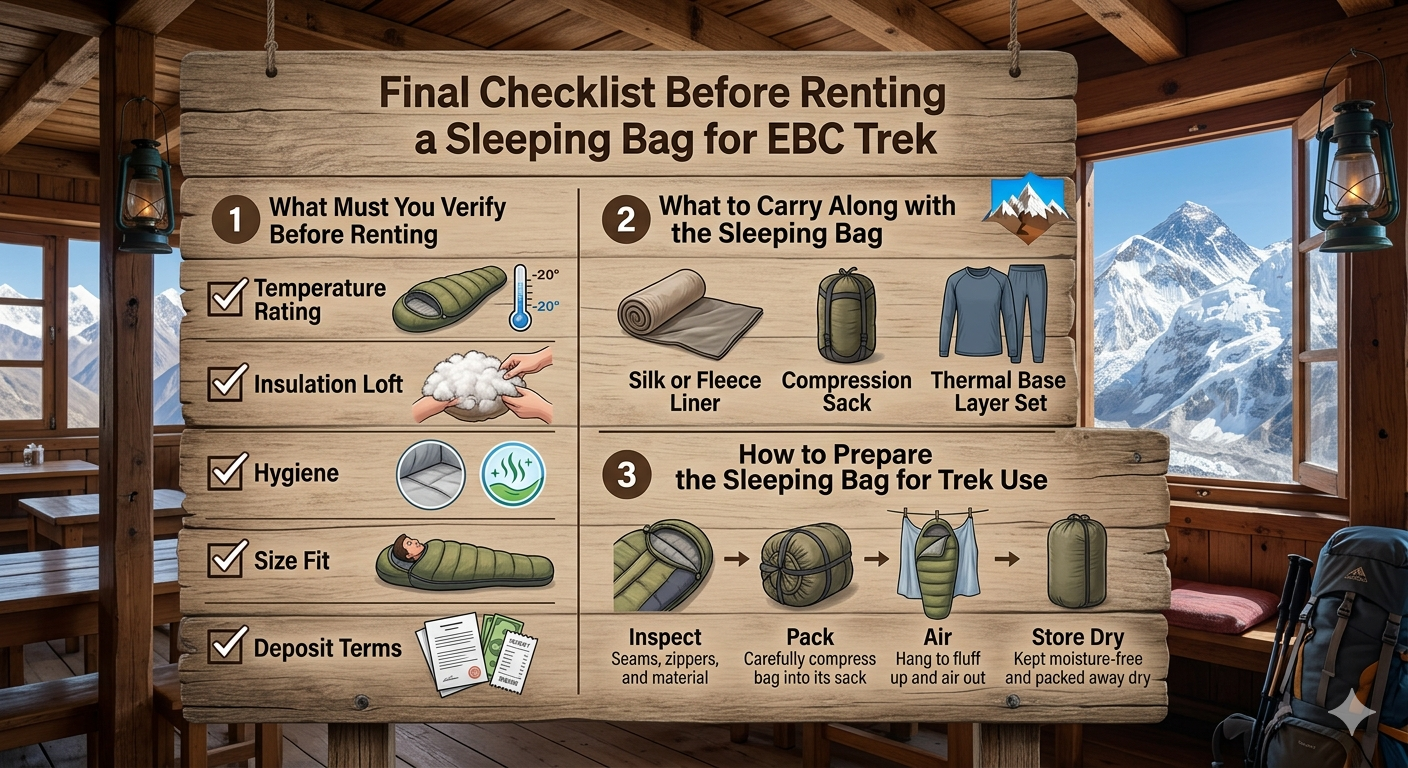
Verify 5 factors before finalizing any sleeping bag rental for EBC trek: temperature comfort rating, insulation loft quality, cleanliness, correct size fit, and deposit terms.
What Must You Verify Before Renting?
Verify these 5 factors at the rental shop before signing:
-
Temperature rating: minus 15°C comfort rating minimum for spring and autumn, minus 20°C for winter
-
Insulation loft: compress and release to confirm full loft recovery within 5 seconds
-
Hygiene: smell interior, check for staining, confirm recent washing
-
Size fit: length matches height plus 15 cm to 20 cm, neck baffle seals fully
-
Deposit terms: amount, return process, damage fee scale
What Should You Carry Along with the Sleeping Bag?
Carry 3 items alongside the rental sleeping bag:
-
Silk or fleece liner: hygiene barrier and warmth supplement
-
Compression sack: reduces sleeping bag volume in the 60L to 70L porter duffel
-
Thermal base layer set: emergency warmth layer worn inside the bag at highest altitudes
These 3 items add 300 g to 600 g of total pack weight, well within the 5 kg to 8 kg daypack target for EBC.
How Do You Prepare the Sleeping Bag for Trek Use?
Prepare the rental sleeping bag in 4 steps before the Lukla flight:
-
Inspect loft, hygiene, and fit at the Thamel shop before accepting
-
Pack in the provided compression sack inside the porter duffel bag (13 kg to 15 kg target)
-
Air the bag at each teahouse during daytime before use each night
-
Keep the bag dry by storing it in a Ziplock bag or dry bag inside the duffel on wet weather sections
Moisture from perspiration and teahouse condensation reduces down insulation efficiency by 30% to 50% when undried. Airing the bag daily at teahouse windows between Namche Bazaar and Gorak Shep maintains loft and warmth performance throughout the trek.
FAQs About Sleeping Bag Rental for Everest Base Camp Trek
Can you rent a sleeping bag in Kathmandu easily?
Yes. Thamel has 50 to 80 gear shops renting sleeping bags at NPR 100 to NPR 300 per day. Minus 15°C to minus 20°C rated bags are in stock year-round. Book early in October and April for branded options.
What sleeping bag rating is enough for Everest Base Camp?
Minus 15°C comfort rating for spring and autumn. Minus 20°C comfort for winter. Comfort rating determines actual warmth. Survival or limit rating does not equal comfort at the same temperature.
How much does it cost to rent a sleeping bag for EBC trek?
NPR 100 to NPR 300 per day. Total NPR 1,400 to NPR 4,200 for a 14-day trek. Deposits of NPR 2,000 to NPR 5,000 are fully refundable. Agency rental costs NPR 150 to NPR 250 per day.
Are rented sleeping bags hygienic?
Variable. Premium Thamel shops wash every 2 to 5 uses. Budget shops wash less often. Always use a silk or fleece liner as a hygiene barrier regardless of shop quality.
Can you rent a sleeping bag in Namche Bazaar?
Yes, but limited. Namche Bazaar has 5 to 10 shops at NPR 300 to NPR 500 per day with low peak-season stock. Kathmandu is the correct rental point. Namche is an emergency backup only.
Do trekking companies provide sleeping bags?
Yes. Mid-range to premium TAAN-accredited packages include a sleeping bag. Budget packages charge NPR 150 to NPR 250 per day as an add-on. Confirm comfort rating and washing history at the pre-trek briefing.
More About Author

Khilak Budhathoki
Travel Director
Khilak Budhathoki is the co-founder and lead trekking guide at Himalaya Trekking Nepal, a locally owned and operated adventure company based in Kathmandu. Born and raised in the foothills of Nepal, Khilak developed a deep love for the mountains from an early age. With over a deca...

USD$1,600 pp
Our Recommendation
Related Blogs
.jpg)


