- 23, Apr 2026 | Khilak Budhathoki
Emergency helicopter evacuation from Everest Base Camp costs USD 4,000 to USD 12,000 depending on pickup altitude, weather, and helicopter availability in 2025 and 2026. Gorak Shep (5,164 m) evacuations cost USD 7,000 to USD 10,000. Everest Base Camp (5,364 m) evacuations reach USD 8,000 to USD 12,000. Namche Bazaar (3,440 m) evacuations cost USD 2,500 to USD 4,000.
Travel insurance covering helicopter rescue to 6,000 m costs USD 150 to USD 400 for a 14-day EBC trek window. Without insurance, trekkers pay the full evacuation cost in cash before or immediately after rescue. AMS, HAPE, and HACE are the 3 primary evacuation triggers, accounting for 70 to 90% of all helicopter rescues from the Khumbu region.
This page covers evacuation cost by location on the EBC route, insurance coverage requirements, what policies must include, the fake helicopter rescue scam, how the rescue coordination process works between guides and the Himalayan Rescue Association and helicopter operators, real cost comparison tables, and a full FAQ on Everest Base Camp emergency evacuation cost for trekkers from the US, UK, Australia, Europe, and India.
How Much Does Emergency Evacuation from Everest Base Camp Cost?
Emergency helicopter evacuation from Everest Base Camp costs USD 4,000 to USD 10,000 depending on pickup altitude, weather conditions, and helicopter availability. Evacuations from Gorak Shep (5,164 m) or Everest Base Camp (5,364 m) reach the upper end of this range. Evacuations from lower altitudes such as Namche Bazaar (3,440 m) cost USD 2,500 to USD 4,000.
Costs in 2025 and 2026 reflect fuel surcharges, aviation regulation fees from the Nepal Civil Aviation Authority, and operator margins from private helicopter companies based in Kathmandu.
Trekkers without travel insurance covering emergency helicopter evacuation pay the full amount out of pocket before or immediately after the rescue. Helicopter operators in the Khumbu region do not operate on credit.
What Factors Affect Everest Base Camp Evacuation Cost?
5 variables determine the final evacuation cost: pickup altitude, weather conditions, number of passengers sharing the flight, medical complexity, and helicopter availability in the Khumbu region.
Altitude is the primary cost driver. Flying to 5,000 m plus along the daily elevation profile from Lukla to Kala Patthar requires high-altitude certified helicopters such as the Airbus H125 or Bell 407, which carry higher operating costs per flight hour. Fuel consumption increases 30 to 40% above 4,500 m compared to sea level operations.
Weather adds unpredictability. Storms at altitude ground helicopters for 12 to 48 hours. Delayed evacuations extend patient risk and may require additional medical intervention at the pickup point. Helicopter window at Gorak Shep is limited to 4 to 6 hours per day due to wind patterns above 5,000 m.
Passenger sharing reduces cost per person. 2 trekkers sharing a flight cut individual cost by 40 to 50%. Solo rescue from Gorak Shep at USD 9,000 becomes USD 4,500 per person with one additional passenger.
Medical complexity increases cost when ground stabilization, oxygen supply, or advanced medical support is required before the helicopter arrives. Nepal's Himalayan Rescue Association provides first-response support at clinics in Pheriche (4,371 m) and Namche Bazaar.
How Much Does Helicopter Rescue Cost by Location on the EBC Route?
Evacuation cost increases with altitude. The table below shows typical 2025 to 2026 helicopter evacuation costs by pickup location on the Everest Base Camp route.
|
Pickup Location |
Altitude |
Evacuation Cost (USD) |
|
Lukla |
2,860 m |
USD 1,500 to USD 2,500 |
|
Namche Bazaar |
3,440 m |
USD 2,500 to USD 4,000 |
|
Dingboche |
4,410 m |
USD 4,000 to USD 6,500 |
|
Lobuche |
4,940 m |
USD 5,500 to USD 8,000 |
|
Gorak Shep |
5,164 m |
USD 7,000 to USD 10,000 |
|
Everest Base Camp |
5,364 m |
USD 8,000 to USD 12,000 |
These figures reflect solo evacuation costs before insurance reimbursement. All helicopters fly to Kathmandu Tribhuvan International Airport or Lukla for patient handover to ground medical teams.
Higher altitude increases cost for 3 reasons: longer flight time, lower air density requiring more fuel per kilometer, and reduced safe operating window per day. A helicopter evacuation from Everest Base Camp involves 2 to 3 times more operational risk than one from Lukla.
Is Travel Insurance Required for Everest Base Camp Evacuation?
Travel insurance covering emergency helicopter evacuation is not legally mandatory for EBC trekking, but Himalaya Trekking Nepal requires proof of valid insurance before departure. Most licensed Nepal trekking operators enforce this as a safety condition.
An uninsured evacuation from Gorak Shep costs USD 7,000 to USD 10,000. Payment is demanded before or immediately after the rescue. Helicopter operators and hospitals in Kathmandu do not offer payment plans.
A standard 14-day EBC travel insurance policy costs USD 150 to USD 400 depending on age, nationality, and coverage limits. The financial protection ratio is USD 150 against USD 10,000 exposure. The gap is 66 to 1.
Real out-of-pocket scenarios without insurance:
-
AMS evacuation from Dingboche (4,410 m): USD 4,000 to USD 6,500 immediate payment
-
HAPE evacuation from Lobuche (4,940 m): USD 5,500 to USD 8,000 plus Kathmandu hospital costs
-
HACE evacuation from Gorak Shep (5,164 m): USD 7,000 to USD 10,000 plus ICU care in Kathmandu
The Nepal Tourism Board recommends insurance for all trekkers above 3,500 m. The Trekking Agencies Association of Nepal (TAAN) includes insurance verification as part of their safety protocol for licensed operators.
Plan your Everest Base Camp (14-Day) trek with full safety coverage from day one.
Himalaya Trekking Nepal includes complete AMS, HACE, and HAPE emergency protocols in every guided itinerary to ensure maximum safety at high altitude.
Before you book, get direct WhatsApp guidance on safety requirements from our expert: Ronit Dahal (Kathmandu): +977 984 305 2075
View full 14-Day EBC Trek itinerary, details & pricing.
What Should Everest Base Camp Insurance Cover for Evacuation?
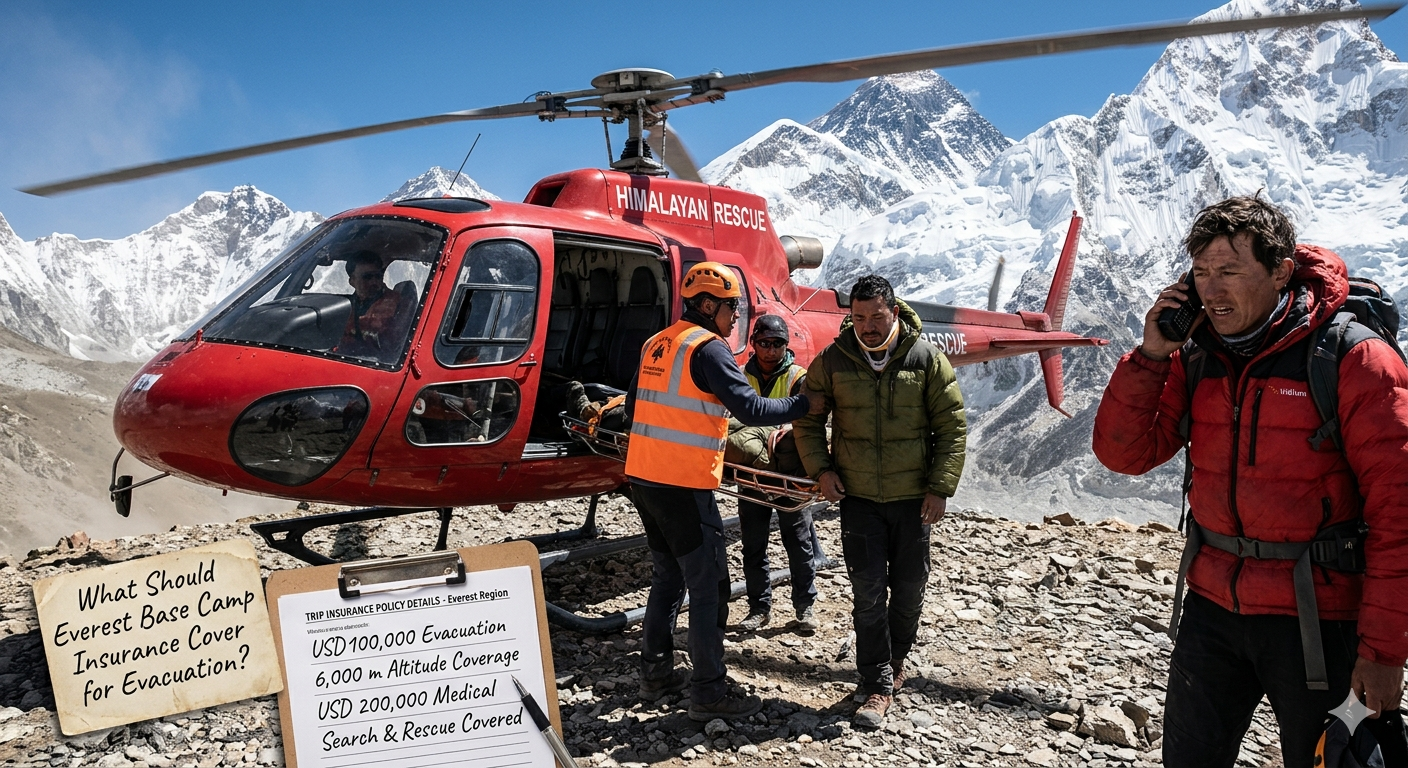
EBC travel insurance must cover emergency helicopter evacuation to a minimum altitude of 6,000 m, with a medical evacuation limit of at least USD 100,000 and emergency medical expenses of USD 200,000 or more.
Standard travel insurance policies cap altitude coverage at 3,000 m to 4,000 m. Everest Base Camp sits at 5,364 m. Kala Patthar sits at 5,545 m. A standard policy does not cover evacuation from either point.
Mandatory coverage requirements for EBC trekking:
-
Emergency helicopter evacuation: Minimum USD 100,000 coverage
-
Medical evacuation altitude ceiling: 6,000 m minimum
-
Emergency medical expenses: USD 200,000 or more
-
Search and rescue (SAR) operations: Covered
-
Trip interruption: Covered for medical evacuation scenarios
-
24-hour emergency assistance hotline: Active and direct contact
Common policy exclusions that disqualify coverage:
-
Altitude exclusion clause above 3,000 m or 4,000 m in standard policies
-
Adventure sports exclusion without a trekking rider added
-
Pre-existing condition clause blocking coverage for prior cardiac or respiratory conditions
-
Alcohol or drug influence exclusion applicable in accident scenarios
The adventure sports rider is the specific policy addition that extends altitude coverage, verified in the pre-departure document and permit checklist for the Khumbu trail. Trekkers who purchase standard travel insurance without this rider are unprotected above 3,000 m to 4,000 m on the EBC route.
How Much Does Everest Base Camp Travel Insurance Cost?
EBC travel insurance with full helicopter evacuation coverage costs USD 150 to USD 400 for a 14 to 21-day trekking window. Premium variation depends on 3 variables: trekker age, country of origin, and selected coverage limits.
Cost breakdown by age bracket:
|
Trekker Age |
Typical Premium (USD) |
Coverage Type |
|
18 to 35 |
USD 150 to USD 220 |
Standard adventure coverage |
|
36 to 50 |
USD 200 to USD 300 |
Standard adventure coverage |
|
51 to 65 |
USD 280 to USD 400 |
High-risk adventure coverage |
|
66 and above |
USD 350 to USD 600 |
Specialist senior coverage |
Major international providers with EBC-verified altitude coverage include World Nomads, IMG Global (International Medical Group), Allianz Travel Insurance, SafetyWing, True Traveller, AXA Travel Insurance, and Generali Global Assistance.
US-based trekkers pay USD 180 to USD 320 on average. UK and Australian trekkers pay GBP 130 to GBP 250 or AUD 220 to AUD 480 for equivalent coverage. European trekkers (Germany, Netherlands, Scandinavia) pay EUR 160 to EUR 350.
Cost against risk: A USD 250 policy covers a USD 10,000 evacuation risk. The premium represents 2.5% of maximum potential liability. No other financial protection product on the EBC trek offers this ratio.
How Does Emergency Evacuation from Everest Base Camp Work?
Emergency evacuation from Everest Base Camp follows a 6-step process from incident to hospital transfer, coordinated between the guide, the trekking agency, the insurance company, and a Kathmandu-based helicopter operator.
The 6-step emergency evacuation process:
-
Guide identifies medical emergency and assesses patient condition with pulse oximeter
-
Guide contacts trekking agency base in Kathmandu via satellite phone or radio
-
Agency contacts insurance company emergency hotline for evacuation authorization
-
Insurance company issues a guarantee letter to the helicopter operator
-
Helicopter dispatches from Kathmandu or Lukla to the designated landing zone
-
Patient is airlifted to Kathmandu or the nearest functioning airstrip for hospital transfer
Flight time from Kathmandu to Gorak Shep is 45 to 60 minutes. Ground-to-hospital total time from evacuation request to Kathmandu arrival averages 3 to 5 hours under clear weather. Weather delays extend this to 12 to 48 hours in storm conditions.
Communication systems in the Khumbu region:
-
Satellite phones: Reliable above 4,500 m where mobile coverage drops
-
Nepal Telecom mobile: Functional at Namche Bazaar and Dingboche
-
Everest Link WiFi: Available at teahouses from Namche to Gorak Shep for data communication
Himalayan Rescue Association clinics at Pheriche (4,371 m) and Namche Bazaar (3,440 m) provide initial medical stabilization based on AMS, HAPE, and HACE symptom assessment at each altitude zone while evacuation is arranged. Both clinics are staffed by rotation doctors during trekking season (March to May, September to November).
Who Coordinates Rescue Operations in the Everest Region?
Emergency rescue in the Khumbu Himalayan trekking region is coordinated by 4 parties: the licensed trekking guide on the ground, the Kathmandu trekking agency, the insurance company's 24-hour assistance desk, and the helicopter operator.
The Himalayan Rescue Association (HRA) provides medical support through its clinics at Pheriche and Namche Bazaar. HRA doctors conduct altitude illness consultations and administer emergency oxygen before helicopter arrival.
Licensed helicopter operators servicing the EBC evacuation zone include Fishtail Air, Simrik Airlines, and Summit Air, all operating from Kathmandu under Nepal Civil Aviation Authority certification.
The insurance company approval process is the most critical coordination step. Without a guarantee letter from the insurer, helicopter operators do not dispatch. This is why 24-hour emergency hotline access and policy activation before departure are non-negotiable requirements.
Guide-led groups with Himalaya Trekking Nepal maintain direct WhatsApp communication with the Kathmandu base throughout the trek. The agency's emergency protocol activates within 15 minutes of guide alert and initiates helicopter dispatch coordination immediately.
What Are the Common Reasons for Evacuation on the EBC Trek?
5 medical conditions account for 90% of helicopter evacuations from the Khumbu region: acute mountain sickness, HAPE, HACE, traumatic injury, and severe dehydration combined with exhaustion.
Evacuation causes ranked by frequency:
-
Acute Mountain Sickness (AMS): Most common evacuation trigger. Onset above 3,000 m. Symptoms include severe headache, vomiting, and inability to walk. Represents 45 to 55% of evacuations.
-
High Altitude Pulmonary Edema (HAPE): Fluid accumulation in lungs. Symptoms include breathlessness at rest, frothy cough, and blue-tinged lips. Requires descent within 1 to 2 hours. Represents 15 to 20% of evacuations.
-
High Altitude Cerebral Edema (HACE): Brain swelling. Symptoms include confusion, loss of coordination, and altered consciousness. Fatal without immediate descent. Represents 10 to 15% of evacuations.
-
Traumatic injury: Falls on rocky trail, suspension bridge accidents, and knee fractures. Represents 10 to 15% of evacuations.
-
Khumbu cough combined with severe dehydration and exhaustion: Respiratory infection triggered by cold dry air above 3,500 m. Represents 5 to 10% of evacuations.
Most evacuations are preventable. Proper acclimatization and AMS prevention through the climb-high sleep-low protocol, guide monitoring, and early symptom response reduce HAPE and HACE evacuation risk by 70 to 80%.
What Is the Fake Helicopter Rescue Scam in Nepal?
The fake helicopter rescue scam involves trekking staff, local medical clinic personnel, or third-party middlemen pressuring trekkers with mild or no symptoms into unnecessary helicopter evacuations to generate commission fees from helicopter operators.
The scam works in 3 stages:
-
A trekker reports a mild headache or minor fatigue at a teahouse or informal clinic
-
Staff exaggerate symptoms and call a helicopter without proper medical assessment
-
The helicopter operator pays a commission of USD 500 to USD 1,500 to the referring party per rescue
Trekkers targeted are almost always insured. Uninsured trekkers are rarely targeted because out-of-pocket payment creates resistance.
Signs of unnecessary evacuation pressure:
-
Recommendation for helicopter evacuation within minutes of complaint
-
No pulse oximeter reading taken before evacuation recommendation
-
No rest or hydration trial suggested before escalation
-
Pressure to sign documents before speaking to your guide or insurance company
According to Nepal Tourism Board reports from 2022 to 2024, the Nepal government conducted crackdowns on fraudulent helicopter rescue operations involving 14 indicted individuals across Kathmandu-based helicopter companies and Khumbu-region clinic staff.
Protection protocol:
-
Never authorize evacuation without speaking to your guide first
-
Request a pulse oximeter reading before any evacuation decision
-
Contact your insurance company directly before authorizing helicopter dispatch
-
Evacuation decisions on Himalaya Trekking Nepal guided treks require guide and agency authorization before any helicopter is called
Can You Reduce or Avoid Evacuation Costs on the EBC Trek?
Evacuation cost risk is reduced by 70 to 80% through 4 prevention strategies: proper acclimatization on a 14-day itinerary, trekking with a certified guide, early AMS symptom management, and maintaining physical fitness.
Acclimatization strategy: Rest days at Namche Bazaar (3,440 m) and Dingboche (4,410 m) allow red blood cell adaptation before ascending to the 4,500 m plus hypoxia zone. Skipping these days increases HAPE and HACE risk by 300 to 400%.
Itinerary selection: The 14-day EBC itinerary reduces AMS incidence to below 8% in guided groups. Compressed 10 to 12-day itineraries raise AMS incidence to 25 to 35%, directly increasing evacuation probability.
Early symptom management: AMS caught at mild stage (headache, fatigue) is treated with rest, hydration, and acetazolamide as a preventive high-altitude medication at 125 mg twice daily. AMS ignored for 12 to 24 hours escalates to HAPE or HACE requiring evacuation. Early response eliminates evacuation need in 70% of mild AMS cases.
Guide-led trekking: Licensed guides monitor oxygen saturation with pulse oximeters twice daily above 4,000 m. Guide-led trekkers show 15 to 20% lower evacuation rates than independent trekkers.
What Happens If You Cannot Pay Evacuation Costs Upfront?
Trekkers without insurance who cannot pay evacuation costs face 3 scenarios: delayed rescue pending payment confirmation, embassy emergency assistance, or rescue on a guide-agency personal guarantee with post-rescue debt obligation.
Insurance guarantee letters are the standard payment mechanism. The insurer issues a written guarantee to the helicopter operator before dispatch. This removes the out-of-pocket upfront requirement for insured trekkers.
Without insurance, helicopter operators request upfront payment or credit card authorization before dispatch. Credit card authorization for USD 7,000 to USD 10,000 is required at the time of call, not on arrival in Kathmandu.
Embassy emergency assistance applies in cases where trekkers face life-threatening situations and have no payment capacity. US, UK, Australian, German, and Norwegian embassies in Kathmandu maintain emergency assistance lines. Embassy support is a loan, not a grant. Reimbursement is required after return home.
Delays due to payment confirmation cause the greatest medical risk. HAPE and HACE require descent within 1 to 2 hours of severe symptom onset. A 3-hour payment delay in a HAPE case at Lobuche (4,940 m) can result in permanent lung damage or death.
Everest Base Camp Evacuation Cost vs Insurance: Cost Comparison
A USD 250 travel insurance premium covers USD 10,000 in evacuation liability. The uninsured trekker carries 40 times the financial risk of the insured trekker at the same altitude.
The table below shows the financial reality of insured vs uninsured evacuation scenarios.
|
Scenario |
Location |
Evacuation Cost |
With Insurance |
Without Insurance |
|
Mild AMS evacuation |
Dingboche (4,410 m) |
USD 5,000 |
USD 0 out of pocket |
USD 5,000 upfront |
|
HAPE evacuation |
Lobuche (4,940 m) |
USD 7,500 |
USD 0 out of pocket |
USD 7,500 upfront |
|
HACE evacuation |
Gorak Shep (5,164 m) |
USD 9,500 |
USD 0 out of pocket |
USD 9,500 upfront |
|
Hospital (Kathmandu ICU, 5 days) |
Kathmandu |
USD 5,000 to USD 15,000 |
Covered to policy limit |
Full personal liability |
|
Total worst-case |
All locations |
USD 20,000 to USD 25,000 |
USD 250 to USD 400 premium |
USD 20,000 to USD 25,000 cash |
According to data from Nepal trekking insurance claim records reviewed by Himalayan adventure travel analysts in 2023, 1 in 12 trekkers on the 14-day guided trek through the Khumbu Valley files an insurance claim during or after the trek. The most common claims are helicopter evacuation (45%), trip interruption due to AMS (30%), and Lukla flight delay compensation (25%).
Frequently Asked Questions About Everest Base Camp Evacuation Cost
How Much Does a Helicopter Rescue from Everest Base Camp Cost?
A helicopter rescue from Everest Base Camp (5,364 m) costs USD 8,000 to USD 12,000 for a solo evacuation. From Gorak Shep (5,164 m), the cost ranges from USD 7,000 to USD 10,000. Costs reflect 2025 to 2026 Nepal helicopter operator rates including fuel, crew, and Nepal Civil Aviation Authority fees.
Is Evacuation Included in Everest Base Camp Trek Packages?
No. Emergency helicopter evacuation is not included in EBC trek packages. Trek packages from Himalaya Trekking Nepal cover guide, porter, accommodation, meals, and permits. Emergency evacuation is a separate insurance-covered expense. The trek package cost does not change if evacuation occurs.
Do All Insurance Policies Cover Helicopter Rescue in Nepal?
No. Standard travel insurance does not cover helicopter rescue above 3,000 m to 4,000 m. EBC trekkers require a policy with an adventure sports rider and altitude coverage to 6,000 m minimum. World Nomads, IMG Global, True Traveller, and AXA Travel Insurance offer Nepal-verified EBC policies.
At What Altitude Does Insurance Stop Covering Evacuation?
Standard insurance policies stop covering evacuation at 3,000 m to 4,000 m. EBC reaches 5,364 m. Kala Patthar reaches 5,545 m. Both exceed standard policy altitude ceilings. The adventure sports rider extends coverage to 6,000 m or above in most specialist EBC policies.
Can Evacuation Costs Be Shared Between Trekkers?
Yes. Helicopter evacuation costs split equally between passengers on the same flight. A solo evacuation from Lobuche at USD 7,500 costs USD 3,750 per person with 2 passengers. Sharing is common in group trekking scenarios where a guide accompanies the evacuated trekker. Insurance reimburses based on actual cost paid, not full charter rate.
How Fast Can a Helicopter Evacuate from Everest Base Camp?
Under clear weather, a helicopter reaches Gorak Shep from Kathmandu in 45 to 60 minutes. Total evacuation time from incident to Kathmandu hospital averages 3 to 5 hours. Weather delays extend this to 12 to 48 hours. Evacuation helicopters operate in a 4 to 6-hour daily window at altitudes above 5,000 m due to wind conditions.
What Is the Most Expensive Evacuation Scenario on the EBC Trek?
The most expensive scenario is a solo HACE evacuation from Everest Base Camp (5,364 m) requiring ground oxygen supply and medical stabilization before helicopter arrival. Total cost including helicopter charter (USD 10,000 to USD 12,000), Himalayan Rescue Association emergency consultation, oxygen supply, and Kathmandu ICU care reaches USD 20,000 to USD 30,000.
Do You Need to Carry Proof of Insurance During the Trek?
Yes. Carry both a digital copy and a printed copy of your insurance policy and your insurer's 24-hour emergency hotline number. Your guide needs the policy number and hotline number to initiate the insurance guarantee letter process. Without this information, helicopter dispatch is delayed pending payment confirmation.
Can Bad Weather Delay Emergency Evacuation?
Yes. Bad weather delays evacuation at high altitude by 12 to 48 hours. Above 5,000 m, helicopters operate safely only in a 4 to 6-hour weather window per day. Storms can ground all flights for multiple days. This is why HAPE and HACE require immediate descent by foot or yak transport when helicopter evacuation is delayed, rather than waiting at altitude.
Is Helicopter Evacuation Always Available on the EBC Route?
No. Helicopter availability in the Khumbu region depends on fleet availability, weather, and operator capacity. During peak trekking season (October and April), simultaneous multiple evacuation requests create 2 to 4-hour wait times even under clear conditions. Himalaya Trekking Nepal maintains relationships with Fishtail Air, Simrik Airlines, and Summit Air to prioritize evacuation requests for clients when needed.
Get the EBC trek safety system built into your itinerary from day one. Himalaya Trekking Nepal is TAAN licensed, Nepal Tourism Board registered, and Nepal Mountain Academy accredited. The 14-day EBC guided package includes daily oximeter checks, acclimatization protocol, and direct emergency coordination with Kathmandu-based rescue services.
Book or inquire here
WhatsApp Nepal: +977 9843052075
WhatsApp Norway: +4793921357
More About Author

Khilak Budhathoki
Travel Director
Khilak Budhathoki is the co-founder and lead trekking guide at Himalaya Trekking Nepal, a locally owned and operated adventure company based in Kathmandu. Born and raised in the foothills of Nepal, Khilak developed a deep love for the mountains from an early age. With over a deca...

USD$1,600 pp
Our Recommendation
Related Blogs