- 19, Apr 2026 | Khilak Budhathoki
ATMs on the Everest Base Camp trek exist at 3 locations: Kathmandu; Lukla at 2,860 meters; and Namche Bazaar at 3,440 meters. No ATM operates above Namche Bazaar. The villages of Tengboche, Dingboche, Lobuche, and Gorak Shep run on a full cash economy using Nepalese rupees (NPR). Lukla ATMs at Rastriya Banijya Bank, Kumari Bank, Siddhartha Bank, and Nepal Invested Mega Bank face power cuts, network failures, and seasonal cash shortages that make them unreliable.
Namche Bazaar is the last functional ATM hub on the route, with 4 to 6 machines at Nabil Bank, Rastriya Banijya Bank, and Siddhartha Bank accepting Visa and Mastercard, with per-transaction limits of NPR 10,000 to NPR 35,000 and a NPR 500 fee per withdrawal. A 12 to 14 day EBC trek requires NPR 35,000 to NPR 80,000 in total cash. Card payments end at Namche Bazaar. No digital payment, mobile wallet, or foreign card terminal operates above 3,440 meters.
The correct cash strategy is withdrawing 70 to 80 percent of the total budget in Kathmandu, topping up at Namche on the acclimatization rest day, and carrying a denomination mix of NPR 100, NPR 500, and NPR 1,000 notes. Trekkers who run out of cash above Namche rely on TAAN-registered agency support, Western Union transfers in Namche, or USD emergency reserves.
Are there ATMs on the Everest Base Camp trek?
ATMs on the EBC trek exist only in Kathmandu, Lukla, and Namche Bazaar. Beyond Namche Bazaar at 3,440 meters, no banking infrastructure operates on the entire route to Everest Base Camp at 5,364 meters. Trekkers cover 130 km round trip through a fully cash-dependent zone with no digital payment options.
Kathmandu provides the most reliable ATM access before the trek. Lukla at 2,860 meters holds 4 bank branches with ATMs, though machine reliability is inconsistent. Namche Bazaar at 3,440 meters functions as the final ATM point on the route, with 4 to 6 machines operational during peak trekking season in October and November.
ATMs on the EBC route serve as backup withdrawal points, not primary cash sources. The correct approach is withdrawing the full trekking budget in Kathmandu and treating Namche Bazaar as a top-up location before ascending into the ATM-free zone above.
The 3 location entities that define cash access on this route are Kathmandu (pre-trek hub), Lukla (gateway ATM point), and Namche Bazaar (final ATM point). Every village above Namche, including Tengboche at 3,867 meters, Dingboche at 4,410 meters, Lobuche at 4,940 meters, and Gorak Shep at 5,164 meters, operates on a cash-only basis with no withdrawal infrastructure.
What Is ATM Availability in Lukla and Why Is Reliability an Issue?
Lukla ATMs operate at 2,860 meters with 4 machines across Rastriya Banijya Bank, Kumari Bank, Siddhartha Bank, and Nepal Investment Mega Bank, but all 4 face recurring reliability failures from power cuts, network outages, and seasonal cash shortages.
Lukla receives electricity from a combination of hydropower and solar generation. Power interruptions occur regularly, particularly in the pre-monsoon months of April and May and during the post-monsoon shoulder season. A power cut disables the ATM entirely. Network failures at this altitude disconnect machines from Nepal's banking grid, rendering foreign card processing impossible even when power is available.
Cash shortages in Lukla ATMs are a documented pattern during peak trekking season. October and November bring 30,000 to 40,000 trekkers through Lukla annually. This volume overwhelms the cash supply capacity of 4 machines in a remote mountain town. Trekkers arriving from early morning Kathmandu flights frequently find machines already depleted by groups who landed the previous day.
The Nepal banking system classifies Lukla as a remote banking zone, meaning cash replenishment logistics depend on cargo flights from Kathmandu. Flight cancellations from weather or technical issues delay resupply.
A trekker who plans their entire cash strategy around Lukla ATMs carries serious financial risk. Lukla ATMs are backup options for small top-up withdrawals only, not the primary cash source for any trekking group.
Why Is Namche Bazaar the Last Functional ATM Hub on the EBC Route?
Namche Bazaar, at 3,440 meters, operates as the strongest banking hub in the Khumbu trekking region, with 4 to 6 ATMs from Nabil Bank, Rastriya Banijya Bank, and Siddhartha Bank accepting Visa and Mastercard, but machine reliability is still not guaranteed at this altitude.
Namche Bazaar holds the highest concentration of banking infrastructure on the EBC route. Nabil Bank, Rastriya Banijya Bank, and Siddhartha Bank all maintain operational ATMs here. The machines accept international cards on the Visa and Mastercard networks. Per-transaction withdrawal limits sit between NPR 10,000 and NPR 35,000 depending on the bank and the trekker's home bank authorization ceiling.
Withdrawal queues at Namche ATMs form daily during peak season. Groups arriving at Namche after a 6-hour walk from Lukla on Day 2 of the standard EBC itinerary often encounter 10 to 20-person queues. Some trekkers report waiting 45 minutes to reach a machine. Factor this into the acclimatization rest day schedule at Namche.
ATM fees in Namche apply per transaction. The standard fee is NPR 500 per withdrawal above the standard bank processing charge. Withdrawing NPR 35,000 in a single transaction minimizes the total fee impact. Multiple small withdrawals accumulate fees rapidly and reduce the available cash benefit.
Namche Bazaar's reliability advantage over Lukla comes from its larger power infrastructure, more consistent Khumbu regional grid connectivity, and higher cash replenishment frequency. Even so, machine outages occur. Every trekker withdraws at Namche before continuing upward, treating it as the definitive last ATM point on the entire route.
Why Do ATMs Stop Existing Beyond Namche Bazaar?
No ATMs operate above Namche Bazaar because villages at 3,800 to 5,200 meters lack stable electricity grids, banking-grade connectivity infrastructure, and the logistics systems required to supply and secure cash machines. banking-grade connectivity infrastructure, and the logistics systems required to supply and secure cash machines at 3,800 to 5,200 meters elevation.
The infrastructure collapse above Namche Bazaar reflects 4 connected failures. First, electricity generation above 3,800 meters relies entirely on solar panels and small-scale battery banks. These systems power teahouse lighting and charging stations but cannot maintain the continuous, stable power draw that ATM operations require. Second, the internet and banking network connectivity needed for card authorization does not exist at reliable speeds above Namche. Third, the logistics of physically transporting cash to high-altitude villages depend entirely on porter and yak caravans from Namche, making cash replenishment cycles days-long and weather-dependent. Fourth, Nepal's banking system has no regulatory or commercial incentive to install ATMs in villages with populations of fewer than 300 permanent residents.
Dingboche at 4,410 meters, Lobuche at 4,940 meters, and Gorak Shep at 5,164 meters are banking system exclusion zones. This is not a temporary infrastructure gap. It reflects the permanent economic reality of operating in the Khumbu Himalaya. The villages manage money entirely through the Nepalese Rupee cash economy, with teahouse owners carrying operating cash from Namche on supply runs.
How Does the Cash Economy System Work on the Everest Base Camp Trek?
The entire EBC route above Lukla operates on a full cash economy using Nepalese Rupees (NPR), where teahouses charge for accommodation, meals, hot showers, and device charging exclusively in cash, with prices increasing at each altitude zone from Namche at 3,440 meters to Gorak Shep at 5,164 meters.
The teahouse payment system covers every expense on the EBC route. Teahouses are small mountain lodges that provide accommodation in twin-share rooms and serve meals from a fixed menu. Payment is settled at the end of each overnight stay. No teahouse above Namche accepts card payments. No teahouse accepts USD or other foreign currency for routine transactions.
Price inflation with altitude is a fixed characteristic of the EBC economy. Every item increases in cost as elevation increases because all food and supplies above Lukla arrive by porter or yak from Namche. The transport cost is built into every price. A meal that costs NPR 500 at Phakding at 2,652 meters costs NPR 800 to NPR 1,200 at Tengboche and NPR 1,200 to NPR 1,800 at Lobuche. A bottle of water costs NPR 100 in Lukla and NPR 400 in Gorak Shep.
The porter and yak logistics cost is the primary driver of altitude-based price inflation. Porters carry loads of 20 to 30 kg from Lukla or Namche to higher camps. Yak teams transport bulk supplies. This ground-level supply chain adds NPR 20 to NPR 100 per kilogram per 1,000 meters of elevation gain. Every teahouse operator absorbs this cost and passes it to trekkers through menu pricing.
How Much Cash Do You Need for the Everest Base Camp Trek?
A 12 to 14 day EBC trek requires NPR 35,000 to NPR 60,000 in personal spending cash beyond any agency package fee, with the daily per-person cost running NPR 2,500 to NPR 5,000 depending on altitude zone, spending habits, and whether hot showers and Wi-Fi are included.
The following table shows the per-day expense breakdown for a trekker on the standard EBC route. All figures are in NPR and represent solo traveler costs outside of any prepaid package.
The table below covers the 7 primary daily expense categories across the 3 altitude zones on the EBC route.
|
Expense Category |
Lukla to Namche (2,860 to 3,440 m) |
Namche to Dingboche (3,440 to 4,410 m) |
Dingboche to Gorak Shep (4,410 to 5,164 m) |
|
Accommodation |
NPR 300 to 600 |
NPR 400 to 800 |
NPR 500 to 1,000 |
|
3 meals |
NPR 1,200 to 2,000 |
NPR: 1,800 to 3,000 |
NPR 2,500 to 4,500 |
|
Hot shower |
NPR 300 to 400 |
NPR 400 to 500 |
NPR 500 to 800 |
|
Device charging |
NPR 100 to 200 |
NPR 200 to 400 |
NPR 400 to 800 |
|
Wi-Fi card |
NPR 500 to 800 |
NPR 700 to 1,000 |
NPR 1,000 to 1,500 |
|
Water bottle |
NPR 100 to 150 |
NPR 200 to 300 |
NPR 300 to 400 |
|
Daily total |
NPR 2,500 to 4,150 |
NPR 3,700 to 6,000 |
NPR 5,200 to 8,900 |
Beyond daily expenses, the full cash requirement includes NPR 3,000 for the Sagarmatha National Park Permit, NPR 2,000 for the Khumbu Pasang Lhamu Rural Municipality Permit, NPR 5,000 to NPR 10,000 for guide and porter tips (standard rate is 10% of agency fee), and NPR 2,000 to NPR 5,000 for souvenirs in Namche Bazaar. Adding a USD 100 to USD 200 emergency buffer brings the total recommended cash to carry from Kathmandu to NPR 50,000 to NPR 80,000 for a 12- to 14-day trek.
What Are ATM Withdrawal Limits, Fees, and Foreign Card Rules in Nepal?
Nepal ATMs impose per-transaction withdrawal limits of NPR 10,000 to NPR 40,000 depending on location and bank, charge NPR 500 per transaction in fees, and accept Visa and Mastercard on Plus and Cirrus networks. Foreign card authorization depends on each trekker's home bank international withdrawal settings, daily limit ceiling, and fraud block status.
The table below shows the 3 withdrawal limit tiers across the EBC route ATM locations.
|
ATM Location |
Withdrawal Limit Per Transaction |
Fee Per Withdrawal |
Card Networks Accepted |
|
Kathmandu |
NPR 35,000 to NPR 40,000 |
NPR 500 |
Visa, Mastercard, Plus, Cirrus |
|
Namche Bazaar |
NPR 10,000 to NPR 35,000 |
NPR 500 |
Visa, Mastercard, |
|
Lukla |
NPR 10,000 to NPR 25,000 |
NPR 500 |
Visa, Mastercard |
These limits reflect both the issuing bank's policy and each machine's daily cash load. Withdrawing at the maximum limit in a single transaction at Kathmandu minimizes the total fee impact across the trek.
Foreign card performance on Nepalese ATMs depends on 4 network conditions:
-
The card operates on the Visa Plus or Mastercard Cirrus network, which most international debit and credit cards support.
-
The home bank has international ATM withdrawals enabled before the travel date.
-
The home bank's own daily withdrawal ceiling applies regardless of what the Nepal ATM allows.
-
The home bank's foreign transaction fee adds 1% to 3% to every withdrawal amount.
Nabil Bank ATMs in Namche Bazaar show the highest foreign card acceptance rate among all EBC route machines. Rastriya Banijya Bank and Siddhartha Bank machines in Namche and Lukla also accept Visa and Mastercard, but approval rates drop during peak season network congestion in October and November.
Before departing for Nepal, 3 home bank actions are essential:
-
Notify the bank of Nepal travel dates to prevent automatic fraud blocks on the card.
-
Confirm and increase the international daily ATM withdrawal ceiling if it falls below NPR 40,000 equivalent.
-
Verify the foreign transaction fee structure to calculate the true cost of each withdrawal.
A trekker who skips these 3 steps risks card blocks at the only ATMs on the route, with no alternative cash access above Namche Bazaar.
Can You Use Cards or Digital Payments on the EBC Trek?
Card payments are accepted at select hotels and lodges in Kathmandu and Namche Bazaar only. No teahouse or lodge above Namche Bazaar accepts any card payment, digital wallet, or mobile payment. The entire route above 3,440 meters is a card-free zone.
Point-of-sale terminals exist in Kathmandu at gear shops in the Thamel district, at licensed hotel properties, and at currency exchange counters. In Namche Bazaar, a small number of lodges and gear shops have POS machines, but the acceptance rate is inconsistent, and network outages frequently render them non-functional.
Mobile payment platforms including Apple Pay, Google Pay, and local Nepali systems like eSewa and Khalti have no acceptance infrastructure on the EBC route. No teahouse operator above Namche possesses the smartphone-based payment infrastructure or banking connectivity to process digital transactions.
The practical implication is clear. A trekker who arrives at Namche with insufficient NPR and expects to supplement with card payments above Tengboche faces a fully disrupted trek. Card access ends definitively at Namche Bazaar. Cash planning at Namche must account for every expense from that point to Everest Base Camp and back to Lukla.
What Is the Best Cash Strategy for the Everest Base Camp Trek?
The best cash strategy for the guided EBC trek is to withdraw 70 to 80 percent of the total required NPR in Kathmandu before the flight to Lukla, withdraw a backup amount at Namche Bazaar ATMs, and split the total cash across 2 separate storage locations for security.
Kathmandu provides the four strongest advantages for cash withdrawal. ATM withdrawal limits are highest, ranging from NPR 35,000 to NPR 40,000 per transaction. Machine reliability is greatest with hundreds of ATMs city-wide. The Thamel district also offers currency exchange services with competitive USD to NPR rates, and exchange counters in Thamel accept clean, crisp USD bills at rates that typically outperform those at airport exchange and Namche exchange counters.
The Namche Bazaar withdrawal serves as a calibration point. After spending 2 days walking from Lukla to Namche, a trekker has a clearer sense of their actual daily spend rate. The Namche withdrawal covers the high-altitude portion of the trek from Tengboche to Gorak Shep and back, where per-day costs are highest.
Splitting cash across 2 storage locations means keeping 60 percent in a money belt or secured inner pocket and 40 percent in the main pack's emergency pouch. This protects against opportunistic theft and ensures that a single incident does not result in a complete cash loss, allowing the trek to continue.
USD bills carried as an emergency reserve require 1 quality standard. Money changers in Namche reject damaged, folded, written-on, or old-series USD bills. Carry only clean, unfolded USD 50 and USD 100 notes issued after 2013.
What Happens If You Run Out of Cash on the EBC Trek?
Running out of cash above Namche Bazaar on the EBC trek creates a critical situation because no ATMs, no money exchange services, and no card payment infrastructure exist above 3,440 meters. Trekkers who exhaust cash above Namche must rely on their guide, trekking agency, or emergency embassy support.
The 4-step emergency protocol for a cash shortage above Namche Bazaar is: contact the trek guide immediately to assess the shortfall, contact the trekking agency in Kathmandu to arrange an emergency cash transfer via Western Union or a porter courier, contact the home country embassy in Kathmandu for financial emergency guidance as a last resort, and use any remaining USD bills as a negotiated payment with teahouse owners who may accept foreign currency in genuine emergencies at unfavorable exchange rates.
Trekking agencies registered with TAAN (Trekking Agencies' Association of Nepal) have established protocols for financial emergencies. A licensed agency can arrange cash delivery by porter from Namche to villages as high as Dingboche within 1 to 2 days. This service carries a logistics fee and depends on the agency's operational capacity.
Western Union operates in Namche Bazaar. A cash transfer from a home country contact to Western Union Namche takes 1 to 4 hours to process. This represents the fastest emergency cash injection available above Lukla. The trekker must physically be in Namche to collect the transfer.
Trek disruption risk from cash shortage is real. Teahouse operators on the EBC route do not extend credit to unknown trekkers. A group that cannot pay for accommodation and meals at a teahouse above Dingboche faces immediate descent to the nearest cash-accessible point.
What Are the Most Common Financial Mistakes Trekkers Make on the EBC Route?
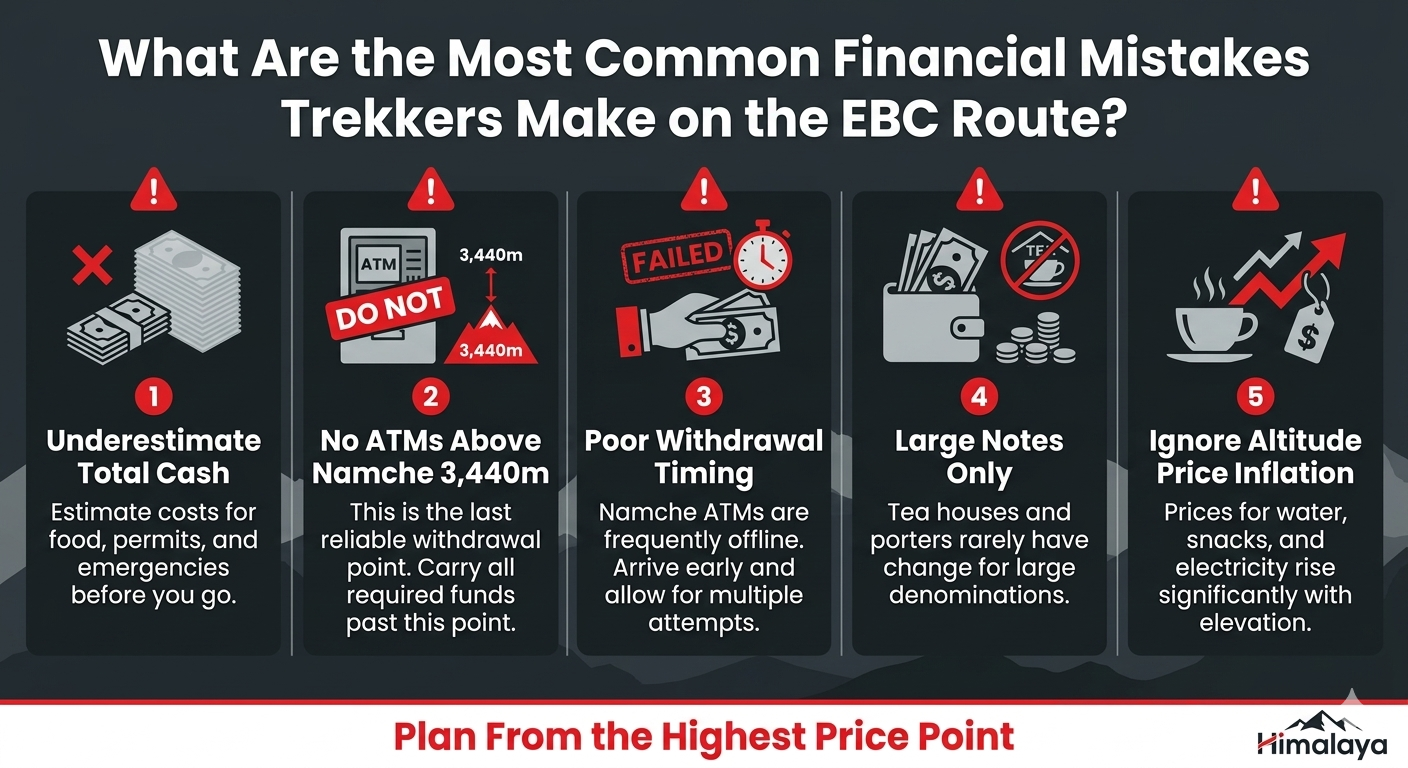
The 5 most common financial mistakes on the EBC route are underestimating the total cash requirement, assuming ATM availability above Namche, withdrawing too little in Kathmandu, ignoring altitude-based price inflation, and carrying only large-denomination NPR notes that teahouses cannot break.
Mistake 1: Underestimating the Total Cash Requirement
Underestimating cash affects the largest share of first-time EBC trekkers. The error comes from using Kathmandu prices as the budget baseline.
-
A meal costs NPR 500 in Thamel and NPR 1,500 in Lobuche. That is a 3x multiplier.
-
A water bottle costs NPR 100 in Lukla and NPR 400 in Gorak Shep.
-
Device charging costs NPR 100 to NPR 200 below Namche and NPR 800 to NPR 1,000 at Gorak Shep.
The 3x price multiplier above 4,000 meters is a planning constant, not a variable. Budget from the highest altitude price point, not the lowest.
Mistake 2: Assuming ATM Availability Above Namche Bazaar
Assuming ATMs exist above Namche is the highest-risk misconception on the EBC route.
-
No ATM has ever operated in Tengboche, Dingboche, Lobuche, or Gorak Shep.
-
No ATM operates above 3,440 meters on the standard EBC route.
-
Online travel forums carry repeat posts from trekkers who made this assumption and faced trek disruption.
Namche Bazaar at 3,440 meters is the final ATM point. Every cash decision above that elevation is permanent until descent.
Mistake 3: Poor Withdrawal Timing at Namche ATMs
Poor withdrawal timing at Namche creates unnecessary queues and depletion risk during the highest-traffic months.
-
Peak queue times at Namche ATMs run from 9:00 AM to 11:00 AM and from 3:00 PM to 5:00 PM in October and November.
-
Machines deplete fastest on days when multiple large trekking groups arrive simultaneously.
-
Withdrawing before 8:00 AM on the Namche acclimatization rest day eliminates both queue time and depletion risk.
Mistake 4: Carrying Only Large-Denomination NPR Notes
Carrying only NPR 1,000 notes creates a daily payment friction problem at every teahouse above Dingboche.
-
Hot water costs NPR 100 per flask.
-
Device charging costs NPR 200 to NPR 400 per session.
-
Wi-Fi cards cost NPR 500 to NPR 1,000.
-
Teahouse owners above Dingboche at 4,410 meters carry minimal change for large notes.
Carry a denomination mix of NPR 100, NPR 500, and NPR 1,000 notes to ensure smooth transactions across all 4 altitude zones from Lukla to Gorak Shep.
Mistake 5: Ignoring Altitude-Based Cost Inflation in the Final 3 Days
Ignoring altitude-based cost inflation produces budget collapse in the final ascent segment between Lobuche at 4,940 meters and Gorak Shep at 5,164 meters. This is exactly when physical stress from altitude is highest and no ATM access exists to correct the shortfall. Budget NPR 5,200 to NPR 8,900 per day for
Pre-Trek ATM and Cash Planning Checklist
Every trekker completes 8 financial preparation steps before the Kathmandu to Lukla flight.
-
Notify home bank of Nepal travel dates and confirm that international ATM access is active.
-
Confirm the daily international withdrawal limit with your home bank and increase it if it is below the NPR 40,000 equivalent.
-
Confirm home bank foreign transaction fee structure.
-
Withdraw NPR 40,000 to NPR 60,000 in Kathmandu before departure for Lukla.
-
Exchange USD 100 to USD 200 into NPR at Thamel exchange counters using clean, post-2013 USD bills.
-
Retain USD 100 to USD 200 as emergency reserve in crisp, undamaged notes.
-
Split total cash across 2 secure storage locations before boarding the Lukla flight.
-
Plan a Namche Bazaar ATM withdrawal on the acclimatization rest day, before 8:00 AM, as the final top-up point before the high-altitude cash-only zone begins.
ATM availability on the Everest Base Camp trek is limited to 3 access points: Kathmandu, Lukla, and Namche Bazaar. The entire 130 km high-altitude zone from Tengboche to Everest Base Camp at 5,364 meters and back to Lukla at 2,860 meters operates entirely on Nepalese rupee cash. The trekker who withdraws NPR 50,000 to NPR 80,000 in Kathmandu, tops up in Namche, and carries a structured cash split across secure storage completes the EBC trek without financial disruption.
More About Author

Khilak Budhathoki
Travel Director
Khilak Budhathoki is the co-founder and lead trekking guide at Himalaya Trekking Nepal, a locally owned and operated adventure company based in Kathmandu. Born and raised in the foothills of Nepal, Khilak developed a deep love for the mountains from an early age. With over a deca...

USD$1,600 pp
Our Recommendation
Related Blogs

Aug 15, 2025
Annapurna Base Camp Trek in Autumn: What to Expect

Aug 14, 2025
Where Is the Best View of the Annapurna Range?
