- 20, Apr 2026 | Khilak Budhathoki
Charging devices on the Everest Base Camp trek is possible from Lukla at 2,860 m to Gorak Shep at 5,140 m. No charging infrastructure exists at Base Camp at 5,364 m. Electricity runs on 2 power sources: hydropower in Lukla, Phakding, and Namche Bazaar, and solar panels in Tengboche, Dingboche, Lobuche, and Gorak Shep. Room socket access ends at Namche Bazaar at 3,440 m. Above Namche Bazaar, charging moves to communal dining areas with shared sockets, time restrictions, and low voltage output that extends charge time from 1 hour to 3 hours per device.
Charging becomes difficult above Namche Bazaar due to 4 compounding factors: limited solar generation capacity, high trekker demand at shared sockets, low voltage output that disables fast charging on modern smartphones, and cold temperatures that reduce lithium-ion battery capacity by 40 to 60%. Overnight temperatures at Lobuche and Gorak Shep drop to minus 15 to minus 20 degrees Celsius. Camera batteries and GoPro batteries are the most vulnerable devices because their charging circuits require stable voltage input to regulate lithium cells. Teahouses at Lobuche and Gorak Shep decline to charge camera batteries, citing low voltage as a damage risk.
Charging cost starts at free in Lukla and reaches NPR 500 to 800 per device in Gorak Shep. Power banks rated at 20,000 mAh or above are the primary charging solution for the full 12 to 14 day route. A 20,000 mAh unit delivers 5 to 7 full smartphone charges.
Trekkers carrying a camera, GPS device, and smartwatch require 2 units totaling 40,000 to 50,000 mAh. Teahouse communal charging serves as a backup in Zones 2 and 3. Solar chargers rated at 10 to 20 W supplement power during acclimatization days at Namche Bazaar and Dingboche. Storing all batteries inside a sleeping bag overnight at Lobuche and Gorak Shep retains 90 to 95% charge through sub-zero nights.
Can You Charge Devices on the EBC Trek?
Yes, you can charge devices on the Everest Base Camp trek. Charging is available at every major stop from Lukla to Gorak Shep, covering approximately 130 km of EBC trail. Charging is not available at Everest Base Camp itself, which sits at 5,364 m. Reliability decreases with altitude, and room charging transitions to communal dining area charging above Namche Bazaar at 3,440 m.
Teahouses along the EBC route provide electricity through 2 primary power sources: hydropower in lower villages and solar panels in higher villages. The quality of that electricity drops significantly above Tengboche at 3,860 m, where solar systems produce low voltage output that slows charging speed from a standard 1 hour to 2 to 3 hours per device.
Trekkers carry devices including smartphones, headlamps, GPS units, cameras, and power banks. Each device class has different charging priorities and cold-weather behavior on the trail.
How Is Electricity Available from Lukla to Gorak Shep?
Electricity on the Everest Base Camp trek comes from 2 distinct power systems: hydropower in the lower Khumbu region and solar panel arrays in the upper villages. Hydropower serves Lukla at 2,860 m, Phakding at 2,652 m, and Namche Bazaar at 3,440 m. Solar power serves Tengboche at 3,860 m, Dingboche at 4,410 m, Lobuche at 4,940 m, and Gorak Shep at 5,140 m.
How Does Hydropower Work in the Lower Khumbu?
Hydropower systems in Lukla, Phakding, and Namche Bazaar deliver stable, consistent electricity. These systems run on mountain rivers and produce output close to Nepal's standard grid voltage of 230V at 50Hz. Charging in these villages takes standard time. Room sockets are available, and trekkers charge devices without queue friction or time restrictions.
How Do Solar Panels Power Upper Villages?
Solar panel arrays in Tengboche, Dingboche, Lobuche, and Gorak Shep collect energy throughout the day and store it in battery banks for evening use. This storage mechanism explains why electricity in upper villages is available primarily in the evening. Cloud cover, rain, and north-facing valley shadows between Tengboche and Dingboche reduce solar collection efficiency.
On overcast days, evening power supply drops further, and teahouses prioritize lighting over device charging. Nepal operates at 230V and 50Hz. Nepal sockets use 2 types: two-pin round sockets (Type C) and three-pin round sockets (Type D and Type M). International trekkers from the US, UK, Australia, and most of Europe require a universal travel adapter.
Where Can You Charge Devices Along the EBC Route?
Charging locations on the Everest Base Camp trek divide into 4 altitude zones, each with different access types, socket availability, and reliability levels. The following table shows the charging situation at each major village on the standard EBC route.
The table below maps each village to its charging access type, power source, and general reliability level:
|
Village |
Altitude |
Power Source |
Charging Location |
Reliability |
|
Lukla |
2,860 m |
Hydropower |
Room socket |
High |
|
Phakding |
2,652 m |
Hydropower |
Room socket |
High |
|
Namche Bazaar |
3,440 m |
Hydropower |
Room socket |
High |
|
Tengboche |
3,860 m |
Solar |
Dining area |
Medium |
|
Pangboche |
3,930 m |
Solar |
Dining area |
Medium |
|
Dingboche |
4,410 m |
Solar |
Dining area or check-in desk |
Low to Medium |
|
Lobuche |
4,940 m |
Solar |
Shared communal station |
Low |
|
Gorak Shep |
5,140 m |
Solar |
Shared communal station |
Very Low |
|
Everest Base Camp |
5,364 m |
None |
No charging available |
None |
Namche Bazaar is the last village where room charging is reliably available. Gorak Shep is the last village where any charging infrastructure exists before the Base Camp approach.
Where Is the Last Charging Point Before Everest Base Camp?
Gorak Shep at 5,140 m is the last charging point before Everest Base Camp. Gorak Shep teahouses operate on solar-only power. Charging is slow, expensive, and shared among all trekkers staying in the lodge. Trekkers who arrive late to Gorak Shep frequently finds all shared sockets occupied. Charging a smartphone to 100% at Gorak Shep takes 3 to 4 hours due to low voltage output.
What Does It Cost to Charge Devices on the Everest Base Camp Trek?
Charging costs on the EBC trek increase with altitude, ranging from free in Lukla and Phakding to NPR 500 to 800 per device in Gorak Shep. Payment is cash only in Nepalese Rupees at all teahouses above Namche Bazaar. Trekkers carry sufficient small denomination NPR notes throughout the trek.
The following table shows charging costs per device at each major village zone:
|
Village Zone |
Charging Cost (NPR) |
Charging Cost (USD approx.) |
Notes |
|
Lukla and Phakding |
Free to NPR 100 |
Free to USD 0.75 |
Some teahouses offer free charging |
|
Namche Bazaar |
NPR 300 to 500 |
USD 2.25 to 3.75 |
Per device, per session |
|
Tengboche to Dingboche |
NPR 400 to 600 |
USD 3.00 to 4.50 |
Dining area only |
|
Lobuche |
NPR 500 to 700 |
USD 3.75 to 5.25 |
Shared station, time limited |
|
Gorak Shep |
NPR 500 to 800 |
USD 3.75 to 6.00 |
Most expensive zone |
Power-intensive devices such as camera batteries and large power banks attract higher fees at upper-village teahouses, as they draw more current from limited solar storage systems. Some teahouses above Namche Bazaar charge per hour rather than per session, with hourly rates ranging from NPR 200 to 400.
Teahouses in morning or late-evening windows occasionally offer free charging when their solar battery storage is at full capacity. Trekkers who arrive at teahouses early, before 3:00 PM, access sockets before the evening queue builds.
Why Does Charging Cost More at Higher Altitudes?
Charging costs increase with altitude because solar power generation is expensive to install, maintain, and operate in remote Himalayan villages above 3,500 m. Diesel generator fuel reaches upper villages by porter and yak, costing significantly more per liter than in Kathmandu. Solar panel systems require specialized technicians for maintenance. Teahouses recoup infrastructure investment through charging fees, lodge meal pricing, and accommodation rates.
Why Does Charging Become Difficult at Higher Altitude?
Charging becomes difficult above Namche Bazaar due to 4 compounding factors: limited solar generation capacity, high trekker demand, low voltage output, and cold temperature effects on lithium-ion batteries. Each factor reduces charging effectiveness independently. Together, they create a charging environment fundamentally different from urban infrastructure.
Low Voltage and Its Effect on Device Charging
Low voltage output from solar systems at upper villages causes 3 direct problems for device charging:
-
Charging time increases from 1 hour to 2 to 3 hours per device
-
Fast charging technology on modern smartphones stops functioning entirely
-
Teahouses at Lobuche and Gorak Shep decline to charge camera batteries, citing low voltage as a damage risk to sensitive lithium cells
Camera batteries and GoPro batteries are particularly vulnerable to low voltage damage because their charging circuits require stable input to regulate cell voltage properly.
Cold Temperature Effects on Charging Infrastructure
Temperatures at Gorak Shep drop to minus 15 to minus 20 degrees Celsius overnight. Water pipes in upper teahouses freeze overnight, and power cable insulation stiffens and cracks in repeated freeze-thaw cycles.
Solar panel output drops when panel surface temperatures fall below zero, reducing daily storage capacity. Trekkers who leave devices plugged in overnight during sub-zero temperatures receive slow, incomplete charges by morning.
What Are the Best Ways to Charge Devices During the EBC Trek?
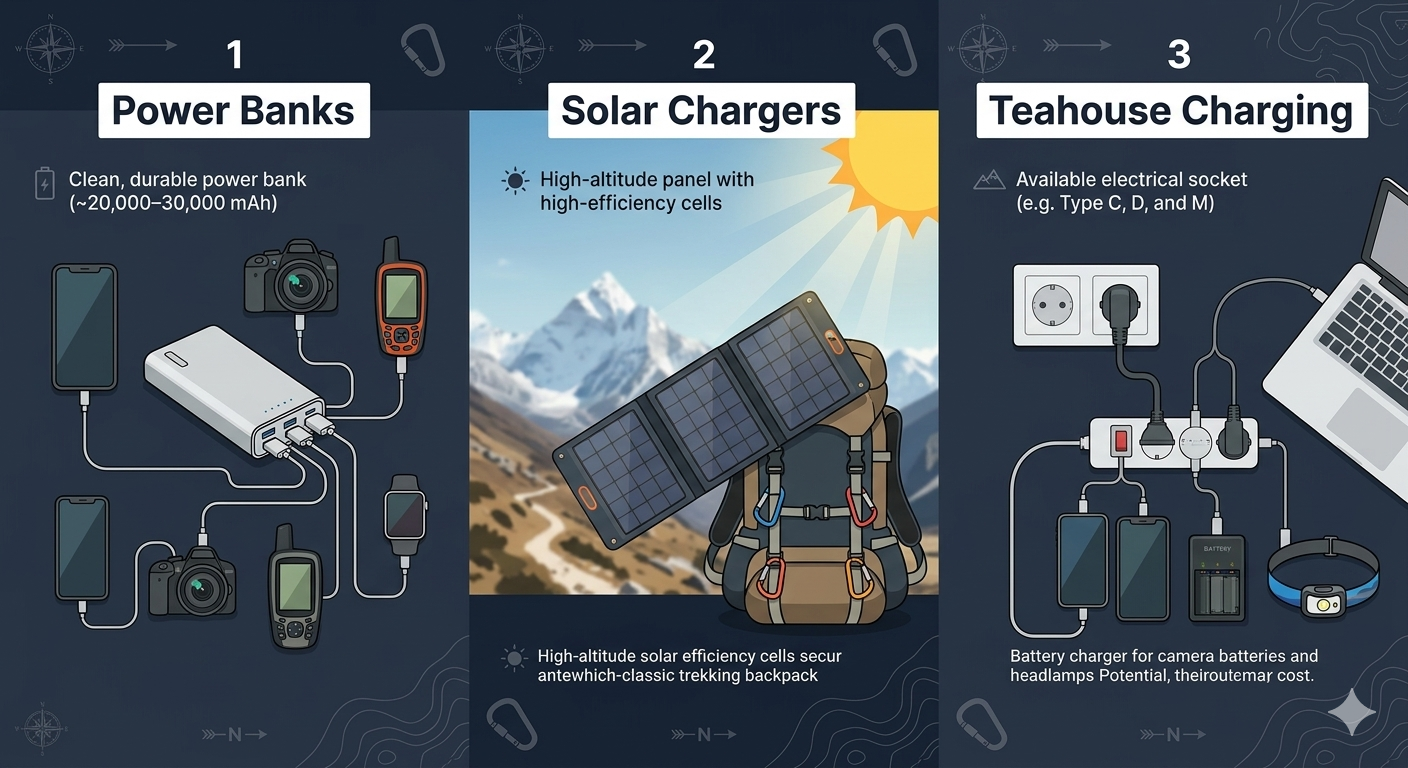
The 3 most effective methods for charging devices on the Everest Base Camp trek are power banks rated at 20,000 mAh or above, teahouse communal charging as a backup, and solar chargers for high-consumption devices such as DSLRs during acclimatization days. Using all 3 methods in combination provides full redundancy across the 12- to 14-day itinerary.
Power Banks
Power banks are the primary charging solution for the EBC trek. A 20,000 mAh power bank delivers 5 to 7 full smartphone charges. A 30,000 mAh unit delivers 8 to 10 charges. Trekkers carrying a camera, GPS device, and smartwatch alongside a smartphone require a second power bank or a higher-capacity unit.
Power banks with dual USB-A and USB-C output ports charge 2 devices simultaneously, reducing the time a trekker depends on teahouse sockets. Anker and Baseus produce lightweight units suitable for the 15 kg Lukla flight baggage limit enforced on Kathmandu to Lukla flights.
IATA Airline Regulation for Power Banks: Power banks above 100 Wh (approximately 27,000 mAh at 3.7V) require individual airline approval for carry-on baggage. Power banks above 160 Wh (approximately 43,000 mAh at 3.7V) are banned from all commercial aircraft under IATA regulations. A standard 20,000 mAh power bank at 3.7V equals approximately 74 Wh, which is within the unrestricted carry-on limit. Power banks travel in carry-on baggage only. Checked baggage containing power banks is rejected at Kathmandu Tribhuvan International Airport.
Solar Chargers
Solar chargers rated at 10 to 20 W charge smartphones and cameras during daylight hours on the trail. Attaching a folding solar panel to the outside of a trekking backpack during 4- to 6-hour acclimatization hikes at Namche Bazaar and Dingboche generates 20 to 40% of a smartphone battery per day. Solar charging works best between Namche and Dingboche, where trail sections face south and receive 5 to 7 hours of direct sunlight on clear days. The Tengboche to Dingboche valley section receives less direct sun due to north-facing orientation and frequent afternoon cloud buildup.
Teahouse Communal Charging
Teahouse communal charging serves as the backup method above Namche Bazaar. Trekkers who arrive at teahouses by 2:00 to 3:00 PM secure socket access before the 6:00 PM dinner rush. Bringing a compact travel power strip with 3 sockets and 2 USB ports to a single teahouse socket allows 1 trekker to charge 4 to 5 devices simultaneously. Confirming with teahouse staff before connecting a power strip prevents socket overload disputes.
What Power Bank Strategy Works Best for the EBC Trek?
The optimal power bank strategy for a 12- to 14-day Everest Base Camp trek combines 1 power bank rated at 20,000 mAh for solo smartphone trekkers and 2 power banks totaling 40,000 to 50,000 mAh for trekkers carrying cameras, GPS devices, and smartwatches. Recharging power banks at teahouses in Lukla, Phakding, and Namche Bazaar costs nothing or minimal fees, extending effective capacity across the full route.
Recommended Power Bank Capacity by Trekker Type
The table below matches device loadout to recommended total power bank capacity:
|
Trekker Type |
Devices Carried |
Recommended Capacity |
Units |
|
Smartphone only |
Phone |
20,000 mAh |
1 unit |
|
Phone plus camera |
Phone, mirrorless or DSLR |
30,000 mAh |
1 to 2 units |
|
Full kit trekker |
Phone, camera, GPS, smartwatch |
40,000 to 50,000 mAh |
2 units |
|
Group of 4 |
Multiple phones and cameras |
60,000 to 80,000 mAh |
3 to 4 units |
Charging Schedule Across the EBC Itinerary
Trekkers fully charge all power banks in Kathmandu before departure. Lukla and Phakding provide the first free or low-cost recharge opportunity on Day 1 and Day 2. Namche Bazaar on Day 3 to Day 5 provides the last reliable high-speed recharge before ascending into solar-only zones. Power bank recharging at Dingboche and above takes 4 to 6 hours per unit due to low voltage.
The charging schedule below maps recharge opportunities to the standard 12-day EBC itinerary:
|
Day |
Location |
Recharge Opportunity |
Priority |
|
Day 1 |
Lukla / Phakding |
Room socket, free to NPR 100 |
Charge everything |
|
Day 3 to 5 |
Namche Bazaar |
Room socket, NPR 300 to 500 |
Top up all units |
|
Day 6 |
Tengboche |
Dining area, NPR 400 to 600 |
Phone priority |
|
Day 8 |
Dingboche |
Dining area, NPR 400 to 600 |
Phone and headlamp |
|
Day 10 |
Lobuche |
Shared station, NPR 500 to 700 |
Phone only |
|
Day 11 |
Gorak Shep |
Shared station, NPR 500 to 800 |
Phone and headlamp only |
How Does Cold Weather Affect Battery Performance on the Trek?
Cold temperatures reduce lithium-ion battery capacity by 20 to 40% at 0 degrees Celsius and by up to 60% at minus 20 degrees Celsius. Lithium-ion batteries used in smartphones, power banks, cameras, and headlamps all experience this chemical performance loss. The reduction is temporary at moderate cold and becomes permanent with repeated deep discharge in freezing conditions.
Battery Drain at High Altitude
3 environmental factors accelerate battery drain above 4,000 m:
-
Weak cellular signal at altitude forces smartphones to continuously increase antenna power, consuming 15 to 30% more battery per hour than at low altitude
-
Sub-zero overnight temperatures discharge power banks by 10 to 20% while stored outside sleeping bags
-
Camera batteries at Lobuche and Gorak Shep drain 2 to 3 times faster than at sea level
How to Protect Batteries from Cold Overnight
Storing power banks, smartphones, and camera batteries inside a sleeping bag overnight at Lobuche and Gorak Shep prevents cold discharge. Trekkers who place devices in an insulated pouch or wrap them in a fleece layer inside the sleeping bag maintain 90 to 95% charge through sub-zero nights.
Hand warmers placed against a power bank before use at temperatures below minus 10 degrees Celsius raise lithium cell temperature from a below-optimal range (under 0 degrees Celsius) to a functional range (15 to 25 degrees Celsius) within 10 minutes. Boiling water or warming batteries is not safe, as temperatures above 45 degrees Celsius damage lithium cell chemistry.
How Can You Preserve Battery Life During the EBC Trek?
Battery life on the Everest Base Camp trek extends by 40 to 60% through 5 device management practices: airplane mode during walking hours, offline map use, reduced screen brightness, power-saving mode activation, and overnight cold storage inside sleeping bags.
5 Proven Battery Conservation Practices
The following practices apply to smartphones, GPS devices, and cameras throughout the 12 to 14 day trek:
-
Airplane mode during trekking hours eliminates cellular antenna drain, saving 20 to 30% battery per day on the trail between villages
-
Offline map downloads through Maps.me or Gaia GPS eliminate data connectivity requirements for navigation, reducing battery consumption by 15% compared to live map streaming
-
Screen brightness reduction to 30 to 40% extends screen-on time by 25 to 35% per charge cycle
-
Power saving mode activation disables background app refresh, location services, and push notifications, extending battery life by 20 to 30%
-
GPS tracking deactivation between villages conserves 10 to 15% additional battery, as continuous GPS polling is one of the highest power consumption functions on smartphones and smartwatches
Downloading offline content before the trek, including cached maps of the Khumbu region, weather apps, and Google Translate's Nepali language pack, reduces live data requests throughout the route.
What Are the Charging Rules Inside Teahouses on the EBC Trek?
Teahouse charging rules on the Everest Base Camp trek follow 3 consistent patterns: charging occurs in the dining area above Namche Bazaar, socket time is restricted to 1 to 2 hours per device during peak evening hours, and teahouse staff disconnect devices that reach full charge to prevent power overload.
Room Charging Versus Communal Charging
Room socket availability divides the EBC route into 2 clear zones:
-
Below Namche Bazaar at Lukla and Phakding: room sockets are available in individual sleeping rooms, and trekkers charge devices privately overnight
-
Above Namche Bazaar from Tengboche through Gorak Shep: charging moves to the communal teahouse dining area or check-in desk, where shared sockets serve all trekking guests simultaneously
Teahouse staff at Tengboche, Pangboche, and Dingboche enforce time restrictions to prevent power overload to solar battery systems. Devices left charging unattended are disconnected after 1 to 2 hours. Arriving at the teahouse before 3:00 PM and plugging in immediately after check-in secures charging time before the dinner crowd occupies all available sockets.
Charging Queue Management
3 tactics reduce queue time at teahouse communal charging stations:
-
Bringing a compact 3-socket travel power strip converts 1 teahouse socket into 3, allowing a full device loadout to charge in a single session
-
Coordinating with trekking group members to rotate charging shifts across a 2 to 3 hour evening window ensures all devices reach sufficient charge
-
Charging the headlamp and phone first, then camera and GPS second, maintains safety-critical device readiness regardless of socket availability
Which Devices Take Priority When Charging on the EBC Trek?
The correct device charging priority order for the Everest Base Camp trek is headlamp first, smartphone second, camera third, GPS device and smartwatch fourth, and power bank recharge fifth. This order reflects safety dependency, not personal preference.
Charging Priority Matrix
The following matrix ranks devices by safety criticality, battery drain rate, and cold sensitivity:
|
Device |
Safety Priority |
Battery Drain Rate |
Cold Sensitivity |
Charging Priority |
|
Headlamp |
Critical |
Low to Medium |
Medium |
1st |
|
Smartphone |
Critical |
High |
High |
2nd |
|
GPS device (Garmin inReach) |
High |
Low |
Medium |
3rd |
|
Camera (DSLR, mirrorless, GoPro) |
Medium |
High |
Very High |
4th |
|
Smartwatch (Garmin, Suunto, Apple Watch Ultra) |
Medium |
Low |
Medium |
5th |
|
Power bank recharge |
Supporting |
N/A |
High |
6th |
Why Is the Headlamp the Highest Charging Priority?
The headlamp is the highest charging priority device because the Everest Base Camp trek requires pre-dawn starts, particularly at 3:00 to 4:00 AM on summit attempt days from Gorak Shep and during the return from Kala Patthar at 5,644 m.
A headlamp with a dead battery at Gorak Shep in darkness at minus 15 degrees Celsius creates a direct safety risk. Rechargeable headlamp batteries require charging every 2 to 3 days on the full trek.
What Happens If Your Devices Run Out of Battery on the Trek?
Running out of battery on the Everest Base Camp trek creates 3 direct operational risks: loss of offline navigation, loss of emergency communication capability, and inability to use a headlamp during pre-dawn trekking segments. These risks increase significantly above Lobuche at 4,940 m, where trail conditions are steep and weather changes rapidly.
Navigation Dependency at High Altitude
Smartphones running offline maps through Maps. I, Gaia GPS, or AllTrails serve as the primary navigation tool for independent trekkers. A phone with zero battery above Namche Bazaar leaves a trekker dependent entirely on trail markers, guide knowledge, or fellow trekkers for route navigation. The Lobuche to Gorak Shep section and the Gorak Shep to Base Camp trail are less marked than lower sections and require reliable navigation tools.
Emergency Communication Loss
The Garmin inReach satellite communicator at 5,140 m enables SOS activation, two-way text messaging, and GPS tracking without cellular network coverage. Battery life on Garmin inReach devices in GPS tracking mode lasts 100 hours at standard settings. Keeping the inReach in expedition mode extends battery life to 30 days at reduced tracking frequency. A dead inReach eliminates satellite emergency contact capability above Namche Bazaar, where Nepal Telecom and Ncell networks operate but with weak signals.
What Is the Complete Charging Strategy for the Everest Base Camp Trek?
The complete charging strategy for the Everest Base Camp trek integrates pre-trek preparation, a zone-based teahouse charging schedule, power bank capacity matched to device loadout, solar charging during acclimatization days, and cold weather battery management from Lobuche to Gorak Shep. Executing all 5 elements eliminates battery failure risk across the full 12 to 14 day route.
Pre-Trek Preparation Checklist
Complete the following before departure from Kathmandu:
-
Charge all devices and power banks to 100% capacity
-
Download offline maps of the Khumbu trekking region on Maps.me or Gaia GPS
-
Download Nepali language pack on Google Translate for offline use
-
Purchase a universal travel adapter compatible with Nepal Type C, D, and M sockets
-
Confirm power bank capacity is below 100 Wh (27,000 mAh) for unrestricted carry-on compliance under IATA regulations
-
Purchase spare camera batteries and a compact 3-socket travel power strip from Thamel in Kathmandu, where prices are 30 to 50% lower than at Namche Bazaar
Combined Energy Strategy by Altitude Zone
Zone 1 (Lukla to Namche Bazaar): Charge all devices and power banks to full capacity at room sockets. Use teahouse electricity freely. This zone is the only opportunity for fast, reliable, zero-queue charging on the full trek.
Zone 2 (Namche Bazaar to Dingboche): Shift to a power bank as the primary power source. Use the teahouse dining area to charge selectively for power bank recharge only. Activate airplane mode and power-saving mode on all devices.
Zone 3 (Dingboche to Gorak Shep): Rely fully on power banks. Charge only the headlamp and smartphone at teahouse stations. Store all batteries inside sleeping bags overnight. Use the solar panel on the backpack during daylight on clear days.
Zone 4 (Gorak Shep and return): Conserve all remaining power bank capacity for the Base Camp approach and Kala Patthar ascent. Return to Zone 1 charging conditions on descent after reaching Namche Bazaar.
Charging devices on the Everest Base Camp trek demands a layered strategy. Power banks rated at 20,000 to 30,000 mAh form the core. Teahouse charging tops up capacity in Zones 1 and 2. Solar chargers supplement during acclimatization days. Cold weather battery management protects stored energy from Lobuche to Gorak Shep. Trekkers who plan this system before leaving Kathmandu complete the EBC trek to Base Camp at 5,364 m without battery failure.
More About Author

Khilak Budhathoki
Travel Director
Khilak Budhathoki is the co-founder and lead trekking guide at Himalaya Trekking Nepal, a locally owned and operated adventure company based in Kathmandu. Born and raised in the foothills of Nepal, Khilak developed a deep love for the mountains from an early age. With over a deca...

USD$1,600 pp
Our Recommendation
Related Blogs