- 22, Apr 2026 | Khilak Budhathoki
Everest Base Camp trek food is teahouse-based, freshly cooked, and available at every stop from Lukla (2,840 m) to Gorak Shep (5,164 m). Dal bhat, thukpa, fried rice, pasta, and soups form the core menu. Western options are available below Dingboche (4,410 m).
Food variety decreases with altitude across 3 zones: Lukla to Namche Bazaar offers 30 to 40 menu items including bakeries and cafes. Tengboche to Dingboche reduces to 20 to 25 items. Lobuche to Gorak Shep carries 10 to 15 core dishes. Meal prices rise 60 to 80% from Lukla to Gorak Shep due to yak and porter transport costs.
Dal bhat is the most recommended meal on the EBC route. One serving provides 700 to 1,000 kcal, combines carbohydrate-rich rice with protein-dense lentils, is cooked fresh at every teahouse, and includes free refills at most stops. Carbohydrate-dominant meals support aerobic energy metabolism at altitude where oxygen drops to 53% of sea level at 5,364 m.
Daily calorie expenditure on EBC trekking days reaches 3,000 to 4,000 kcal. Appetite suppression above 4,000 m reduces natural hunger signals by 20 to 40%. Forced eating every 3 to 4 hours maintains trekking performance and supports altitude acclimatization.
Food safety above Namche Bazaar requires 4 practices: ordering freshly cooked hot meals only, avoiding raw vegetables and reheated meat, drinking boiled or purified water exclusively, and maintaining daily fluid intake of 3 to 4 liters. Bacterial gastroenteritis from unsafe food is the most common medical evacuation trigger after acute mountain sickness (AMS) on the Khumbu Valley route.
Guided full board EBC packages include all 3 daily meals. Independent trekkers budget $25 to $50 USD per day for food. Vegetarian food is available across the full route. Vegan and gluten-free trekkers supplement with personal supplies from Namche Bazaar. Everest Base Camp trek food system supports safe, high-performance trekking from Lukla to Base Camp.
What Food Is Available on the Everest Base Camp Trek?
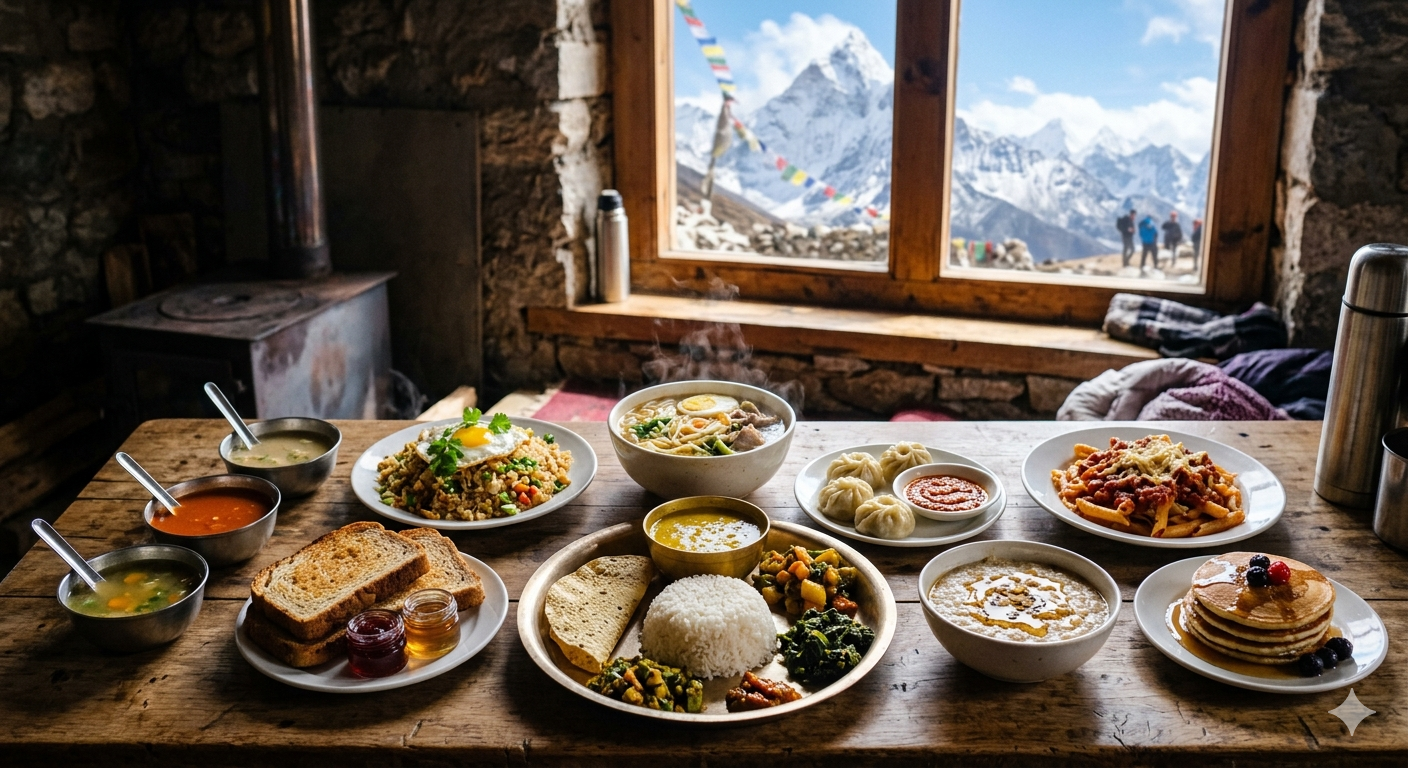
Everest Base Camp trek food includes dal bhat, noodles, fried rice, pasta, soups, Tibetan bread, eggs, pancakes, and porridge. Western options include pizza, pasta, and omelettes. Menu variety decreases with altitude from Lukla (2,840 m) to Gorak Shep (5,164 m).
Teahouses along the Khumbu Valley route serve standardized multi-page menus. The same core dishes appear across all villages from Lukla to Lobuche. Fresh ingredient availability reduces above Namche Bazaar (3,440 m) due to yak and porter supply chain limitations.
Typical Teahouse Menu Along the Everest Base Camp Route
Teahouse menus divide into 4 categories: breakfast items, lunch meals, dinner dishes, and drinks.
The 10 most common food items across all EBC teahouses:
-
Dal bhat (lentil soup with rice and vegetables)
-
Thukpa (Tibetan noodle soup with vegetables or egg)
-
Fried rice with egg or vegetables
-
Sherpa stew (potato, vegetable, and meat broth)
-
Momos (steamed or fried dumplings)
-
Pasta with tomato or garlic sauce
-
Tibetan bread with jam or honey
-
Porridge with honey
-
Pancakes with syrup
-
Soups including garlic soup, tomato soup, and vegetable soup
Local vs Western Food Options
Local Nepali food and Western food both appear on every teahouse menu below Dingboche (4,410 m).
Local food options: dal bhat, thukpa, Sherpa stew, momos, tsampa (roasted barley flour porridge), and sel roti (Nepali ring-shaped fried bread).
Western food options: pizza, pasta, omelette, toast, pancakes, fried eggs, and apple pie.
Menu variety decreases at 3 altitude bands:
-
Lukla to Namche Bazaar: Full menu with 30 to 40 items including bakery goods
-
Tengboche to Dingboche: Reduced menu with 20 to 25 items, limited fresh vegetables
-
Lobuche to Gorak Shep: Simplified menu with 10 to 15 items, higher prices
How Do Teahouse Menus Work on the Everest Base Camp Trek?
Teahouse menus on the EBC route are standardized multi-page printed menus. Each dish is cooked fresh after ordering. Menu content is similar across villages. Customization options reduce above Namche Bazaar.
Teahouses are defined as mountain lodges providing accommodation and meals along trekking routes in Nepal. The Khumbu Valley teahouse system includes over 60 teahouses from Lukla to Gorak Shep.
How Teahouse Menus Work
Every teahouse carries a physical menu with sections for breakfast, lunch, dinner, snacks, hot drinks, and cold drinks. Prices are listed in Nepali Rupees (NPR) and US Dollars (USD). Meals are prepared in a kitchen visible from the dining area.
Fixed vs Flexible Ordering
Meals are cooked fresh after each order. Fixed set menus are rare. Customization such as removing ingredients or requesting substitutions is accepted at lower altitudes. Above Dingboche (4,410 m), kitchens operate with limited stock and substitution requests are often declined.
Seasonal and Supply-Based Menu Changes
Teahouse menus change between trekking seasons. October to November (autumn season) produces the widest menu variety. March to May (spring season) offers similar variety. Winter months (December to February) reduce menu options by 30 to 40% at higher altitudes due to limited porter supply runs.
What Do You Eat in a Typical Day on the EBC Trek?
A typical trekking day on EBC includes 3 meals: breakfast at the teahouse before departure, lunch at a mid-route teahouse, and dinner at the night-stop teahouse. Total daily calorie intake targets 2,500 to 3,500 kcal.
Breakfast Options
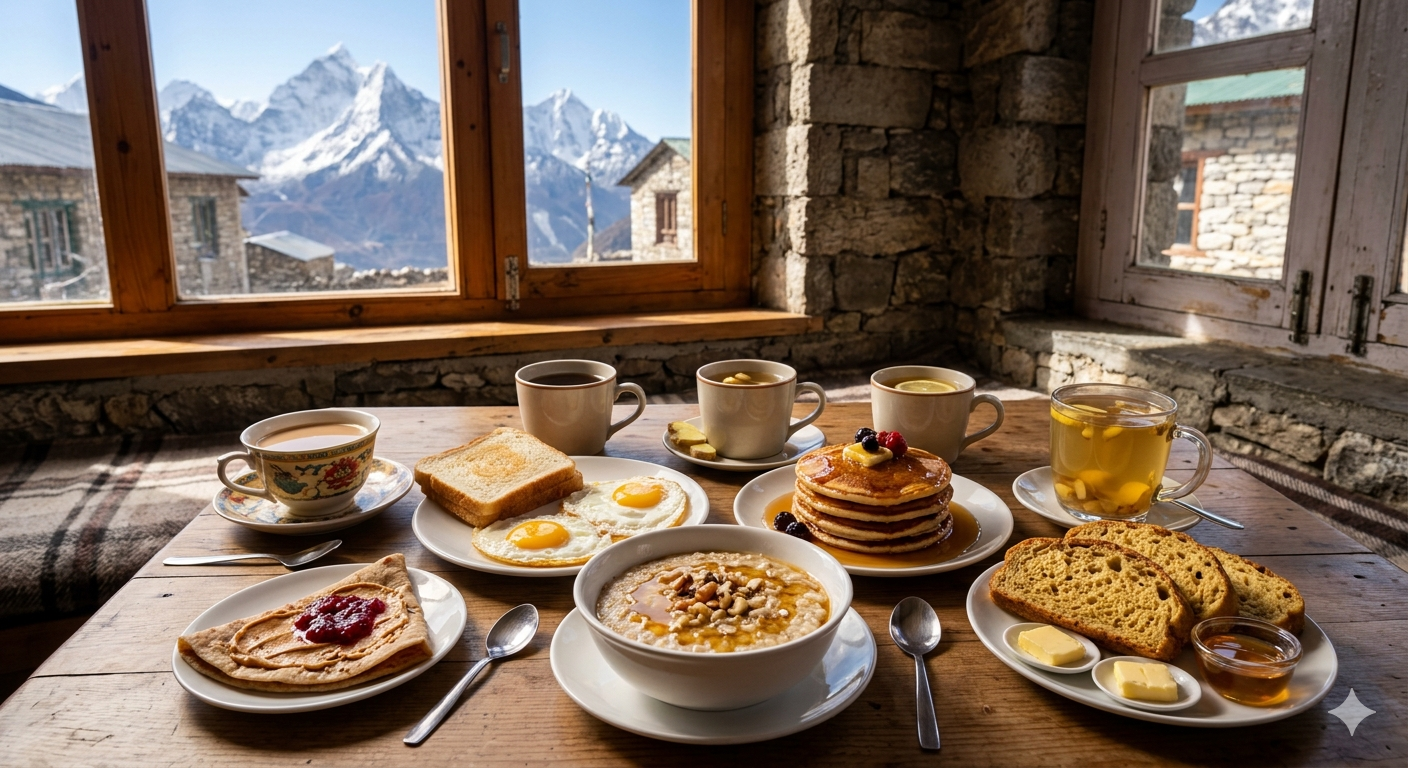
Breakfast is served between 6:00 AM and 8:00 AM at most teahouses. Standard breakfast items and their average calorie values:
-
Porridge with honey: 350 to 450 kcal
-
Eggs (2 fried or scrambled) with toast: 400 to 500 kcal
-
Pancakes with syrup: 450 to 550 kcal
-
Chapati with peanut butter or jam: 350 to 400 kcal
-
Tibetan bread with butter and honey: 400 to 480 kcal
Hot drinks served at breakfast include milk tea, black tea, ginger tea, lemon tea, and instant coffee. Herbal teas such as ginger lemon honey tea are recommended for altitude adaptation and throat comfort.
Lunch Meals on the Trail
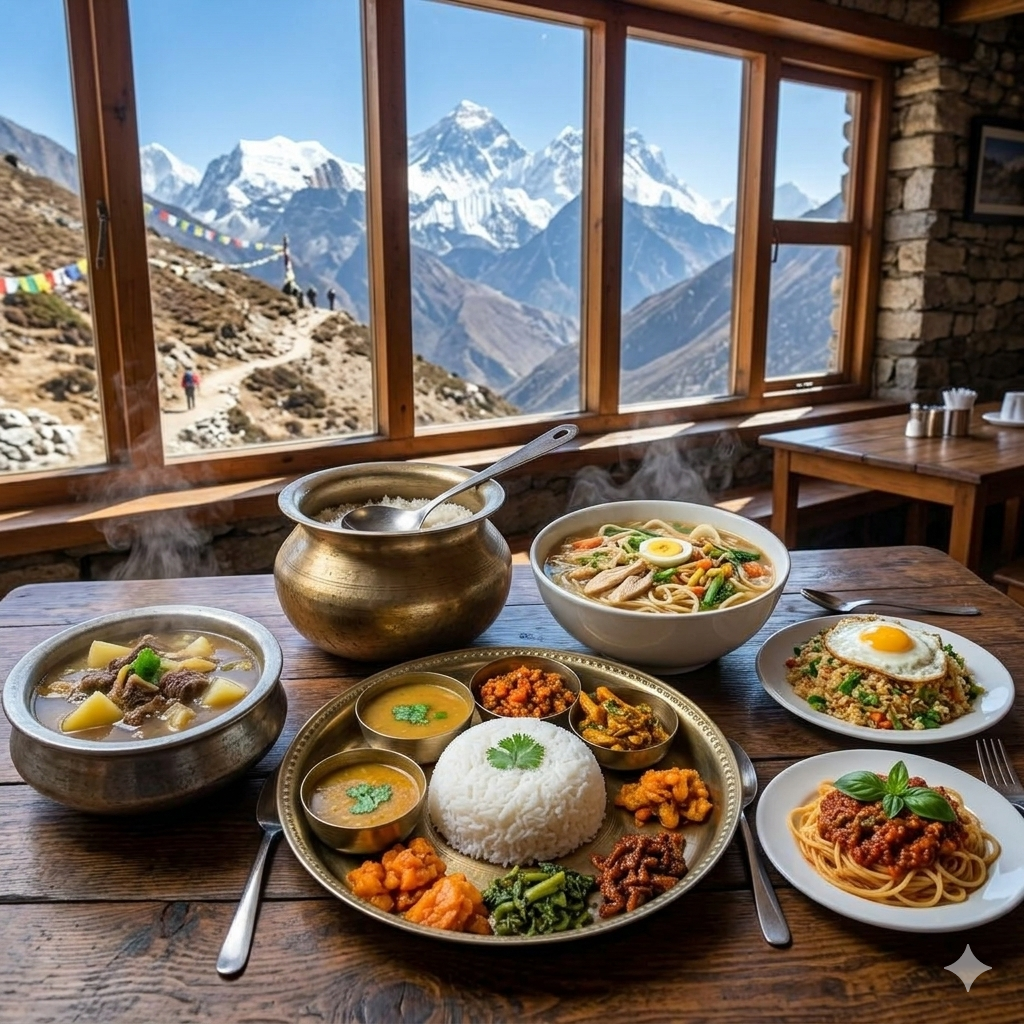
Lunch is eaten at a teahouse along the trekking route, typically 2 to 4 hours after departure. Standard lunch items and calorie values:
-
Dal bhat: 700 to 1,000 kcal (with unlimited rice and lentil soup refills at many teahouses)
-
Fried rice with egg: 550 to 700 kcal
-
Noodle soup (thukpa): 400 to 550 kcal
-
Pasta with tomato sauce: 500 to 650 kcal
-
Sherpa stew: 450 to 600 kcal
Dal bhat is the highest-calorie and most energy-stable lunch choice. Many teahouses offer free refills on rice and lentil soup, making it the best value meal on the route.
Dinner at Teahouses
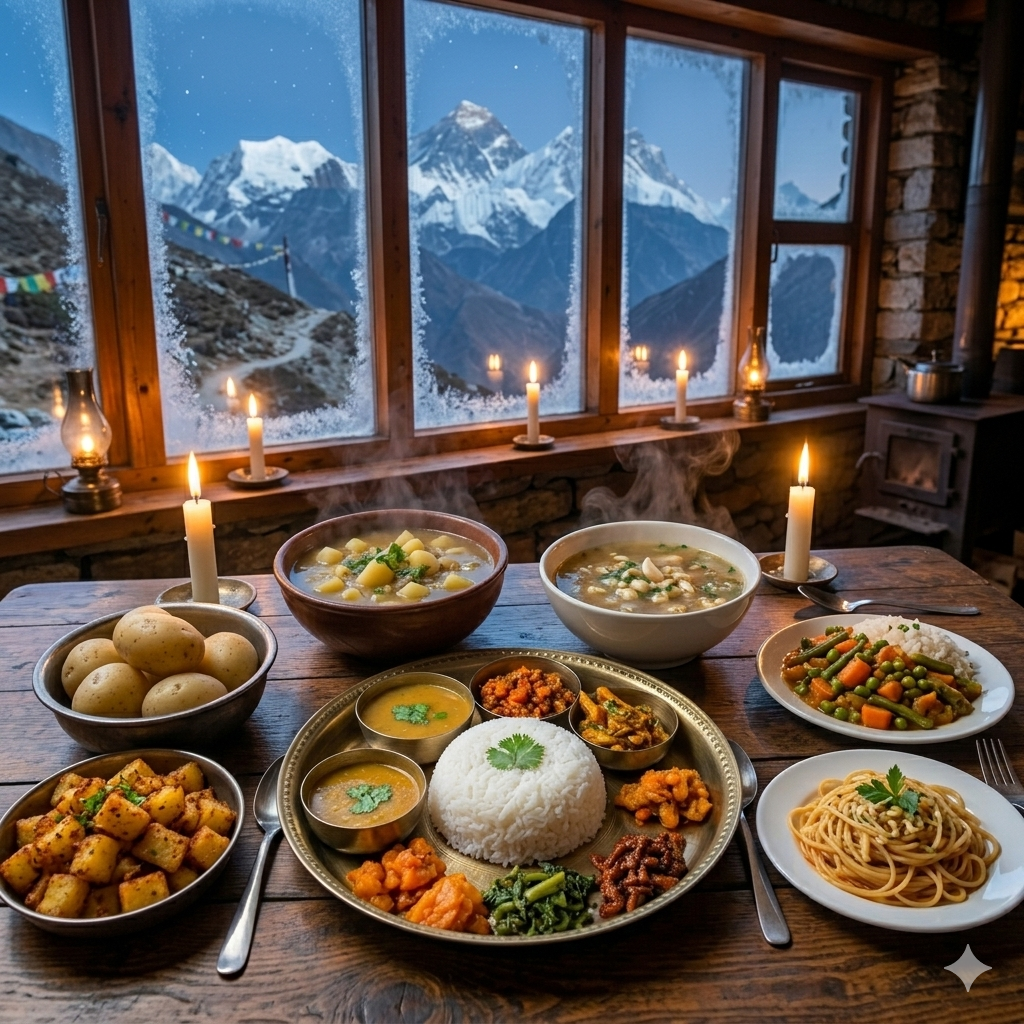
Dinner is the largest meal of the trekking day. High-carbohydrate dinners replenish glycogen stores used during 5 to 7 hours of trekking. Standard dinner items:
-
Dal bhat: 800 to 1,000 kcal
-
Vegetable curry with rice: 600 to 750 kcal
-
Pasta with garlic sauce: 500 to 650 kcal
-
Potato dishes (boiled, fried, or in soup): 400 to 600 kcal
-
Garlic soup as a starter: 150 to 200 kcal
Garlic soup is consumed widely on the EBC route for its reported benefits in supporting altitude acclimatization. According to wilderness medicine practitioners working in the Khumbu region, garlic contains allicin, which supports vasodilation and blood circulation at altitude.
Why Is Dal Bhat the Most Recommended Food on the EBC Trek?
Dal bhat is the most recommended EBC trek food because it provides 700 to 1,000 kcal per serving, combines high-carbohydrate rice with protein-rich lentils, is cooked fresh at every teahouse, and includes free refills at most stops on the route.
Dal bhat is defined as the traditional Nepali meal of lentil soup (dal) served with steamed rice (bhat), along with vegetable sides and pickles. Dal bhat originates from the Indian subcontinent and became the staple trekking meal of Nepal's mountain communities.
Nutritional Composition of Dal Bhat
A standard dal bhat serving at an EBC teahouse contains:
-
Rice: 400 to 500 kcal (carbohydrate energy)
-
Dal (lentil soup): 150 to 200 kcal (protein and iron)
-
Vegetable side (tarkari): 80 to 120 kcal
-
Pickle (achar): 20 to 40 kcal
-
Total per serving: 650 to 860 kcal, rising to 900 to 1,000 kcal with refills
Lentils provide 18 g of protein per 100 g dry weight. Iron content in lentils supports red blood cell production, which is the same physiological process activated during altitude acclimatization.
Why Dal Bhat Works at High Altitude
Dal bhat is cooked fresh at each order. Fresh preparation eliminates bacterial contamination risk from reheated or stored food, which is the primary food safety risk above Namche Bazaar.
High carbohydrate content supports aerobic energy metabolism. At altitude, the body preferentially burns carbohydrates over fat because carbohydrate metabolism requires less oxygen per unit of energy produced.
How Does Food Availability Change Along the EBC Route?
Food availability on the EBC route decreases with altitude across the Khumbu trail stages. Lukla offers 30 to 40 menu items. Namche Bazaar adds bakeries and cafes. Above Dingboche, menus reduce to 10 to 15 core items. Gorak Shep has the most limited food supply on the route.
Lower Region: Lukla to Namche Bazaar
Lukla (2,840 m) to Namche Bazaar (3,440 m) offers the widest food variety on the route. Namche Bazaar functions as the main supply hub for the Khumbu region.
Namche Bazaar food options include:
-
Bakeries with fresh bread, cakes, and pastries
-
Coffee shops with espresso machines
-
Restaurants with pizza, burgers, and Western menus
-
Supermarkets with packaged snacks, energy bars, and drinks
Mid Region: Tengboche to Dingboche
Tengboche (3,860 m) to Dingboche (4,410 m) offers moderate food variety. Fresh vegetables reduce in supply. Protein options narrow to eggs and canned or dried meat.
Key food changes in this zone:
-
Fresh salad and raw vegetables become less available
-
Fruit options reduce to canned or dried varieties
-
Bakery items disappear above Tengboche
-
Garlic soup appears on most menus as an altitude staple
High Region: Lobuche to Gorak Shep
Lobuche (4,940 m) to Gorak Shep (5,164 m) carries the most limited menus. Food supply reaches these villages via yak transport only. Yak routes from Namche Bazaar to Gorak Shep take 3 to 4 days.
Food available at Lobuche and Gorak Shep:
-
Dal bhat (always available)
-
Noodle soup
-
Potato dishes
-
Eggs
-
Instant noodles
-
Hot drinks
Food prices at Gorak Shep are 60 to 80% higher than Lukla prices due to transport cost.
Is Food Included in Everest Base Camp Trek Packages?
Food inclusion in EBC trek packages depends on the package type. Full board guided packages include breakfast, lunch, and dinner. Independent trekking requires paying per meal at each teahouse, averaging $25 to $50 USD per day for food.
Guided Trek Packages
Full board guided EBC packages include 3 meals per day at teahouses along the route. Meals are pre-arranged with teahouse owners by the trekking agency. Full board packages remove daily food cost uncertainty and allow trekkers to focus on acclimatization and pacing.
Typical meals included in full board packages:
-
Breakfast: porridge or eggs with tea or coffee
-
Lunch: dal bhat or noodle soup at a mid-route teahouse
-
Dinner: dal bhat or pasta at the night-stop teahouse
Snacks, energy drinks, alcoholic beverages, and bottled water are excluded from full board packages at all price points.
Independent Trekking Costs
Independent trekkers pay per meal at each teahouse. Average meal prices by altitude zone:
|
Zone |
Altitude |
Breakfast (USD) |
Lunch (USD) |
Dinner (USD) |
|
Lower (Lukla to Namche) |
2,840 to 3,440 m |
3 to 5 |
5 to 8 |
5 to 8 |
|
Mid (Tengboche to Dingboche) |
3,860 to 4,410 m |
4 to 6 |
6 to 10 |
6 to 10 |
|
High (Lobuche to Gorak Shep) |
4,940 to 5,164 m |
6 to 9 |
10 to 15 |
10 to 15 |
The above table shows average teahouse meal prices across the 3 altitude zones of the EBC route, excluding drinks and snacks.
Daily food budget for independent trekkers: $25 to $35 USD in lower zones, $35 to $50 USD in upper zones.
How Much Does Food Cost on the Everest Base Camp Trek?
EBC trek food costs average $25 to $50 USD per day depending on altitude zone. Total food cost for a 14-day trek ranges from $350 to $700 USD for independent trekkers. Guided full board packages include all meals.
Average Cost by Altitude Zone
Food prices increase with altitude for 1 primary reason: transport cost. All supplies above Namche Bazaar travel by yak or porter. Yak transport from Namche to Gorak Shep costs approximately $3 to $5 USD per kg of goods transported.
Price comparison for dal bhat across altitude zones:
-
Lukla (2,840 m): $4 to $6 USD
-
Namche Bazaar (3,440 m): $5 to $7 USD
-
Dingboche (4,410 m): $7 to $10 USD
-
Gorak Shep (5,164 m): $10 to $14 USD
Cost Breakdown by Meal Type
Drinks represent a significant daily cost addition. Hot drinks average $1.50 to $3 USD per cup at lower altitudes and $2 to $4 USD above Dingboche. Bottled water prices reach $3 to $5 USD per 1-liter bottle at Gorak Shep.
Boiled water from teahouses costs $0.50 to $1.50 USD per liter across all zones. This is the most cost-effective and safe hydration option above Namche Bazaar.
Why Prices Increase with Altitude
The 3 factors driving food price increases at altitude:
-
Yak transport cost from Namche Bazaar to upper villages
-
Porter carry cost for goods on non-yak accessible paths
-
Seasonal supply frequency (2 to 3 supply runs per week vs daily at lower zones)
What Are the Safe Drinking Water Options on the EBC Trek?
Safe drinking water on the EBC trek comes from 4 sources: boiled water from teahouses, water purification tablets, personal filter bottles, and UV purification devices. Daily hydration requirement is 3 to 4 liters on trekking days.
Water contamination is the primary cause of trekking illness on the EBC route. Giardia lamblia and E. coli contamination occur in untreated stream and tap water throughout the Khumbu Valley.
Safe Drinking Water Options
The 4 safe water methods and their effectiveness:
-
Boiled water: 100% effective at killing pathogens. Available at all teahouses for $0.50 to $1.50 USD per liter.
-
Purification tablets (iodine or chlorine): 99.9% effective against bacteria and viruses. Treatment time is 30 minutes. One tablet treats 1 liter.
-
Filter bottles (LifeStraw, Sawyer): Remove bacteria and protozoa but not all viruses. Effective for daytime stream water on trail.
-
UV purification (SteriPen): 99.9% effective against all pathogens. Treats 1 liter in 90 seconds. Requires charged battery.
Daily Hydration Needs
Daily fluid intake targets 3 to 4 liters on trekking days at altitude. Dehydration accelerates acute mountain sickness (AMS) symptoms including headache and fatigue. Urine color is the practical hydration indicator: pale yellow indicates adequate hydration, dark yellow indicates dehydration.
Electrolyte loss through sweat and high respiratory rate at altitude requires electrolyte replacement. Oral rehydration salts (ORS) or electrolyte powder dissolved in 500 ml of water replaces sodium, potassium, and chloride lost during trekking days.
Is Food Safe on the Everest Base Camp Trek?
Food safety on the EBC trek depends on 3 factors: preparation method, storage conditions, and altitude zone. Freshly cooked hot food at teahouses is safe at all altitudes. Raw vegetables, reheated meat, and unboiled water carry contamination risk above Namche Bazaar.
Hygiene Standards in Teahouses
Teahouse kitchen hygiene varies across the route. Lower altitude teahouses near Namche Bazaar maintain higher hygiene standards due to competition and tourist density. Higher altitude teahouses operate with limited water supply and basic kitchen infrastructure.
Freshly cooked food is the safest choice at all altitudes. Heat above 70°C kills the bacterial pathogens common in the Khumbu region including Giardia, Salmonella, and E. coli.
Foods to Avoid at High Altitude
The 5 food categories carrying highest contamination risk above Namche Bazaar:
-
Meat above Namche Bazaar: Yak meat and chicken have limited cold storage above 3,440 m. Bacterial growth accelerates in inconsistent refrigeration conditions.
-
Raw salads and uncooked vegetables: Washing water contamination transfers pathogens directly.
-
Dairy products in remote teahouses: Unpasteurized yak milk and cheese carry Brucella and Listeria risk.
-
Reheated rice: Bacillus cereus toxin survives reheating in rice stored at room temperature.
-
Unboiled tap or stream water: Giardia cysts survive in cold mountain water and resist standard tablet purification at high doses.
Safe Eating Practices
The 4 safe eating practices for EBC trekkers:
-
Order freshly cooked hot meals only
-
Carry personal hand sanitizer and use before every meal
-
Drink boiled or purified water exclusively
-
Avoid raw food above Namche Bazaar regardless of teahouse presentation
How Does Food Impact Performance at High Altitude?
Food directly impacts trekking performance at altitude through 3 mechanisms: carbohydrate availability for aerobic energy, hydration level for oxygen transport efficiency, and calorie balance against the 3,000 to 4,000 kcal daily energy expenditure on EBC trekking days.
Why High-Carbohydrate Diets Work Better at Altitude
Carbohydrate metabolism produces ATP (adenosine triphosphate, the body's energy currency) using less oxygen per unit than fat metabolism. At 5,000 m altitude where oxygen availability drops to 53% of sea level, carbohydrate-dominant diets preserve aerobic performance.
According to research published by the Wilderness Medical Society, high-carbohydrate diets improve exercise performance at altitude by 8 to 12% compared to mixed macronutrient diets at equivalent caloric intake.
Practical carbohydrate-dense foods available on EBC route: dal bhat, fried rice, pasta, potatoes, Tibetan bread, and porridge.
Appetite Loss Above 4,000 Meters
Appetite suppression above 4,000 m is a documented altitude physiology response. Reduced oxygen availability affects the hypothalamus, which regulates hunger signals. Trekkers at Dingboche (4,410 m) and above report 20 to 40% reduction in natural hunger compared to sea-level baseline.
Appetite loss creates a calorie deficit that compounds fatigue. Forcing regular meals every 3 to 4 hours maintains energy levels despite reduced hunger.
Digestion Changes in Low Oxygen
Gastrointestinal motility slows at altitude above 3,500 m. Reduced blood oxygen decreases digestive enzyme activity and gut movement speed. Heavy, fatty, or fried meals increase digestive stress and nausea risk at altitude.
Light, carbohydrate-based meals digest faster and reduce gut discomfort during altitude adaptation. Garlic soup, ginger tea, and hot lemon drinks support digestion and reduce nausea in the first 24 to 48 hours at new altitude levels.
What Are the Best Foods to Eat for High Altitude Trekking?
The best foods for high altitude trekking are carbohydrate-dense, freshly cooked, and easily digestible. Dal bhat, fried rice, pasta, potato dishes, garlic soup, and hot liquids are the 6 most performance-supporting food choices on the EBC route.
Energy-Dense Foods for Trekking Performance
The following table shows the best energy-dense foods available on EBC and their calorie content per serving:
|
Food |
Calories per Serving |
Key Nutrient |
|
Dal bhat (with refills) |
900 to 1,000 kcal |
Carbohydrate + protein |
|
Fried rice with egg |
600 to 700 kcal |
Carbohydrate + fat |
|
Pasta with sauce |
550 to 650 kcal |
Carbohydrate |
|
Potato soup |
400 to 500 kcal |
Carbohydrate + potassium |
|
Porridge with honey |
400 to 480 kcal |
Carbohydrate + sugar |
|
Tibetan bread with butter |
420 to 500 kcal |
Carbohydrate + fat |
The above table shows calorie estimates for standard teahouse serving sizes at EBC route teahouses.
Foods That Support Acclimatization
Garlic soup is consumed by trekkers at altitude for its vasodilatory properties. Allicin in garlic supports blood vessel dilation, improving circulation at reduced oxygen pressure.
Hot liquids including ginger tea, lemon honey tea, and plain boiled water maintain hydration, support digestion, and raise core temperature in cold teahouse environments. Fluid temperature above 60°C also reduces bacterial contamination risk from residual pathogens.
Tsampa (roasted barley flour) is the traditional high-altitude food of Sherpa and Tibetan communities. Tsampa is mixed with butter tea or water into a dense paste. It provides 380 kcal per 100 g and is the highest-calorie-per-gram food naturally available in the Khumbu region.
Foods to Avoid
The 5 food and drink categories that reduce altitude trekking performance:
-
Alcohol: Alcohol at altitude accelerates dehydration, disrupts sleep quality, and worsens AMS symptoms. Alcohol vasodilates peripheral vessels, reducing blood available for core organ oxygenation.
-
Heavy fried meals: High fat content slows gastric emptying and increases nausea at altitude.
-
Carbonated drinks: CO2 in carbonated drinks alters blood pH balance at altitude, compounding respiratory alkalosis effects.
-
Excess caffeine: More than 2 cups of coffee per day increases diuretic effect and dehydration risk.
-
Raw meat and uncooked eggs: Bacterial contamination risk is highest with these items above Namche Bazaar.
What Snacks and Supplements Should You Bring for the EBC Trek?
Trekkers carry personal snacks to supplement teahouse meals between stops. The 5 most effective trail snacks are mixed nuts, energy bars, dark chocolate, dried fruit, and electrolyte powder. Total recommended personal snack weight is 500 g to 1 kg for the full trek.
High-Energy Snacks
Trail snacks provide fast energy between teahouse meal stops. Snacks with high calorie density and low weight are the most practical for the Khumbu Valley route.
The 7 best trail snacks for EBC by calorie-to-weight ratio:
-
Mixed nuts and seeds: 580 to 620 kcal per 100 g
-
Dark chocolate (70% cocoa): 550 to 600 kcal per 100 g
-
Energy bars (Cliff, Larabar, or local equivalents): 400 to 450 kcal per 100 g
-
Dried mango, apricot, or banana: 280 to 320 kcal per 100 g
-
Peanut butter sachets: 590 to 610 kcal per 100 g
-
Glucose biscuits: 400 to 450 kcal per 100 g
-
Instant oat sachets: 350 to 380 kcal per 100 g
Namche Bazaar supermarkets stock most of the above items. Purchasing snacks at Namche reduces pack weight from home and provides fresher stock.
Electrolytes and Supplements
Electrolyte imbalance is a common performance issue on the EBC trek. Sodium and potassium loss through sweat and increased respiratory rate at altitude creates fatigue, cramps, and headache.
The 3 most useful supplements for EBC trekking:
-
Oral rehydration salts (ORS): Replace sodium, potassium, and glucose lost through sweat. Dissolve 1 sachet in 1 liter of boiled water. Use after heavy trekking days.
-
Electrolyte powder (Nuun, Tailwind): Add to water bottle for continuous electrolyte replacement during trekking.
-
Iron supplements: Support red blood cell production during acclimatization. Recommended for trekkers with diagnosed iron deficiency prior to departure.
What Vegetarian, Vegan, and Special Diet Options Are Available?
Vegetarian food is widely available on the full EBC route. Vegan options are available but limited above Dingboche. Gluten-free and allergy-specific diets require personal food supplements from Namche Bazaar onwards.
Vegetarian Availability
Vegetarian food covers 70 to 80% of all teahouse menu items. Dal bhat, vegetable noodle soup, fried rice with egg, vegetable pasta, potato dishes, and all bread and porridge items are vegetarian. Eggs are available at all teahouses from Lukla to Gorak Shep.
Vegetarian trekkers face no nutritional limitation on the EBC route with dal bhat as the primary meal.
Vegan Limitations
Vegan trekkers find suitable options below Dingboche. Dal bhat without ghee, vegetable thukpa, plain fried rice, and plain noodles are vegan. Above Dingboche, butter and milk appear in most cooked items due to simplified kitchen preparation methods.
Vegan trekkers carry protein supplements from Namche Bazaar to compensate for limited high-protein plant options above 4,000 m.
Allergy and Gluten-Free Considerations
Gluten-free options are not labeled on teahouse menus. Rice dishes, potato dishes, and lentil soup are naturally gluten-free. Cross-contamination risk exists in shared cooking surfaces. Trekkers with celiac disease carry personal gluten-free supplies from Kathmandu or Namche Bazaar.
Nut allergy trekkers review dishes individually. Peanuts and mixed nuts appear in some breakfast items and snack offerings at lower altitude teahouses.
Should You Bring Your Own Food for the EBC Trek?
Trekkers bring personal snacks and supplements, not full meals. Teahouse food is sufficient for 3 daily meals across the full EBC route. Personal food additions target energy top-up between meal stops and dietary gap coverage.
What to Bring
The 5 personal food items worth carrying from home or Kathmandu:
-
Personal electrolyte powder or ORS sachets (10 to 14 servings)
-
High-calorie trail snacks (500 g to 1 kg total)
-
Protein powder for vegan or vegetarian trekkers (optional)
-
Instant coffee or herbal tea bags for personal preference
-
Glucose tablets for rapid energy during steep ascents
What Not to Bring
Heavy or perishable food adds pack weight without benefit. Teahouses provide all 3 daily meals at every stop. Bringing full meal replacements wastes pack capacity needed for safety gear and warm layers.
Weight vs Nutrition Trade-Off
Target snack weight of 500 g to 800 g provides 2,000 to 3,000 kcal of supplemental energy across the full trek. Every additional kilogram of pack weight increases daily energy expenditure by 3 to 5% on ascent stages. Snack selection maximizes calorie-to-weight ratio.
Why Does Eating Become Difficult at High Altitude?
Eating becomes difficult above 4,000 m due to 3 physiological responses: appetite suppression from hypothalamic oxygen sensitivity, taste alteration from reduced salivary function, and fatigue-driven reduced hunger after long trekking days.
Appetite Suppression
Appetite suppression at altitude is triggered by reduced oxygen supply to the hypothalamus, the brain region regulating hunger. Trekkers at Dingboche (4,410 m) and Gorak Shep (5,164 m) report significant reduction in natural hunger signals despite high energy expenditure.
Forced eating strategy: consume small meals every 3 hours regardless of hunger level. This maintains blood glucose and prevents energy crash on long ascent days.
Taste Changes
Taste perception changes at altitude due to reduced olfactory sensitivity in dry, cold air. Foods taste blander above 4,000 m. Strong flavors from garlic, ginger, and spices maintain food appeal at altitude. This explains why garlic soup and spiced teas are the most consumed items at Lobuche and Gorak Shep.
Fatigue and Reduced Hunger
Physical fatigue after 6 to 7 hours of trekking reduces appetite through cortisol elevation. High cortisol levels at altitude suppress ghrelin (the hunger hormone). Eating within 30 minutes of arriving at the teahouse, before fatigue peaks, increases calorie intake consistency.
How Does Food Reach Everest Base Camp? Logistics Explained
Food reaches teahouses on the EBC route through 3 supply systems: yak transport from Namche Bazaar to upper villages, porter carry on non-yak paths, and helicopter supply for emergency or premium resupply above Lobuche.
Transport via Yaks and Porters
Yaks are the primary supply animal in the Khumbu Valley trekking region above Namche Bazaar. A yak carries 80 to 120 kg of goods per trip. Yak transport from Namche Bazaar to Lobuche takes 2 to 3 days. Supply runs occur 2 to 4 times per week during peak trekking season.
Porters carry loads on paths too narrow or steep for yaks. A standard porter load is 25 to 30 kg. Porter transport adds $1 to $3 USD per kg to food cost, which is reflected in teahouse meal prices above Dingboche.
Supply Chain Limitations
Supply chain limitations produce 3 practical outcomes for trekkers:
-
Menu variety decreases with altitude due to lower supply frequency
-
Food prices increase with altitude due to transport cost stacking
-
Fresh produce availability ends above Namche Bazaar due to perishability during multi-day transport
Seasonal Food Availability
Pre-monsoon and post-monsoon trekking seasons produce the best food availability and variety. Monsoon season (June to August) disrupts yak and porter supply routes. Winter season (December to February) reduces supply runs to once or twice per week above Dingboche.
How Does EBC Trek Food Compare to Other Trekking Routes?
EBC trek food is more varied and commercially developed than Annapurna Circuit lower sections and significantly better serviced than Kilimanjaro. Namche Bazaar offers bakery, cafe, and Western restaurant infrastructure not found on most comparable Himalayan routes.
EBC vs Annapurna Base Camp Food Variety
Annapurna Base Camp (ABC) trek teahouses follow the same dal bhat and noodle menu structure as EBC. ABC teahouses are fewer in number and smaller in size. Namche Bazaar has no equivalent on the ABC route in terms of food variety and commercial development.
EBC advantage: Namche Bazaar functions as a resupply town with supermarkets, bakeries, and 20 to 30 restaurants. ABC has no equivalent commercial food hub.
EBC vs Kilimanjaro Food Systems
Kilimanjaro trekking uses a porter-carried camp food system. All meals are prepared by the trekking crew and eaten at campsites. There are no teahouses or commercial food stops on Kilimanjaro routes.
EBC teahouse system allows trekkers to choose meals, adjust diet, and purchase snacks at each stop. Kilimanjaro trekkers eat pre-set crew-prepared meals with no individual choice.
EBC food system provides greater dietary flexibility and variety than Kilimanjaro for trekkers with specific nutrition requirements.
What Are the Most Common Food Mistakes Trekkers Make on EBC?
The 6 most common food mistakes on the EBC trek are eating unsafe food above Namche Bazaar, insufficient daily hydration, skipping meals due to altitude appetite loss, over-reliance on personal snacks, consuming alcohol at altitude, and ignoring electrolyte replacement.
The 6 mistakes and their direct consequences:
-
Eating raw or reheated meat above Namche: Bacterial gastroenteritis causes vomiting, diarrhea, and severe dehydration. This is the most common medical evacuation trigger after AMS.
-
Drinking fewer than 3 liters per day: Dehydration accelerates headache onset and reduces SpO2 levels by 2 to 4%.
-
Skipping meals at altitude: Calorie deficit above 4,000 m compounds altitude fatigue, reducing trekking pace and increasing acute mountain sickness risk.
-
Relying only on snacks: Snacks provide insufficient carbohydrate density for 5 to 7 hour trekking days. Full teahouse meals are required at breakfast and dinner minimum.
-
Drinking alcohol above 3,500 m: Alcohol worsens AMS symptoms, disrupts sleep architecture, and increases dehydration rate.
-
Ignoring electrolytes: Sodium and potassium depletion produces muscle cramps, weakness, and cognitive fog on Day 5 to Day 8 of the trek.
Frequently Asked Questions about Everest Base Camp Trek Food
Is Food Included in Everest Base Camp Trek Packages?
Full board guided EBC trek packages include breakfast, lunch, and dinner. Snacks, drinks, and bottled water are excluded. Independent trekkers pay per meal at teahouses, averaging $25 to $50 USD per day.
How Much Should I Budget for Food Per Day on the EBC Trek?
Daily food budget for independent trekkers is $25 to $35 USD in lower altitude zones and $35 to $50 USD above Dingboche. A 14-day independent trek totals $400 to $600 USD in food costs. Guided full board packages absorb this cost within the package price.
What Is the Best Food to Eat During the Trek?
Dal bhat is the best food on the EBC trek. It provides 700 to 1,000 kcal per serving, is cooked fresh, includes protein from lentils, and offers free refills at most teahouses. Garlic soup is the best supplementary dish for altitude acclimatization support.
Is Vegetarian Food Safe on the Trek?
Vegetarian food is safe and widely available across the full EBC route. Dal bhat, vegetable soups, fried rice, pasta, eggs, and bread are available at all teahouses from Lukla to Gorak Shep.
Can I Get Vegan Food on the EBC Route?
Vegan food is available below Dingboche at most teahouses. Above 4,410 m, dairy appears in most cooked items. Vegan trekkers carry protein supplements and personal snacks from Namche Bazaar to cover nutritional gaps above Dingboche.
Is Drinking Water Safe on the Trek?
Tap and stream water on the EBC route is not safe to drink untreated. Boiled water from teahouses, purification tablets, filter bottles, and UV purification devices produce safe drinking water at all altitudes. Daily intake targets 3 to 4 liters.
What Snacks Should I Bring for the EBC Trek?
The 5 best snacks to bring are mixed nuts, energy bars, dark chocolate, dried fruit, and electrolyte powder. Target 500 g to 1 kg total snack weight. Namche Bazaar stocks most snack options for purchase on the route.
Is Food Expensive at Higher Altitude on the EBC Trek?
Food prices increase 60 to 80% from Lukla to Gorak Shep. A dal bhat costs $4 to $6 USD at Lukla and $10 to $14 USD at Gorak Shep. Price increases reflect yak and porter transport costs from Namche Bazaar supply runs.
More About Author

Khilak Budhathoki
Travel Director
Khilak Budhathoki is the co-founder and lead trekking guide at Himalaya Trekking Nepal, a locally owned and operated adventure company based in Kathmandu. Born and raised in the foothills of Nepal, Khilak developed a deep love for the mountains from an early age. With over a deca...

USD$1,600 pp
Our Recommendation
Related Blogs


Jan 01, 2026
A Complete Guide for Annapurna Base Camp Trek
