- 13, Jan 2026 | Khilak Budhathoki
Food and accommodation on the Annapurna Base Camp Trek form the practical foundation of the journey, with family-run teahouses providing meals, rooms, drinking water, and essential facilities throughout the 110-kilometer route to Annapurna Base Camp at 4,130 meters. The standard trail through the Annapurna Conservation Area passes major settlements including Chhomrong, Sinuwa, Dovan, Deurali, and Machhapuchhre Base Camp, where trekkers can eat traditional Nepali meals such as dal bhat alongside pasta, noodles, pancakes, momos, soups, vegetarian dishes, and other international foods. Accommodation ranges from basic private rooms to shared rooms, with mattresses, blankets, communal dining halls, shared bathrooms, electricity, Wi-Fi, and hot showers available according to the elevation and individual teahouse.

Food variety, accommodation comfort, drinking-water access, and daily expenses change progressively as the trail climbs above 2,500–3,000 meters because supplies become more difficult and costly to transport to higher villages. Lower-elevation teahouses offer broader menus and more developed facilities, while Deurali, Machhapuchhre Base Camp, and Annapurna Base Camp provide a more basic mountain-lodge experience with fewer food choices and limited amenities. This guide explains what trekkers can expect to eat and drink, how vegetarian, vegan, and other dietary requirements are managed, what rooms and facilities are available, how to stay warm and hydrated at altitude, what equipment improves teahouse comfort, and how much food, accommodation, showers, charging, Wi-Fi, and drinking water typically cost along the Annapurna Base Camp Trek.
What Types of Food Are Available on the Annapurna Base Camp Trek?

Teahouses on the Annapurna Base Camp Trek serve 4 main food categories: traditional Nepali meals, international and western dishes, vegetarian and vegan options, and high-energy trekking foods. The full menu range, typically 40 to 60 items per teahouse, is available at villages below 2,800 meters. Menu selection narrows progressively above that point.
The variety surprises most first-time trekkers. Lower-elevation teahouses at Ghorepani, Chhomrong, and Sinuwa serve multi-page menus covering everything from fresh pasta to banana pancakes. As the trail climbs past Himalaya Hotel (2,900m) and Deurali (3,230m), menus shrink to 15–25 reliable items. At Annapurna Base Camp itself, trekkers choose from 10–12 dishes.
What Meals Are Typically Served at Annapurna Base Camp Trek Teahouses?
Teahouses serve 3 meals daily, breakfast, lunch, and dinner, each covering 10 to 25 items on the menu. Dal bhat, eggs, noodle soup, fried rice, porridge, and pasta are the most consistent items across all elevation zones.
Breakfast menus include: porridge with honey or brown sugar, pancakes (plain, banana, or egg), Tibetan bread, toast with jam or peanut butter, tsampa porridge, fried or scrambled eggs, and muesli with milk. Hot black tea, masala chai, and Nescafé coffee appear on every breakfast menu. Lunch and dinner menus extend to momos (steamed dumplings), dal bhat, vegetable curries, garlic soup, pasta with tomato or garlic sauce, and thukpa (Tibetan noodle soup).
Dal bhat earns its status as the premier trail meal for 3 reasons: unlimited refills at most teahouses, 700–900 calories per serving, and availability from the first teahouse to the last. Teahouses in Chhomrong and Ghorepani maintain the most complete menus, arriving at these villages opens the full selection. Above Deurali, the menu narrows but dal bhat, noodle soup, and eggs remain reliably available.
Can You Get Traditional Nepali Food During the Annapurna Base Camp Trek?
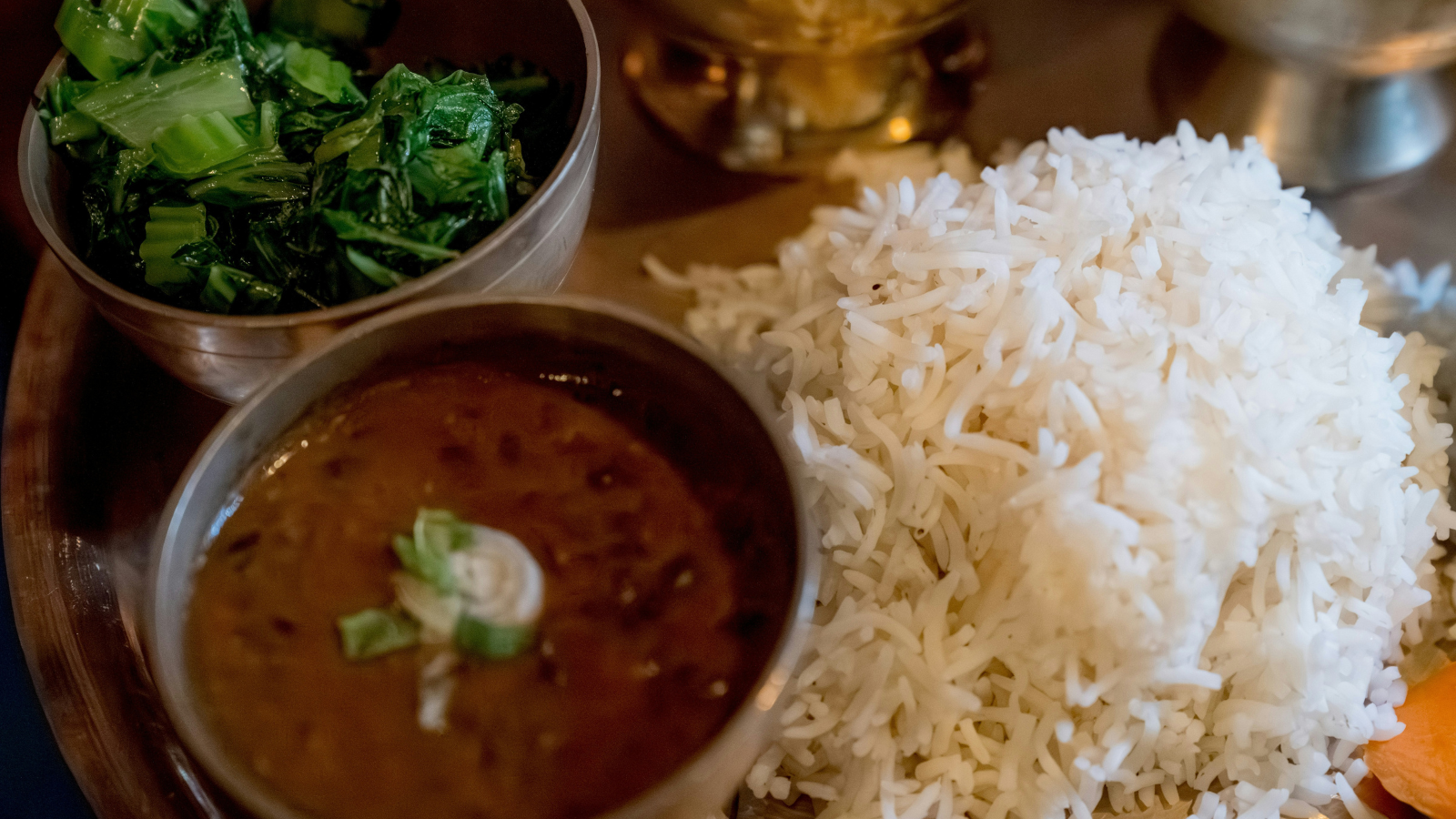
Traditional Nepali food is available at every teahouse on the Annapurna Base Camp Trek. Dal bhat, lentil soup served with steamed rice, vegetable curry, and pickled condiments, is the definitive trail meal and costs NPR 600–1,200 ($4.50–$9.00) depending on elevation.
Dal bhat is not simply a rice-and-lentil dish. The full plate arrives with: steamed white or brown rice (unlimited), tarkari (vegetable curry), dal (spiced lentil soup), gundruk (fermented leafy greens), achar (tomato or sesame pickle), and sometimes papadum. Teahouses in the Chhomrong and Ghorepani areas include local specialties, gundruk soup, tama curry made from bamboo shoots, and sel roti (sweet fried rice bread), on their extended menus.
Trekkers who order dal bhat once per day sustain energy levels more consistently than those relying on western dishes. The unlimited refill policy means trekkers burning 3,500–4,500 calories per active hiking day eat to satiety without paying extra.
What Vegetarian and Vegan Food Options Are Available On Annapurna Base Camp Trek?
Vegetarian food is the dominant option on the Annapurna Base Camp Trek, over 80% of standard teahouse menu items are vegetarian. Vegan options cover 30–40% of the standard menu and include dal bhat (without ghee), vegetable fried rice, plain noodle soups, stir-fried vegetables, and boiled potatoes.
Trekkers with vegan requirements face no significant dietary challenges below 3,500 meters. At Machhapuchhre Base Camp and Annapurna Base Camp, the total menu shrinks, but rice-based dishes and vegetable soups without animal products remain reliably available.
One critical detail vegan trekkers consistently overlook: some teahouses add ghee (clarified butter) to dal bhat rice and lentil soup as standard preparation. Specifying "ghee nahal" (without ghee) at each teahouse before ordering ensures the meal is prepared correctly. This specification eliminates the most common inadvertent animal product on the route.
Can Trekkers Get High-Protein and Energy-Rich Meals on Annapurna Base Camp Trek?
Trekkers access 5 main protein sources on the Annapurna Base Camp Trek: eggs, lentils (dal), chicken, paneer (Indian cottage cheese), and canned tuna. Protein availability decreases above 3,000 meters, chicken becomes unreliable above Himalaya Hotel, and paneer availability depends on supply runs.
Eggs are the most consistent high-protein option from base to summit. A 2-egg omelet provides 12–14 grams of protein and remains on every menu. Lentils in dal bhat contribute 18–22 grams of plant protein per serving. The combination of a dal bhat dinner and egg breakfast covers the majority of protein requirements for trekkers following a 1.2–1.6 gram-per-kilogram-of-body-weight protein target.
Above Deurali (3,230m), the practical high-protein strategy is: eggs at breakfast, dal bhat at dinner, and personal protein bars or nuts carried from Pokhara as trail supplements. Packing 300–500g of mixed nuts from Pokhara provides 6–8 trail-side protein servings without adding significant pack weight.
Are Western and International Foods Available on the Annapurna Base Camp Trek?
Western and international food is available on the Annapurna Base Camp Trek at teahouses below 3,200 meters. Pasta, pizza, sandwiches, burgers, continental breakfast items, and apple pie appear on menus at Ghorepani, Chhomrong, and Sinuwa. Above Deurali, western options narrow to pasta, garlic bread, and basic soup.
Pasta (spaghetti with tomato or garlic sauce) is the most consistent western dish across the full route, available through Himalaya Hotel (2,900m). Pizza is available at Chhomrong and Ghorepani but disappears entirely above 2,500 meters. Pancakes and French toast remain on breakfast menus through Himalaya Hotel. Trekkers expecting pizza at base camp face disappointment; trekkers expecting eggs, noodle soup, and rice dishes are never short of options.
What Snacks and Drinks Are Available Along the Annapurna Base Camp Trek?
Trekkers access 4 snack categories at teahouses and trail shops along the Annapurna Base Camp Trek: energy bars and chocolate, packaged biscuits and chips, nuts and dried fruit, and local sweets. Hot drinks, black tea, masala chai, lemon ginger honey tea, Tibetan butter tea, and Nescafé, are available at every teahouse on the route.
Trail shop availability is concentrated in the lower half of the trek. Villages at Chhomrong, Bamboo, and Sinuwa carry Snickers bars, Pringles, local Biskwit biscuits, and packet noodles at small stalls. Above Dovan (2,600m), trail shops become rare. By Machhapuchhre Base Camp, only teahouse kitchens supply snacks.
A 500ml cup of black tea costs NPR 80–200 depending on elevation. Masala chai, lemon tea, and ginger tea appear throughout the route. Tibetan butter tea, brewed tea mixed with yak butter and salt, is a high-calorie warming drink found at upper-elevation teahouses and provides 80–100 calories per cup. Energy drinks (Red Bull, Sting) are occasionally available below 2,500 meters but are not recommended above 3,000 meters due to the cardiovascular strain at altitude.
The practical snack strategy: purchase 10–15 energy bars, 400–500g of mixed nuts, and 5–10 chocolate bars in Pokhara before departure. These fill gaps above 3,000 meters where trail shops disappear and teahouse snack selections are minimal.
How Does Food Availability Change With Trekking Altitude?
Food availability on the Annapurna Base Camp Trek decreases directly with elevation. Below 2,500 meters, teahouse menus carry 40–60 items. From 2,500 to 3,500 meters, menus narrow to 20–30 items. At Annapurna Base Camp (4,130 meters), trekkers choose from 10–15 items.
This reduction reflects the logistics of the supply chain. Every food item above Dovan (2,600m) arrives via porter, a physical constraint that limits perishables, fresh produce, and variety. Teahouse operators at higher elevations stock shelf-stable, high-calorie foods that withstand transport and storage. Fresh meats, salads, and specialty ingredients disappear from menus as elevation increases.
What Foods Are Best for Energy at Higher Altitudes?
The 5 best foods for energy at higher altitudes on the Annapurna Base Camp Trek are: dal bhat (rice and lentil meal), oatmeal porridge with honey, garlic soup, pasta with olive oil, and Tibetan bread with peanut butter. These deliver sustained energy through complex carbohydrates while minimizing digestive stress, a critical factor above 3,500 meters where the gastrointestinal system works less efficiently.
Appetite suppression affects most trekkers above 3,000 meters. The body's oxygen-deprived state reduces hunger signals while energy expenditure remains high. Trekkers who eat 4–5 small meals daily (rather than 2–3 large meals) maintain energy levels more effectively. Garlic soup is a traditional upper-altitude staple, most trekkers consume it nightly at Deurali and Machhapuchhre Base Camp, where it serves both as nutrition and a reported circulation aid at elevation.
Foods to limit above 3,500 meters: heavy proteins like red meat (unavailable on this route but relevant for food choices), high-fat fried items, and excessive dairy. These slow digestion and increase the risk of gastrointestinal discomfort in a system already stressed by reduced atmospheric oxygen.
Are Fresh Fruits and Vegetables Available Throughout the Annapurna Base Camp Trek?
Fresh fruits and vegetables are available below 3,000 meters on the Annapurna Base Camp Trek. Teahouses at Ghorepani, Tadapani, and Chhomrong serve salads, fruit plates, boiled seasonal vegetables, and stir-fried greens. Above Himalaya Hotel (2,900m), fresh produce narrows to potatoes, cabbage, and carrots, root vegetables and hardy greens that survive porter transport and cold storage.
Seasonal availability shapes the fresh produce experience significantly. March through May (spring season): strawberries and tropical fruits appear at lower elevations; local greens are abundant. October through November (autumn peak season): Annapurna-region apples are a trek highlight at villages like Ghorepani and Chhomrong, served fresh, cooked into apple pie, or pressed into juice. December through February: fresh produce is most limited across the full route.
Above 3,200 meters, potatoes are the most reliable vegetable regardless of season. Teahouse operators store them in cool cellars year-round. Boiled potatoes, potato soup, and aloo tarkari (potato curry) are dependable, calorie-rich options through Annapurna Base Camp.
Is Safe Drinking Water Available on the Annapurna Base Camp Trek?
Safe drinking water is available throughout the Annapurna Base Camp Trek through 3 sources: bottled mineral water (sold at all teahouses), boiled water (available on request at most teahouses at NPR 50–100 per liter), and self-treated water using UV purifiers or chemical tablets. Untreated tap water and stream water throughout the route carry contamination risk from livestock activity and require treatment before consumption.
Bottled mineral water (500ml) costs NPR 100 at lower elevations and increases to NPR 200–400 at teahouses above 3,000 meters. Relying exclusively on bottled water for a 10-day trek generates substantial plastic waste, a growing environmental concern in the Annapurna Conservation Area, which receives over 190,000 visitors annually.
How Can Trekkers Stay Hydrated During the Annapurna Base Camp Trek?
Trekkers stay hydrated on the Annapurna Base Camp Trek by drinking 3–4 liters daily, using a personal water purification system, monitoring urine color (pale yellow indicates adequate hydration), and supplementing with hot electrolyte drinks at teahouses. Above 3,000 meters, the body loses water faster through increased respiration while simultaneously reducing thirst sensation, making intentional hydration discipline essential.
The 3 most practical water purification systems for this trek are:
-
UV purifier (SteriPen or similar): Treats 1 liter in 90 seconds using ultraviolet light. Effective against bacteria, viruses, and protozoa. Weighs 60–80 grams. Requires 2 AA batteries or USB charging.
-
Squeeze filter (Sawyer Squeeze or LifeStraw): Filters bacteria and protozoa from stream water. Weighs under 90 grams. Does not address viruses, effective when sourcing from clean mountain streams, not village tap water.
-
Iodine or chlorine dioxide tablets: Cheapest and lightest option. Treats 1 liter in 30 minutes (iodine) or 4 hours (chlorine dioxide, which is more thorough). Effective against most bacterial and viral contaminants.
Electrolyte powder (Oral Rehydration Salts or commercial electrolyte sachets) added to purified water replenishes sodium and potassium lost through sweat and respiration. Packing 15–20 electrolyte sachets from Kathmandu or Pokhara covers the full trek duration. Teahouse-served hot lemon water with honey provides hydration alongside vitamin C, a practical daily immune support at altitude.
What Accommodation Is Available on the Annapurna Base Camp Trek?

Accommodation on the Annapurna Base Camp Trek consists entirely of teahouses, family-run mountain lodges that provide beds, meals, and basic amenities at every major village along the route. The Annapurna Conservation Area hosts over 1,800 registered teahouses, with approximately 120 operating directly on the standard ABC itinerary across 12 primary villages.
Teahouse accommodation on this route eliminates the need for tent camping, cooking equipment, or food porterage. This distinguishes the Annapurna Base Camp Trek from more remote Himalayan routes. Trekkers carry only personal gear, clothing, sleeping equipment, and personal items, while teahouses supply the rest.
What Are Annapurna Base Camp Trek Teahouses Like?
Annapurna Base Camp Trek teahouses are family-operated mountain lodges containing 8–20 guest rooms, 1 central dining hall with a wood or gas stove, and shared bathroom facilities. The dining hall functions as the social and thermal hub, trekkers eat, plan, warm up, and exchange trail information in this communal space.
Teahouse quality varies significantly by elevation and village population. Lower-elevation teahouses at Ghorepani (2,874m) and Chhomrong (2,170m) are the most developed on the route, multi-story buildings with insulated wooden rooms, solar lighting, and extended menu options. Higher-elevation teahouses above 3,500 meters prioritize structural durability over comfort. Thin plywood walls, corrugated metal roofing, and smaller rooms are standard above Deurali.
What Facilities Are Available in Teahouse Rooms of Annapurna Base Camp?
Standard teahouse rooms on the Annapurna Base Camp Trek include 5 facilities: a single or double bed with mattress, a pillow, 1–2 blankets, a small window, and a lockable door. Room size averages 6–10 square meters. Wooden storage hooks on the wall substitute for closets or shelves.
At established teahouses below 3,000 meters, rooms include a power outlet for device charging, a reading light, and occasionally a small table. Above 3,000 meters, rooms are more minimal, smaller windows, thinner walls, and less consistent power availability. Bringing a personal sleeping bag liner adds warmth and hygiene; teahouse blankets are not washed between every guest stay.
Do Teahouses Provide Private or Shared Rooms?
Teahouses on the Annapurna Base Camp Trek offer both private rooms and shared dormitory rooms. Private rooms, containing 1 or 2 beds for solo trekkers or couples, are the standard accommodation type. Dormitory rooms (4–8 beds per room) are available at select lower-elevation teahouses and serve as overflow options during peak season.
Peak trekking season runs March–May and October–November. During these periods, private rooms at popular villages, Chhomrong, Deurali, and Machhapuchhre Base Camp, fill by 2:00–3:00 PM as trekking groups arrive. Trekkers without advance booking during peak season risk sharing a dormitory or accepting a less preferred teahouse. Off-peak trekkers (December–February and June–September) access private rooms readily without reservation pressure.
Are Bathrooms Private or Shared on the Annapurna Base Camp Trek?
Bathrooms on the Annapurna Base Camp Trek are predominantly shared. Most teahouse guest rooms do not include attached (en-suite) bathrooms. Shared bathroom blocks serve 8–20 rooms per teahouse, typically containing 2–4 toilet stalls and 1–2 sinks with cold running water.
En-suite private bathrooms are available at select teahouses in Chhomrong, Ghorepani, and Jhinu Danda, priced 30–50% higher than standard rooms. Above Himalaya Hotel (2,900m), all bathrooms are shared without exception. Both squat-style and Western-style toilets appear throughout the route; Western toilets are more common at lower-elevation, higher-volume teahouses.
Do Teahouses Have Hot Showers and Electricity?
Hot showers are available at teahouses below 3,500 meters on the Annapurna Base Camp Trek. Solar-heated water delivers hot showers at most teahouses in this elevation range, costing NPR 200–500 ($1.50–$3.75) per shower. Firewood-heated water supplements solar heating at higher elevations during cloudy weather.
Above 3,500 meters, hot shower availability is inconsistent and depends on daily solar conditions. At Annapurna Base Camp (4,130m), hot showers are not reliably available, trekkers use wet wipes for personal hygiene during the summit section.
Electricity via solar panels and micro-hydropower is present at all major teahouses below 4,000 meters. Device charging costs NPR 100–300 ($0.75–$2.25) per session at most teahouses. At Annapurna Base Camp, solar panels provide limited communal lighting and intermittent charging access. A 20,000 mAh power bank charged in Pokhara covers 5–6 full smartphone charges without requiring teahouse electricity on the upper trail.
Is Wi-Fi and Mobile Connectivity Available at Teahouses?
Wi-Fi is available at teahouses along the entire route, including Annapurna Base Camp (4,130m), though connection speeds range from 1–5 Mbps. Most teahouses charge NPR 200–500 per session or include Wi-Fi access for guests eating meals at the establishment. Connection speeds range from 1–5 Mbps, adequate for messaging and email but insufficient for video streaming.
Mobile network coverage: Ncell and Nepal Telecom (NTC) provide 4G service at most lower-elevation villages from Nayapul through Bamboo. Coverage becomes intermittent above Dovan (2,600m) and drops to 2G or no signal near Machhapuchhre Base Camp. Purchasing a Ncell or NTC SIM card in Pokhara (NPR 100–200 including starter data) is the most cost-effective connectivity solution for the full trek duration.
How Does Accommodation Change at Higher Elevations?

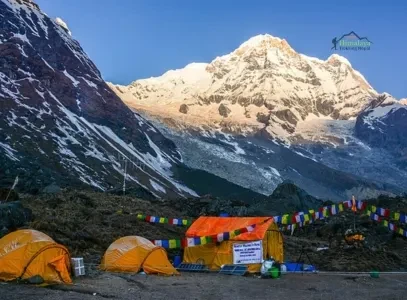
Teahouse accommodation on the Annapurna Base Camp Trek becomes progressively more basic above 3,000 meters. Room size decreases, wall insulation thins, bathroom facilities simplify, and amenity availability narrows. At Annapurna Base Camp (4,130m), 4–6 teahouses operate during peak trekking season, offering the most basic accommodation on the entire route.
The elevation gradient in accommodation quality is the single most important factor to understand before departure. Expecting lower-elevation comfort standards at base camp leads to frustration. Expecting basic mountain shelter, a clean mattress, blankets, and a dining hall with hot food, sets the right benchmark for the upper trail.
What Accommodation Can You Expect Near Annapurna Base Camp?
Near Annapurna Base Camp (4,130 meters), trekkers access 4–6 operating teahouses during peak season. Rooms measure approximately 6 square meters, contain a single or bunk bed, thin walls, and no private bathroom. Bathrooms are entirely shared, offering a mix of traditional squat-style facilities and newly installed Western-style toilets. A central dining hall with gas heating serves all guests. Gas-powered hot showers are available at Annapurna Base Camp for an additional fee, though trekkers often use wet wipes as a backup during supply shortages.
Staying overnight at Annapurna Base Camp rather than descending to Machhapuchhre Base Camp the same afternoon is the recommended approach for one specific reason: the 360-degree sunrise view of the Annapurna Sanctuary, surrounded by Annapurna I (8,091m), Annapurna South (7,219m), Hiunchuli (6,441m), and Machhapuchhre (6,993m), is one of the most dramatic mountain panoramas accessible without technical climbing skills. This experience is unavailable to day-visitors who ascend and descend in the same afternoon.
How Cold Are Teahouses at Higher Altitudes?
Teahouse interiors above 3,500 meters on the Annapurna Base Camp Trek reach 5–10°C at night during peak trekking season (March–May and October–November). In winter months (December–February), interior temperatures at Annapurna Base Camp drop below 0°C after midnight. Guest rooms receive no active heating; dining halls maintain warmer temperatures through cooking heat and communal body warmth.
Temperature decreases 6.5°C per 1,000 meters of elevation gain on average. A trekker departing Pokhara (800m) at 24°C ambient temperature arrives at Annapurna Base Camp in conditions approximately 21°C colder. This differential demands proper sleeping equipment regardless of departure season. Altitude affects far more than temperature alone, for the full breakdown of terrain, distance, and fitness demands, see our guide to Annapurna Base Camp Trek difficulty.
Are Blankets or Bedding Provided by Teahouses?
Teahouses on the Annapurna Base Camp Trek provide 1–2 wool or cotton blankets per bed. These blankets deliver sufficient insulation for nights above 5°C, typical at lower elevations. Above 3,500 meters, nightly temperatures drop below this threshold during peak season and consistently fall below 0°C in winter.
A personal sleeping bag rated to -10°C is the critical gear item for comfortable sleeping above 3,000 meters. Sleeping bag liners add 5–8°C of warmth and weigh 200–400 grams, a practical supplement for lower-elevation nights where the full sleeping bag feels excessive. Teahouses on the ABC route do not offer sleeping bag rentals, unlike some Everest region teahouses. Trekkers must carry personal sleeping bags from Kathmandu or Pokhara.
What Should You Bring for Comfortable Teahouse Stays?
Trekkers bring 6 essential items for comfortable teahouse stays on the Annapurna Base Camp Trek: a sleeping bag (-10°C rating), earplugs, a sleeping bag liner, flip flops for indoor use, a headlamp with extra batteries, and a 20,000 mAh power bank.
-
Sleeping bag (-10°C rating): Ensures warmth above 3,500 meters regardless of blanket quality. Synthetic fill performs better than down in wet, humid conditions during monsoon shoulder periods.
-
Earplugs: Teahouse walls are thin. Neighboring rooms, communal dining areas, and early-rising trekkers generate noise between 4:00–5:00 AM.
-
Sleeping bag liner: Adds warmth at lower elevations and creates a hygienic barrier on blankets that are laundered infrequently during peak season.
-
Flip flops: Required for outdoor bathroom access at night on cold stone and dirt walkways.
-
Headlamp (with spare batteries): Power outages occur throughout the route. Summit day starts at 4:00–5:00 AM in darkness.
-
Power bank (20,000 mAh): Covers 5–6 full smartphone charges between reliable teahouse charging stops on the upper trail.
For the complete gear rundown beyond these six essentials, see our full Annapurna Base Camp packing list.
How Much Do Food and Accommodation Cost on the Annapurna Base Camp Trek?

Food and accommodation on the Annapurna Base Camp Trek costs $25–$50 USD per person per day on average. Budget trekkers covering basics, 1 private room and 3 meals, spend $25–$30 daily. Trekkers adding hot showers, Wi-Fi, bottled beverages, and premium menu items spend $40–$50 daily.
Total food and accommodation expenditure for a 10-day standard itinerary ranges from $250 to $500 USD per person. Nepal's teahouse trekking costs have increased 15–20% between 2022 and 2025, driven by infrastructure investment in the Annapurna Conservation Area and sustained post-pandemic trekking demand growth. These figures cover food and lodging only, for the full trip cost including permits, guides, and gear, see our complete Annapurna Base Camp Trek budget.
What Is the Average Daily Food Cost on the Annapurna Base Camp Trek?
The average daily food cost on the Annapurna Base Camp Trek is $15–$25 USD per person. This covers 3 meals: breakfast ($4–$6), lunch ($5–$8), and dinner ($6–$11), calculated at mid-route elevation teahouses.
The following table outlines typical meal costs at 3 elevation zones on the ABC route. Costs reflect 2025–2026 prices in Nepalese Rupees (NPR) and approximate USD equivalents at the current exchange rate of approximately NPR 133 per USD.
|
Elevation Zone |
Sample Meal |
Approximate Cost (NPR) |
Approximate Cost (USD) |
|
Below 2,500m (Ghorepani, Chhomrong) |
Dal bhat with unlimited refills |
350–500 |
$2.60–$3.75 |
|
2,500–3,500m (Bamboo, Deurali) |
Dal bhat or pasta with sauce |
500–750 |
$3.75–$5.65 |
|
Above 3,500m (MBC, ABC) |
Noodle soup or rice dish |
750–1,100 |
$5.65–$8.30 |
Altitude directly inflates food prices because all supplies above 2,600 meters are porter-carried. Teahouse operators factor porter wages into menu pricing at higher elevations, making a bowl of soup at Annapurna Base Camp 2–3 times the price of the same dish at Nayapul.
What Is the Average Daily Accommodation Cost on the Annapurna Base Camp?
Teahouse accommodation on the Annapurna Base Camp Trek costs NPR 300–1,500 ($2.25–$11.25 USD) per person per night. The dominant pricing model on this route is meal-bundled accommodation: teahouses offer rooms at NPR 300–500 when guests eat both breakfast and dinner at the teahouse, compared to NPR 800–1,500 for the room alone when guests eat elsewhere.
This bundled model creates an incentive that works in the trekker's favor. Eating at the teahouse where you sleep is cheaper than sleeping at one teahouse and eating at another. The bundled rate is the standard expectation on the ABC route, most trekkers follow it without negotiation.
What Is Usually Included in Teahouse Accommodation?
Standard teahouse accommodation includes 5 items: 1 private or shared room with mattress, 1–2 blankets, a pillow, shared bathroom access, and dining hall access. At most teahouses below 3,500 meters, electric lighting within the room is included. Some teahouses include filtered or boiled drinking water in the room rate, confirm at check-in rather than assuming.
Which Food and Accommodation Costs Are Not Included on the Annapurna Base Camp?
7 common costs fall outside the standard teahouse room rate on the Annapurna Base Camp Trek: hot showers (NPR 200–500), device charging (NPR 100–300), Wi-Fi access (NPR 200–500), bottled or treated drinking water (NPR 100–400 per liter), all meals (billed separately per item), packaged snacks, and soft drinks or beer.
Trekkers who budget only for accommodation consistently underestimate daily spend. Hot showers and charging add NPR 300–800 per day. Drinking water from bottles adds NPR 500–1,200 daily across 3–4 liters if purchased exclusively in bottles. Budgeting NPR 1,500–2,000 ($11–$15 USD) as a daily ancillary expense buffer, beyond meal and room costs, reflects actual spending patterns on this route.
How Can You Make Food and Accommodation More Comfortable on the Annapurna Base Camp Trek?
Trekkers improve food and accommodation comfort on the Annapurna Base Camp Trek through 4 practical strategies: arriving at villages before 3:00 PM to secure the best available rooms, carrying personal nutritional supplements and snacks for the upper trail, bringing a -10°C sleeping bag, and communicating dietary requirements to each teahouse at check-in.
Comfort on the ABC route is a function of preparation, not luck. Trekkers who address gear, nutrition, and logistics before departing Pokhara experience materially better conditions on the upper trail than those who rely entirely on trail availability.
What Should You Consider When Choosing Teahouses?
The 4 key factors for choosing teahouses on the Annapurna Base Camp Trek are: dining hall cleanliness, menu variety relative to elevation, bathroom condition, and room heating availability. These factors determine daily comfort and are assessable within 3 minutes of arrival at any village.
Start by checking the dining hall. A well-maintained space with clean tables, a functioning heater, and a current menu board indicates a well-run teahouse. Inspect the bathroom block before committing to a room, particularly above 3,000 meters where maintenance standards vary widely. Functional toilets, basic hand-washing access, and reasonable cleanliness are the baseline indicators.
During peak season (March–May and October–November), the best teahouses in each village fill between 2:00 and 3:30 PM. Arriving in this window, rather than pushing further along the trail to gain an extra hour of elevation, secures access to superior rooms, cleaner bathrooms, and more attentive kitchen service.
How Can You Manage Dietary Restrictions During the Annapurna Base Camp Trek?
Trekkers manage dietary restrictions on the Annapurna Base Camp Trek through 3 methods: carrying a written dietary restriction card in Nepali, selecting teahouses with extended menus at lower elevations, and packing personal supplementary food for the upper trail above 3,500 meters.
A written card in Nepali stating specific dietary restrictions, gluten-free, vegan, nut allergy, lactose intolerance, eliminates communication gaps at teahouses where English proficiency varies. Trekking agencies in Kathmandu and Pokhara provide printed dietary cards as part of trek preparation, or they can be prepared with any translation app before departure.
Gluten-free trekkers face the most consistent challenge on this route. Plain steamed rice, dal bhat rice (confirm no flour-thickened sauce), and boiled potatoes are the most reliably gluten-free options. Momos, thukpa noodles, and most baked goods contain wheat flour. Trekkers with celiac disease carry 5–7 days of personal gluten-free protein bars and snacks to supplement the limited safe options above 3,500 meters.
How Can Himalaya Trekking Nepal Help With Food and Accommodation?
Himalaya Trekking Nepal organizes the Annapurna Base Camp Trek with pre-confirmed teahouse reservations, dietary accommodation planning, and guide-led meal coordination to ensure trekkers access the best available food and lodging at every elevation on the route.
The Himalaya Trekking Nepal team selects teahouses based on 5 criteria: cleanliness, meal quality, room condition, sanitation standards, and verified client feedback from prior groups. This removes the uncertainty of self-booking during peak season when preferred teahouses reach capacity by mid-afternoon.
Trekkers with specific dietary requirements, vegan, gluten-free, nut allergies, high-protein diets, or religious food restrictions, communicate these during the pre-trek consultation with the Himalaya Trekking Nepal planning team. The assigned guide communicates upcoming dietary needs to teahouse operators one stage in advance, improving meal customization across the route.
Every Himalaya Trekking Nepal itinerary includes detailed guidance on what to pack for teahouse stays, what to expect from food at each elevation zone, and how to budget for daily ancillary costs, so trekkers arrive on the trail informed, equipped, and prepared for the realities of mountain teahouse life.
What Are the Key Takeaways About Food and Accommodation on the Annapurna Base Camp Trek?
Food and accommodation on the Annapurna Base Camp Trek are available at all 12 major villages along the standard route, from Nayapul to Annapurna Base Camp, through an established teahouse network serving over 80,000 trekkers annually. The 7 key facts every trekker needs to know before departure:
-
Teahouses serve 3 daily meals (breakfast, lunch, and dinner) with menus ranging from 10 items at Annapurna Base Camp to 60 items at Chhomrong and Ghorepani.
-
Dal bhat is the highest-value meal on the route: unlimited refills, 700–900 calories per serving, NPR 400–900 depending on elevation, and available at every teahouse from start to finish.
-
Food variety decreases above 3,000 meters: menus narrow from 40+ items to 10–15 items at Annapurna Base Camp (4,130m), with rice dishes, noodle soups, and eggs remaining consistently available.
-
Teahouse rooms are private (standard) or shared (dormitory): 1–2 blankets are provided, but a personal sleeping bag rated to -10°C is required above 3,000 meters for comfortable sleep.
-
Hot showers cost NPR 200–500 and are available through approximately 3,500 meters via solar heating; bring wet wipes for personal hygiene on the summit section.
-
Daily food and accommodation costs total $25–$50 USD per person: with prices increasing by 30–50% above 3,000 meters due to porter-carried supply logistics.
-
Vegetarian and vegan food is available throughout the full route: rice-based dishes and vegetable soups are the most reliable plant-based options above 3,500 meters.
The Annapurna Base Camp Trek teahouse network is one of the most comprehensive mountain accommodation systems in the world. Trekkers who understand the altitude-based shift in food variety, accommodation quality, and daily costs arrive on the trail better prepared, and reach Annapurna Base Camp more comfortable, better nourished, and more able to absorb one of the great mountain experiences on earth.
Planning your Annapurna Base Camp Trek with Himalaya Trekking Nepal gives you a team that handles teahouse logistics, dietary coordination, and route-specific guidance, so you focus entirely on the mountains.
More About Author

Khilak Budhathoki
Travel Director
Khilak Budhathoki is the co-founder and lead trekking guide at Himalaya Trekking Nepal, a locally owned and operated adventure company based in Kathmandu. Born and raised in the foothills of Nepal, Khilak developed a deep love for the mountains from an early age. With over a deca...
USD$1,400 pp
Our Recommendation

USD$600 pp
Our Recommendation
Related Blogs

Jan 25, 2026
Annapurna I – 10th Highest Mountain in the World
Feb 06, 2026
Modi River: Nepal's Dynamic Himalayan River
Aug 16, 2026
Best Trek Food Ideas for Nepal Treks: What to Eat
